

Datacenters operate around the clock, and poor lighting creates real risks. Staff members working in these environments face hazards from inadequate visibility, while equipment monitoring suffers when illumination falls short.
At PacLights, we’ve seen firsthand how datacenter safety lighting transforms both worker safety and operational efficiency. The right lighting system prevents accidents, reduces fatigue, and keeps your infrastructure secure.
Why Datacenter Lighting Matters More Than Most Think
Electrical Safety and Visibility
Inadequate lighting in datacenters directly increases injury rates among maintenance and installation staff. The Electrical Safety Foundation International reports that contact with electricity causes approximately 150 deaths annually in the United States, and poor visibility amplifies this risk significantly. When technicians cannot see electrical connections, cable runs, or grounding points clearly, they make mistakes that lead to shocks, burns, and near-misses.
Staff working on energized or de-energized equipment near server racks need consistent, shadow-free illumination to identify hazards before they become incidents. Datacenters that operate 24/7 mean your team works across all shifts, including overnight hours when natural light disappears entirely. Uneven lighting creates dark spots where workers miss trip hazards, miswire connections, or fail to notice temperature warnings on equipment.
The True Cost of Poor Lighting
The cost of a single electrical incident-medical expenses, downtime, regulatory fines, and lost productivity-far exceeds the investment in proper lighting infrastructure. A single shock or burn injury can sideline a technician for weeks, disrupting maintenance schedules and forcing overtime on other staff members. Regulatory fines under OSHA standards add thousands of dollars to incident costs, while equipment damage from mistakes made in poor lighting compounds financial losses.
Cognitive Performance and Work Quality
Eye strain and fatigue directly impact decision-making quality during critical maintenance tasks. Research in occupational health shows that workers in poorly lit environments experience faster cognitive decline and higher error rates within four hours of continuous work. In datacenters, this translates to missed early warning signs of equipment failure, incorrect cable management, and safety protocol violations.
Technicians performing detailed work on circuit breakers, UPS systems, or cooling infrastructure require illumination levels between 300 and 500 lux to maintain accuracy and alertness. Many existing datacenters rely on legacy fluorescent fixtures that flicker, create uneven coverage, and consume excessive energy-adding heat to an already thermally stressed environment. Modern LED high-bay fixtures with advanced controls eliminate flicker, provide uniform light distribution, and reduce heat generation by up to 75 percent compared to older technologies.
Equipment Monitoring and Detection
Equipment visibility suffers when lighting fails to reach deep into server cabinets, cable trays, and mechanical rooms. Poor visibility means delayed detection of overheating components, loose connections, or fire suppression system issues. Technicians cannot monitor real-time equipment status or spot potential failures when shadows obscure critical zones.
Proper lighting with customizable mounting heights and beam angles eliminates shadows and ensures every critical zone receives adequate illumination for real-time monitoring and safe equipment access. This visibility becomes especially important as datacenters expand with AI-driven infrastructure, where high-density electrical systems and complex cooling networks demand constant visual inspection. The next section explores the specific features that make datacenter lighting systems effective in these demanding environments.
What Makes Datacenter Lighting Systems Effective
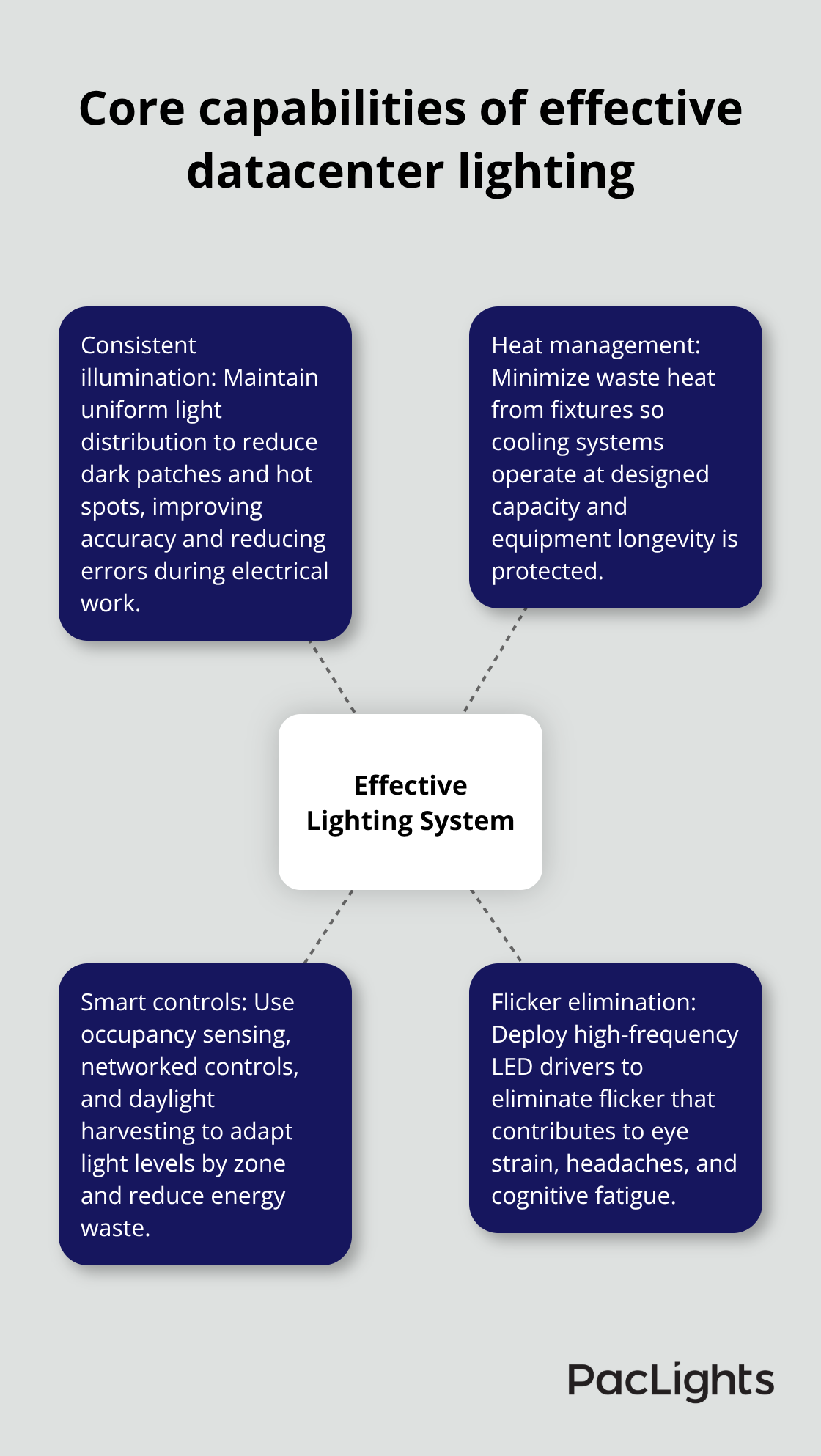
Datacenter lighting systems must deliver unwavering illumination across every operational zone without creating heat stress or energy waste. Effective systems combine three technical capabilities that directly impact both safety outcomes and operational costs.
Illumination Consistency Eliminates Visual Adaptation Problems
Illumination consistency matters far more than raw brightness alone. OSHA and NFPA standards require 300 to 500 lux in work areas where technicians handle electrical equipment, but inconsistent lighting-where some zones receive 200 lux while others hit 600 lux-creates visual adaptation problems that increase eye strain and error rates within two hours of work. LED high-bay fixtures with precision beam angles eliminate the dark patches and hot spots that plague older fluorescent installations, delivering uniform light distribution across server racks, cable management zones, and mechanical rooms simultaneously.
Heat Generation Threatens Cooling Efficiency
Heat generation directly threatens datacenter cooling efficiency and equipment longevity. Traditional metal halide or fluorescent fixtures emit 60 to 75 percent of their energy as waste heat, forcing cooling systems to work harder and consuming an additional 15 to 20 percent in operational electricity costs. Modern LED technology reduces this waste heat by up to 75 percent compared to legacy systems, which means your cooling infrastructure operates at designed capacity rather than compensating for lighting-generated thermal load.
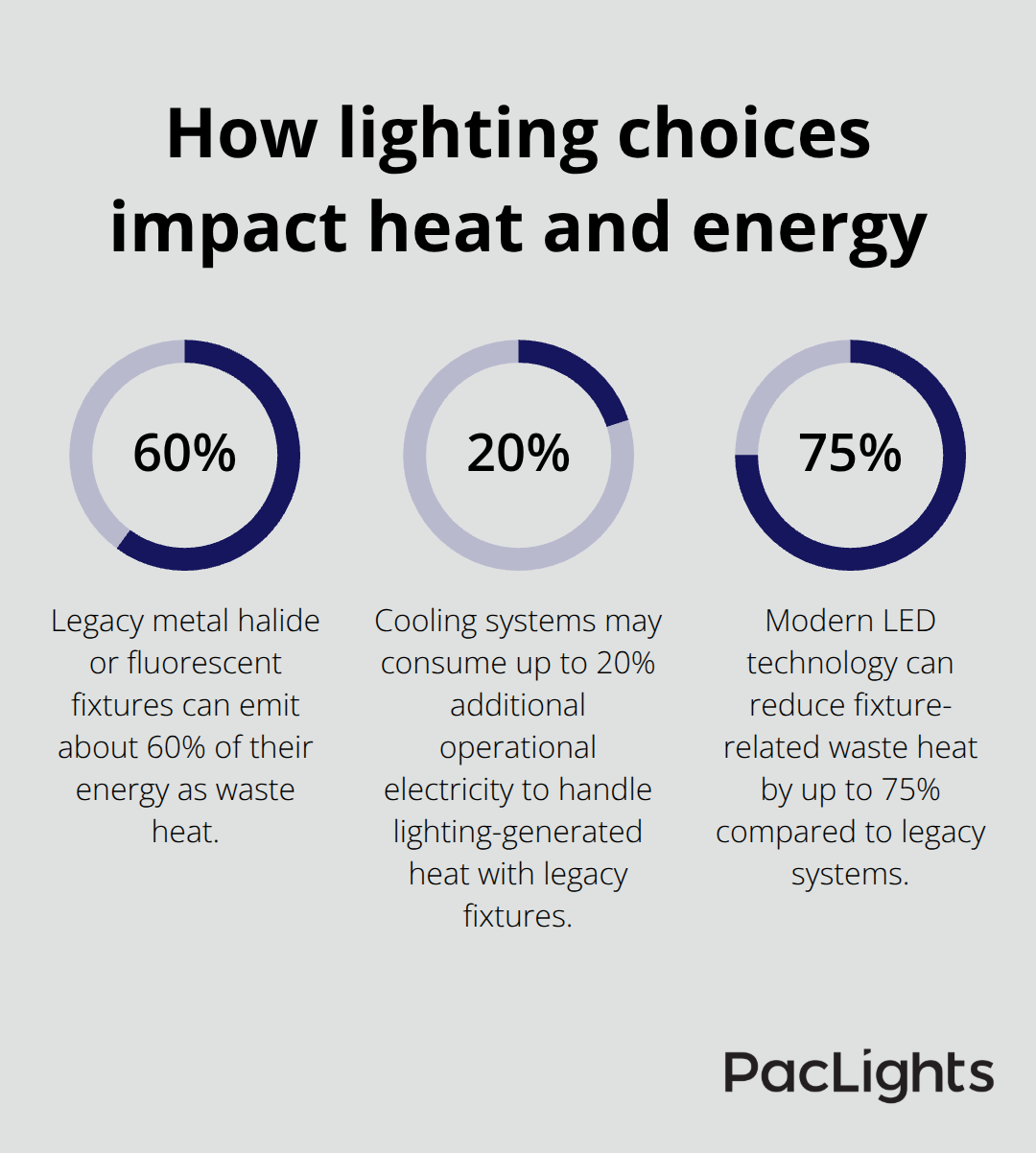
This efficiency gain compounds over time-a datacenter replacing 50 high-bay fixtures with LED equivalents reduces annual lighting energy consumption by approximately 40,000 kilowatt-hours, translating to roughly $4,000 to $6,000 in yearly savings depending on regional electricity rates.
Smart Controls Adapt to Real Operational Conditions
Advanced control systems separate effective datacenter lighting from merely adequate installations. Motion sensors and occupancy detection reduce energy waste in areas accessed intermittently, such as equipment storage rooms or cable management spaces, but they introduce complexity that demands proper configuration. Networked lighting controls allow facility managers to adjust illumination levels across different zones without rewiring, accommodating layout changes as datacenters expand or reconfigure server arrangements. Daylight harvesting sensors optimize fixture output based on natural light availability in perimeter areas, reducing energy consumption during daylight hours while maintaining consistent lux levels during evening and overnight shifts.
Flicker Elimination Protects Cognitive Performance
The most overlooked control feature is flicker elimination through high-frequency ballasts or direct-drive LED systems. OSHA and the American Academy of Ophthalmology recognize that fluorescent flicker below 100 Hz triggers measurable increases in eye strain, headaches, and cognitive fatigue within three to four hours of exposure. LED fixtures operating at 10 to 20 kHz eliminate this biological response entirely, allowing technicians to maintain focus and accuracy during extended maintenance windows. Temperature monitoring integration within lighting systems adds another layer of safety-fixtures equipped with thermal sensors alert facility teams to cooling system failures before equipment damage occurs, since rising ambient temperatures indicate insufficient air circulation or heat removal capacity.
These technical foundations establish why lighting design matters in datacenters, but implementation requires careful planning to match your facility’s specific layout and operational demands. The next section explores how to assess your datacenter’s lighting needs and select fixtures suited for server room environments.
How to Plan Your Datacenter Lighting System
Assess Your Current Lighting Performance
Start with a detailed site assessment before purchasing a single fixture. Walk through your datacenter with a light meter and document illumination levels at server cabinet height, in cable trays, within mechanical rooms, and along emergency egress routes. NFPA 101 Section 7.9.3 requires emergency lighting to maintain at least 1 foot-candle at floor level along exit paths, but your operational areas demand 300 to 500 lux for safe electrical work. Most datacenters fall short in critical zones-cable management areas often receive only 150 to 200 lux while equipment racks get 400 lux, creating hazardous inconsistency. Measure at multiple heights and times of day if your facility has windows, since perimeter lighting behaves differently during morning shifts versus evening maintenance windows.
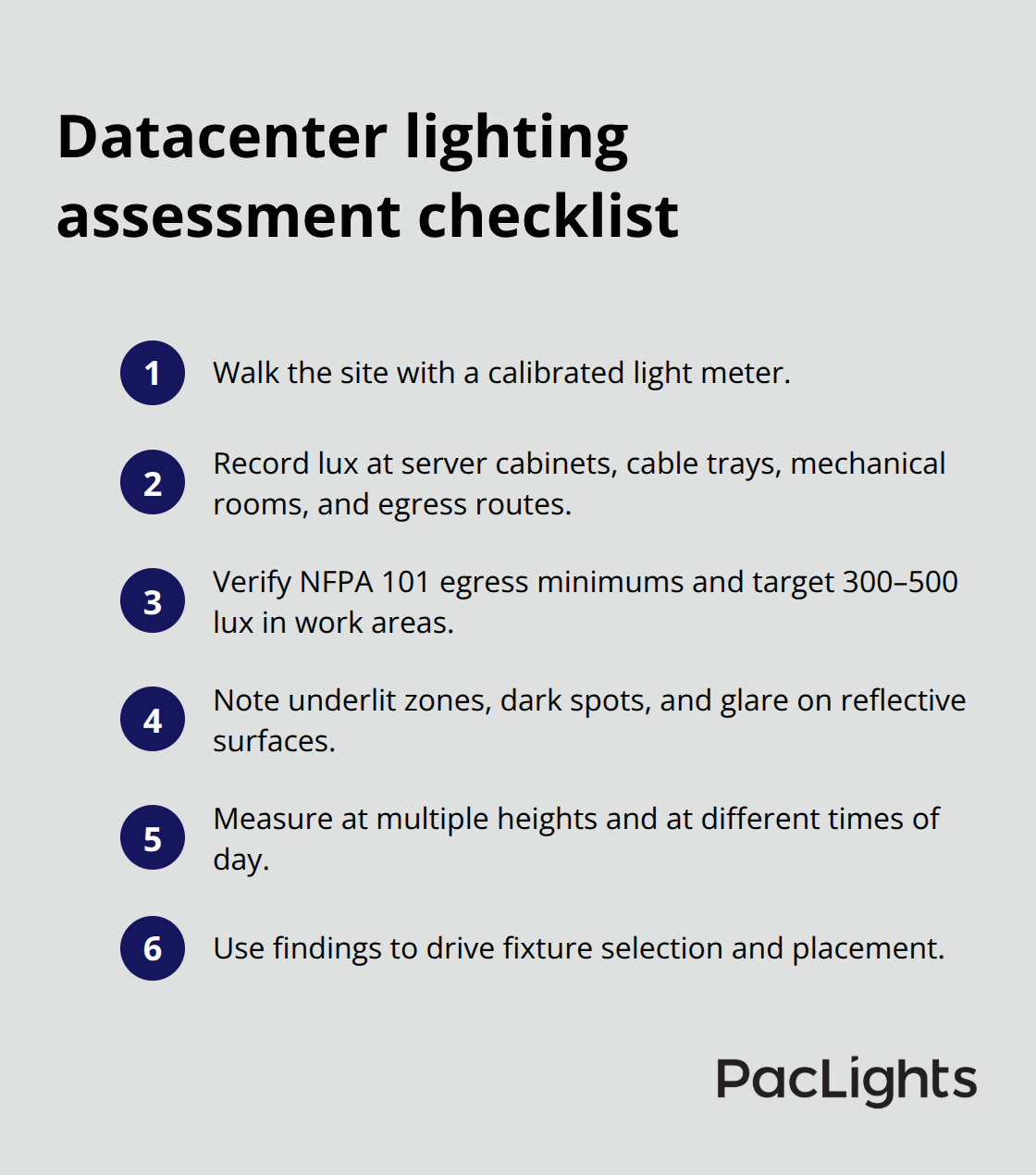
Document hot spots where fixtures create glare on monitor screens or reflective surfaces, and identify dead zones where shadows obscure equipment status indicators. This baseline assessment prevents costly mistakes-installing fixtures without understanding your actual light distribution patterns leads to either oversized systems that waste energy or undersized systems that fail to meet safety standards. Your measurements establish the foundation for all subsequent fixture selection and placement decisions.
Select Fixtures Built for Server Room Conditions
Fixture selection demands specificity about your server room environment rather than generic high-bay choices. Datacenters require sealed LED fixtures rated for continuous operation in temperature ranges of 50 to 95 degrees Fahrenheit, with IP54 or higher dust ratings to prevent thermal throttling from particulate accumulation on lens surfaces. Avoid fixtures with external ballasts or drivers that generate additional heat in already warm server rooms. Verify that your chosen fixtures support networked controls compatible with your building management system-standalone fixtures force manual adjustments when you reconfigure server layouts or expand capacity.
High-bay and linear strip fixtures with optional daylight and motion controls provide flexibility for different datacenter zones. Mount fixtures at heights between 12 and 16 feet in server rooms to minimize shadows cast by tall equipment racks while maintaining beam spread that covers aisle widths of 8 to 12 feet. Networked lighting controls allow facility managers to adjust illumination levels across different zones without rewiring, accommodating layout changes as datacenters expand or reconfigure server arrangements.
Plan Emergency Lighting Separately
Emergency lighting demands separate planning entirely-NFPA 101 and UL 924 require centralized emergency lighting inverters that supply 90 minutes of battery backup to corridors, stairwells, and exits during power outages. A single centralized inverter eliminates the need for dozens of wall-mounted battery backup fixtures, reducing maintenance burden and providing more reliable coverage than distributed systems. Calculate your emergency lighting load by summing the wattage of all exit signs and egress fixtures, then verify that your chosen inverter supplies adequate capacity plus 25 percent headroom for future additions.
Conclusion
Proper datacenter safety lighting delivers measurable returns across worker protection, equipment reliability, and operational costs. When technicians work in consistently illuminated environments with minimal eye strain, they catch electrical hazards earlier, perform maintenance with fewer errors, and complete tasks faster. Equipment monitoring improves dramatically when shadows no longer obscure critical zones, allowing your team to detect cooling failures, loose connections, and fire suppression issues before they escalate into costly incidents. A facility replacing 50 legacy fixtures with modern LED high-bays reduces annual energy consumption by approximately 40,000 kilowatt-hours, generating $4,000 to $6,000 in yearly savings depending on regional electricity rates.
Start your upgrade with a detailed site assessment using a light meter to identify underlit zones and inconsistent coverage patterns. Document illumination levels at server cabinet height, in cable trays, and along emergency egress routes to establish your baseline. Then select fixtures specifically rated for datacenter environments with sealed designs, IP54 or higher dust ratings, and networked control compatibility.
We at PacLights provide durable, customizable datacenter safety lighting solutions tailored to your facility’s specific needs, including free lighting layout designs and ROI assessments to guide your investment decisions. Contact us through our website at paclights.com to start planning your upgrade today.
Disclaimer: PacLights is not responsible for any actions taken based on the suggestions and information provided in this article, and readers should consult local building and electrical codes for proper guidance.