

Datacenter operators waste thousands of dollars annually on inefficient lighting systems that consume excessive power while delivering poor visibility. At PacLights, we’ve seen firsthand how the right approach to rack lighting transforms both operational costs and safety outcomes.
This guide shows you how to optimize rack lighting in datacenters through proven strategies that reduce energy consumption, improve maintenance efficiency, and eliminate common design mistakes.
Why Rack Lighting Matters in Datacenters
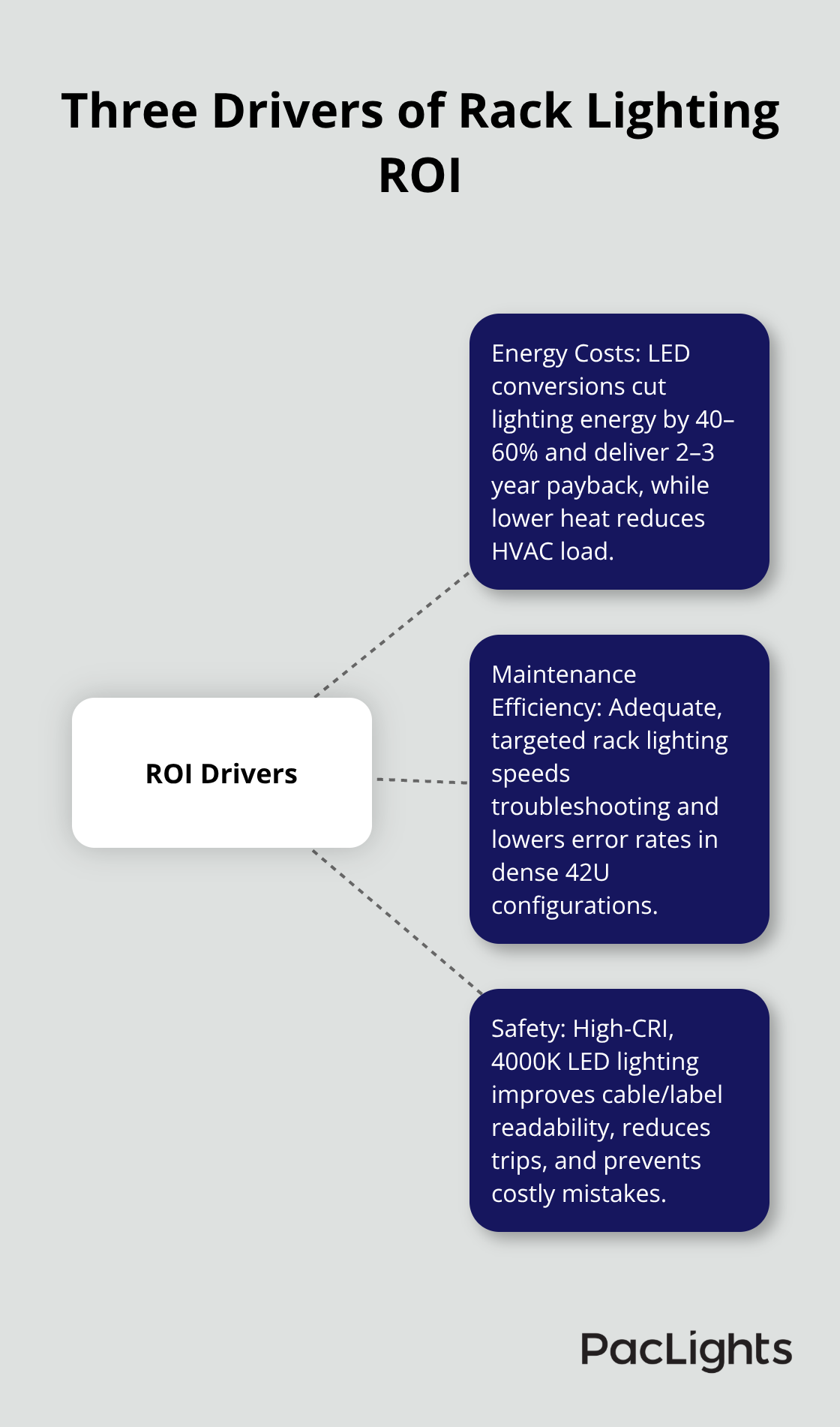
Lighting accounts for 3 to 5 percent of a datacenter’s total energy load, but this modest percentage masks a critical efficiency opportunity. According to the US Department of Energy, datacenters consume 1 to 2 percent of global electricity, and lighting represents 17 to 25 percent of a datacenter’s total energy use. That means a mid-sized facility spends $100,000 to $180,000 annually on lighting alone. The majority of datacenters-roughly 80 percent-have not updated their lighting systems in over a decade, running fluorescent fixtures that consume 1.0 to 1.5 watts per square foot compared to modern LED systems at 0.1 to 0.3 watts per square foot. Switching from legacy fluorescent or metal halide lighting to LED reduces total lighting energy use by 40 to 60 percent, with payback periods of 2 to 3 years. This represents one of the fastest ROI wins available to datacenter operators.
Visibility and Maintenance Efficiency Drive Real Costs
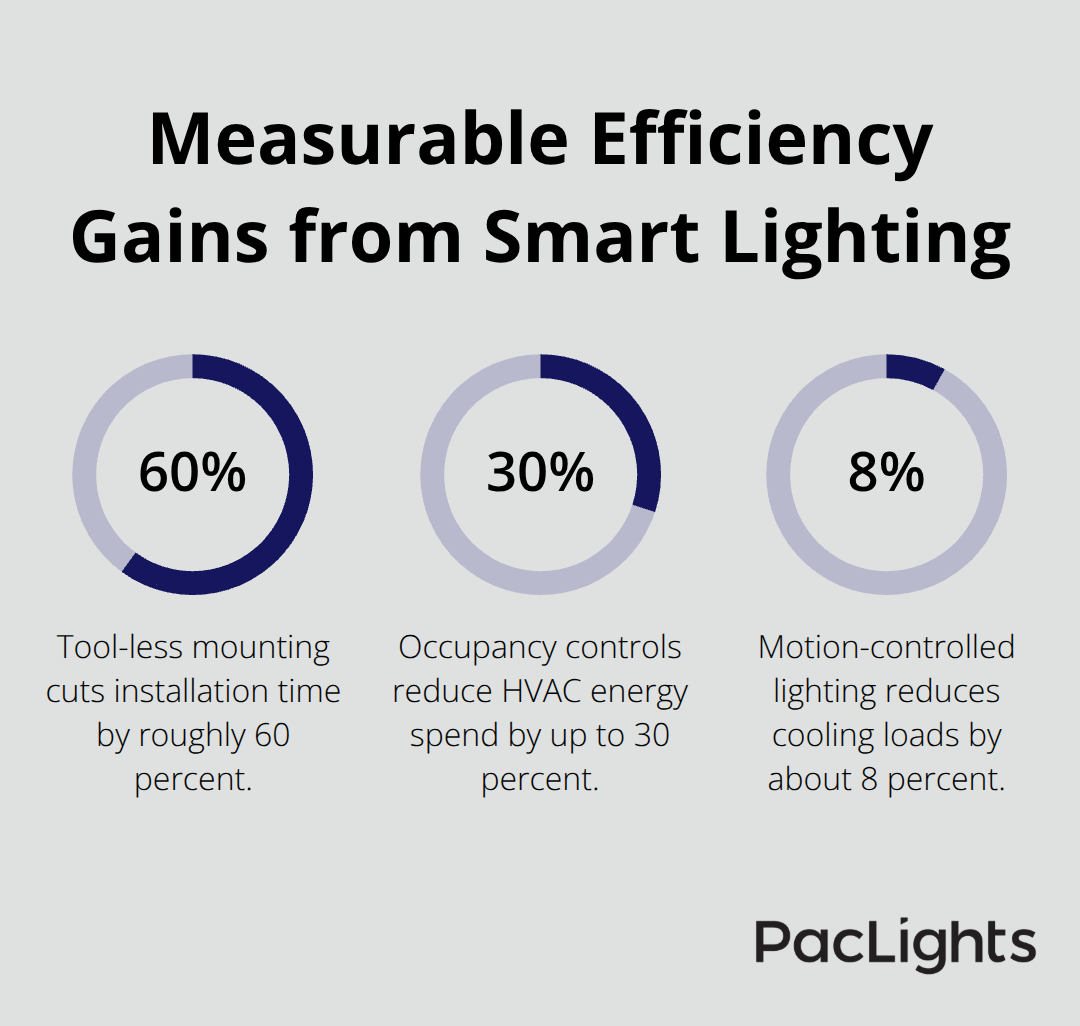
Poor lighting forces technicians to work slower and less accurately. ASHRAE standards recommend a minimum of 200 lux vertical illuminance on rack faces and 500 lux on equipment tops, yet many older facilities fall far short. When visibility is inadequate, maintenance tasks take longer, error rates climb, and unplanned downtime becomes more likely. Dense 42U rack configurations and cold aisle containment block overhead light penetration, creating shadows that demand targeted rack-mounted illumination. Without proper lighting, a technician spends 30 minutes troubleshooting a connection that would take 10 minutes under adequate illumination. Multiply that inefficiency across dozens of maintenance events per month, and you see why proper illumination reduces errors and directly impacts labor productivity. Motion-controlled rack lighting reduces cooling loads by about 8 percent while ensuring light appears only when technicians are present, eliminating wasted energy during idle periods. This targeted approach also keeps heat generation low-LED fixtures emit significantly less heat than incandescent or fluorescent alternatives, reducing HVAC demand and compounding energy savings beyond lighting alone.
Safety and Error Prevention Cannot Be Overlooked
Inadequate lighting in server rooms creates genuine safety risks and operational errors. Technicians working in dim aisles make cable connection mistakes, miss equipment damage, and struggle to read labels and indicators. High CRI LED lighting above 90 improves color accuracy for cables, labels, and status indicators within server racks, making it easier to spot problems before they cascade into failures. A technician working at 4000K color temperature maintains better alertness than one working under dim or yellowish light, directly reducing the likelihood of errors during critical maintenance windows. Proper illumination also prevents trips, falls, and equipment damage in aisles crowded with power distribution units and cable trays. The safety argument alone justifies upgrading outdated lighting systems, but when combined with energy and productivity gains, the business case becomes overwhelming.
The Path Forward Requires Strategic Planning
These three factors-energy costs, maintenance efficiency, and safety-converge to create an urgent case for rack lighting optimization. The question is not whether to upgrade, but how to approach the transition strategically. The next section covers the best practices that transform lighting from a cost center into a competitive advantage.
How to Deploy LED Fixtures That Actually Reduce Your Lighting Costs
LED Specifications That Deliver Real Performance
LED fixtures designed for rack environments deliver 300 to 600 lumens per 1U fixture at 15 to 30 watts, far outpacing the 1.0 to 1.5 watts per square foot consumed by legacy fluorescent systems. Direct-mount LED strip lights mounted beneath shelves direct concentrated illumination onto equipment below, eliminating shadows in dense 42U configurations where overhead light cannot penetrate. Aluminum-cased fixtures last 25,000 to 50,000 hours compared to fluorescent lifespans of 10,000 to 20,000 hours, cutting replacement labor and service disruptions across your facility. Tool-less mounting reduces installation time by roughly 60 percent versus fixtures requiring screws or brackets, which means you can retrofit high-traffic corridors and critical racks within days rather than weeks.
Color Temperature and Installation Strategy
Color temperature matters more than most operators realize: 4000K to 5000K in server areas keeps technicians alert and improves error detection during maintenance windows, while 3000K in break areas reduces eye strain during extended shifts. Power over Ethernet (PoE) rack lighting eliminates separate power runs by sharing existing Cat-6 cables, simplifying installation and reducing capital expenditure by $2 to $5 per square foot on materials and labor. Start with a pilot installation in one or two critical areas to validate performance and ROI before committing to facility-wide deployment, which typically reveals payback periods of 2 to 3 years when combining energy savings, reduced cooling load, and maintenance efficiency gains.
Motion Sensors Transform Passive Fixtures Into Active Tools
Motion sensors and networked controls transform LED fixtures from passive components into active efficiency tools that respond to actual occupancy rather than operating on fixed schedules. Motion-controlled lighting reduces cooling loads by about 8 percent while ensuring illumination appears only when technicians enter aisles, eliminating wasted energy during idle periods and keeping heat generation low. Daylight harvesting in perimeter zones and offices adjacent to data halls reduces artificial lighting needs by 30 to 50 percent beyond LED efficiency alone, while occupancy controls also reduce HVAC energy spend by up to 30 percent.
Real-Time Monitoring and Data-Driven Decisions
Networked lighting controls enable real-time data on occupancy, energy use, and equipment performance, integrating with your building management system for cross-system efficiency gains that extend far beyond lighting. Per-fixture power monitoring helps identify underperforming lights and prioritize maintenance before failures occur, while sensor data guides whether to light by aisle, by zone, or by other logical segmentations based on actual activity patterns. A comprehensive lighting audit reveals baseline consumption and identifies high-drain fixtures, typically taking 2 to 3 days for a mid-sized facility and providing a concrete ROI plan.
Phased Retrofit Approach Secures Quick Wins
Implement a phased retrofit approach starting with high-traffic corridors and break areas to deliver quick wins within 6 to 12 months, justifying broader deployment and securing rebates before incentive programs tighten. This strategic sequencing allows you to measure results from early installations, refine your control settings, and build internal support for facility-wide upgrades. Once you establish baseline performance metrics and validate energy savings in pilot zones, you’re positioned to scale the deployment across your entire datacenter while maximizing rebate eligibility and demonstrating measurable ROI to stakeholders.
Where Datacenters Go Wrong With Lighting
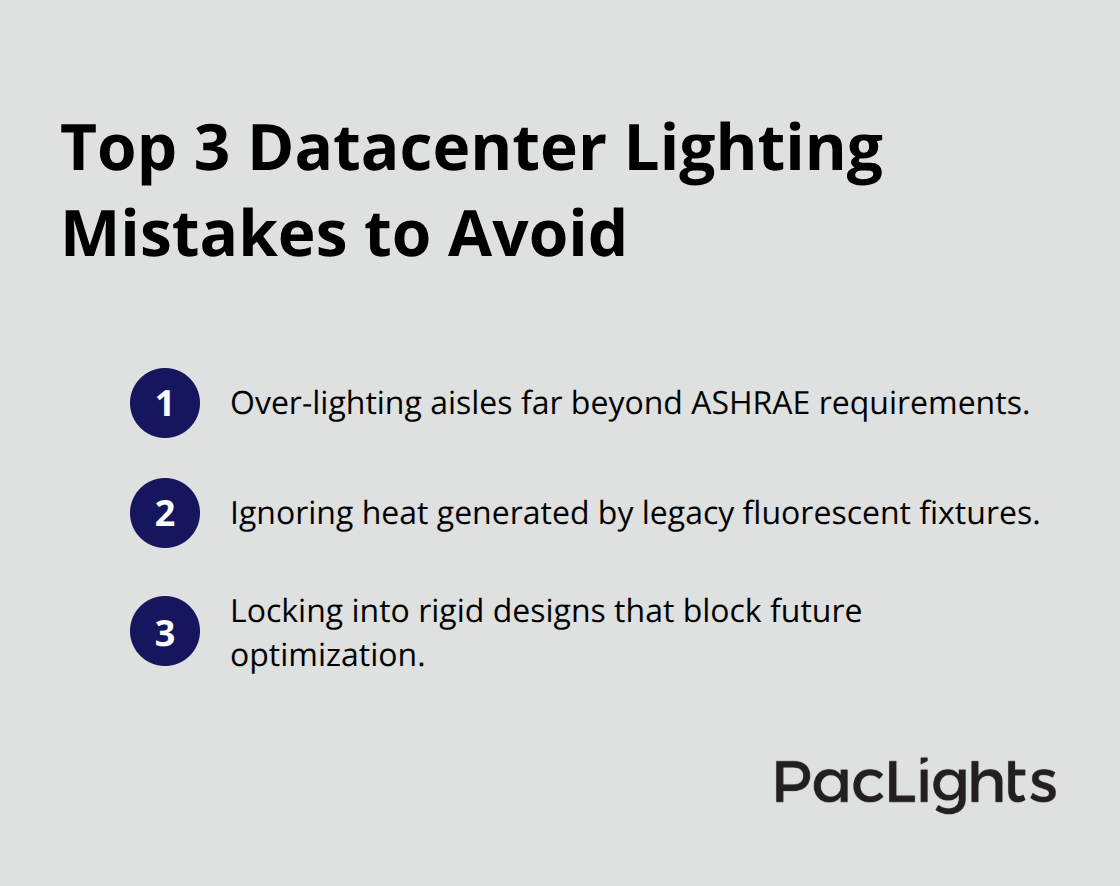
Datacenter operators routinely make three critical mistakes that waste thousands of dollars and undermine the efficiency gains available through modern lighting systems.
Over-Lighting Aisles Beyond Practical Requirements
The first mistake is over-lighting aisles and rack faces far beyond ASHRAE standards, which recommend 200 lux vertical illuminance on rack faces and 500 lux on equipment tops. Many facilities install fixtures that deliver 800 to 1000 lux across entire aisles, flooding spaces with light that technicians do not need and creating unnecessary heat generation. A technician performing maintenance needs adequate visibility at the specific equipment they are servicing, not stadium-level brightness across the entire aisle. Fluorescent and metal halide systems compound this problem because operators cannot easily dim or control them-they run at full output regardless of occupancy or task requirements. The result is wasted energy that drives up cooling costs without improving maintenance speed or accuracy.
Ignoring Heat Generation From Legacy Lighting Systems
The second mistake is failing to account for the heat generated by older lighting systems when calculating total cooling load. Fluorescent fixtures consume 1.0 to 1.5 watts per square foot and convert most of that energy into heat rather than useful light, forcing HVAC systems to work harder to maintain target temperatures. A facility running 5000 square feet of fluorescent lighting at 1.25 watts per square foot generates roughly 6250 watts of heat that cooling systems must remove. Switching to LED systems operating at 0.1 to 0.3 watts per square foot reduces that heat load to 500 to 1500 watts, cutting cooling demand and delivering energy savings that extend far beyond the lighting system itself. Operators who fail to measure baseline heat generation often underestimate the true cost of their existing systems and miss the compounding benefits of LED conversion.
Designing Rigid Systems That Block Future Optimization
The third and most damaging mistake is designing lighting systems without considering future scalability and flexibility. Many datacenters install hard-wired lighting fixtures on fixed schedules with no occupancy controls, making it impossible to adapt as facility layouts change or racks relocate. A facility that adds new equipment rows or reorganizes cold aisle containment cannot easily adjust lighting zones or reconfigure fixtures, forcing expensive retrofits or acceptance of poor illumination in new areas.
This inflexibility also prevents datacenters from implementing sensor-driven lighting strategies that reduce energy consumption by 30 to 50 percent beyond LED efficiency alone. Motion sensors and networked lighting controls require fixtures and wiring designed for modularity and future adjustment, yet most existing systems lack this capability.
Building Flexibility Into Your Lighting Foundation
Modular LED fixtures that support Power over Ethernet (PoE) power distribution and wireless controls eliminate the need for separate power runs and allow you to reconfigure lighting zones without rewiring. This approach costs slightly more upfront but prevents costly redesigns when your facility evolves. A facility that locks itself into a rigid lighting design today will spend years paying the penalty through inflexible operations, higher energy bills, and inability to optimize lighting as new technologies emerge. Measure actual requirements rather than guessing at illumination levels, and choose systems that support future optimization rather than static operation. The difference between a flexible, adaptable lighting infrastructure and a fixed one determines whether your datacenter can respond to changing needs or remains trapped by yesterday’s design decisions.
Final Thoughts
Optimizing rack lighting in datacenters delivers measurable returns across energy costs, operational efficiency, and safety. A mid-sized facility spending $100,000 to $180,000 annually on lighting reduces that expense by 40 to 60 percent through LED conversion, with payback periods of 2 to 3 years. Motion sensors and networked controls compound these savings by cutting lighting energy use by an additional 30 to 50 percent beyond LED efficiency while simultaneously reducing cooling loads by roughly 8 percent.
Technicians working under proper illumination complete maintenance tasks faster and with fewer errors, while ASHRAE-compliant lighting at 4000K color temperature keeps staff alert and improves their ability to spot cable connections and equipment damage. Adequate visibility prevents trips, falls, and connection mistakes that cascade into unplanned downtime, directly lowering labor costs and accelerating equipment issue resolution. Safety improves measurably when you implement the right lighting strategy.
Start with a lighting audit to establish your baseline consumption and identify high-drain fixtures, then implement a phased retrofit starting with high-traffic corridors and critical racks to deliver quick wins within 6 to 12 months. Design your lighting infrastructure for flexibility using modular LED fixtures with Power over Ethernet support and wireless controls, which allows you to adapt as your facility evolves. Contact us at PacLights for a free ROI assessment to understand exactly how to optimize rack lighting in your specific datacenter environment.
Disclaimer: PacLights is not responsible for any actions taken based on the suggestions and information provided in this article, and readers should consult local building and electrical codes for proper guidance.