

A high-bay submittal should describe the ambient temperature where the luminaire operates, not only the temperature people experience at the occupied floor. In a tall warehouse, the air around suspended fixtures can differ from a thermostat reading or a spot observation taken near a doorway. Roof geometry, solar gain, process heat, air movement, seasonal operation and mounting position can all affect the condition at the fixture level.
The practical review is not a request for a guessed “worst-case” number. It is a documented comparison between credible operating conditions and the rating conditions for the exact proposed configuration. Record where the fixture will be, how the temperature evidence was obtained, which mounting arrangement and accessories apply, and what the current manufacturer documentation actually says. If those pieces do not line up, keep the configuration open for clarification rather than treating a room setpoint as approval.
Define the ambient at the luminaire
Start by naming the condition under review. “Warehouse temperature” can refer to a wall thermostat, a floor-level work area, outdoor weather, return air or the air immediately around a luminaire. Those are different observation locations. For a product rating, the useful question is the ambient condition surrounding the installed fixture under the stated mounting and operating conditions.
Mark the proposed luminaire elevation and its relationship to the roof deck, beams, ducts, mezzanines and other nearby surfaces. A measurement height without a drawing reference can be ambiguous. Use stable coordinates, bay or aisle identifiers and an elevation reference that the facility team, distributor and lighting specifier can all recognize.
Keep temperature evidence separate from lighting performance. A thermal review does not replace a photometric calculation, and a good light level does not establish that a luminaire is within its documented operating condition. The two reviews can share the same fixture schedule, but each needs its own inputs and disposition.
Describe credible warm operating conditions
A single reading on a mild morning rarely describes a warm operating condition. Build the observation plan around the conditions that could reasonably coincide: production or process loads, doors and ventilation positions, HVAC schedule, roof exposure, nearby heat sources, lighting operating state and the season or outdoor condition. Do not add an invented temperature to make the record look complete. Identify what was observed, what was not observed and which future condition still needs review.
Tall spaces can develop vertical temperature differences, especially when heat accumulates near the roof and air mixing varies over time. The amount and direction of that difference are site-specific. Record evidence at the fixture level or at a defensible nearby reference rather than applying a generic adjustment to a floor reading. If direct observation at elevation is not practical, document the alternative method and have the responsible project team decide whether it is adequate.
Changing operations can also change the thermal picture. New process equipment, revised ventilation, altered roof insulation, seasonal door use or a different mounting elevation may invalidate an earlier assumption. Treat those changes as triggers to revisit the thermal record, not as reasons to overwrite the original evidence.
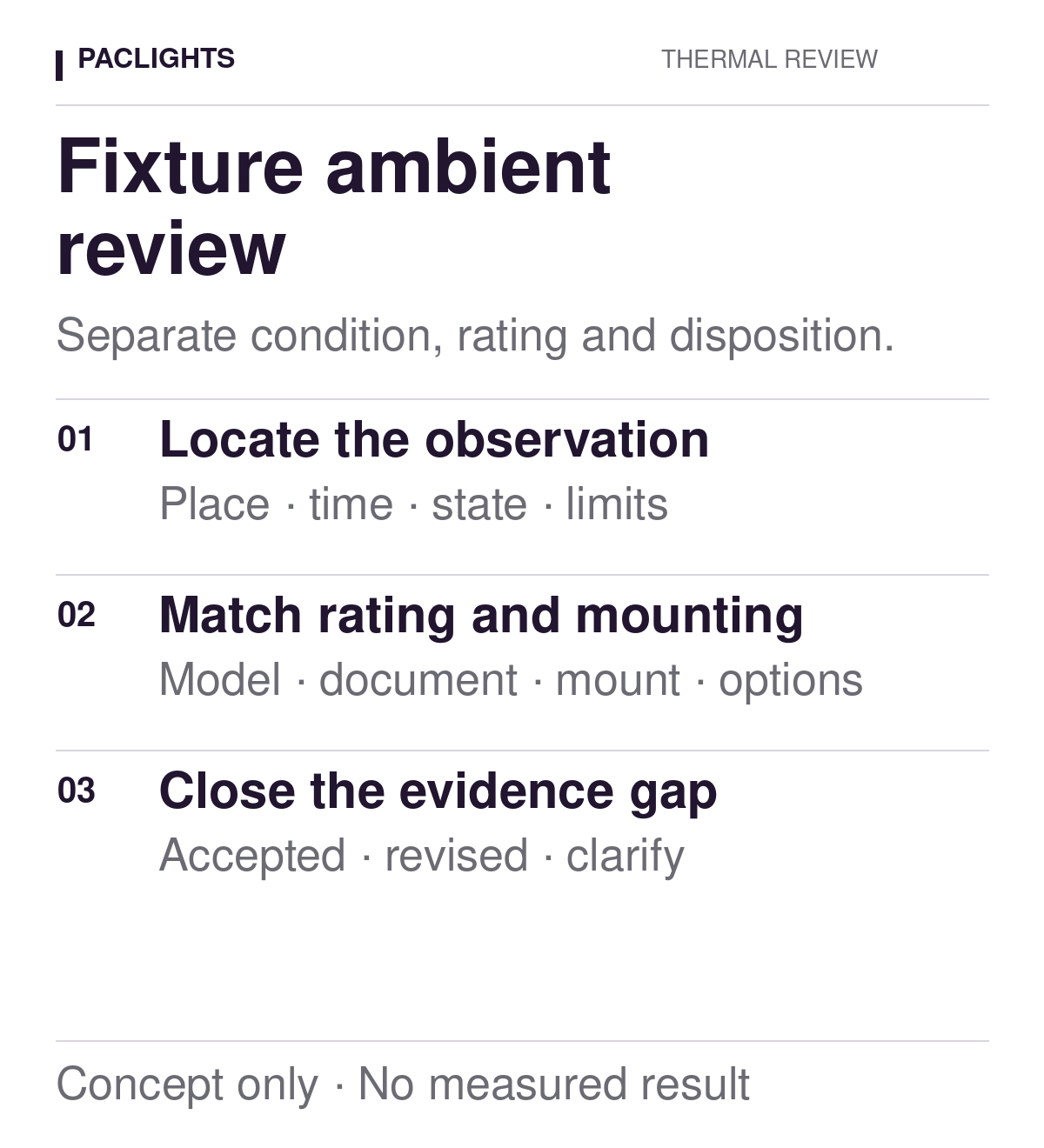
Record the observation method and its limits
A usable temperature record identifies the sensor or instrument, observation location, date and time, duration, operating state and relevant environmental conditions. It also states whether the value is a short spot observation, a logged interval or another documented method. A number without this context can appear more precise than the evidence supports.
Place observation points where they answer the review question. A point near the fixture can support the fixture-level condition; a point at the occupied floor can help explain human comfort or room operation. Neither should be silently substituted for the other. When multiple fixture elevations or roof zones exist, identify which locations the evidence represents and which remain unobserved.
Include instrument identification and the responsible record owner, but do not imply laboratory accuracy or professional certification unless it exists. Note practical limitations such as limited sampling, uncertain sensor placement, incomplete seasonal coverage or changed ventilation. A clear limitation is more useful than a hidden assumption because it tells the manufacturer or designer exactly what needs resolution.
Match the exact fixture rating and mounting condition
Read the current manufacturer specification for the precise product generation and selected configuration. Family-level marketing language is not enough. Confirm the model, output setting, input condition, control or emergency option, optical accessory and mounting arrangement that will appear in the submittal. A rating tied to one arrangement should not be carried to another arrangement without documentation.
The current PacLights FLHE linear high-bay family specification states that the luminaire is suitable for ambient temperatures up to 50°C (122°F) when the fixture is suspended at least 18 inches from the ceiling. That statement is useful only with its condition attached. It does not establish the ambient at a particular project, approve another mounting arrangement or replace the current installation instructions and project review.
List the document title, revision or issue identifier, retrieval date and the exact clause used for the comparison. Specifications can change, and an ordering family can include several configurations. Keep the applicable document with the fixture schedule so a later reviewer can see which condition supported the accepted selection.
Separate mounting evidence from a temperature guess
The mounting record should show the proposed suspension, distance to the relevant ceiling or roof reference, nearby obstructions and any accessories that affect the arrangement. The high-bay mounting-change review explains why hardware, ceiling relationship, service access, lighting geometry and sensor view need a coordinated check. For the thermal submittal, keep the narrower question visible: does the exact mounting arrangement satisfy the conditions attached to the cited rating?
Do not convert an undocumented separation, a similar-looking bracket or an assumed airflow path into approval. Photographs and dimensions help identify the arrangement, but the responsible manufacturer or designer must resolve any condition that the documents do not cover. Structural capacity, electrical installation and access requirements remain separate project reviews.
If the project proposes more than one mounting arrangement, create a row for each. A suspended aisle group and a surface-mounted service area should not share one unexplained thermal disposition. Stable row IDs make later substitutions and field changes easier to recognize.
Connect the rating evidence to the ordered configuration
Build a small cross-reference rather than filing unrelated documents together. Each row should connect the fixture schedule ID, full ordered configuration, location or zone, mounting arrangement, temperature evidence, cited rating condition and disposition. Use “clarify” where evidence is missing; a blank cell should not be read as acceptance.
This mirrors the document-control approach in our guide to matching an IES file to the ordered fixture configuration. In both cases, the family name alone is insufficient. The project team needs a traceable link between the exact equipment being ordered and the evidence used in the design or submittal review.
Record revisions rather than replacing earlier entries. If the fixture, accessory, mounting position or operating condition changes, add the new basis and identify what superseded the earlier disposition. This keeps a procurement change from inheriting an approval that belonged to another configuration.
Resolve undocumented conditions before acceptance
A concise clarification request should state the exact configuration, proposed mounting, observation location, credible warm operating condition and the specific rating question. Attach the current drawing, fixture schedule, manufacturer document and temperature record. Ask for a written disposition that can be retained with the submittal.
Avoid broad questions such as “Is this high bay okay for a warehouse?” They invite a family-level answer that may not address the project condition. Ask instead whether the identified configuration and mounting arrangement are suitable for the documented condition, and list any evidence gap that prevents the reviewer from making that comparison.
Close each row as accepted as documented, revised, or held for clarification. Preserve the date, responsible source and evidence reference. For a PacLights project discussion, bring the full ordering configuration, current product documents, mounting drawing and fixture-level temperature record. That package lets the team review the actual condition instead of relying on a floor thermostat or a generic family limit.
Disclaimer: PacLights is not responsible for any actions taken based on the suggestions and information provided in this article, and readers should consult local building and electrical codes for proper guidance.