

Datacenters consume massive amounts of energy, with lighting often accounting for 20-30% of total facility power usage. Network lighting systems give you real-time control over every fixture, cutting energy waste and operational costs significantly.
At PacLights, we’ve seen firsthand how smart lighting transforms datacenter efficiency. This guide walks you through everything you need to know about implementing these systems in your facility.
What Network-Connected Lighting Systems Deliver
Core Architecture and Power Delivery
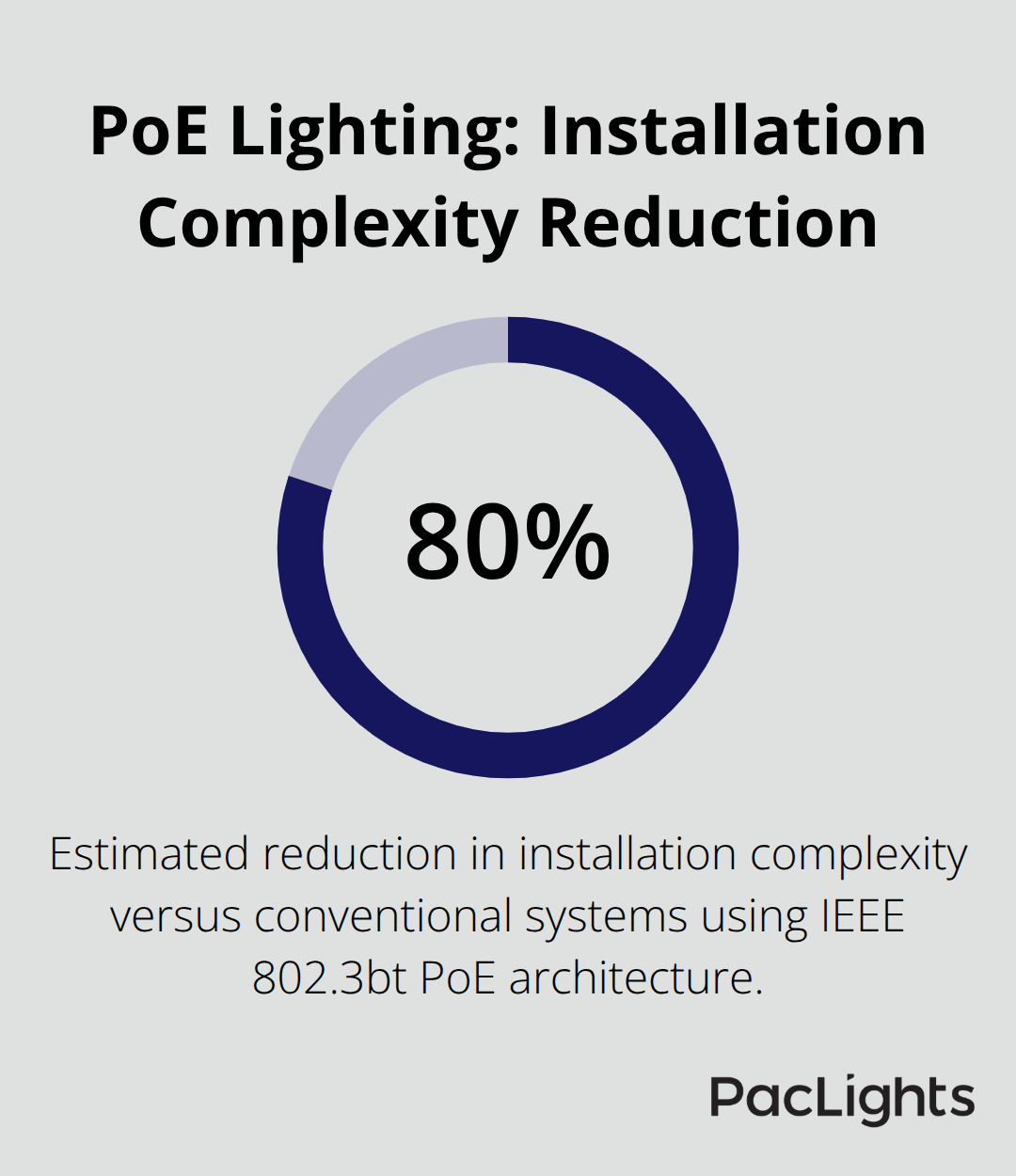
Network-connected lighting systems combine intelligent hardware, data communication, and centralized software to give you precise control over every fixture in your datacenter. The core architecture includes PoE switches that supply power and data through standard Ethernet cables, connected luminaires equipped with microcontrollers and sensors, and management software that monitors and optimizes performance across your entire facility. The IEEE 802.3bt standard enables up to 90 watts of power per device over four-pair Ethernet, eliminating the need for separate electrical wiring and reducing installation complexity by roughly 80% compared to conventional systems. This simplified infrastructure directly cuts your labor costs and accelerates deployment timelines.
Real-Time Responsiveness vs. Traditional Lighting
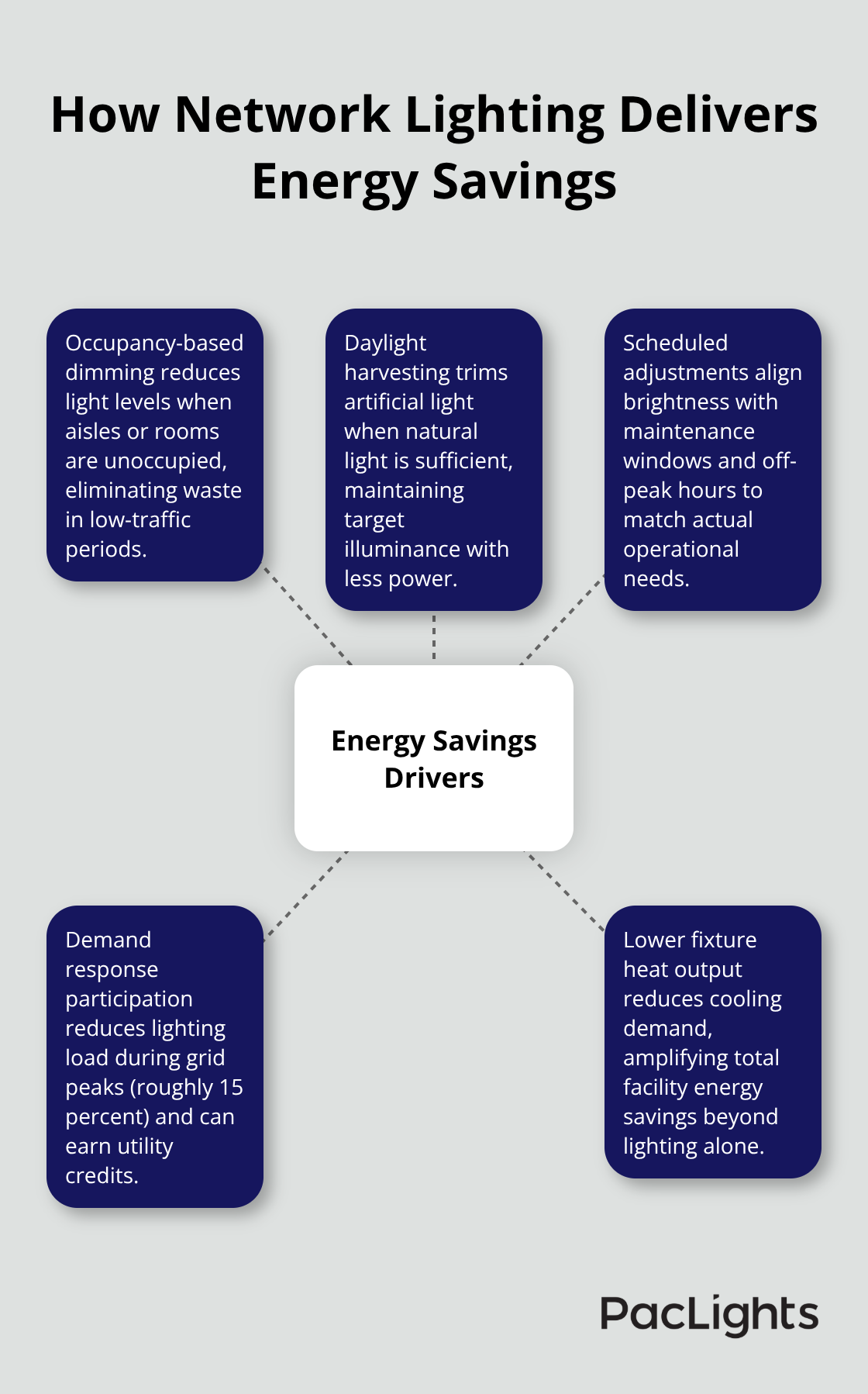
Unlike traditional lighting that runs on fixed schedules or manual switches, networked systems respond to real-time conditions. Occupancy sensors detect when spaces are in use, daylight harvesting reduces artificial light when natural light is sufficient, and thermal monitoring prevents overheating in cable bundles. These capabilities work together to eliminate wasted energy and adapt your lighting to actual facility needs rather than assumptions.
The Financial Case for Network-Connected Systems
Energy savings typically range from 30% to 65% with automated adjustments and integrated controls. Real-time luminaire-level energy monitoring shows you exactly which zones consume the most power, enabling targeted optimization rather than guessing where waste occurs. You can schedule lighting to match maintenance windows, reduce brightness during off-peak hours, and participate in demand response programs that earn credits during grid peak events. Predictive maintenance and remote monitoring reduce service calls by about 60% while extending fixture lifespans, lowering your total cost of ownership over time.
Installation and Equipment Costs
Upfront equipment costs run 25–40% higher than conventional LEDs, but total installation expenses drop 40–50% due to simplified infrastructure and reduced labor. The Global Market Insights report shows the smart lighting market reached USD 15.7 billion in 2024 and is forecast to grow to USD 88.4 billion by 2034, reflecting rapid adoption of these systems across commercial and industrial facilities where datacenters increasingly compete for energy efficiency credentials. This market expansion signals that network-connected lighting has moved from emerging technology to standard practice.
Understanding these fundamentals positions you to evaluate how network-connected lighting fits your specific datacenter environment and operational goals. The next section examines the measurable energy reductions and financial benefits you can expect during implementation.
Energy Savings and Cost Reduction in Datacenters
Quantifying Real Energy Reductions
Network-connected lighting cuts datacenter energy consumption by 30 to 65 percent depending on your baseline conditions and how aggressively you implement automated controls. That range reflects actual deployments, not theory. Real facilities achieve 50 percent reductions through occupancy-based dimming, daylight harvesting, and scheduled brightness adjustments aligned with maintenance windows. A 2024 analysis from Global Market Insights found that energy efficiency and sustainability now drive approximately 25 percent of smart lighting market growth, meaning facilities managers across the industry prioritize measurable power reductions. In datacenters where lighting represents 20 to 30 percent of total facility consumption, a 50 percent reduction in lighting load translates directly to lower cooling requirements since less heat radiates from fixtures. This cascading effect amplifies your savings beyond the lighting system itself.
Identifying High-Consumption Zones
Real-time luminaire-level energy monitoring shows exactly which zones consume the most power, letting you identify high-consumption areas like server aisles or equipment rooms that benefit most from aggressive automation. Demand response integration adds another layer of savings by allowing your lighting system to participate in utility programs during grid peak events, potentially earning credits while reducing load by roughly 15 percent during critical periods. This visibility transforms lighting from a fixed overhead into a managed asset you can optimize continuously.
ROI and Payback Periods
ROI timelines depend heavily on your current lighting infrastructure and local electricity costs, but most datacenters recover equipment investments within three to five years through energy savings alone. Upfront equipment costs run 25 to 40 percent higher than conventional LEDs, yet total installation expenses drop 40 to 50 percent because network-connected systems eliminate separate electrical wiring and reduce labor complexity by approximately 80 percent. Predictive maintenance capabilities reduce service calls by about 60 percent while extending fixture lifespans, lowering your maintenance budget significantly.
Integration Challenges and Planning
Integration with existing datacenter infrastructure requires careful planning around your power distribution, network topology, and building management systems. Thermal management becomes critical in large deployments since high-power PoE runs can raise cable bundle temperatures by 12 to 15 degrees Celsius, requiring thoughtful routing and cooling integration to prevent performance degradation. Retrofit projects face interoperability challenges in roughly 62 percent of cases, so plan comprehensive integration testing and confirm that your existing BMS infrastructure can communicate with new lighting controllers through open standards or gateway interfaces.
Phased Implementation Strategy
Starting with a phased rollout in high-use zones like server aisles and equipment rooms lets you validate ROI calculations before expanding across your entire facility. This approach reduces risk and provides concrete data to justify broader investment. Once you establish baseline performance in these zones, you can confidently scale the system across your entire datacenter while refining control strategies based on real operational patterns. The next section walks you through the specific steps needed to assess your facility and plan a successful implementation.
Implementing Network-Connected Lighting in Your Datacenter
Assess Your Facility and Infrastructure
Start your implementation with a detailed facility audit that maps your current lighting infrastructure, electrical capacity, and network topology. Walk through your server aisles, equipment rooms, corridors, and outdoor areas to document fixture types, quantities, age, and power consumption patterns. Measure your existing electrical loads to confirm that your power distribution can handle PoE switch deployment without overloading circuits already serving IT equipment-this step prevents costly rewiring. Simultaneously, assess your network infrastructure by checking router placement, Ethernet cable runs, and available bandwidth. Most datacenters require multiple PoE switches distributed across zones since the 100-meter Ethernet limit necessitates a star topology with careful planning around switch placement.
Thermal management planning is critical here: high-power PoE runs can raise cable bundle temperatures by 12 to 15 degrees Celsius, so identify cable routing that minimizes heat accumulation near sensitive IT equipment. Verify that your building management system can communicate via open standards like BACnet or through gateway interfaces, since roughly 62 percent of retrofit projects encounter interoperability challenges when manufacturers use proprietary protocols. Document baseline energy consumption by zone using utility bills and any existing sub-metering data so you can quantify actual savings after deployment. This assessment phase typically takes two to four weeks depending on facility size and complexity.
Plan Your Phased Rollout Strategy
Your integration strategy should prioritize a phased rollout that begins with high-consumption zones like server aisles and equipment rooms where occupancy sensors and demand response participation generate immediate ROI. Start installation in one aisle or zone, validate that your BMS integration functions correctly, and measure energy reductions against your baseline before expanding facility-wide. This approach reduces deployment risk and provides concrete financial data to justify broader investment to stakeholders.
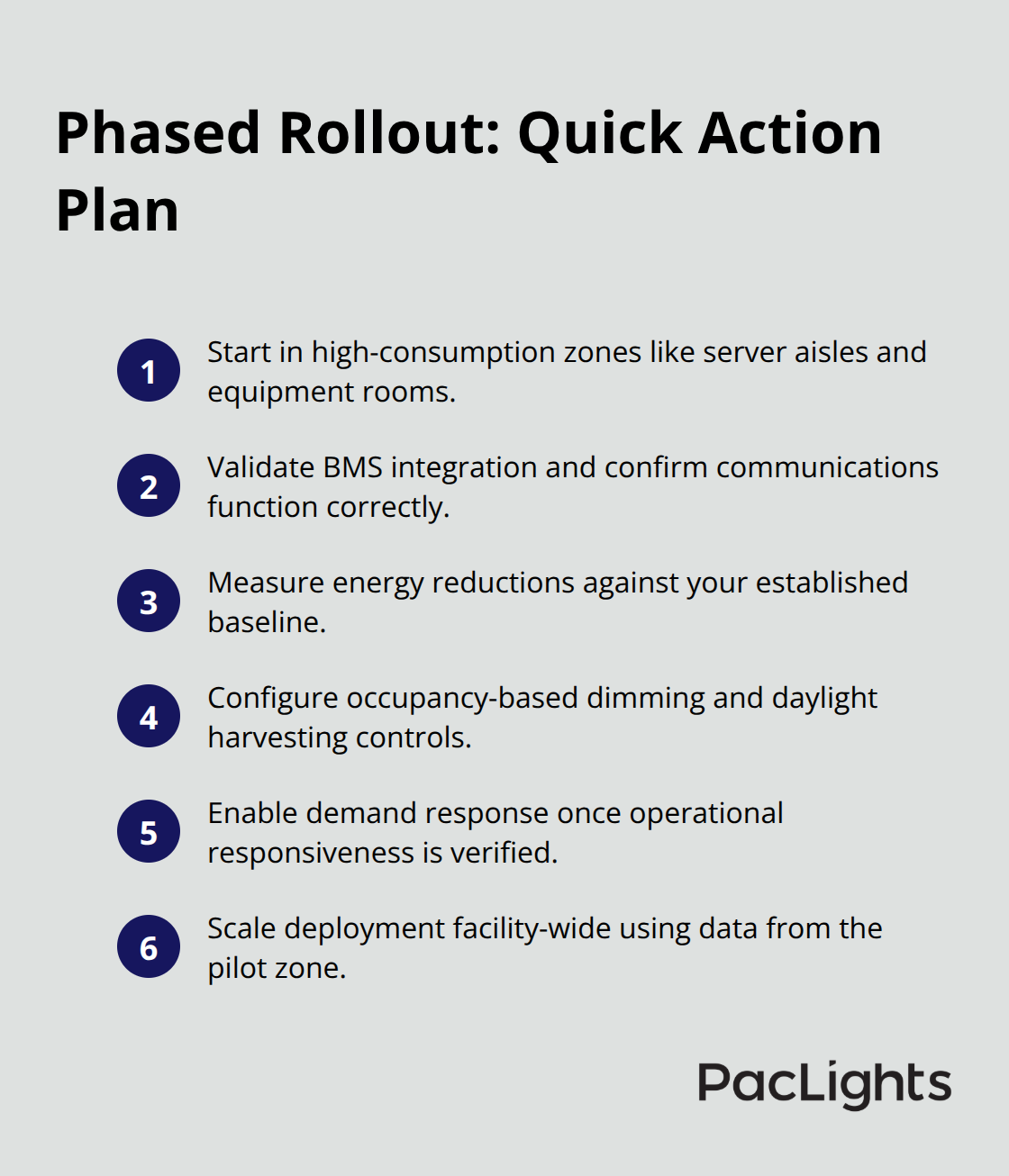
Configure occupancy-based dimming and daylight harvesting controls during the initial phase, then layer in demand response capabilities once your team understands the system’s responsiveness.
Execute Installation and Integration
Plan maintenance workflows around your 24/7 operations by scheduling installations during maintenance windows when spaces are already unoccupied. After deployment, establish a real-time energy monitoring dashboard that displays consumption by zone, time of day, and fixture type so facility managers can identify underperforming areas and optimize control settings continuously. Predictive maintenance alerts should flag thermal issues, sensor malfunctions, and fixture degradation before they impact operations, reducing emergency service calls by approximately 60 percent. Document all control settings, network configurations, and integration points in your facility management system so future staff understand how the system operates.
Monitor Performance and Optimize Continuously
Review performance metrics monthly during your first year to confirm that energy savings align with projections, then transition to quarterly reviews once the system stabilizes. Most datacenters achieve 30 to 65 percent reductions in lighting energy through aggressive automation, though your specific results depend on baseline conditions and how thoroughly you implement occupancy controls across all zones. Real-time luminaire-level energy monitoring shows exactly which zones consume the most power, letting you identify high-consumption areas that benefit most from aggressive automation. Demand response integration adds another layer of savings by allowing your lighting system to participate in utility programs during grid peak events, potentially earning credits while reducing load by roughly 15 percent during critical periods.
Final Thoughts
Network-connected lighting systems transform datacenter operations by delivering measurable energy reductions, lower maintenance costs, and operational flexibility that traditional lighting cannot match. Your facility gains real-time visibility into consumption patterns, enabling targeted optimization across every zone rather than relying on fixed schedules or manual adjustments. The 30 to 65 percent energy savings typical in datacenter deployments translate directly to reduced cooling loads, lower utility bills, and improved sustainability credentials that matter to stakeholders and regulators alike.
Network lighting creates long-term value through predictive maintenance that extends fixture lifespans and reduces emergency service calls by approximately 60 percent. Your team accesses actionable data through luminaire-level energy monitoring, occupancy analytics, and demand response participation that transforms lighting from a fixed overhead into a managed asset. These capabilities position your datacenter to adapt quickly as operational demands shift, whether you need to support higher-density equipment deployments or respond to grid demand events that reward load reduction.
The smart lighting market reached USD 15.7 billion in 2024 and continues accelerating as energy efficiency drives adoption across commercial and industrial sectors. We at PacLights provide energy-efficient lighting fixtures and networked lighting controls tailored to datacenter environments, including optional motion and daylight sensors that optimize energy use. Schedule a facility audit with our team to establish baseline consumption and identify the zones where network-connected lighting delivers the fastest payback.
Disclaimer: PacLights is not responsible for any actions taken based on the suggestions and information provided in this article, and readers should consult local building and electrical codes for proper guidance.