

A high-bay mounting change deserves a fresh review even when the fixture, wattage and circuit remain the same. Moving from chains to a surface bracket, shortening a suspension or relocating a pendant can change the conditions around the luminaire and the geometry used in the lighting design. Confirm the exact product instructions, rating conditions, hardware and service access before accepting the revised arrangement.
The useful starting question is specific: what differs from the last documented installation, and which approvals or calculations depended on it? A general statement that a product offers several mounting options does not establish that every option carries identical operating conditions. Keep the proposed arrangement tied to the exact fixture configuration and current manufacturer documentation.
Describe the change with two identifiable arrangements
Record the existing mounting method and the proposed method side by side. Include fixture model and generation, output setting, installed accessories, mounting hardware and the drawing revision. Photograph the existing arrangement where a safe, authorized inspection permits it. Mark whether the proposal changes suspension length, fixture elevation, orientation or position relative to the roof structure.
Use clear references for dimensions. A floor-to-fixture measurement and a fixture-to-ceiling separation answer different questions. Identify the surfaces or reference points used for each measurement; a roof deck, beam and suspended ceiling can be at different elevations. Where documentation leaves the required reference unclear, request clarification rather than choosing the most convenient interpretation.
Separate a change in hardware from a change in location. A replacement bracket could retain the previous light-source position, while a shorter suspension could move the fixture even if the support point stays fixed. Recording both differences helps the manufacturer and lighting designer identify the parts of the review they need to address.
Read the ambient rating together with its mounting conditions
Product ratings can be conditional. The current specification sheet for the PacLights FLHE linear high-bay family, for example, states suitability for up to 50°C (122°F) ambient temperature when the fixture is suspended at least 18 inches from the ceiling. The same sheet lists surface and pendant/conduit mounting accessories as well as suspension options. Read those statements together; the accessory list alone does not establish the same temperature rating for a different arrangement.
That example is a product-document condition, not a universal high-bay clearance rule. Do not copy it to another family, assume a particular field installation satisfies it, or infer an alternative rating for a closer mount. Confirm the current documentation for the exact variant and ask PacLights to resolve a proposed configuration that is not clearly covered.
Keep the source and revision with the submittal. If an older drawing and a current specification appear to disagree, identify the discrepancy explicitly. A written disposition should name the fixture and mounting arrangement it addresses. A general reply about the product family is less useful when the unresolved question concerns a specific installed option or ceiling condition.
Document conditions where the fixture will operate
An occupied-floor temperature or thermostat setting does not establish the ambient condition at the luminaire. Describe the proposed location relative to the roof, heat-producing equipment, enclosed spaces and other relevant features. If temperature evidence is needed, the project team should define how and under which operating conditions it will be obtained. Do not substitute a comfortable floor-level observation for evidence at the fixture location.
Record the basis of each condition: an actual observation, a project design assumption or information still to be confirmed. Include the observation location, date and operating state when available. A snapshot taken during mild conditions may not describe the warm conditions relevant to the design. The purpose is to give the reviewer a traceable basis, without turning an undocumented assumption into a measured fact.
Also identify obstructions or added equipment near the proposed position. A revised roof assembly, nearby duct or accessory can make the actual arrangement different from a simple open-ceiling sketch. Give the manufacturer enough context to answer the configuration question; a single separation dimension may not describe everything relevant.
Check the hardware and the space needed for service
Match the proposed mounting kit to the exact fixture and the current manufacturer instructions. Record its part identification, attachment arrangement and any documented limitations. Similar appearance is not evidence that a bracket or adapter belongs to the same product generation. Resolve missing or conflicting identification before the change moves into procurement or field work.
Keep fixture-to-mount compatibility separate from approval of the building support. A listed accessory does not, by itself, establish the capacity or condition of an existing support, roof member or attachment point. Those questions belong with the responsible project professionals. This review record should identify who will resolve them rather than imply that a lighting-product selection completes a structural review.
Consider how authorized maintenance personnel will reach the fixture after the change. Mark access routes, nearby equipment and the space needed to inspect or service the actual assembly under its instructions. Check whether a bracket, conduit arrangement or adjacent obstruction interferes with access to controls or other service points. Do not invent a universal service clearance where the documentation supplies none; request the necessary project-specific disposition.
Revisit the lighting geometry and sensor view
Changing a luminaire’s elevation, orientation or position can change how its distribution reaches the work. Ask the lighting designer whether the existing calculation still represents the proposed arrangement. Provide the actual fixture locations, relevant task surfaces, optical configuration, output setting and corresponding photometric file. An unchanged fixture count does not make an earlier calculation representative.
Check the receiving planes separately. Floor travel, elevated work and vertical rack labels are different surfaces; the mounting change may affect them differently. For broader planning context, our warehouse lighting layout overview discusses layout considerations. Use the current project criteria and calculation for the proposed change rather than applying a general spacing example as an acceptance rule.
Where racks or storage are also changing, coordinate the two reviews. The warehouse rack-change lighting review explains which geometry and task information to carry into that discussion. A fixture raised toward the roof while a rack row becomes taller introduces two changes; reviewing only one can leave the model incomplete.
For an installed sensor, compare its proposed position and view with the manufacturer’s guidance and the intended controlled area. Identify possible obstructions and affected approach routes. If the physical change affects coverage or zone boundaries, plan a functional retest against the approved sequence. Preserve expected group responses, daylight interaction, delays and restoration requirements as separate checks; do not assume old settings prove unchanged behavior.
Close the review before the revised arrangement becomes the baseline
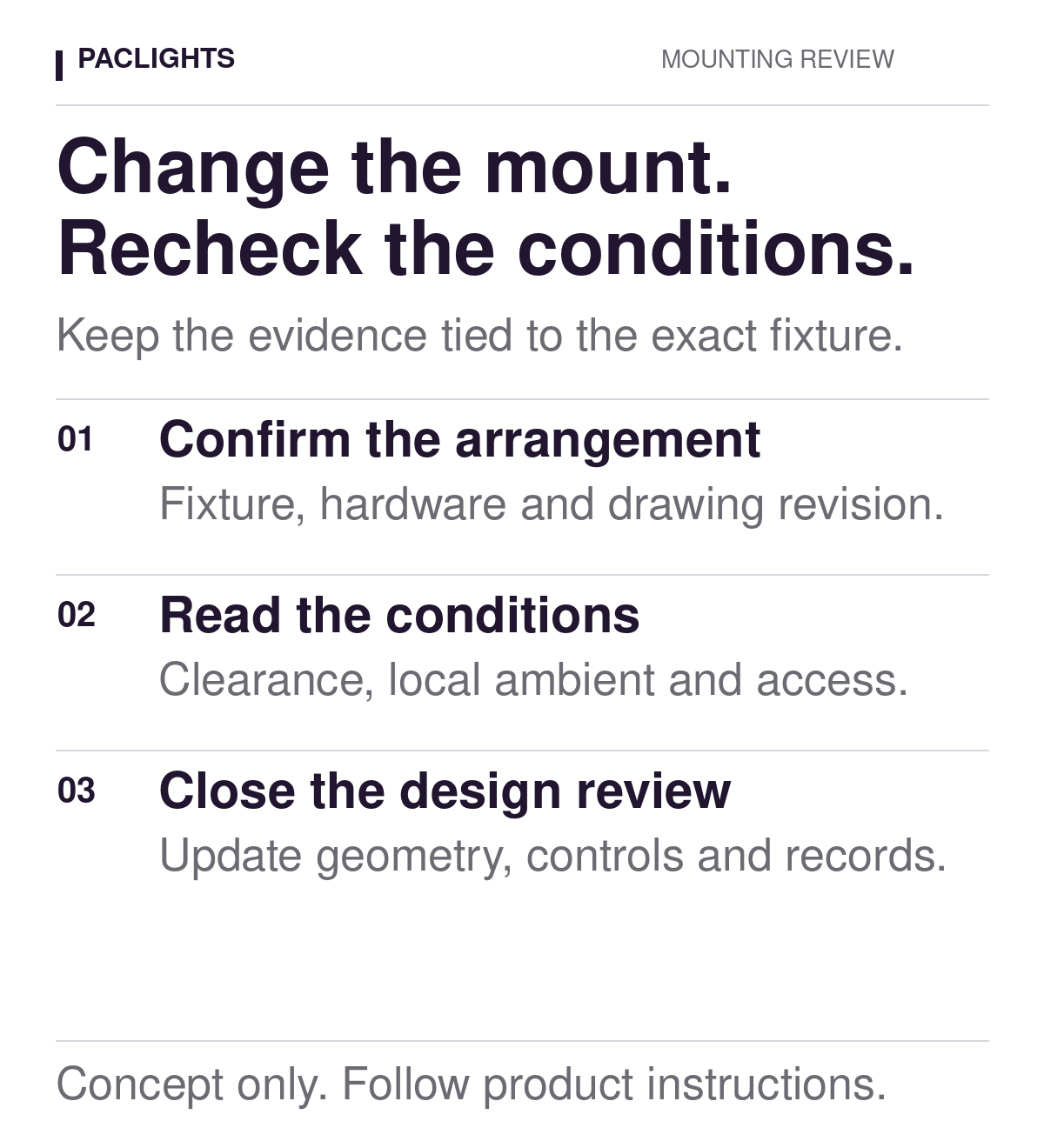
A useful change record links each open question to an owner and a disposition. Include the existing and proposed drawings, exact fixture and kit identification, applicable instructions, rating conditions, access observations and any lighting or controls review. State which points are resolved and which remain open. Preserve the manufacturer’s response with the configuration it actually addresses.
After authorized work, compare the installed arrangement with the reviewed drawing. Record discrepancies and complete any required observation or functional checks before closing the change. Keep the final revision available for maintenance so the next team does not work from the superseded mounting detail.
For a PacLights review, send the complete fixture ordering information, current and proposed mounting details, ceiling relationship, relevant ambient-condition evidence and the specific question requiring confirmation. Add the lighting plan and control schedule when position or orientation changes. That package supports a focused answer about the proposed installation and a clear record of what still needs project approval.
Disclaimer: PacLights is not responsible for any actions taken based on the suggestions and information provided in this article, and readers should consult local building and electrical codes for proper guidance.