

A useful warehouse rack-face lighting check records exactly where the meter was placed, which direction its receiving surface faced, and what the warehouse was doing at that moment. A reading written beside an aisle number leaves too much unresolved. The next person needs to distinguish a vertical location label from a horizontal shelf, an empty bay from a loaded one, and occupied lighting from a standby condition.
Prepare the observation plan before collecting numbers. Agree on the tasks, surfaces, locations and operating conditions with the person reviewing the lighting. Keep the resulting record separate from a general floor survey. It can support a project-specific assessment, but it does not establish a universal light-level target or demonstrate that every picking position has been checked.
Start with the task and the surface
Identify what someone must see at each position: a location label on a beam, a carton label facing the aisle, an item inside a shelf, or paperwork at a fixed station. These tasks may occupy the same bay while presenting different surfaces to the lighting. Write down the actual task rather than describing the area only as “storage” or “picking.”
Illuminance describes light arriving at a surface. A horizontal floor reading and a reading on a vertical rack face therefore answer different questions. Neither number alone describes how easily a person can read a label. Label condition, contrast, viewing position and reflections also deserve an observation note when they are relevant.
Ask the designer or responsible reviewer to define the applicable project criteria and measurement method. Record the reference and revision alongside the plan. Do not copy a target for another warehouse task or borrow a vertical measurement height from an unrelated application. Where the task surface is tilted or recessed, describe that geometry explicitly instead of calling every observation a rack-face reading.
Give every observation a repeatable address
Use a current drawing to identify the aisle, rack row, bay and side. Add a point identifier that remains stable between visits. An elevation sketch is useful when several labels or picking levels share the same plan position. State the height reference, such as the finished floor, and record the actual height with units. A beam number alone may become ambiguous after rack adjustments.
Also describe where the receiving surface sits relative to the rack face. A measurement at the front label holder differs from one taken farther inside a shelf. Record the setback or other locating detail needed to reproduce the position. Include the drawing revision and a contextual photograph where facility rules permit it; the photograph supplements the written coordinates and orientation rather than replacing them.
Choose the observation locations to answer the review question. If the concern is a particular lower picking level, include that location and explain the scope. If the assignment is an acceptance survey, follow the agreed sampling plan. Convenient access points should not silently become a claim that the whole aisle is represented. Mark inaccessible points as not measured, with a reason.
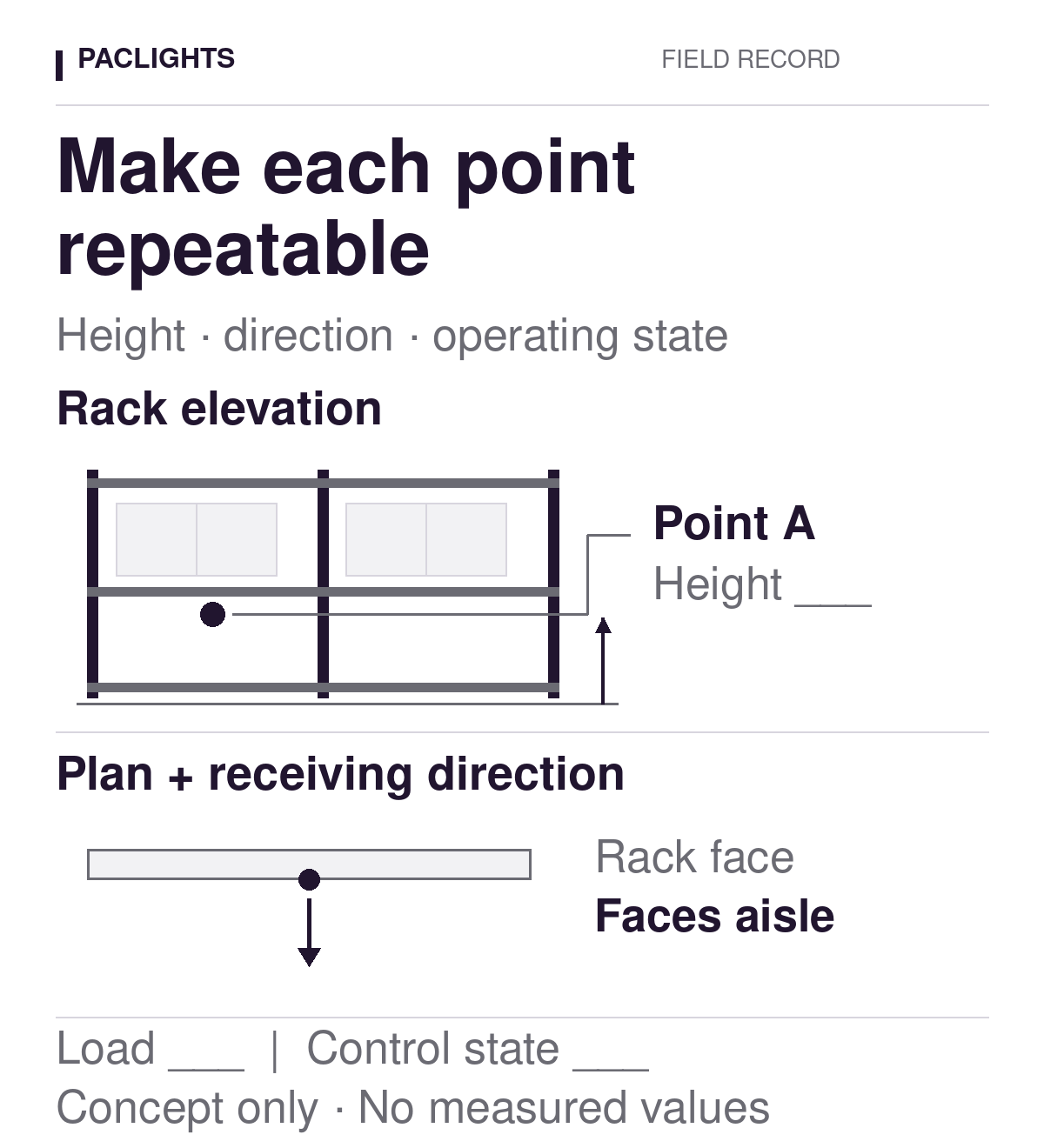
Record orientation separately from viewing direction
For a vertical rack-face observation, the meter’s receiving plane represents the specified vertical surface. Record which way it faces, using an unambiguous drawing direction or named aisle side. Merely writing “vertical” leaves two opposite-facing surfaces indistinguishable. Follow the instrument instructions and the agreed method for positioning the sensor; do not turn it toward a nearby luminaire simply to obtain a higher reading.
The worker’s viewing direction is a separate field. Someone may read a label obliquely while approaching along the aisle, whereas the label’s surface remains fixed. Record that viewing context when investigating a reported difficulty. A meter oriented toward the observer is not automatically measuring illuminance on the label plane. Keep a photograph or sketch of the orientation with the observation so later reviewers can identify the distinction.
Record the meter identity, units and relevant calibration information. Retain the original readings and their units in the log. If a later report converts lux to foot-candles or vice versa, label the converted field and preserve the source values so the comparison can be checked. Use an instrument suitable for the task and follow its operating procedure, including any required preparation or stabilization. Document limitations rather than treating an unverified phone reading as an acceptance measurement. Arrange access under the facility’s normal safety procedures; this checklist is not an instruction to enter an active vehicle route or climb storage racks.
Describe the load and the lighting state
A rack drawing does not describe every obstruction present during a visit. Record whether the bay is empty, partly loaded or loaded as normally operated. Note projecting cartons, solid shelf decks, pallet positions and other obstructions relevant to the point. If the question concerns a permitted maximum load envelope, distinguish that documented envelope from the load actually observed.
Do not move stock or alter operations solely to improve the result. Where an authorized comparison of two load conditions is useful, retain separate observation sets and describe the difference. An empty-bay reading cannot establish the light reaching a recessed position when cartons block its path. Our rack-change lighting review checklist explains when altered rack geometry calls for a wider layout assessment.
Record the operating mode at the time of each set: occupied, standby, scheduled scene or an authorized test condition. Identify the relevant control group and known output setting. Note daylight conditions, open doors or skylight contribution where they affect the observation. If a sensor changes the lighting during the measurement, flag that change and repeat under a documented stable condition when permitted. Do not combine readings from different states without identifying them.
Keep floor results and rack-face results distinct
Use separate fields or clearly labeled sheets for horizontal floor points, vertical rack faces and other task surfaces. Retain the original point identifiers, units and conditions with each result. A summary that mixes these surfaces into one aisle average removes the information the reviewer needs to interpret it.
Keep calculated and measured results distinct too. If comparing with a photometric report, confirm the matching coordinates, plane height, direction, fixture configuration, obstruction assumptions and operating state. Identify whether the calculation is initial or maintained. A difference between a calculation and a site observation is a question to investigate, not immediate proof that a fixture is defective.
For broader context on fixture positioning and functional zones, see the warehouse lighting layout guide. Base the present measurement assignment on its own agreed criteria and method. General spacing examples and broad lighting ranges cannot replace the project’s defined surfaces and conditions.
Send an observation package that supports a decision
Give the reviewer the marked plan and elevation, point-by-point observations, instrument details, condition notes and unresolved access limitations. Attach the current fixture and control schedule. The PacLights FLHE linear high-bay family lists optional aisle optics and control options; the family name alone does not identify which configuration is installed. Confirm the actual variant and setting before attributing a result to its distribution.
State the decision you need: clarifying a reported label-reading difficulty, checking defined acceptance points, or deciding whether a revised layout needs further design work. Assign an owner to missing information and identify what must be repeated under different conditions. Bring that record, the relevant drawings and the verified equipment schedule to PacLights for a project discussion. The useful outcome is a traceable assessment of the actual task, with remaining uncertainties visible.
Disclaimer: PacLights is not responsible for any actions taken based on the suggestions and information provided in this article, and readers should consult local building and electrical codes for proper guidance.