

Most datacenter managers underestimate how much lighting affects both operational costs and equipment reliability. Getting datacenter ambient lighting levels right isn’t optional-it directly impacts your bottom line and facility performance.
At PacLights, we’ve seen facilities waste thousands annually on improper lighting while simultaneously compromising visibility and safety. This guide covers the standards, optimal levels, and practical solutions that actually work.
Lighting Standards and Compliance Requirements
NFPA 101 and Emergency Egress Mandates
Datacenters operate under a complex web of safety and energy regulations that most facility managers only partially understand. NFPA 101, the Life Safety Code, mandates minimum lighting levels along all egress paths: an average of 1 foot-candle during normal operations and 0.6 foot-candles under emergency power, with no point dropping below 0.1 foot-candles.
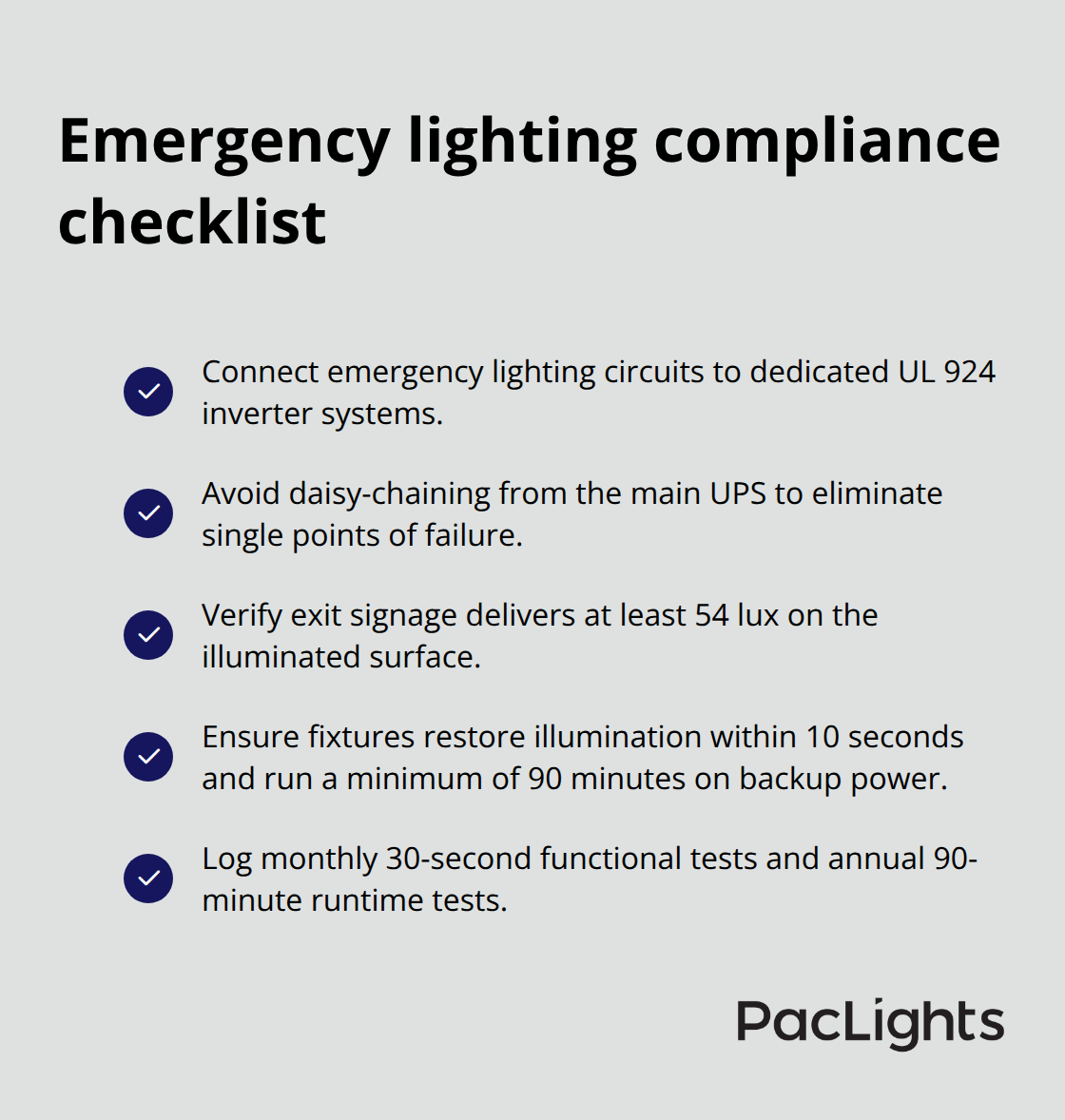
OSHA standards 1910.37 and 1910.38 reinforce these requirements, while UL 924 governs emergency lighting equipment itself, requiring fixtures to restore illumination within 10 seconds and operate for a minimum of 90 minutes on backup power. Exit signage must deliver at least 54 lux on the illuminated surface, yet many datacenters have faded or inadequately illuminated exit signs that would fail a rigorous compliance audit.
Your emergency lighting circuits must connect to inverters on dedicated UL 924 systems, not daisy-chained from your main UPS. A single point of failure in your power distribution can leave your entire facility dark when technicians need visibility most. TIA-942 and local building codes add additional layers of requirements, though many datacenter operators treat compliance as a checkbox rather than an opportunity to improve operations.
Maintenance Zone Illumination Requirements
Active maintenance zones require 400–500 lux to enable detailed work on server cabinets and cable management without eye strain or errors. General datacenter aisles should maintain 200–300 lux during normal operations, while vacant spaces can operate at 100–150 lux to conserve energy. Many facilities apply uniform lighting across all zones, which either wastes energy in rarely occupied corridors or leaves maintenance areas dangerously dim.
NFPA 101 also requires monthly 30-second functional tests and annual 90-minute runtime tests of emergency lighting, with documented logs to prove compliance. Self-diagnostic LED fixtures flag failures before they become safety issues, but only if you monitor them actively.
Preventing Compliance Gaps Through Professional Assessment
A qualified lighting designer uses 3D room renders to visualize distribution and prevent dark spots before installation begins. Most facilities discover they either overspend on energy while undershooting visibility, or undershoot compliance while wasting money on unnecessary illumination. The gap between minimum compliance and optimal performance is where real savings and safety gains emerge-and identifying that gap requires a professional assessment tailored to your specific layout and operational patterns.
Optimal Ambient Lighting Levels for Datacenters
Matching Illumination to Work Demands Across Zones
The mistake most datacenter operators make is treating lighting as a one-size-fits-all problem. You don’t need 400 lux everywhere, and lighting every corner at maintenance-level brightness wastes thousands annually on energy and cooling. The real strategy matches illumination to actual work demands across distinct zones. Maintenance areas where technicians perform detailed cabinet work, cable termination, and equipment swaps require 400–500 lux to prevent errors and eye strain. General aisles between equipment rows operate efficiently at 200–300 lux, which provides enough visibility for navigation and routine inspections without unnecessary energy overhead. Vacant corridors and storage areas can drop to 100–150 lux since they see sporadic traffic.
This three-tier approach cuts energy waste compared to uniform lighting while maintaining safety and operational precision. NFPA 101 sets the floor at 1 foot-candle (about 10.8 lux) along egress paths, but that’s survival-level illumination, not operational lighting. Many facilities spend $50,000 annually on lighting and waste 30–40% of that budget by overshooting brightness in low-traffic zones while undershooting it in high-work areas.
How Lighting Impacts Equipment Reliability and Labor Productivity
Lighting directly impacts both equipment reliability and labor productivity, though most managers focus only on compliance. Inadequate ambient lighting in maintenance zones reduces task accuracy by up to 15% according to occupational lighting research, meaning technicians misread port labels, plug cables into wrong interfaces, and trigger equipment failures that cost far more than proper illumination ever would. Conversely, excessive brightness creates glare on control panels and monitoring screens, degrading visibility for the very tasks you’re trying to support.
The balance point sits at 400–500 lux in active maintenance areas with color temperature around 5000K to boost alertness for precise work. Proper lighting prevents costly mistakes that ripple through your entire operation.
Energy and Cooling Load Reductions from Strategic Lighting
Lighting affects cooling loads significantly. Datacenter cooling typically accounts for 30–40% of total facility energy consumption, and traditional fluorescent or incandescent fixtures generate substantial heat that cooling systems must remove. LEDs cut lighting energy use by roughly 75% compared to legacy fixtures and produce far less heat, which reduces cooling demand by approximately 5–10% when combined with strategic fixture placement.
A mid-sized datacenter spending $50,000 annually on lighting can recover $20,000–$30,000 in year-one savings from LEDs alone, plus an additional $8,000–$15,000 in cooling cost reductions. Over ten years, that compounds to $100,000+ in recovered costs while extending fixture lifespans to 50,000+ hours. Professional lighting layout assessments map your actual work patterns and identify which zones truly need high illumination versus which are oversupplied, revealing where your facility loses money and performance simultaneously.
Implementing Efficient Datacenter Lighting Solutions
Choosing the Right LED Fixtures for Your Datacenter Layout
LED retrofit projects in existing datacenters fail most often because facility managers treat them as simple bulb swaps rather than strategic infrastructure upgrades. The reality is that retrofitting requires selecting between high bay fixtures for tall spaces with wide aisles or linear fixtures for narrow aisles and lower ceilings, then positioning them directly above open aisles between equipment rows to prevent shadows on cables and ports. A typical 24/7 datacenter spending $50,000 annually on lighting can reduce costs by $20,000–$30,000 in the first month alone through LED conversion, according to Energy Innovation research, because LED fixtures cut energy consumption by roughly 75% compared to traditional fluorescent or incandescent systems. That savings compounds when you factor in cooling load reductions of 5–10%, which translates to an additional $8,000–$15,000 annually in cooling cost reductions for mid-sized facilities. The payback period for a complete LED retrofit typically falls between 18–24 months, after which you operate at dramatically reduced energy costs while LEDs retain at least 70% of initial brightness after 50,000 hours of operation.
Many datacenters install uniform fixture types across all zones instead of matching fixture types to actual spatial constraints, which either wastes money on oversized high bays in tight corridors or leaves maintenance areas inadequately lit with undersized linear strips. Professional lighting layout designs that visualize your specific aisle widths, ceiling heights, and work patterns prevent these costly errors before installation begins.
Deploying Motion Sensors and Daylight Controls
Motion sensors and daylight harvesting controls transform energy savings from one-time LED benefits into compounding monthly reductions. Motion sensors reduce lighting energy use by 20–35% in most datacenters because they dim or turn off lights in empty aisles and trigger full brightness within seconds when technicians enter, with optimal settings dimming after 10–15 minutes of no movement rather than immediate shutoff. Daylight harvesting with photoelectric sensors can cut daytime lighting energy use by 30–50%, with southern regions typically seeing larger gains if your facility has skylights or large windows.
The mistake most facilities make is installing sensors without networked controls, which leaves technicians manually adjusting settings and negates sensor benefits. Networked lighting controls coordinate motion sensors, daylight sensors, and manual overrides across the entire facility and integrate with your building management system to optimize both lighting and HVAC simultaneously.
Calculating ROI and Implementation Costs
A mid-sized datacenter typically invests $8,000–$20,000 in networked controls installation, recovering that investment within 2–3 years through compounded energy savings. When you combine LEDs with motion sensors and daylight harvesting, total energy reductions approach 40–50%, meaning a facility starting with a $50,000 annual lighting budget can realistically target $20,000–$25,000 in total annual savings.
PacLights offers free lighting layout designs and ROI assessments that identify which fixtures, sensor placements, and control strategies deliver maximum returns for your specific facility layout and operational patterns.
Final Thoughts
Datacenter ambient lighting levels directly determine whether your facility operates efficiently or wastes thousands annually through poor energy management and preventable equipment failures. The standards establish minimum compliance thresholds, but optimal performance requires matching illumination to actual work demands across distinct zones-maintenance areas at 400–500 lux, general aisles at 200–300 lux, and vacant spaces at 100–150 lux. This tiered approach prevents the common mistake of uniform lighting that either wastes energy or compromises safety and operational accuracy.
The financial case proves compelling for most facilities. A mid-sized datacenter spending $50,000 annually on lighting recovers $20,000–$30,000 in year-one savings through LED conversion, plus an additional $8,000–$15,000 in cooling cost reductions (since lighting typically contributes 15–20% of datacenter cooling loads). Motion sensors and daylight harvesting push total energy reductions toward 40–50%, meaning your facility captures savings month after month without additional capital investment beyond the initial retrofit.
Professional assessment tailored to your specific layout and operational patterns separates successful retrofits from failed projects. Generic lighting solutions fail because they ignore your actual aisle widths, ceiling heights, and work patterns. We at PacLights provide free lighting layout designs and ROI assessments that identify which fixtures, sensor placements, and control strategies deliver maximum returns for your facility.
Disclaimer: PacLights is not responsible for any actions taken based on the suggestions and information provided in this article, and readers should consult local building and electrical codes for proper guidance.