

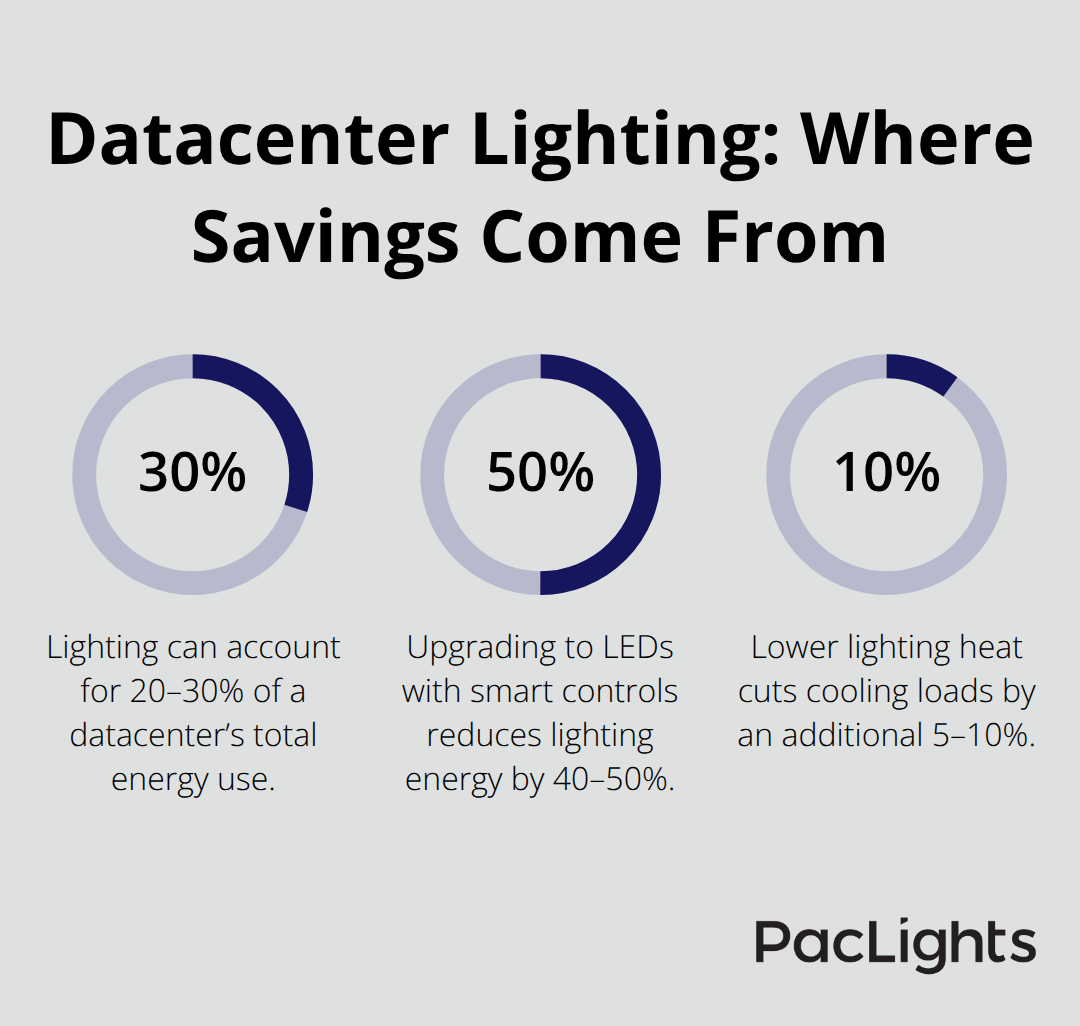
Datacenters consume massive amounts of energy, with lighting often accounting for 20-30% of total facility power usage. At PacLights, we know that implementing the right lighting controls can slash these costs while reducing your environmental footprint.
This datacenter lighting controls guide walks you through everything from basic switches to advanced smart systems, plus the best practices that actually work.
Why Lighting Controls Drive Real Datacenter Savings
Datacenters operate 24/7, which means lighting runs continuously regardless of occupancy. According to the U.S. Department of Energy, lighting typically consumes 20-30% of a datacenter’s total energy budget, but most facilities waste significant portions of that through over-illumination and poor control strategies. A datacenter spending $50,000 annually on lighting can cut that bill by $20,000 to $30,000 per year simply by upgrading to LED fixtures paired with motion sensors and automated dimming. That’s not a one-time savings either-those reductions compound annually. A mid-sized facility running this approach recovers over $100,000 in combined lighting and cooling cost reductions within a decade. The math is straightforward: older fluorescent and HID systems generate excess heat that forces your cooling systems to work harder, while LEDs emit significantly less thermal energy. When you reduce lighting energy consumption by 40-50%, cooling loads drop by an additional 5-10%, adding another $8,000 to $15,000 per year in savings for a typical installation.
Heat Reduction Directly Impacts Your Bottom Line
LED fixtures produce far less waste heat than traditional bulbs, which directly stabilizes datacenter temperatures and extends HVAC equipment lifespan. This is not theoretical-the physics of LED efficiency means lower operating temperatures in your facility, period. Networked lighting controls take this further when you integrate motion sensors and daylight harvesting to eliminate unnecessary illumination. Motion sensors alone cut lighting energy use by 20-35% in typical datacenters, automatically dimming or switching off lights after 10-15 minutes of no movement.
Daylight Harvesting and Motion Sensors Multiply Your Savings
Daylight harvesting reduces daytime lighting costs by 30-50% depending on your location and window orientation. Installation costs for networked controls in a mid-sized facility typically range from $8,000 to $20,000, with payback occurring within 2-3 years. These systems work because they respond to real occupancy patterns rather than fixed schedules, which means your facility only powers lights when and where technicians actually need them.
Sustainability Goals and Regulatory Compliance
Proper lighting controls support your sustainability reporting-LED upgrades with documented energy reductions help meet LEED certification requirements and environmental disclosure goals that increasingly matter to stakeholders and regulators. Your next step involves understanding which control systems actually fit your facility’s layout and operational demands.
Types of Datacenter Lighting Control Systems
Most datacenters start with basic manual switches, then realize too late that this approach wastes thousands annually. Manual controls require technicians to physically flip switches or adjust dimming panels, which means lights stay on in empty aisles for hours after maintenance ends. Facilities with manual-only setups report lighting running at full capacity even during low-occupancy periods like nights and weekends. The fundamental problem is that human behavior remains inconsistent; technicians forget to turn off lights, and no one wants to walk back to a control panel just to dim a fixture. This approach works only in tiny server rooms with a handful of staff who maintain strict discipline. For any datacenter with multiple aisles and rotating maintenance windows, manual controls alone guarantee wasted energy and missed savings.
Motion Sensors Deliver Immediate Payback Without Complexity
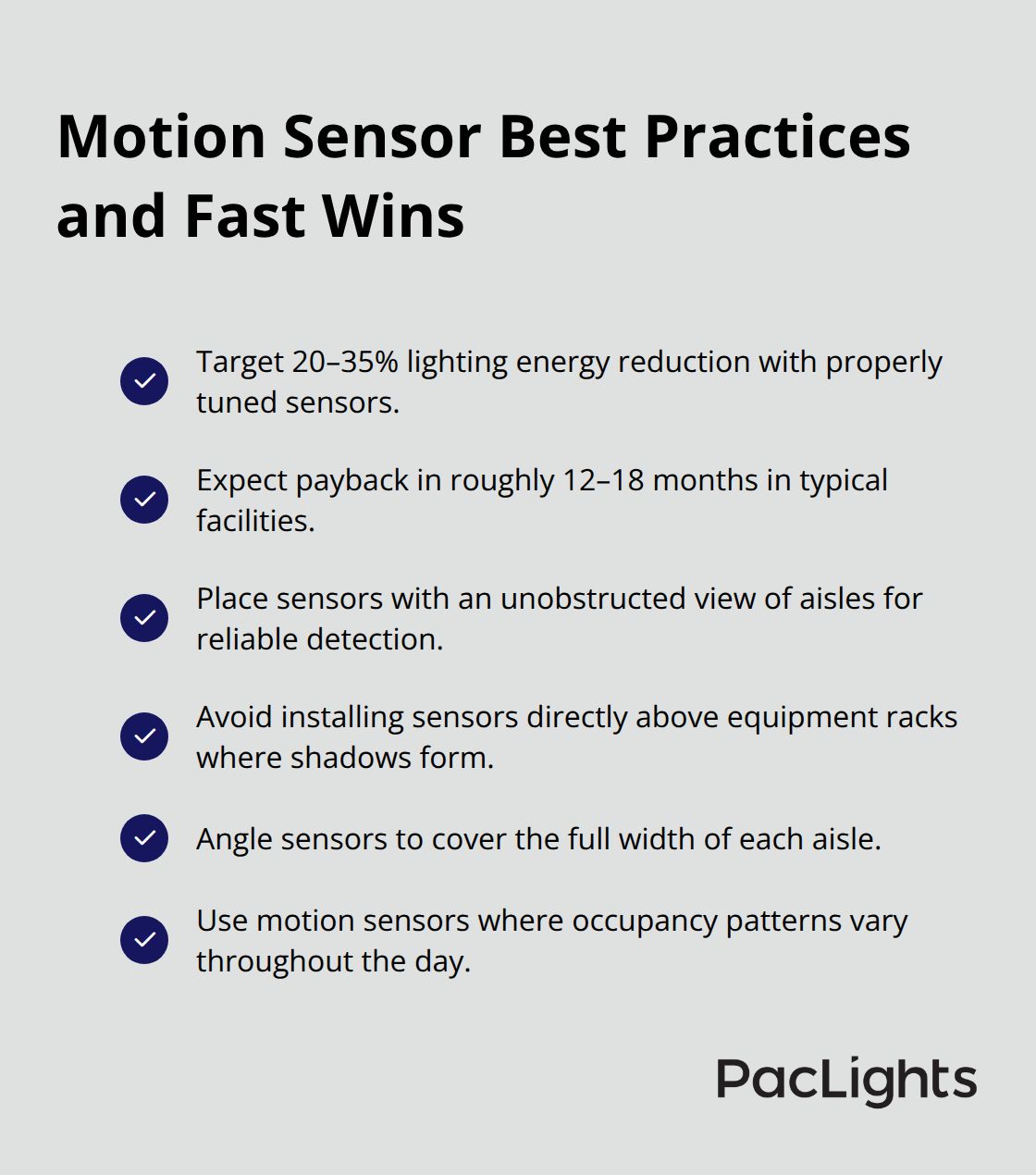
Occupancy sensors represent the simplest upgrade path and work particularly well in datacenters with variable foot traffic. These devices detect movement in aisles and automatically brighten lights to full level, then dim or shut off after 10-15 minutes of inactivity. Installation costs run low because sensors mount directly onto existing fixtures or suspend from ceilings without requiring new wiring infrastructure. A datacenter with 40 aisles might add 80-120 motion sensors for roughly $2,000-$4,000 in hardware, then see payback within 12-18 months through the 20-35% energy reduction that motion sensors typically deliver. The critical detail most facilities overlook is sensor placement-units must have an unobstructed view of aisles and cannot sit directly above equipment racks where shadows block detection. Incorrect positioning causes lights to dim unexpectedly during maintenance, leaving technicians in darkness. Proper installation means mounting sensors at angles that cover the full width of your aisles. Motion sensors work best in datacenters where occupancy patterns vary significantly throughout the day, such as facilities with staggered maintenance schedules or those supporting multiple customer environments.
Networked Controls Scale Across Your Entire Facility
Networked lighting control systems coordinate motion sensors, daylight harvesting, and manual overrides through a central interface that communicates across your entire building or campus. These systems integrate with your building management infrastructure, allowing automated scheduling that aligns lighting with HVAC cycles and planned maintenance windows. Installation costs for mid-sized facilities typically range from $8,000 to $20,000, but payback occurs within 2-3 years because networked controls achieve 40-50% total energy reductions when combined with LED fixtures and strategic fixture placement. The real advantage surfaces when you operate multiple datacenters or facilities across different locations-one control platform manages lighting, energy consumption reporting, and alerts from a single dashboard. Real-time monitoring detects fixture failures before they impact operations, reducing unplanned maintenance downtime. Networked systems also enable energy data collection that supports LEED certification documentation and sustainability reporting. Implementation requires coordination with your electrical team and building automation specialists to ensure proper integration. Networked controls make the most sense for larger operations where you need visibility into energy performance across multiple sites.
Choosing Between Motion Sensors and Networked Systems
Motion sensors offer simplicity and fast payback for facilities with straightforward layouts and predictable occupancy patterns. Networked systems demand more upfront investment but deliver superior control, scalability, and reporting capabilities across complex or multi-site operations. The decision ultimately depends on your facility’s size, occupancy variability, and whether you need centralized energy monitoring across multiple locations. Once you select your control approach, the next critical step involves assessing your current lighting infrastructure and identifying which fixtures and placements will maximize the effectiveness of your chosen control system.
Implementing Lighting Controls That Actually Deliver Results
Conduct a Complete Lighting Audit Before You Buy
Start with a complete lighting audit before purchasing any equipment. Walk your datacenter aisles during different times of day and note which areas receive adequate illumination and which ones sit dark or over-lit. Measure existing lux levels using a smartphone app or handheld meter-most datacenters need 200-300 lux in general areas and 500 lux in server aisles where technicians perform detailed work. Compare these readings against your current energy bills and fixture inventory to establish a baseline. This audit reveals whether your facility over-illuminates certain zones, which wastes thousands annually.
Many datacenters install fixtures designed for warehouse spaces rather than server environments, creating uneven lighting that forces technicians to work in shadows or bright spots. Document your ceiling height, aisle width, and cabinet layout during this assessment because these dimensions directly determine which control system and fixture type will perform best. A facility with narrow aisles and standard 10-foot ceilings requires different solutions than one with 20-foot ceilings and wide equipment rows. Schedule your audit during normal operating hours to capture real occupancy patterns-this data becomes critical when configuring motion sensor sensitivity and dimming thresholds later.
PacLights offers free lighting layout designs and ROI assessments that identify the specific fixtures and control strategies matching your facility’s geometry and energy goals, which accelerates this evaluation process significantly.
Match Control Systems to Your Actual Occupancy Patterns
Align your control selection with actual occupancy patterns rather than theoretical ideals. A datacenter with consistent 24/7 staffing and staggered maintenance windows benefits from motion sensors combined with daylight harvesting, while a facility with concentrated maintenance shifts during business hours needs networked controls that support scheduled dimming routines. Test your chosen system in a single aisle or section before full-scale deployment-this pilot approach reveals sensor placement issues, dimming speed problems, or integration conflicts with your existing infrastructure at minimal cost.
Set motion sensors to dim after 15 minutes of inactivity rather than immediately switching off, which prevents technicians from working in darkness when movement sensors miss subtle motion during cable work. Configure your networked controls to log energy consumption data weekly so you can identify performance trends and spot fixture failures before they cascade into larger problems.
Track Performance Metrics and Adjust Regularly
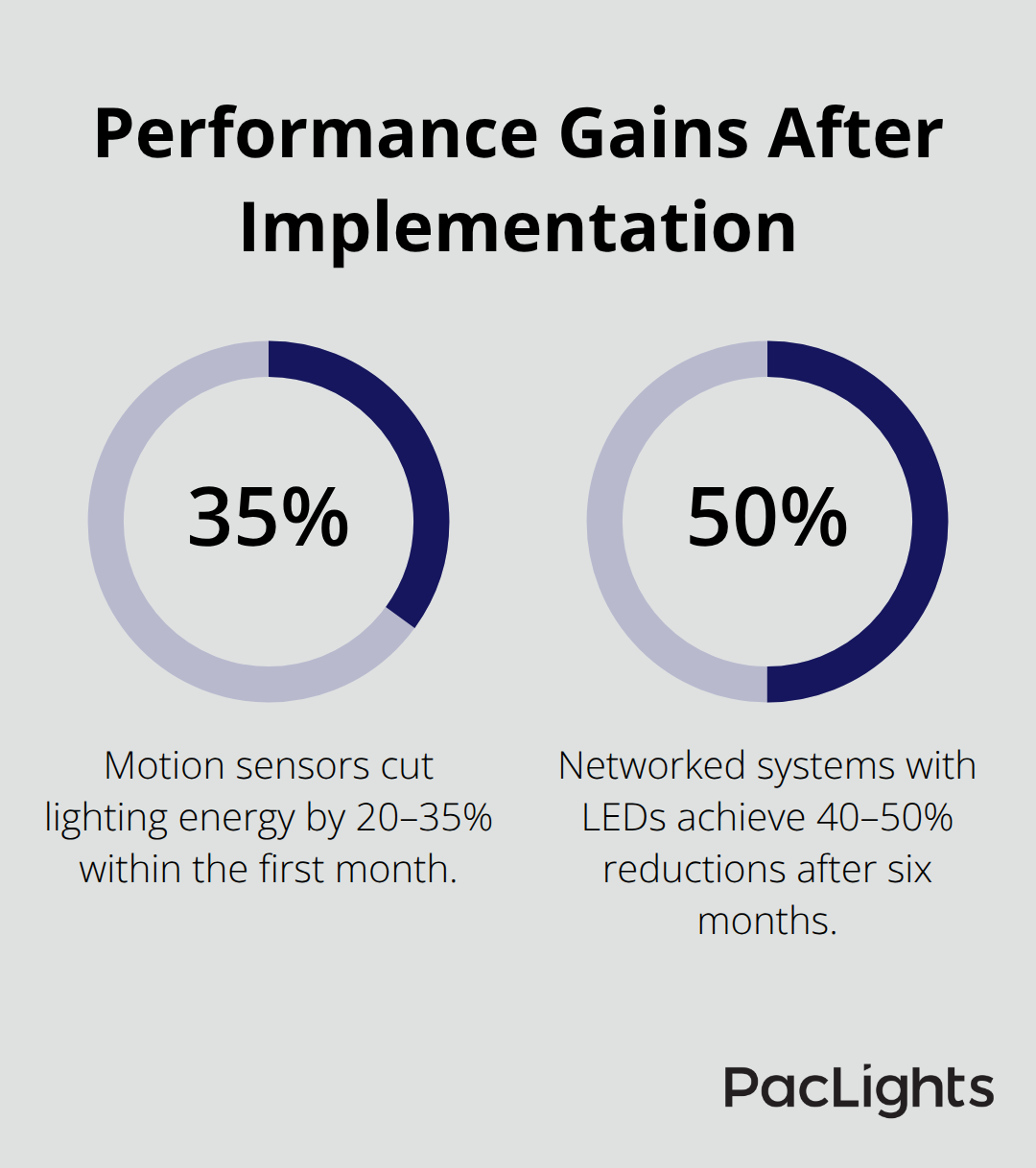
Most facilities see motion sensors reduce lighting energy by 20-35% within the first month, while networked systems paired with LED upgrades achieve 40-50% reductions after six months as staff adjusts to new occupancy patterns and maintenance schedules optimize around system capabilities. Monitor these metrics actively-facilities that set controls and ignore them typically see performance drift within 90 days as technicians override settings or sensors accumulate dust that blocks detection.
Quarterly reviews of energy data against your baseline measurements keep systems performing at design specifications and catch degradation before savings evaporate. This ongoing attention transforms your lighting controls from a one-time installation into a continuously optimized asset that protects your investment and maintains the energy reductions you achieved during implementation.
Final Thoughts
Datacenter lighting controls deliver measurable returns that extend far beyond your first energy bill. The combination of LED fixtures, motion sensors, and networked controls reduces lighting energy consumption by 40–50% while cutting cooling costs by an additional 5–10% annually. A mid-sized facility spending $50,000 yearly on lighting recovers over $100,000 in combined savings within a decade, making this one of the highest-ROI infrastructure upgrades available.
Motion sensors alone deliver 20–35% energy reductions with minimal complexity, while networked systems scale across multiple locations and provide the energy data required for LEED certification and sustainability reporting. Your occupancy patterns determine which approach fits best-concentrated maintenance shifts favor scheduled dimming, while variable staffing benefits from motion-activated systems. Implementation starts with a complete lighting audit that measures existing lux levels and identifies over-illuminated zones, revealing which fixtures and control strategies will maximize performance in your specific facility layout.
We at PacLights understand that every datacenter operates differently, which is why we offer free lighting layout designs and ROI assessments to identify the exact fixtures and controls matching your facility’s geometry and energy goals. Our energy-efficient LED fixtures work seamlessly with motion sensors and advanced networked lighting controls to optimize performance across your entire operation. Visit PacLights to explore how our customizable solutions transform your lighting infrastructure into a continuous cost-reduction asset.
Disclaimer: PacLights is not responsible for any actions taken based on the suggestions and information provided in this article, and readers should consult local building and electrical codes for proper guidance.