

Standard high bay lights fail in harsh environments. Moisture, chemicals, and temperature swings break them down fast.
Vapor tight high bay fixtures are built differently. They seal out contaminants and last years longer, cutting your maintenance headaches and replacement costs. At PacLights, we’ve seen facilities switch to vapor tight fixtures and recover their investment within two years.
What Vapor Tight High Bay Fixtures Actually Are
Vapor tight high bay fixtures are sealed lighting units that keep moisture, dust, and corrosive vapors away from the electrical components inside. Unlike standard high bays that expose their internals to the environment, vapor tight models use gasketed housings rated IP65, IP66, or IP67 to block contaminants entirely. IP65 means dust-tight and water-jet resistant, IP66 handles powerful jets from washdown equipment, and IP67 provides temporary submersion protection. The difference matters in real operations. A standard fixture in a car wash fails within months. A vapor tight fixture rated IP67 operates reliably for years in the same environment because water never reaches the driver, LEDs, or wiring.
Housing Materials Determine Real-World Performance
The housing material you choose determines how long your fixture survives in specific conditions. Fiberglass offers chemical and UV resistance with lighter weight, making it ideal for food processing plants where caustic cleaners and humidity create constant corrosion pressure. Polycarbonate excels in general wet locations requiring impact resistance, such as loading docks where equipment bumps fixtures regularly. Stainless steel delivers maximum corrosion resistance for coastal or marine facilities where salt air accelerates degradation. Aluminum and coated aluminum balance strength with heat dissipation for warehouses and manufacturing floors. Fiberglass dominates high-volume installations due to lower cost and easier handling, but polycarbonate often outperforms it in facilities expecting frequent physical contact with fixtures.
Sealed Lenses and Gaskets Prevent Premature Failure
The lens and gasket system separates fixtures that fail in two years from those lasting ten. Sealed lenses prevent dust and moisture from accumulating inside the optical chamber, which degrades light output and eventually causes internal corrosion. Tool-free latch access for relamping saves hours of downtime when you need to swap tubes or replace components. NSF certification combined with fiberglass housing and IP65 or higher ratings qualifies fixtures for sanitary food environments where cleaning protocols demand both moisture resistance and washdown compatibility.
Match Your IP Rating to Real Exposure Levels
Your facility’s specific exposure determines which combination of materials, IP ratings, and gasket designs prevents failure. A walk-in freezer operates at minus 40°F and high humidity. A pharmaceutical manufacturing plant experiences frequent high-temperature washdowns. A parking garage faces exhaust fumes and moisture. Each demands different protection levels, and oversizing or undersizing your IP rating wastes money or guarantees premature failure. Don’t overspec IP67 for a space that rarely experiences direct washdowns, and don’t underestimate the corrosion risk in coastal environments where NEMA 4X ratings (which address enclosure corrosion resistance) matter as much as IP ratings themselves.
Consider NEMA 4X When Corrosion Risk Exists
IP ratings alone don’t guarantee enclosure longevity in chemically aggressive or coastal environments. NEMA 4X supplements IP ratings by addressing corrosion resistance, protecting the housing itself from salt air, chemical fumes, and other degrading factors. A robust vapor tight solution combines the right IP rating with NEMA 4X when corrosion risk is present. This dual approach ensures that both the internal components and the external enclosure survive harsh conditions without premature deterioration.
Now that you understand what vapor tight fixtures are and how their materials and ratings protect against specific environmental threats, the next step is identifying which industries and applications benefit most from this technology.
Applications and Industries That Benefit Most
Food Processing and Cold Storage Facilities
Food processing facilities operate at temperatures between 32°F and 50°F with constant washdowns using caustic chemicals and high-pressure water jets. Standard high bay fixtures corrode and fail within months in these conditions because moisture penetrates the housing and corrodes electrical components. Vapor tight fixtures rated IP66 or IP67 with fiberglass or stainless steel housings survive these environments for a decade or longer. NSF-certified vapor tight fixtures meet sanitation requirements for food plants, eliminating the need for separate compliance solutions.
Cold storage facilities face similar pressures, with operating temperatures dropping to minus 40°F. Thermal cycling causes standard fixtures to develop micro-cracks in seals, allowing condensation to accumulate inside. Vapor tight fixtures with NEMA 4X ratings and sealed gaskets maintain integrity through extreme temperature swings without performance degradation.
Chemical Plants and Pharmaceutical Manufacturing
Chemical plants and pharmaceutical manufacturers require fixtures that withstand aggressive cleaning protocols and corrosive fumes. High-temperature washdowns at 180°F or higher degrade standard housings rapidly. IP69K-rated vapor tight fixtures handle these extreme washdowns without degradation. Polycarbonate housing resists chemical splash better than aluminum, and tool-free latch designs allow technicians to access internal components for maintenance without dismantling the entire fixture.
Parking Garages and Outdoor Industrial Spaces
Parking garages present different challenges: exhaust fumes, salt spray in coastal areas, and moisture accumulation. Standard fixtures accumulate corrosion on internal components within two to three years, dimming output and creating safety hazards. Vapor tight fixtures with NEMA 4X ratings protect against salt air and exhaust degradation, maintaining consistent light output for eight to ten years.
Outdoor industrial spaces like loading docks and shipping areas experience weather exposure, dust, and occasional equipment impacts. IP65-rated vapor tight fixtures with polycarbonate lenses withstand these conditions while standard fixtures develop water intrusion and lens hazing within eighteen months. The performance gap between vapor tight and standard fixtures becomes undeniable once you examine the actual operating environments where each technology fails or succeeds.
Understanding where vapor tight fixtures excel reveals why energy efficiency and long-term cost savings make them the smarter investment for facilities operating in harsh conditions.
Energy Efficiency and Cost Savings with Vapor Tight Fixtures
LED Technology Slashes Your Electricity Bills
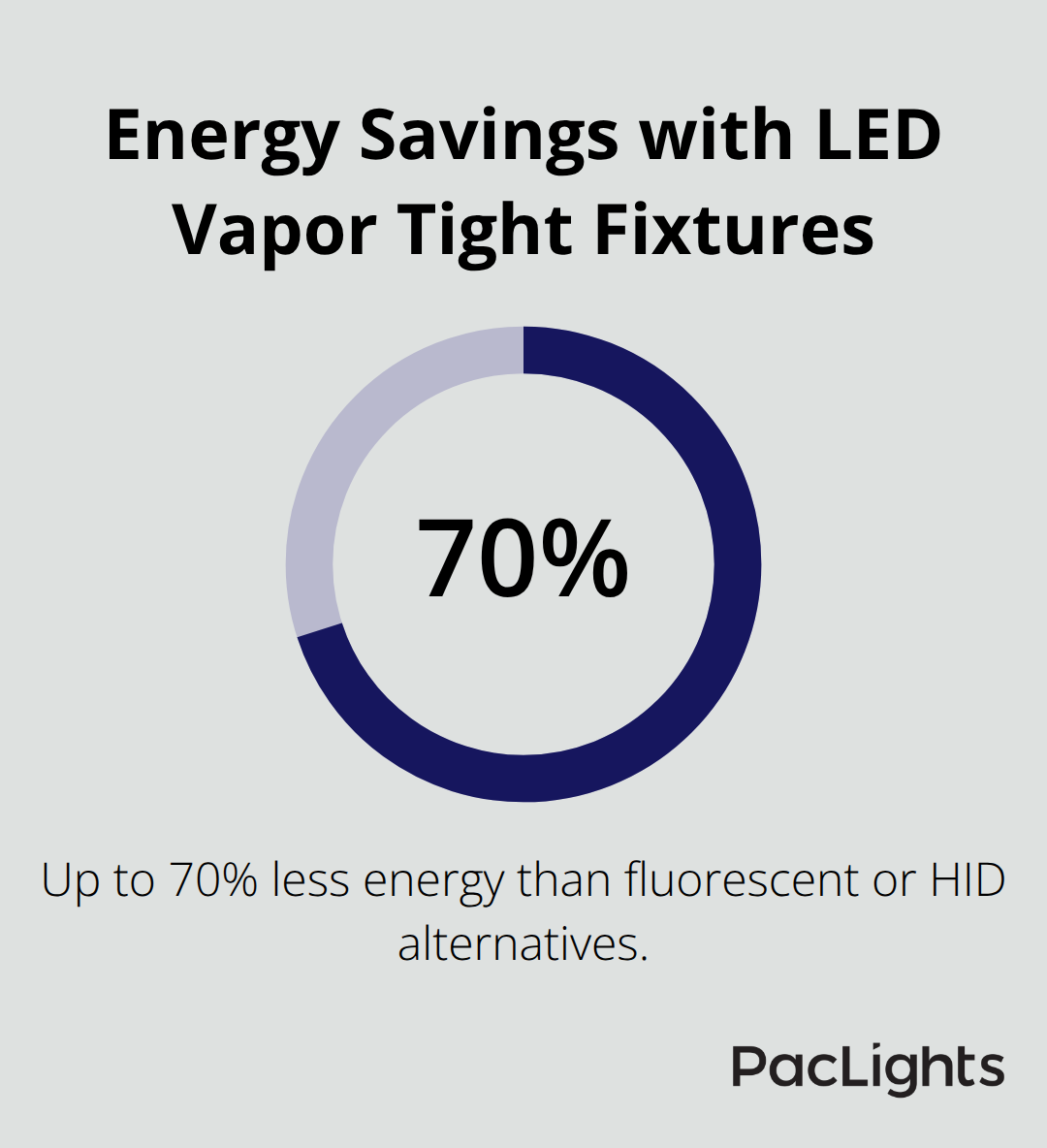
LED vapor tight fixtures cut energy consumption by up to 70% compared with fluorescent or HID alternatives, translating to measurable savings on your electricity bill within the first year. A food processing facility running twelve 250W vapor tight fixtures for sixteen hours daily consumes 48 kilowatt-hours per day, versus 160 kilowatt-hours with equivalent HID fixtures. At an average industrial electricity rate of $0.12 per kilowatt-hour, that facility saves $5,500 annually just on power consumption.
The savings compound over time because LED fixtures maintain consistent lumen output throughout their lifespan, whereas HID and fluorescent fixtures dim progressively. Operators must either accept reduced visibility or replace fixtures prematurely to maintain adequate light levels. This progressive dimming forces unnecessary replacement cycles that drain maintenance budgets in harsh environments.
Long Lifespan Eliminates Replacement Costs
Vapor tight LED fixtures rated at 50,000 hours or longer-with some models exceeding 100,000 hours-eliminate the replacement cycle that drains maintenance budgets. A parking garage that previously replaced standard high bays every two years now replaces vapor tight fixtures once per decade, reducing labor costs and facility downtime significantly.
The lifespan advantage proves itself in real operations. In cold storage facilities operating at minus 40°F, standard fixtures develop seal failures within eighteen to twenty-four months due to thermal cycling. Vapor tight fixtures maintain integrity for eight to ten years because sealed gaskets and NEMA 4X-rated housings resist temperature stress without degradation.
Calculate Your Actual ROI
ROI calculations for vapor tight retrofits depend on three variables: energy savings, maintenance cost reduction, and avoided downtime expenses. A 40,000-square-foot warehouse spending $8,000 annually on high bay replacement and $12,000 on electricity for standard fixtures recovers a vapor tight retrofit investment within eighteen to twenty-four months through combined savings.
Chemical plants and pharmaceutical manufacturers experience faster payback because aggressive washdown environments force them to replace standard fixtures annually or semi-annually. The maintenance cost advantage of vapor tight fixtures becomes substantial in these settings. PacLights offers free ROI assessments and lighting layout designs to help facilities calculate exact payback periods based on their specific operating conditions, energy rates, and maintenance history.
Why Vapor Tight Fixtures Outperform Standard Alternatives
The decision to upgrade addresses both efficiency and durability simultaneously. Vapor tight fixtures deliver superior performance in harsh conditions where standard fixtures fail repeatedly and expensively. Standard fixtures cannot survive the environmental pressures that vapor tight models handle routinely, making the comparison straightforward for any facility operating in moisture, chemical, or temperature-extreme environments.
Final Thoughts
Vapor tight high bay fixtures solve a problem that standard lighting cannot address: reliable operation in environments where moisture, chemicals, and temperature extremes destroy ordinary equipment. Facilities operating in food processing plants, chemical manufacturing, cold storage, parking garages, and outdoor industrial spaces face a choice between repeated fixture failures and investing in technology built to survive these conditions. Energy savings of up to 70% compared with HID alternatives, combined with lifespans reaching 100,000 hours, deliver payback within eighteen to twenty-four months for most facilities.
Selecting the right vapor tight solution requires matching three factors to your specific environment. Determine your actual exposure level and choose an IP rating that fits real conditions rather than worst-case scenarios (IP65 handles most wet locations, IP66 suits high-pressure washdowns, and IP67 covers temporary submersion). Select housing material based on your primary threat: fiberglass for chemical resistance, polycarbonate for impact resistance, stainless steel for maximum corrosion protection, or aluminum for balanced performance. Verify that NEMA 4X ratings protect the enclosure itself when coastal or chemically aggressive environments are present.
We at PacLights provide free lighting layout designs and ROI assessments to help you calculate exact payback periods based on your facility’s specific conditions, energy rates, and maintenance history. Our vapor tight high bay fixtures come with durable construction, extended warranties, and support for advanced lighting controls to optimize energy use further. Contact us to discuss your facility’s lighting challenges and explore solutions tailored to your environment.
Disclaimer: PacLights is not responsible for any actions taken based on the suggestions and information provided in this article, and readers should consult local building and electrical codes for proper guidance.