

Before ranking two warehouse lighting proposals, check that their results describe the same conditions. A report using a different light loss factor may show a different maintained illuminance even when the fixture arrangement is otherwise similar. That difference is a reason to examine the assumptions, not evidence that one proposal needs fewer fixtures or delivers better performance.
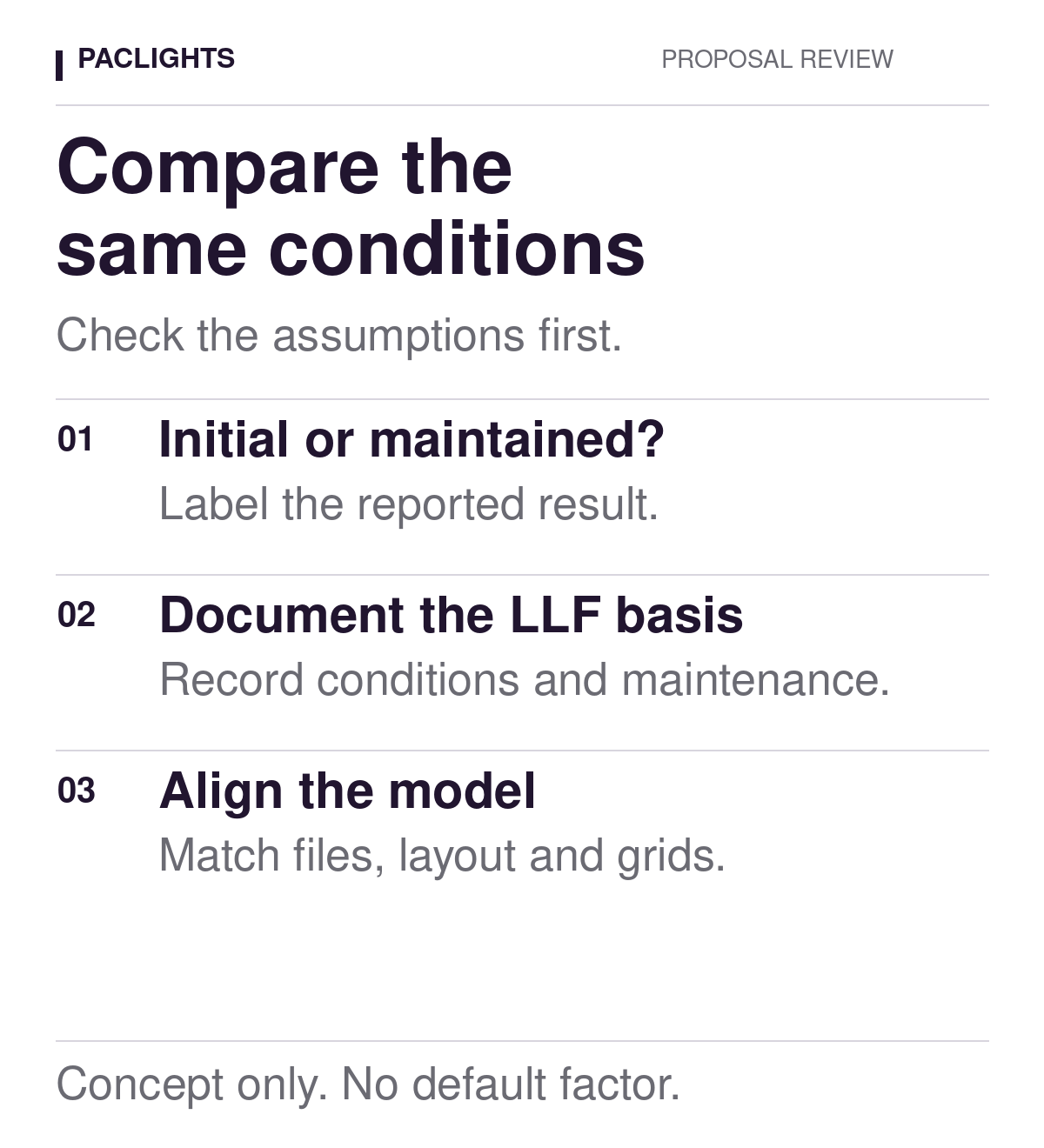
Start with a side-by-side input record. Identify initial and maintained results, the loss-factor basis, the maintenance scenario, the exact photometric files, and the modeled warehouse. Ask the designer to resolve differences before using summary values to support a purchasing decision. Keep the original reports so the comparison remains traceable.
Separate initial results from maintained results
Initial rated output describes a starting reference. Maintained lighting calculations include stated allowances for changes in output or delivery under the conditions represented by the model. The light loss factor, or LLF, expresses an allowance relative to the rated reference. Its components can address initial operating conditions as well as depreciation over time. Read the report definition rather than assuming every factor means aging alone.
Label each result explicitly. A table headed only “average illuminance” leaves an essential question unanswered: is it an initial result or a maintained result, and under which operating condition? Record units, calculation surface, and report revision beside that label. An initial average in one proposal should not be ranked directly against a maintained average in another.
The distinction also affects acceptance. A newly installed system observed under documented conditions is not a measurement of its future maintained condition. Site observations and design predictions have different purposes. Ask the project designer to explain how commissioning observations relate to the specified criteria, including any separate initial and maintained checks.
Request the factor and its basis together
A decimal by itself is an incomplete input. Ask each proposer to state the total LLF, the components used, their sources, and the conditions or time horizon they represent. The explanation should make clear which allowances concern light-source depreciation, luminaire dirt, room surfaces, or other applicable operating variations. Component names and implementation can differ between reports, so compare their meaning rather than their labels alone.
Check whether any adjustment is already represented in the photometric data or elsewhere in the model. Applying the same effect twice can distort a comparison. Conversely, a blank worksheet cell does not establish that a relevant effect was considered. Have the designer identify where each allowance enters the calculation and explain any omission.
Do not replace both proposals’ factors with a convenient common number just to make the tables look comparable. Some differences may be justified by documented equipment or environmental conditions. A useful review distinguishes unsupported differences from legitimate product-specific inputs. Retain the evidence and have the responsible designer determine the comparable calculation basis.
Make the maintenance scenario credible
Ask what operation and maintenance the maintained calculation assumes. Record expected operating hours, the relevant evaluation interval, the anticipated environment, and any cleaning assumptions that support the selected inputs. A clean receiving area and an area exposed to substantial contamination may need different consideration. The actual conditions and product documentation should guide that discussion.
Check whether the proposed maintenance can be performed in the warehouse. Access above active racks, production interruptions, safe work arrangements, and responsibility for cleaning all affect the practicality of a maintenance plan. A schedule written into a calculation note is not evidence that the owner has accepted or funded it.
Keep output maintenance, equipment life, and warranty language separate. A warranty term does not establish the LLF at a particular operating hour. Likewise, a lumen-maintenance statement does not by itself account for every condition affecting light delivered to the task. Request the underlying documentation applicable to the proposed variant and ask the designer how it supports the calculation.
Match the fixture configuration and the warehouse model
Confirm the complete equipment identity: product family, output setting, optical option, orientation, and the photometric file used. A similar family name is not a file-to-fixture match. Where scaling has been applied, ask for its documented basis and limitations. The purchasing schedule and calculation schedule should describe the same intended equipment.
The PacLights FLHE linear high-bay family lists optional aisle optics and control choices. For a proposal comparison, those options are reasons to identify the actual configuration. They do not establish that every installation has the same distribution or that a family-level output statement validates an individual calculation.
Then compare mounting positions, elevations, rack geometry, load obstructions, and surface assumptions. A lower LLF is not a substitute for modeling an obstruction that blocks light from a picking task. Our rack-change lighting review explains why revised racks and task surfaces can require a new evaluation even when existing fixtures remain operational.
Inspect the calculation grids too. Record area boundaries, point spacing, receiving-plane height and direction, exclusions, and summary-statistic definitions. A report covering open floor cannot automatically be compared with one limited to rack aisles. Matching units is necessary, but it does not establish matching tasks or calculation surfaces.
Use a worksheet that exposes unanswered questions
Create one row for each decision-relevant input, with separate columns for proposal A, proposal B, supporting reference, and disposition. Useful rows include result type, total LLF, component basis, maintenance interval, cleaning assumptions, photometric identity, output setting, mounting geometry, rack model, calculation planes, and drawing revision. Use “not stated” for missing information rather than filling in a plausible value.
Add an owner and a resolution date for each clarification. Keep the response with the revised report, particularly when an assumption changes during bidding. A comparison worksheet is most useful when a later reviewer can identify which issue was resolved, which remains uncertain, and which report superseded the original.
For broader terminology, our light loss factor overview introduces the topic. For procurement, use project-specific evidence and the designer’s stated basis rather than adopting an example factor or an unrelated project outcome as the rule for your warehouse.
Request comparable reruns before choosing a winner
Consider an illustrative review with no assumed numerical results: proposal A states maintained values and a cleaning interval, while proposal B reports initial values without a maintenance basis. The correct next step is clarification. It is not a percentage adjustment to the headline average, and it does not establish which fixture count is adequate.
Ask the designer for a comparison that uses agreed common project conditions while preserving justified equipment-specific inputs. Require differences to be identified in the report. If a sensitivity check is useful, label the changed assumption and keep the other inputs consistent. Do not treat that exercise as evidence that the assumed operating condition will occur.
Compare energy and commercial terms separately using verified input power, operating hours, control sequences, installation scope, and maintenance provisions. Maintained illuminance alone cannot establish annual energy consumption, payback, or overall value. Keep glare, task visibility, uniformity, controls behavior, and the applicable project criteria in the review rather than reducing the decision to a single average.
For a PacLights project review, provide both complete proposals, their equipment schedules and photometric files, the current warehouse drawing, task descriptions, and the loss-factor and maintenance notes. Mark the specific discrepancies you need resolved. That gives the team a concrete next step: comparable calculations and a documented basis for the purchasing decision.
Disclaimer: PacLights is not responsible for any actions taken based on the suggestions and information provided in this article, and readers should consult local building and electrical codes for proper guidance.