

NSF certification for lights isn’t optional in certain industries-it’s a requirement that directly impacts your facility’s safety and compliance. At PacLights, we understand that choosing the right lighting means understanding the standards that protect your operations.
This guide walks you through what NSF certification actually means, which facilities need it, and how it protects your bottom line.
What NSF Certification Actually Protects
NSF certification for lighting fixtures means your facility meets the sanitation and safety standards set by NSF International, an independent organization that develops public health standards. When a fixture carries the NSF mark, it has passed rigorous testing-product evaluation, accredited lab testing, on-site manufacturing inspection, and annual plant inspections to maintain compliance. The certification specifically addresses food safety concerns: fixtures must be shatterproof to prevent glass contamination, feature smooth crevice-free exteriors to block bacteria buildup, and withstand high-pressure washdowns without degradation. NSF-certified fixtures use polycarbonate lenses instead of glass, stainless steel hardware, and corrosion-resistant aluminum housings that resist sanitizing chemicals. The IP65 or IP69K ratings on these fixtures indicate they can handle moisture, dust, and aggressive cleaning regimens. This isn’t theoretical-facilities without NSF-certified lighting face real consequences. The FDA Food Code specifies minimum illumination levels: 108 lux in dry storage areas, 215 lux in food prep zones, and 540 lux where staff handle food. Failure to meet NSF standards triggers violations, fixture removal orders, or facility shutdowns until compliance is achieved, costing millions in damages and lost production.
Why Standard Lighting Falls Short
Standard LED fixtures lack the design features that prevent contamination. They may have exposed fasteners, unsealed gaps, or glass components that create harboring spots for bacteria and mold. NSF-certified lighting eliminates these vulnerabilities through hermetically sealed designs and completely smooth surfaces. The difference matters in cold storage environments too-vapor-tight NSF fixtures withstand temperature fluctuations and moisture that would damage conventional lighting. Facilities that cut corners on lighting certification often discover the problem during inspections or when product recalls occur. The cost of a recall far exceeds the investment in proper NSF-certified fixtures.
The Real ROI of NSF Certification
NSF-certified LED fixtures typically last 50,000 to 75,000 hours, roughly 25,000 hours longer than incandescent options, which translates to fewer maintenance interruptions in food processing environments. LED technology delivers up to 80% energy savings compared to traditional metal halide or fluorescent systems. A 100W NSF-certified LED high bay produces approximately 15,000 lumens at 5,000K while saving roughly 60% energy versus a 250W metal halide fixture. The payback period typically ranges from three to five years when accounting for reduced electricity consumption and minimal maintenance labor. Many NSF-certified LED fixtures come with five-year warranties, supporting long-term facility planning. Beyond cost savings, NSF certification simplifies regulatory audits by providing verifiable evidence that your facility meets USDA and FDA requirements, reducing inspection friction and demonstrating commitment to food safety that builds consumer confidence.
Where NSF Certification Matters Most
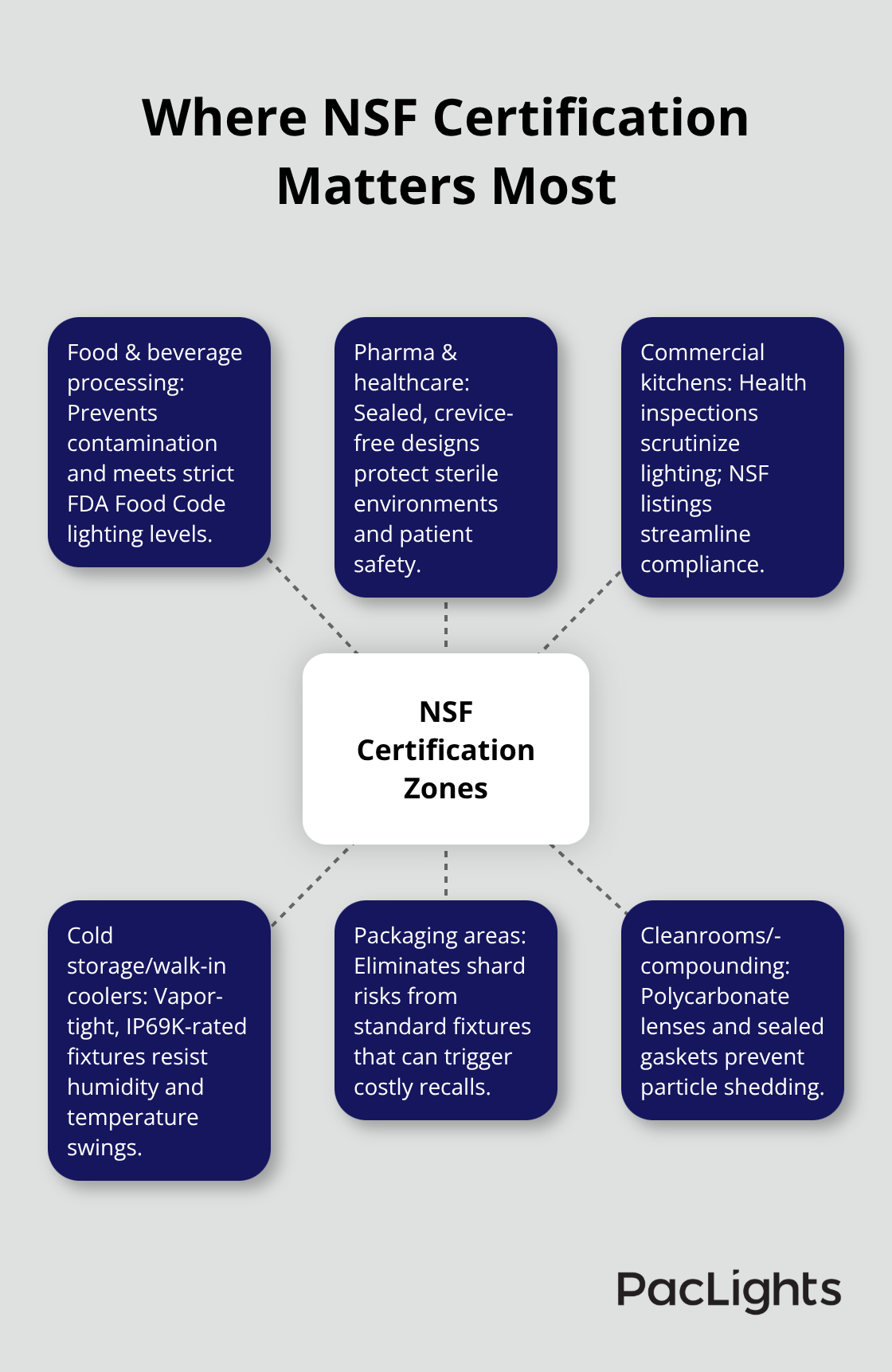
Food processing facilities, pharmaceutical environments, and commercial kitchens all require NSF-certified lighting to operate legally. Walk-in refrigerators, prep areas, and packaging zones each demand specific illumination levels and washdown resistance. Healthcare facilities and laboratories also benefit from NSF-certified fixtures because the same design principles that prevent food contamination prevent bacterial growth in sterile environments. Understanding which zones in your facility require NSF certification helps you allocate resources effectively and avoid costly compliance gaps.
Industries and Applications That Require NSF Certification
Food and Beverage Processing Facilities
Food and beverage processing facilities operate under the strictest lighting requirements in any industry. The FDA Food Code mandates specific illumination levels across three distinct zones: 108 lux in dry storage and walk-in refrigerators, 215 lux in food prep and service areas, and 540 lux in zones where staff directly handle food products. These aren’t suggestions-they’re regulatory minimums. A facility processing meat, dairy, or produce must install NSF-certified fixtures in every zone where contamination could occur.
Walk-in coolers present a particular challenge because temperature fluctuations and high humidity degrade standard fixtures rapidly. NSF vapor-tight fixtures rated IP69K withstand these conditions without condensation buildup that harbors bacteria. In packaging areas, NSF certification becomes non-negotiable because glass or plastic fragments from standard lighting can contaminate products bound for retail shelves, triggering recalls that cost hundreds of thousands of dollars.
Pharmaceutical Manufacturing and Healthcare Environments
Pharmaceutical manufacturing and healthcare environments face equally rigid standards. Cleanrooms, sterile compounding areas, and medication storage zones all require NSF-certified lighting because the same contamination risks that threaten food safety threaten patient safety. A hospital pharmacy preparing IV medications cannot tolerate crevices where bacteria accumulate. NSF-certified fixtures with polycarbonate lenses and sealed gaskets eliminate these harboring spots.
Pharmaceutical labs conducting research or quality control testing also mandate NSF certification to prevent particle contamination that compromises test results. The design principles that protect food products protect sterile environments with equal effectiveness.
Commercial Kitchens and Food Service Operations
Commercial kitchens in restaurants, catering operations, and institutional food service differ from processing facilities only in scale, not in regulatory requirements. The FDA Food Code applies equally to a restaurant kitchen as to a frozen food manufacturer. A 200-seat restaurant serving lunch and dinner operates under the same 540 lux requirement in food prep zones as a large industrial facility.
Many restaurant owners underestimate this requirement and install standard LED fixtures, only to face violations during health inspections. Health departments increasingly scrutinize lighting during inspections because contamination failures directly threaten public health. NSF-certified fixtures demonstrate compliance immediately and eliminate negotiation during audits.
Understanding Zone-Specific Requirements
The practical reality is that NSF certification isn’t industry-specific-it’s zone-specific. Any facility where food, pharmaceuticals, or sterile products are handled, stored, or prepared requires NSF-certified lighting in those specific zones. A manufacturing plant might need NSF certification in the production floor but standard lighting in administrative offices. Understanding your facility’s zones prevents overspecification in low-risk areas and ensures you don’t cut corners in high-risk zones.
Many facility managers request NSF-certified fixtures across entire facilities to simplify procurement and standardize maintenance protocols, even in areas where the FDA doesn’t explicitly require it. This approach reduces complexity and ensures consistent quality standards throughout operations. Once you identify which zones demand NSF certification, the next step involves selecting fixtures that match your specific environmental conditions and performance requirements.
Why NSF-Certified Lighting Protects Your Facility’s Operations and Bottom Line
Compliance Prevents Operational Shutdowns
NSF certification directly prevents the regulatory violations that shut down operations. When a health inspector arrives at your facility, they check three things: illumination levels, fixture condition, and certification status. A facility without NSF-certified lighting fails immediately, regardless of how clean the space appears. The FDA Food Code requires 540 lux in food handling zones, and standard fixtures cannot deliver this while meeting sanitation standards. Violations result in fixture removal orders that force operational shutdowns until compliant lighting is installed. Facilities that maintain NSF-certified lighting systems pass inspections faster and avoid costly remediation orders. The upfront cost difference between standard LED and NSF-certified LED is typically 20-30% higher, but that investment protects against shutdown risk.
Pharmaceutical facilities face even stricter scrutiny. A cleanroom contamination incident traced to lighting can trigger FDA inspections, product holds, and mandatory recalls. NSF-certified fixtures eliminate this exposure because their sealed, crevice-free design prevents particle shedding. Healthcare facilities particularly benefit because the same polycarbonate lenses and stainless steel hardware that protect food also protect sterile environments. NSF certification demonstrates compliance during audits without requiring inspectors to question your fixture selections. This reduces inspection time and builds regulatory confidence in your facility’s operations.
Energy Savings and Longevity Drive Financial Returns
NSF-certified LED fixtures deliver 50,000 to 75,000 hours of operational life compared to 15,000 to 25,000 hours for standard LEDs in harsh environments. This longevity matters in food processing because maintenance interruptions cost money. A 100W NSF-certified high bay delivers 15,000 lumens while consuming 60% less energy than a 250W metal halide fixture. For a facility operating 16 hours daily, this translates to approximately 5,840 kilowatt-hours saved annually per fixture. At typical industrial electricity rates of $0.12 per kilowatt-hour, that represents $700 per fixture yearly.
A mid-size food processing facility with 50 high bays saves $35,000 annually in electricity alone. The payback period typically ranges from three to five years when accounting for reduced maintenance labor and eliminated lamp replacement cycles. Many NSF-certified fixtures carry five-year warranties, providing cost certainty for facility planning.
Contamination Prevention Justifies the Investment
Beyond direct energy savings, NSF certification reduces contamination-related losses. A product recall costs between $100,000 and $10 million depending on product type and distribution scope. Preventing even one recall justifies the entire lighting upgrade investment across most facilities.
Final Thoughts
NSF certification for lights protects your facility from contamination, regulatory violations, and operational shutdowns that cost millions in damages and lost production. The investment in NSF-certified fixtures pays for itself through energy savings, extended equipment life, and eliminated recall risks-a facility operating 50 high bays saves approximately $35,000 annually in electricity costs alone, with payback periods typically ranging from three to five years. Beyond financial returns, NSF-certified lighting demonstrates compliance during health inspections and regulatory audits, reducing friction with agencies and building consumer confidence in your products.
Start by mapping your facility zones and documenting current illumination levels against FDA Food Code minimums: 108 lux in dry storage, 215 lux in prep areas, and 540 lux where staff handle food. Assess your washdown intensity and temperature requirements to determine whether IP65 or IP69K ratings are necessary, and verify that any fixture you consider carries formal NSF listing numbers in NSF International’s certified products database before ordering. Vapor-tight fixtures work best in cold storage environments where temperature fluctuations and moisture create challenges for standard lighting.
We at PacLights offer NSF-certified fixtures across high bays, linear strips, vapor-tight options, and specialty applications tailored to your specific needs. Our team provides free lighting layout designs and ROI assessments to help you identify which zones require NSF certification and calculate your expected energy savings. Contact us to discuss your facility’s lighting requirements and receive a customized quote that accounts for your zone-specific needs and long-term operational goals.
Disclaimer: PacLights is not responsible for any actions taken based on the suggestions and information provided in this article, and readers should consult local building and electrical codes for proper guidance.