

Picking the wrong lighting fixture for a regulated facility can cost you thousands in compliance fines and operational disruptions. NSF certified fixtures aren’t just another checkbox-they’re built to meet strict sanitation, durability, and safety standards that matter in food processing, pharmaceuticals, and healthcare.
At PacLights, we’ve seen facilities struggle because they didn’t understand what NSF certification actually means or how to verify it. This NSF certified fixtures guide walks you through exactly what to look for, why it matters, and how to make the right choice for your operation.
What NSF Certification Actually Means
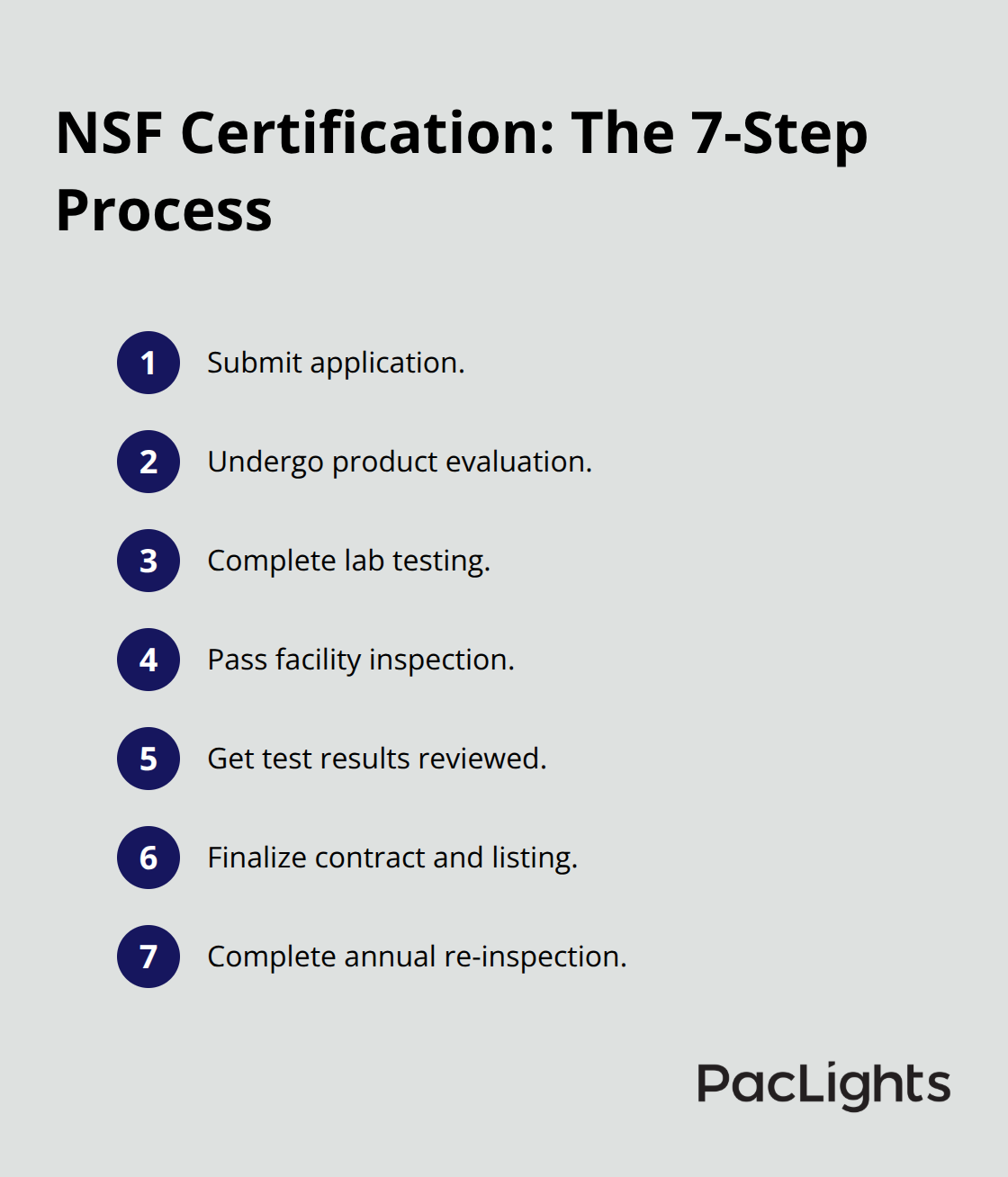
NSF certification isn’t a generic quality stamp. NSF International, an independent third-party organization, tests lighting fixtures against NSF/ANSI 2 standards specifically for food safety and sanitation environments. The certification process involves seven distinct steps: application, product evaluation, lab testing, facility inspection, test results review, contract and listing, then annual re-inspection. This means a fixture carrying the NSF mark has passed rigorous testing and must pass ongoing compliance checks every single year. The NSF database lists over 180 countries that recognize this certification, making it the global standard for food processing, pharmaceutical, and healthcare lighting.
What the NSF Mark Actually Guarantees
When you see the NSF mark on a fixture, you’re looking at proof that it meets strict requirements for shatterproof construction, corrosion resistance, and easy sanitation. Many facilities wrongly assume UL or ETL listing alone covers food safety requirements. It doesn’t. Those certifications verify electrical safety and performance, but NSF certification specifically addresses contamination prevention, which is why FDA and USDA regulations mandate NSF-certified lighting in food zones and splash zones. A fixture can be UL listed and still fail food safety inspection if it lacks NSF certification.
The Specific Standards Fixtures Must Meet
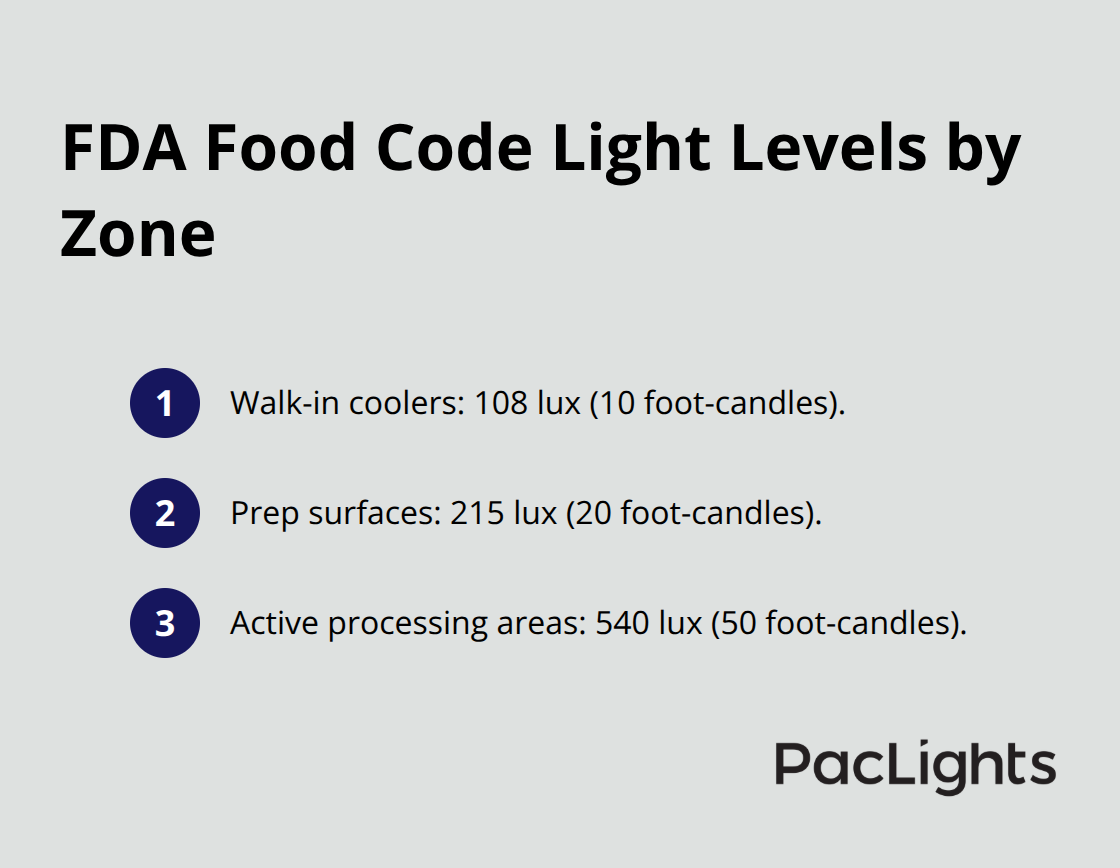
NSF-certified fixtures must deliver adequate light output measured in footcandles for safe food handling. The FDA Food Code specifies three distinct zones with different requirements: walk-in refrigerators and dry storage need at least 108 lux (10 foot-candles) 75 centimeters above the floor during cleaning, surfaces where food is provided or near equipment like reach-ins require at least 215 lux (20 foot-candles), and areas where employees work directly with food or utensils demand at least 540 lux (50 foot-candles). Beyond brightness, NSF standards mandate shatterproof materials like polycarbonate or acrylic lenses to prevent glass contamination. Fixtures must resist dust and water through sealed housings with IP65 or higher ratings, with IP69K preferred for washdown-heavy zones to withstand high-pressure, high-temperature spray. Materials must be corrosion-resistant to handle harsh sanitizers and cleaners. Designs must feature smooth exterior surfaces with zero crevices where bacteria or mold can hide, and no exposed fasteners that could harbor contaminants.
The Real Cost of Non-Compliance
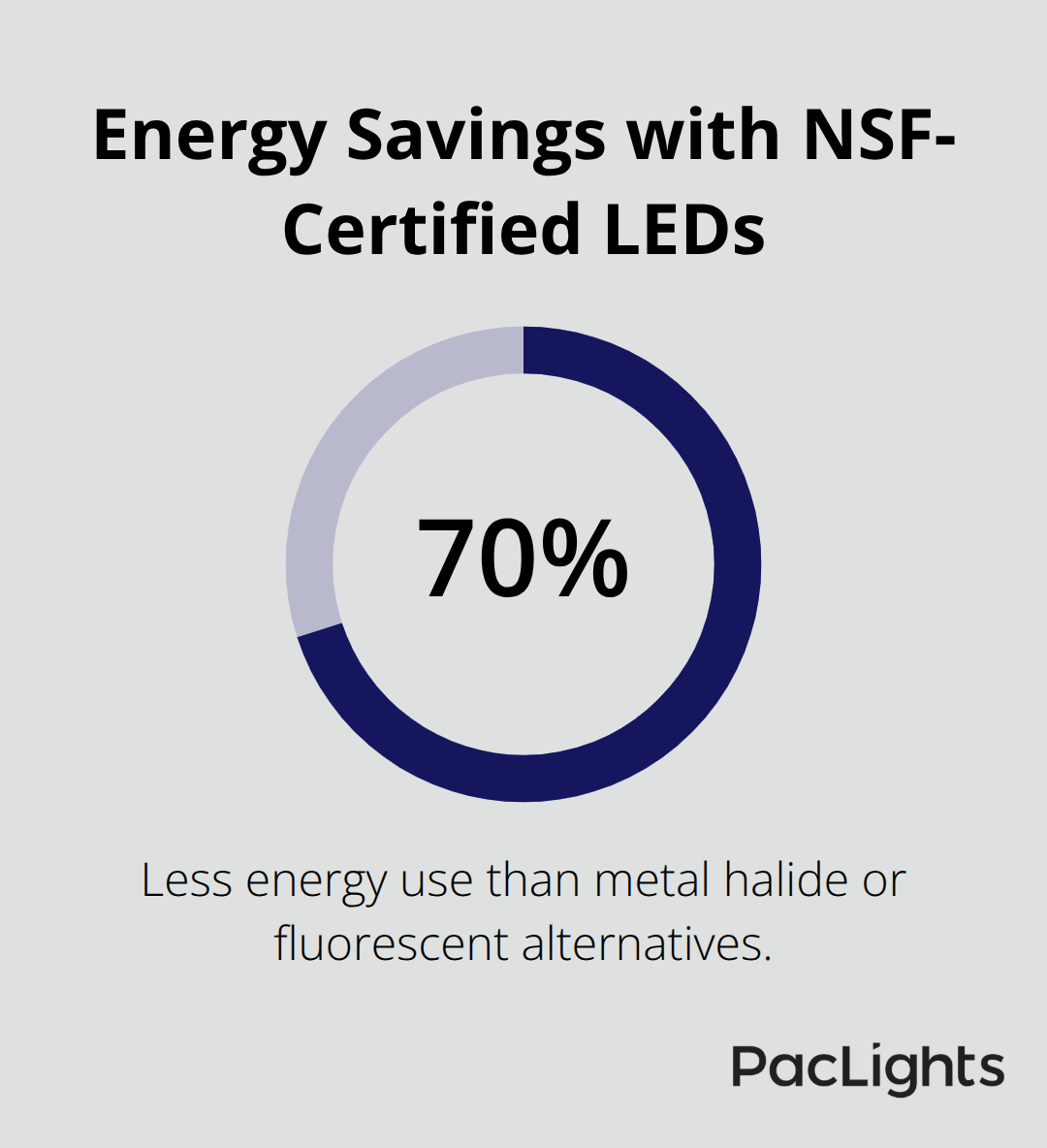
Non-compliance results in regulatory violations, fixture removal, or plant shutdowns until compliance is achieved. NSF-certified LED fixtures typically consume 70 percent less energy than traditional metal halide or fluorescent alternatives, delivering substantial electricity savings over their 50,000 to 75,000 hour lifespan. Most come with five-year warranties, reducing maintenance costs significantly. The smooth, non-porous design of NSF fixtures eliminates crevices that trap debris, making your sanitation schedules faster and more effective.
Facilities that implement NSF-certified lighting report improved processing visibility, easier sanitation with less downtime for cleaning, and higher worker comfort and productivity.
Where NSF Certification Applies Beyond Food
Beyond food processing, NSF-certified lighting is equally important in pharmaceutical labs, cleanrooms, and healthcare facilities where contamination risks are equally severe. The same standards that protect food products protect patients and sensitive pharmaceutical processes. Understanding these specific requirements helps you select fixtures that actually meet your facility’s needs rather than settling for generic industrial lighting that leaves compliance gaps.
What to Actually Check Before Buying NSF Certified Fixtures
NSF certification is the baseline, but the real work happens when you examine what’s behind that mark. You need to verify three specific things on every fixture you consider: the NSF listing itself, the IP rating for your specific zone, and the material construction.
Verify NSF Certification and Zone Requirements
Start by checking the NSF database directly-don’t rely on vendor claims alone. Confirm the fixture carries NSF/ANSI 2 certification, not just ETL listing to NSF Standard 2, which only covers non-food zones. For splash zones where washdowns happen daily, demand IP69K rated fixtures that withstand high-pressure, high-temperature spray. For food zones with direct product contact, look beyond the IP rating and examine the physical construction. Polycarbonate or acrylic lenses prevent shattering, but you also need to verify the housing material resists corrosion from sanitizers like quaternary ammonium compounds and bleach-based cleaners.
Inspect Material Construction and Surface Design
Stainless steel hardware and aluminum housings with protective coatings outperform standard steel that rusts within months of exposure to harsh chemicals. Check that all fasteners are recessed or welded-exposed screws trap bacteria and become maintenance nightmares. The fixture surface must be completely smooth with zero crevices; even small gaps around lens edges or mounting brackets harbor mold and bacteria that contaminate your product.
Calculate Energy Efficiency and Operating Costs
NSF certified LEDs deliver measurable returns on your investment. Standard fixtures with 50,000 hour lifespans at 70 percent lower energy consumption than metal halide alternatives mean you replace bulbs far less often and cut electricity bills substantially. A 150W LED wash down high bay delivering 22,500 lumens costs significantly less to operate than older 400W metal halide units producing similar output.
Match Color Rendering and Temperature to Your Zones
Color rendering matters for product quality-try for CRI Ra80 minimum so your staff accurately evaluates food color and quality during processing. Color temperature options between 3500K and 5000K let you match lighting to different zones; cooler 5000K light works better in processing areas where precision matters, while 4000K suits general work zones.
Review Warranties and Calculate Total Cost of Ownership
Most NSF certified fixtures come with five year warranties covering sealed components, but clarify what’s excluded-some warranties only cover the housing, not the driver or control modules. Request spec sheets showing lux output at different mounting heights because FDA Food Code compliance depends on hitting specific footcandle targets in each zone. A fixture rated for 540 lux at one meter might deliver only 270 lux at two meters, making it unsuitable for high ceiling installations. Calculate your total cost of ownership including installation, electricity over the fixture lifespan, and maintenance labor. A more expensive fixture with sealed connectors and tool-free lens access reduces downtime during sanitation cycles, offsetting the higher upfront cost within two years of operation. These details separate fixtures that merely meet compliance from fixtures that actually perform in your facility’s specific environment.
Where NSF Certified Lighting Actually Gets Used
Food processing facilities face the harshest lighting demands of any industry. USDA and FDA inspectors specifically mandate NSF-certified fixtures in food zones where product contact occurs and splash zones where daily washdowns happen. A 150W LED wash down high bay delivering 22,500 lumens with IP69K rating handles the reality of high-pressure cleaning without fixture degradation. Processing floors with 540 lux (50 foot-candles) requirements demand fixtures that maintain output after years of chemical exposure. Facilities using non-NSF fixtures typically replace them within 18 months due to corrosion and lens degradation, while NSF-certified alternatives operate for 50,000 to 75,000 hours with minimal maintenance.
FDA Food Code Zones Drive Fixture Selection
The FDA Food Code zones create different needs across a single facility: walk-in coolers need 108 lux, prep surfaces need 215 lux, and active processing areas need 540 lux. Selecting the wrong fixture type for each zone creates compliance gaps that inspectors catch immediately.
Strip fixtures work for coolers and storage, but high bays or vapor tight fixtures handle processing floors where moisture and chemical spray remain constant. Each zone demands specific fixture characteristics-coolers tolerate lower lux levels but require sealed construction to prevent condensation damage, while processing areas need maximum light output combined with washdown protection.
Pharmaceutical and Healthcare Applications
Beyond food processing, pharmaceutical manufacturing and laboratory environments require equally rigorous NSF-certified lighting because product contamination carries the same regulatory consequences. Cleanrooms and sterile storage areas cannot tolerate any fixture that harbors bacteria or mold in crevices. The sealed housing and corrosion-resistant materials that protect food products protect pharmaceutical compounds with identical effectiveness. Healthcare facilities use NSF-certified lighting in operating rooms, sterile preparation areas, and equipment storage where infection control standards mirror food safety requirements. A 4-foot vapor tight LED linear fixture delivering 21,600 lumens with selectable wattage and color temperature accommodates both surgical precision lighting and general hospital work zones.
Installation Timing and Cost Impact
The practical difference between facilities that select NSF-certified fixtures intentionally and those that retrofit later comes down to cost and downtime. A facility installing NSF-certified lighting during renovation or expansion pays the upfront cost once and avoids compliance violations for decades. Retrofitting non-compliant fixtures means emergency replacements during active operations, production shutdowns during installation, and staff retraining on new fixture maintenance. Installation timing affects your total cost of ownership significantly-planned upgrades cost far less than emergency compliance corrections.
Verification Steps Before Purchase
Request spec sheets showing actual lux output at your ceiling heights because published lumens ratings do not translate directly to floor-level illumination. Verify NSF certification status in the NSF database rather than accepting vendor claims. Confirm IP ratings match your specific washdown frequency and chemical exposure. The fixtures you select today determine whether your facility passes inspections confidently or scrambles to replace non-compliant lighting under regulatory pressure.
Final Thoughts
NSF certification transforms lighting from a generic utility into a compliance tool that protects your facility, your product, and your bottom line. The rigorous testing process, annual re-inspections, and global recognition across 180 countries mean you avoid regulatory risk when you select NSF-certified fixtures. The real value emerges when you examine what sits behind that mark: shatterproof construction, corrosion-resistant materials, sealed housings that prevent contamination, and energy efficiency that cuts electricity costs by 70 percent compared to older alternatives.
Verifying NSF certification requires three concrete steps. First, check the NSF database directly rather than accepting vendor claims alone. Second, confirm the fixture carries NSF/ANSI 2 certification for your specific zone, not just ETL listing to NSF Standard 2, which covers only non-food areas. Third, request spec sheets showing actual lux output at your ceiling heights, material specifications for corrosion resistance, and warranty details that clarify what components are covered.
Making the right choice means calculating total cost of ownership rather than comparing upfront prices. A sealed fixture with tool-free lens access costs more initially but reduces sanitation downtime and extends operational life to 50,000 to 75,000 hours. FDA Food Code compliance depends on hitting specific footcandle targets in each zone, so verify that your selected fixtures deliver the required lux levels at your actual mounting heights. At PacLights, we offer free lighting layout designs and ROI assessments to help you identify exactly which fixtures match your facility’s zones, workload, and compliance requirements.
Disclaimer: PacLights is not responsible for any actions taken based on the suggestions and information provided in this article, and readers should consult local building and electrical codes for proper guidance.