

Your lighting system is one of the largest operating expenses in any commercial facility. At PacLights, we’ve seen firsthand how NSF certified retrofit lamps cut energy costs while meeting strict compliance standards.
This guide walks you through everything you need to know about upgrading to NSF certified retrofit lamps-from understanding why standards matter to implementing changes that deliver real ROI.
What NSF Certification Actually Means
Understanding NSF/ANSI 2 Certification
NSF/ANSI 2 certification is a third-party safety verification administered by NSF International that confirms lighting fixtures meet strict public health standards for food handling and processing environments. This certification matters because it verifies that fixtures are shatterproof, corrosion-resistant, sealed against contamination, and designed for environments where food safety directly impacts human health. The certification process requires manufacturers to submit products for accredited lab testing, undergo on-site facility inspections, and pass annual retesting to maintain listing status. When you see the NSF mark on a retrofit lamp, you know the product has passed rigorous evaluation across material safety, design integrity, and performance metrics rather than relying on generic industry standards.
Regulatory Consequences of Non-Compliance
Food facilities that operate without NSF-certified lighting face regulatory violations from the FDA and USDA, potential facility shutdowns, and liability exposure that can reach millions of dollars when contamination occurs. The FDA Food Code defines specific light intensity zones for different food-handling activities, with dry food storage areas requiring a minimum of 108 lux at 30 inches above the floor. NSF-certified fixtures meet these exact requirements while also eliminating contamination risks through sealed housings, crevice-free surfaces, and polycarbonate shatterproof lenses that prevent glass fragments from entering food or equipment.
Beyond Food Processing
Facilities beyond food processing also benefit from NSF standards, including healthcare facilities, pharmaceutical labs, and cleanrooms where durability and cleanliness are non-negotiable. These environments demand the same level of protection and reliability that NSF certification provides.
The Retrofit Advantage
The practical advantage of upgrading to NSF-certified retrofit lamps is that you align your facility with recognized standards while reducing installation complexity and cost compared to replacing entire fixture systems. Retrofit lamps fit into existing housings, meaning you preserve electrical infrastructure while gaining compliance and energy efficiency simultaneously. LED retrofit lamps deliver up to 75 percent energy savings versus metal halide fixtures and approximately 50 percent versus fluorescent systems, with typical lifespans reaching 50,000 hours or more.
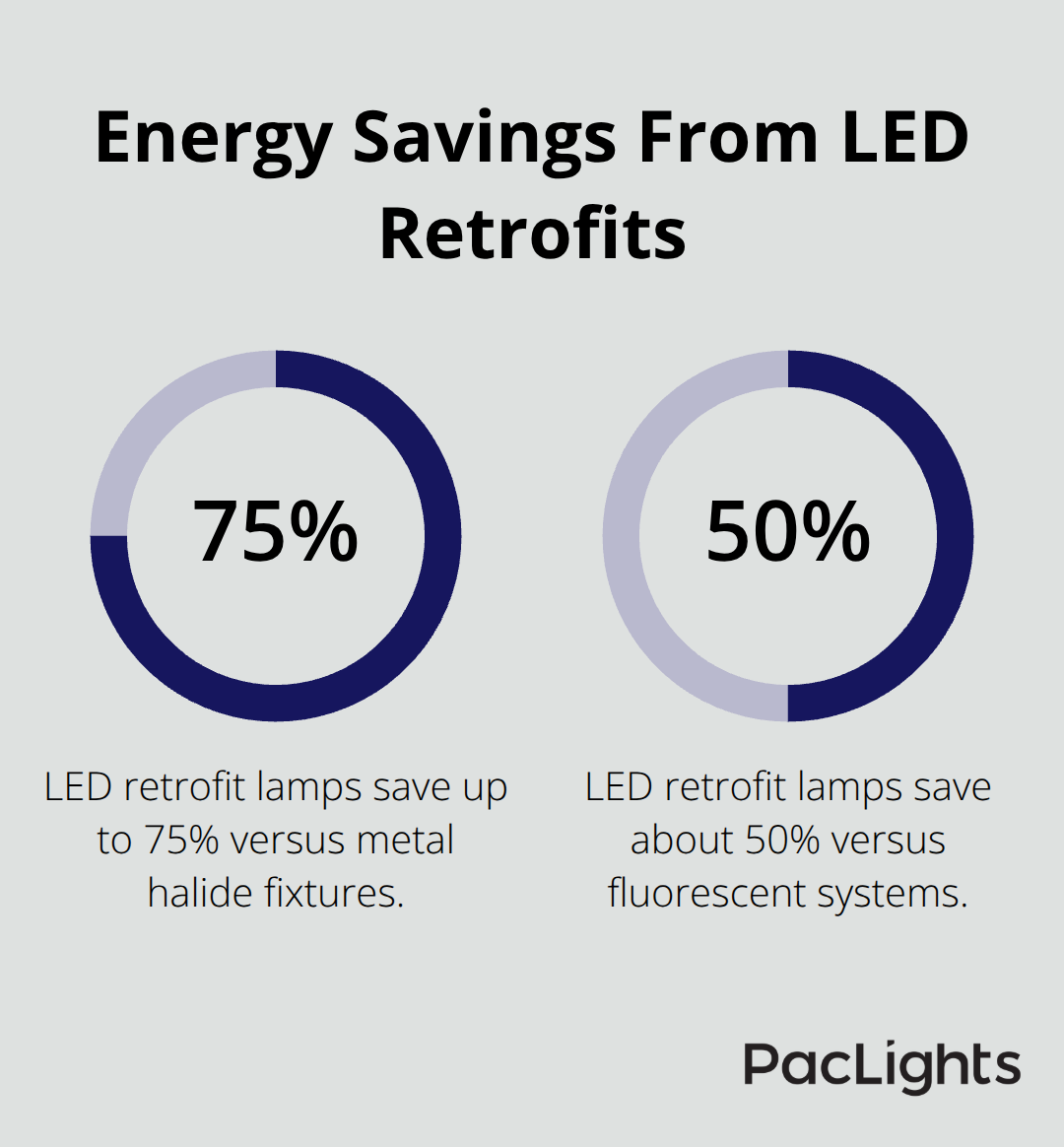
This combination of lower operating costs and compliance certainty makes the upgrade financially rational even before calculating avoided fines and shutdown risk.
Verification and Measurement
When you plan your retrofit project, verify that specific lamp families carry NSF/ANSI 2 listing rather than assuming all LED retrofit products meet food-safety standards, as certification applies to tested product lines only. Light level measurements should be taken at staff working height (typically around 30 inches above the floor) to confirm your upgraded fixtures deliver adequate illumination for the specific zones in your facility. This verification step ensures your retrofit investment aligns with both NSF standards and your facility’s actual operational needs.
What You Actually Gain From NSF Certified Retrofit Lamps
Energy Savings That Hit Your Bottom Line
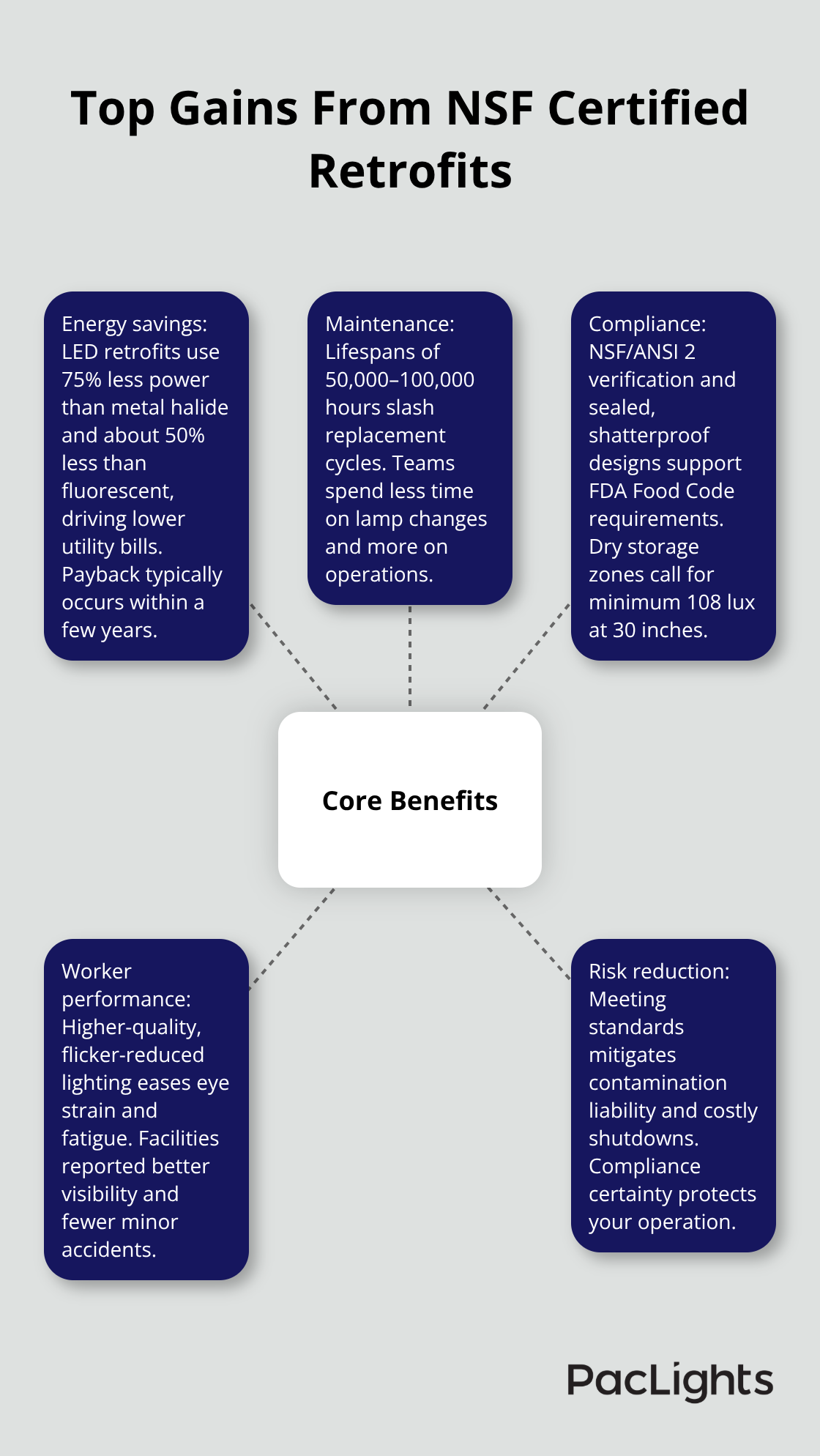
NSF certified retrofit lamps cut energy consumption dramatically because LED technology uses 75 percent less power than metal halide fixtures and 50 percent less than fluorescent systems. This reduction translates directly into lower utility bills month after month, with payback periods typically occurring within a few years depending on usage patterns and installation scope. A warehouse retrofit with electronic ballasts and T8 tubes achieved a 30 percent reduction in energy consumption while improving lighting uniformity across the facility. The financial case strengthens further when you measure the operational improvements that accompany energy savings.
Worker Performance and Reduced Fatigue
Light quality improvements directly impact how your team performs on the job. Educational facilities saw a 40 percent reduction in energy usage after upgrading to high-efficiency T8 tubes with electronic ballasts, and teachers reported improved student engagement and reduced headaches due to higher-quality lighting and reduced flicker. Office retrofits achieved a 25 percent reduction in electricity consumption through occupancy sensors and glare-minimizing diffusers, proving that upgrading lighting quality reduces both operating costs and worker fatigue simultaneously. Workers in the warehouse retrofit reported less eye strain and better visibility, which correlated with fewer minor accidents and higher productivity gains.
Lower Maintenance Costs Over Time
LED retrofit lamps reach 50,000 to 100,000 hour lifespans, meaning you replace lamps far less frequently than traditional systems. This extended lifespan reduces labor and inventory expenses over time, as your maintenance team spends less effort on lamp replacements and more time on facility operations. The sealed designs of NSF certified fixtures also simplify cleaning schedules, further lowering maintenance demands.
Compliance That Protects Your Operation
NSF certified fixtures eliminate the regulatory risk that haunts non-compliant facilities. FDA and USDA violations can force shutdowns costing millions of dollars, but NSF certified retrofit lamps deliver adequate light intensity for food processing zones as defined by the FDA Food Code. Dry food storage areas receive minimum 108 lux at 30 inches above the floor, so your facility meets regulatory requirements without overshooting illumination levels that waste energy. This compliance certainty protects your operation from contamination liability and regulatory enforcement actions.
Measuring Success in Your Facility
When you upgrade to NSF certified retrofit lamps, you gain three measurable wins: lower energy bills, reduced maintenance costs, and regulatory compliance that protects your bottom line. The investment pays for itself while you gain a safer working environment and the confidence that your facility meets recognized standards. Your next step involves assessing your current system to identify which retrofit lamps align with your specific facility layout and operational zones.
How to Plan Your Retrofit Project From Start to Finish
Document Your Current Lighting System
Start with a complete inventory of what you currently have installed. Walk through your facility with a clipboard and photograph each fixture type, noting the wattage, lamp type (metal halide, fluorescent T5/T8, or incandescent), and the area it illuminates. Pay special attention to zones where food handling occurs, as these demand NSF certified fixtures while other areas may not. Count fixtures in each zone because this determines your retrofit scope and budget.
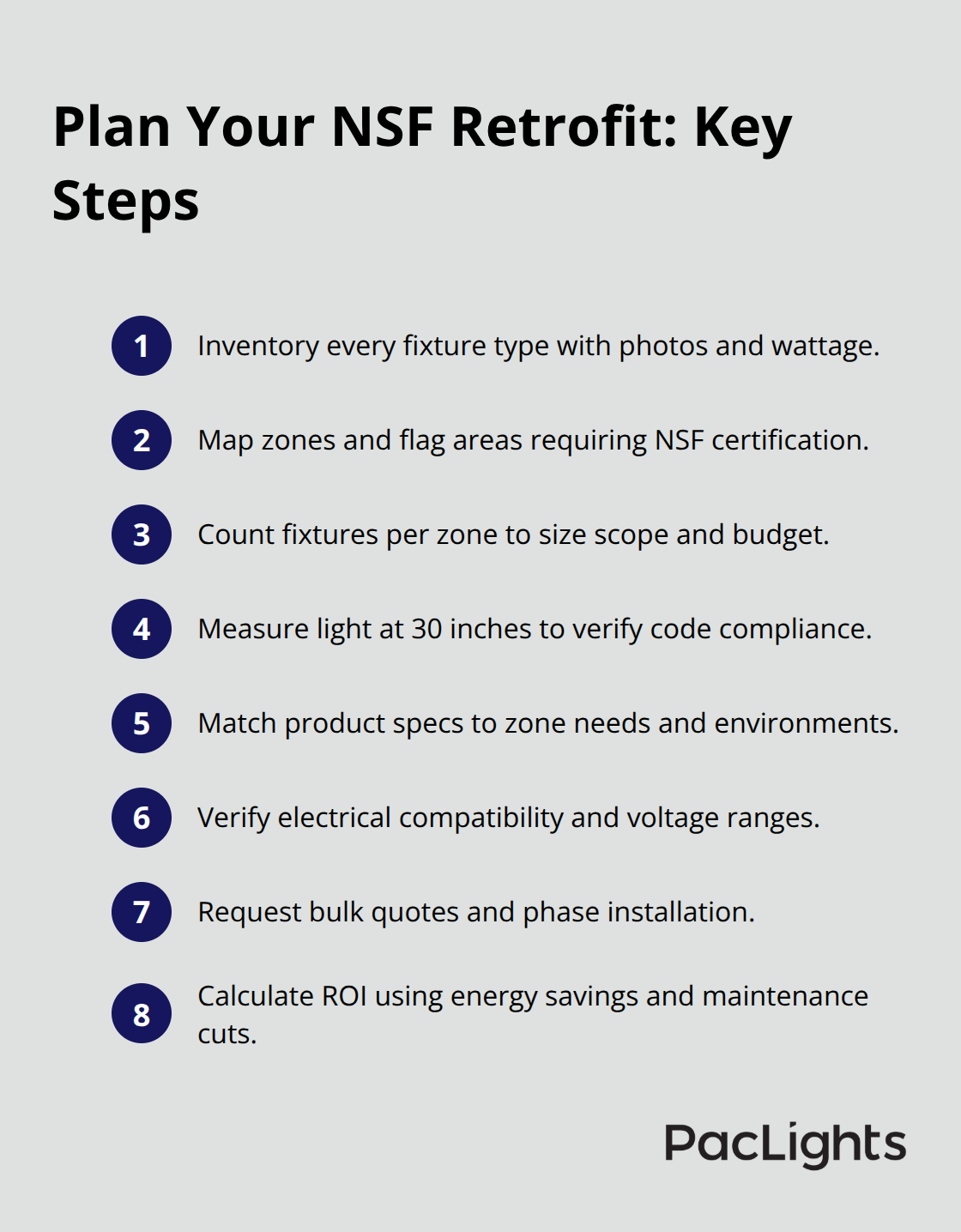
Measure light levels using a light meter at staff working height (30 inches above the floor) in your critical areas.
The FDA Food Code requires minimum 108 lux in dry food storage, so if your current readings fall below this standard, those zones need immediate attention. Document which fixtures are sealed versus open to contamination, which have exposed fasteners that trap debris, and which show signs of corrosion or moisture damage. This assessment reveals which retrofit lamps deliver the highest compliance gain.
Match Specifications to Your Facility Zones
NSF certified high bay lights reach 38,000 lumens at 150–190 lumens per watt with IP66 and IP69K ratings, making them suitable for harsh washdown environments. Linear vapor tight options deliver 150 lumens per watt with IP65 protection and UV-stabilized polycarbonate lenses, ideal for splash zones near processing equipment. Match these specifications against your documented zones to identify which product families fit your facility layout.
Verify Electrical Compatibility
Check whether your existing ballasts can be bypassed for direct LED connection or if you need drivers that work with your current wiring. Confirm input voltage options available on retrofit kits, as facilities often run 100–277V, 100–347V, or 277–480V depending on age and configuration. This verification step prevents costly installation errors and ensures your retrofit lamps integrate seamlessly with existing infrastructure.
Obtain Quotes and Phase Your Installation
Request bulk quotes from suppliers once you have identified the exact lamp families and quantities needed, because pricing drops significantly for orders exceeding 50 units. Phase your installation across multiple weeks rather than replacing everything simultaneously, minimizing operational disruption while allowing your maintenance team to learn the new fixture designs. Prioritize food zones first since non-compliance poses the greatest regulatory risk, then address splash zones, then general facility areas.
Calculate ROI and Compare Options
Calculate your ROI by comparing total retrofit cost against annual energy savings from reduced consumption. A facility consuming 100,000 kWh annually for lighting at 12 cents per kilowatt-hour saves approximately 3,600 dollars yearly after a 30 percent energy reduction through LED retrofit, meaning a 50,000-dollar retrofit investment pays back in roughly 14 years before accounting for maintenance cost reductions or avoided regulatory fines. Request spec sheets from manufacturers showing NSF certification status, IP ratings, beam angles, and color rendering index values to compare options objectively rather than relying on sales claims.
Final Thoughts
NSF certified retrofit lamps deliver measurable advantages that justify the upgrade investment across three critical areas. They cut energy costs by 30 to 75 percent depending on your current fixture type, with payback periods typically occurring within a few years, and they eliminate regulatory risk by meeting FDA and USDA standards for food handling environments. Better light quality also improves worker productivity, reducing eye strain and correlating directly with fewer accidents and higher output.
The long-term value extends far beyond initial cost savings because your maintenance team spends less time replacing lamps when fixtures reach 50,000 to 100,000 hour lifespans, and sealed NSF designs simplify cleaning schedules in washdown environments. Compliance certainty protects your operation from million-dollar shutdowns and recalls that devastate your bottom line, and when you calculate avoided fines, reduced downtime, and lower maintenance expenses alongside energy savings, the financial case becomes overwhelming.
Document your current lighting system by photographing fixtures and measuring light levels at staff working height in critical zones, then identify which areas require NSF certification based on food handling activities. Request bulk quotes from suppliers once you have exact quantities and specifications, and phase your installation across multiple weeks to minimize operational disruption. We at PacLights offer free lighting assessments and ROI calculations to help you identify which NSF certified retrofit solutions align with your specific facility zones and budget constraints.
Disclaimer: PacLights is not responsible for any actions taken based on the suggestions and information provided in this article, and readers should consult local building and electrical codes for proper guidance.