

Data centers consume roughly 1-2% of global electricity, with lighting accounting for 17-25% of that total energy use. At PacLights, we’ve seen firsthand how efficient lighting strategies can cut energy costs by 40-60% while meeting strict sustainability regulations.
The right lighting system transforms both your bottom line and your environmental footprint. This guide walks you through proven solutions that work.
How Much Does Lighting Really Cost Your Data Center?
Data center operators spend between 17-25% of their total electricity budget on lighting alone. For a mid-sized facility consuming 5 megawatts annually, that translates to roughly $200,000-$300,000 per year on lighting costs. Most facilities don’t realize this figure until they conduct an actual energy audit. The problem compounds because older lighting systems waste enormous amounts of energy through inefficient fixtures, lack of occupancy controls, and continuous operation in spaces that sit empty for hours.
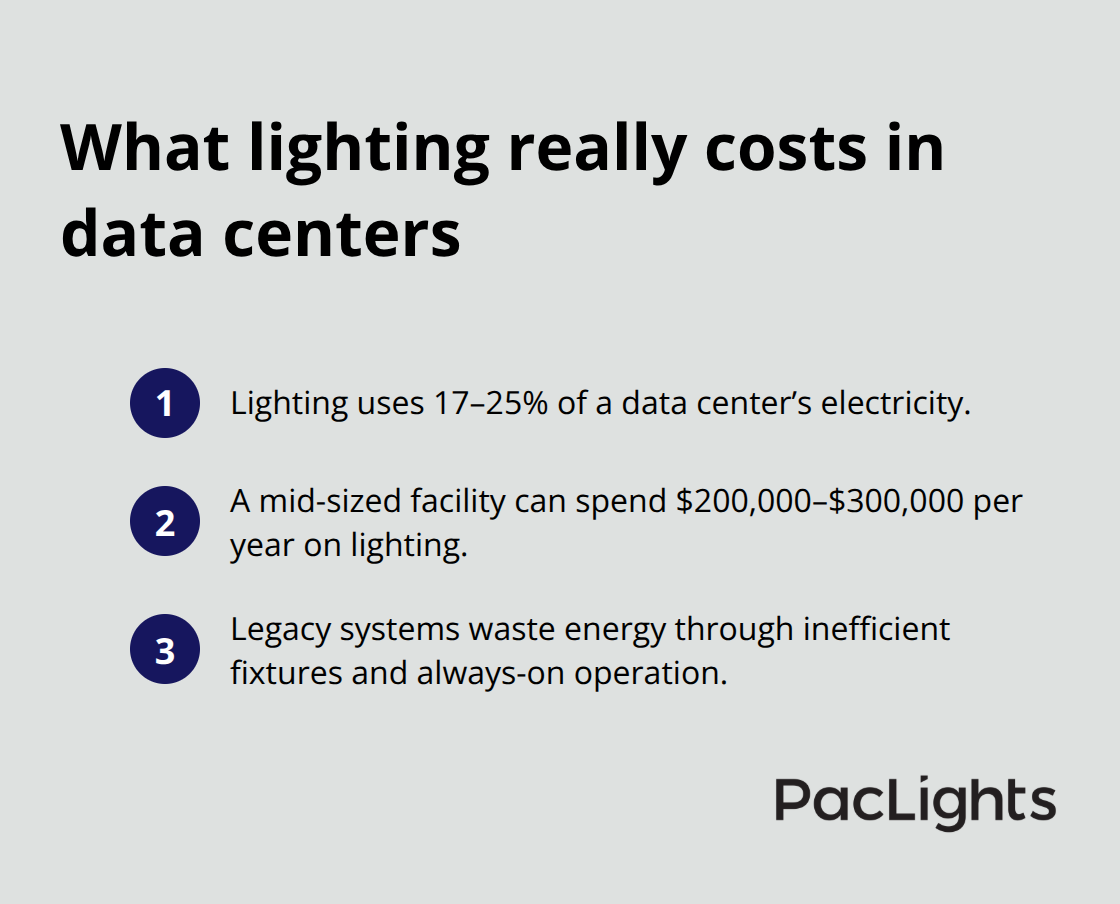
Nearly 80% of data centers operate lighting systems that haven’t been updated in over a decade. These legacy systems run fluorescent or metal halide fixtures that consume 3-4 times more electricity than modern LED alternatives while generating excess heat that forces cooling systems to work harder. The financial impact extends beyond the electricity bill-older fixtures require frequent replacement, increase maintenance labor costs, and reduce operational reliability.
Why Legacy Lighting Drains Your Budget
Outdated fixtures operate inefficiently across the board. A typical fluorescent system in a server room consumes 1.0-1.5 watts per square foot, while modern LED systems operate at 0.1-0.3 watts per square foot. Over a year, this difference translates to tens of thousands of dollars in wasted energy. Metal halide fixtures generate significant heat, forcing your HVAC systems to work overtime and multiplying cooling costs. The combination of poor lighting efficiency and excessive heat output creates a vicious cycle that inflates your total facility energy consumption.
Regulatory Pressure is Forcing Change
Global regulations now mandate lighting efficiency improvements. LEED certification requires efficient lighting and daylight harvesting strategies, with many data center operators discovering that green certifications directly reduce operational costs while improving their sustainability credentials. ISO 50001 energy management frameworks increasingly require facilities to track and optimize lighting as part of broader energy strategies. Data centers pursuing these certifications must document baseline energy consumption, implement controls, and demonstrate measurable reductions.
The financial incentive is real: facilities that achieve ENERGY STAR certification report electricity savings of 20-30% compared to non-certified peers. Government rebates and incentives further improve economics, with some jurisdictions offering $0.50-$1.00 per watt for LED retrofit projects. These incentives significantly reduce upfront costs and accelerate payback timelines (typically 2-3 years for most facilities).
The Cost of Waiting
Waiting to upgrade lighting systems means paying premium rates today while falling behind on compliance requirements that will eventually become mandatory. Facilities that act now capture available rebates and avoid rushed, expensive retrofits later. The longer you operate legacy lighting, the more you sacrifice in energy costs, maintenance expenses, and competitive positioning in an increasingly sustainability-focused market.
Understanding your current lighting costs sets the foundation for evaluating LED solutions and control systems that can transform your facility’s energy profile.
LED Lighting Outperforms Traditional Systems in Data Centers
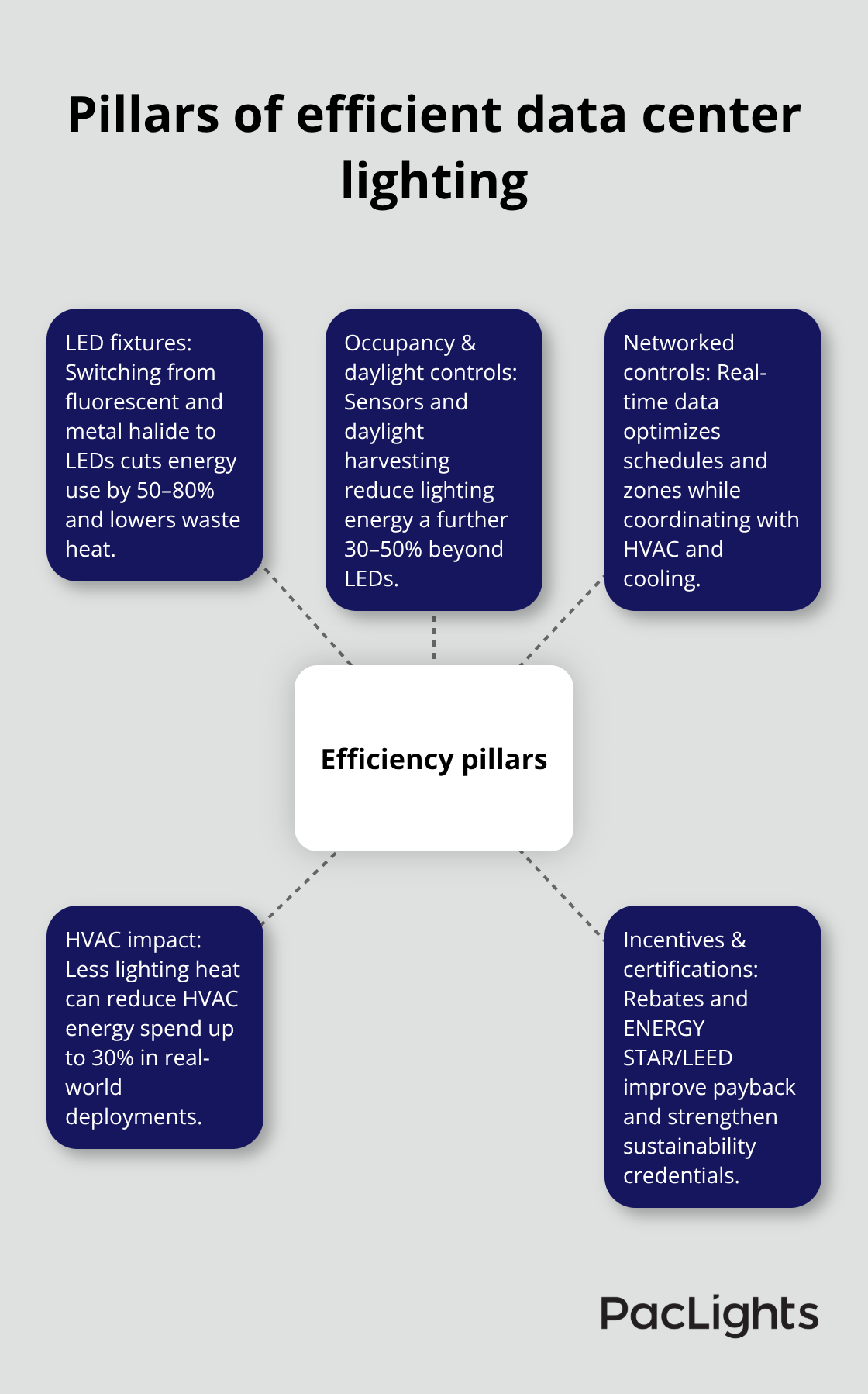
LED technology has fundamentally changed what’s possible in data center lighting. Facilities achieve energy reductions of 50-80% when switching from fluorescent and metal halide systems to modern LEDs, with payback periods of 2-3 years. The performance difference is stark: a fluorescent fixture consumes 1.0-1.5 watts per square foot while LED systems operate at 0.1-0.3 watts per square foot. That efficiency gap translates directly to lower electricity bills and reduced cooling demands, since LEDs generate significantly less waste heat than legacy fixtures. LED fixtures last 50,000+ hours compared to 10,000-20,000 hours for fluorescent systems, which means your maintenance team spends far less time on replacements and your facility experiences fewer service disruptions. The upfront cost of LEDs has dropped substantially over the past five years, making the total cost of ownership dramatically lower than traditional lighting despite any initial price premium.
Selecting the Right Fixture Types for Your Server Environment
High bay and linear lighting fixtures serve as the workhorses of data center illumination. High bay LED fixtures are engineered for the 15-25 foot ceilings typical in server rooms and deliver 150-300 lux across server aisles without creating glare on monitoring screens or equipment displays. Linear LED strips and troffer lights work well in corridors, maintenance areas, and equipment rooms where space constraints limit high bay installation. The right fixture type matches your specific space: vertical server aisles benefit from high bays that illuminate equipment labels and connections clearly, while horizontal corridors perform better with linear strips that distribute light evenly. Color temperature matters more than many operators realize. Cooler light around 4000K-5000K in server areas improves technician alertness and error detection, while warmer 3000K lighting in break areas and monitoring stations reduces eye strain during extended shifts. Selecting the right combination of fixture types prevents over-lighting (which wastes energy) and under-lighting (which compromises safety and productivity).
Motion Sensors and Daylight Controls Eliminate Phantom Energy Loss
Motion sensors and daylight harvesting systems represent the second pillar of LED efficiency, cutting lighting energy use an additional 30-50% beyond what LEDs alone achieve. Occupancy sensors detect movement and automatically dim or turn off lights in server aisles, maintenance rooms, and corridors that sit empty for extended periods. Many data centers operate these secondary spaces on 24/7 schedules even though they’re occupied only a few hours per week. Real-world deployments show occupancy-driven controls reduce HVAC energy spend up to 30% because less lighting means less waste heat and lower cooling requirements. Daylight harvesting systems measure natural light through windows and automatically reduce artificial lighting in perimeter zones, which proves particularly valuable for data center administrative offices and monitoring stations. Motion sensors and daylight controls integrate directly into fixture options, with wireless systems that avoid expensive rewiring of existing infrastructure. The sensors communicate via networked controls that provide visibility into which spaces are actually occupied and when, giving you actionable data to optimize facility layout and staffing decisions. A phased approach-starting with high-traffic corridors and break areas-reduces deployment costs while demonstrating quick wins that justify broader rollout.
Advanced Networked Lighting Controls Drive Continuous Optimization
Networked lighting control systems transform lighting from a static function into a dynamic, data-driven component of your facility infrastructure. These systems collect real-time data from sensors throughout your data center, tracking occupancy patterns, energy consumption, and equipment performance across rooms, aisles, and zones. The data reveals which spaces consume the most energy and when, enabling targeted optimization that generic schedules cannot achieve. Integration with building management systems allows lighting controls to coordinate with HVAC, cooling, and power distribution for facility-wide efficiency gains. Per-fixture power monitoring identifies underperforming fixtures and prioritizes maintenance or upgrades before failures occur. Lighting analytics provide actionable insights at the level of rooms, cages, and aisles, supporting targeted energy optimization that reduces waste. Security-conscious deployments use IP-based networks with VLAN and MAC-based security, storing data locally to reduce exposure to external networks while maintaining operational visibility.
With LED fixtures, occupancy controls, and networked systems in place, your data center has the foundation for measurable energy savings. The next step involves conducting a comprehensive lighting audit and calculating the return on investment for your specific facility.
Implementing Energy Efficient Lighting Systems
Conduct a Lighting Audit to Quantify Your Savings Potential
The gap between understanding that your lighting system wastes money and actually upgrading it comes down to one thing: knowing exactly what you’re working with and what the financial payoff will be. A proper lighting audit reveals your baseline energy consumption, identifies which fixtures drain the most power, and quantifies the savings potential in dollars. A complete facility survey, proposed photometric layout, fixture specifications, and a detailed ROI report eliminate guesswork and give you concrete numbers to justify the investment to stakeholders. Most data centers discover during an audit that they spend $200,000–$300,000 annually on lighting alone, with 40–60% of that energy completely wasted through inefficient fixtures and round-the-clock operation in unoccupied spaces.
The audit process takes 2–3 days for a mid-sized facility. What matters most is capturing baseline consumption data before you make any changes, so you can measure actual savings after implementation. Without this baseline, you’re essentially making decisions in the dark.
Deploy Retrofit Solutions That Fit Your Timeline and Budget
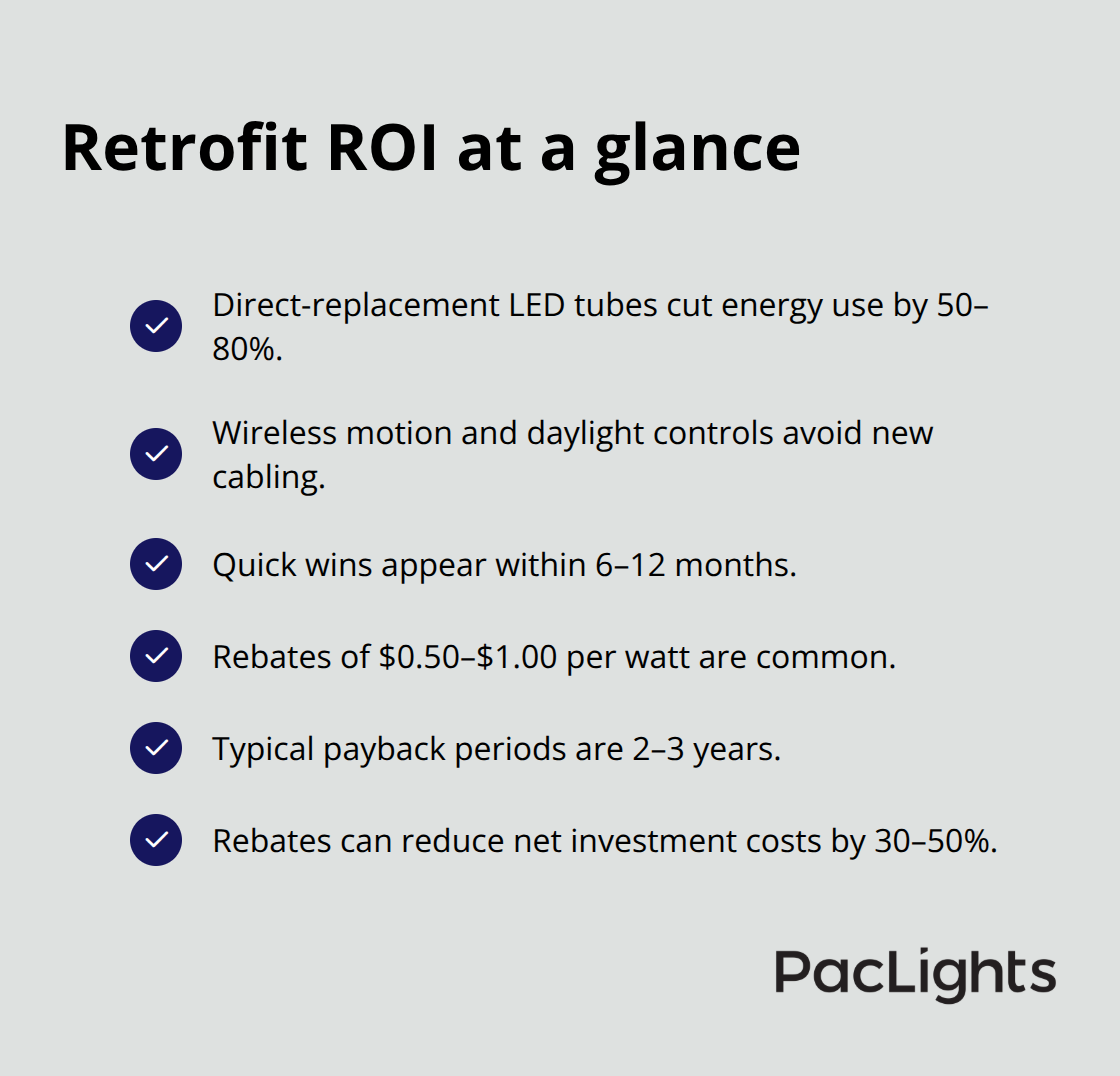
Retrofit solutions designed specifically for existing infrastructure accelerate deployment and reduce disruption to operations. Direct-replacement LED tubes work with your current ballasts, avoiding expensive rewiring while cutting energy consumption by 50–80% compared to fluorescent systems. Wireless motion sensor and daylight control systems eliminate the need for new cabling, which means you can install occupancy-based controls in secondary spaces like corridors and maintenance areas without major construction.
A phased retrofit approach starting with high-traffic areas demonstrates quick wins within 6–12 months, which then justifies broader rollout to the entire facility. Government rebates and incentives ranging from $0.50–$1.00 per watt in many jurisdictions dramatically improve economics, with typical payback periods of 2–3 years for complete LED retrofits. Facilities that secure available rebates before deadlines reduce net investment costs by 30–50%, making the business case substantially stronger.
Integrate Networked Controls for Continuous Optimization
Once your physical infrastructure receives upgrades with efficient fixtures and controls, networked lighting systems provide ongoing optimization that continues generating savings year after year. Real-time occupancy data reveals which spaces consume the most energy and when, enabling you to adjust schedules, staffing patterns, and facility layout based on actual usage rather than assumptions. Integration with building management systems allows lighting controls to coordinate with HVAC and cooling systems, multiplying efficiency gains across multiple facility systems.
Per-fixture power monitoring identifies underperforming equipment before failures occur, preventing service disruptions in critical areas. The data collected through networked controls justifies continued investment in advanced systems because you can prove exactly how much energy and money they save. Effective maintenance of lighting systems plays a pivotal role in sustaining energy efficiency over time, ensuring your investment continues to deliver returns.
Final Thoughts
Energy-efficient lighting strategies deliver measurable financial returns while positioning your data center for long-term competitiveness. Upgrading from legacy systems to LED fixtures with occupancy controls and networked management cuts lighting energy consumption by 50-80%, translating to $100,000-$180,000 in annual savings for a mid-sized facility. These savings compound year after year, with payback periods typically falling between 2-3 years even before accounting for government rebates that reduce net investment costs by 30-50%.
Green lighting strategies strengthen your operational resilience and market position in ways that extend far beyond immediate cost reduction. Facilities that achieve LEED or ENERGY STAR certification report 20-30% electricity savings compared to non-certified peers while meeting increasingly stringent regulatory requirements. The data collected through networked lighting systems provides actionable insights that inform decisions about facility layout, cooling optimization, and staffing patterns, while per-fixture power monitoring prevents unexpected failures in critical areas.
Start with a comprehensive lighting audit to establish your baseline energy consumption and quantify savings potential specific to your facility. We at PacLights understand the complexity of upgrading data center lighting systems, and our efficient lighting fixtures, retrofit solutions, and advanced controls are specifically designed for the demanding environments you operate in. Contact PacLights today to schedule your facility assessment and discover exactly how much your data center can save.
Disclaimer: PacLights is not responsible for any actions taken based on the suggestions and information provided in this article, and readers should consult local building and electrical codes for proper guidance.