

Picking the right lighting fixtures for food service and healthcare facilities isn’t optional-it’s a regulatory requirement. NSF certified fixtures list the products that actually meet health and safety standards, which means you avoid compliance headaches down the road.
At PacLights, we’ve seen facilities waste thousands on retrofits because they chose fixtures without proper certification. The good news is that understanding which fixtures carry NSF certification makes your purchasing decision straightforward and protects your operation.
What NSF Certification Actually Requires
NSF International certification isn’t a generic safety label-it’s a rigorous validation process specifically designed for food and healthcare environments. When a fixture earns NSF/ANSI 2 certification, it passes seven distinct steps: application submission, product evaluation, lab testing, manufacturing facility inspection, test results review, contract listing, and annual retesting. This means NSF-certified fixtures undergo continuous accountability through yearly plant audits, unlike standard UL or ETL marks that only verify electrical safety. The certification covers three operational zones: Non-Food Zone for general areas, Splash Zone for washdown-heavy spaces, and Food Zone for direct food contact or preparation surfaces. Each zone demands different material specifications and protection ratings.
Material and Design Requirements Across Zones
Food Zone fixtures must feature hermetically sealed housings with zero exposed fasteners, smooth non-porous surfaces, and corrosion-resistant materials like polycarbonate or stainless steel. Splash Zone fixtures typically require IP65 or IP66 ratings to resist water and dust; Food Zone fixtures often carry IP69K ratings to withstand high-pressure, high-temperature washdowns at 80–100 bar without water infiltration or performance degradation. These design specifications eliminate bacteria harborage points that standard fixtures leave exposed.
How NSF Differs from Standard Electrical Certifications
Standard electrical certifications like UL or ETL validate that lighting won’t catch fire or shock someone-they don’t address contamination prevention or sanitation compatibility. NSF certification tests materials for non-toxic composition, evaluates design to eliminate bacteria harborage points, and simulates extreme washdown conditions.
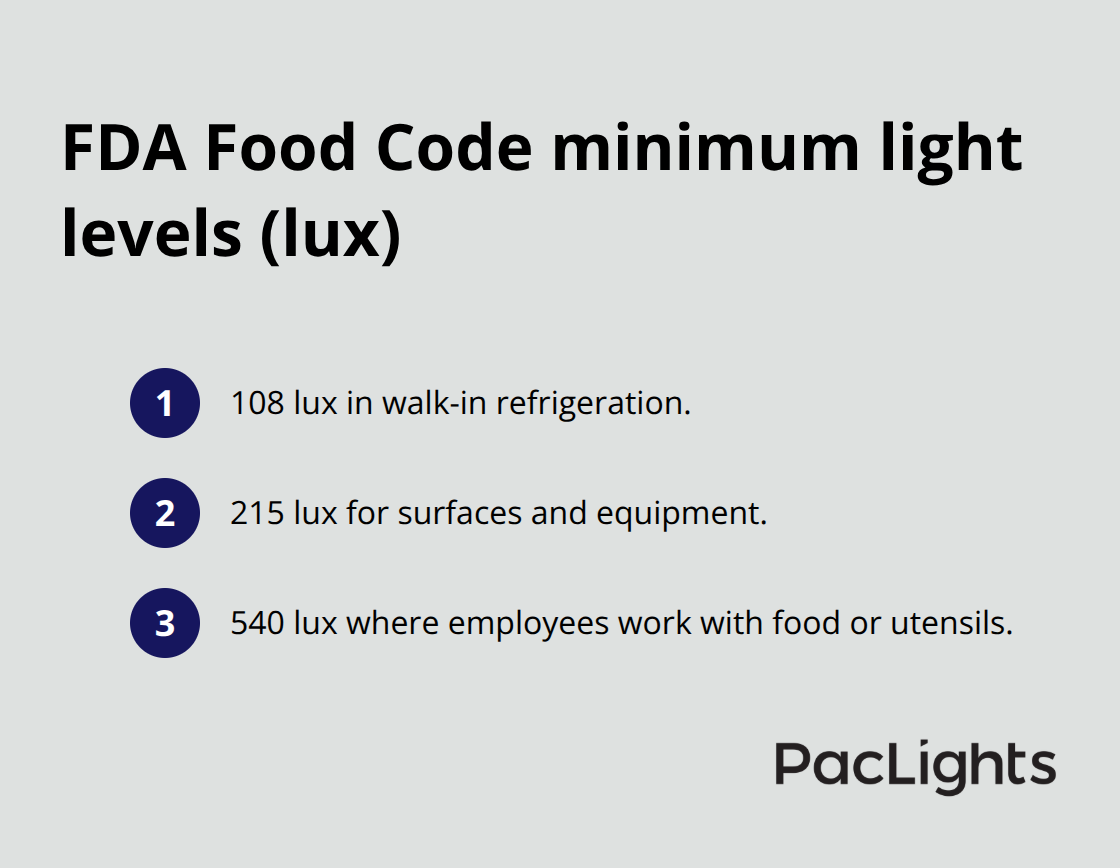
The FDA Food Code specifies three light-intensity zones with exact requirements: at least 108 lux in walk-in refrigeration, at least 215 lux for surfaces and equipment, and at least 540 lux where employees work with food or utensils. NSF-certified fixtures maintain performance in sub-zero temperatures below −20°C, where some LED systems fail. Corrosion-resistant construction withstands aggressive cleaning chemicals used in sanitization programs, extending service life compared to standard fixtures.
Performance and Durability Advantages
NSF-certified LED fixtures typically deliver 50,000 to 75,000 hours of operational life, compared with 10,000 to 20,000 hours for traditional metal halide or fluorescent systems. This durability translates to roughly 18–36 months ROI through reduced maintenance downtime and energy savings up to 70% versus older technologies. High color rendering index values above 80 and selectable color temperatures from 3500K to 5000K improve worker visibility during food inspection and handling, reducing eye strain and contamination incidents.
Regulatory Recognition and Inspection Readiness
The NSF mark is recognized in over 180 countries, strengthening your facility’s position during regulatory audits and third-party inspections. When USDA or FDA inspectors visit, they look for NSF certification or ETL listing to NSF Standard 2 as proof that your lighting meets food safety requirements. Fixtures with IP69K ratings and sealed construction prevent water and debris infiltration during sanitation cycles, eliminating hidden contamination sources that inspectors specifically target. Facilities using non-certified fixtures face regulatory violations, potential shutdowns, and costly retrofits that can cost tens of thousands of dollars per day. NSF certification isn’t just labeling-it’s ongoing compliance and quality assurance that protects your operation from recalls and operational interruptions.
Understanding what NSF certification actually covers helps you make informed purchasing decisions. The next section shows you which specific fixtures appear on the NSF certified list and how to identify them for your facility’s needs.
Key Fixtures on the NSF Certified List
Indoor Fixtures Approved for Regulated Environments
The NSF Official Listings page displays hundreds of certified fixtures across multiple manufacturers as of June 2026, covering LED High Bays, Vapor Tight units, Flat Panels, Troffers, Canopy Hood lights, and linear configurations. Your facility’s ceiling height, washdown intensity, and task requirements determine which fixtures work best. High bay models dominate the list for processing areas with ceilings 18 feet or higher, delivering tens of thousands of lumens per fixture depending on model. These units come with selectable wattage and color temperature options ranging from 2700K to 6500K, with 4000K and 5000K being most common for food environments where accurate color perception prevents contamination mistakes.
Vapor-tight fixtures appear frequently for kitchens and walk-in freezers, offering complete moisture and dust sealing backed by ETL or UL certifications and often DLC Premium listing for energy rebate eligibility. LED tube options in 2ft, 4ft, and 8ft configurations provide flexibility for retrofit projects; many support Type B ballast bypass or Type A/B hybrid setups, letting you upgrade existing infrastructure without complete rewiring. Strip lights deliver uniform task lighting at workstations and can be linked to create longer runs, with optional motion sensors reducing energy waste in low-traffic zones.
Zone-Specific Protection Levels
The listings specify which zone each fixture covers-Food Zone (Non-Contact), Splash Zone, or Non-Food Zone-so you match protection levels to your specific areas without overspending on unnecessary specifications. Voltage options span 120-277V as standard, with high-voltage 347-480V variants available for larger facilities. Most certified fixtures support 0-10V dimming or equivalent controls, allowing integration with networked lighting systems that optimize energy use across your operation.
Color Rendering and Emergency Backup Options
Color rendering index options include 80 CRI and 90 CRI, with 90 CRI recommended for detailed food inspection work where color accuracy prevents quality issues. Emergency backup options appear frequently with battery-backed operation to maintain visibility during power outages, critical in food processing where sanitation schedules don’t pause for darkness. The global supply base includes facilities in the United States, China, Mexico, and Vietnam, illustrating broad production capacity.
Verifying Certification and Specifications
When verifying purchases, confirm the specific model number appears on NSF materials rather than relying on vendor marketing claims alone, since many product suffixes affect certification status. Request datasheets that clearly show NSF certification or ETL listing to NSF Standard 2, IP rating, warranty length typically around five years, and L70 lifespan specifications confirming 50,000+ hour durability. These details protect your investment and ensure compliance with regulatory requirements.
The next section explains how NSF-certified fixtures reduce your compliance risk and protect your facility from costly violations and operational interruptions.
How NSF Certified Fixtures Protect You From Violations
Regulatory agencies don’t care about your lighting supplier’s promises or marketing claims. The FDA Food Code and USDA require documented proof that your facility meets specific lighting standards, and NSF certification provides exactly that proof. When inspectors arrive, they look for NSF/ANSI 2 certification or ETL listing to NSF Standard 2 on your fixtures. Non-certified lighting creates immediate compliance gaps that inspectors flag as violations. Facilities using standard commercial fixtures face regulatory citations that escalate quickly, starting with warnings and advancing to operational restrictions or shutdowns if violations persist. NSF-certified fixtures eliminate this vulnerability because they pass the seven-step certification process that NSF International requires, including annual retesting and facility inspections. Your inspection readiness improves dramatically because you can produce documentation showing each fixture meets food safety requirements, not just electrical safety. The NSF mark is recognized in over 180 countries, which means your certification holds weight during third-party audits and regulatory reviews.
The Real Cost of Retrofit Projects
Facilities that skip NSF certification during initial installation face expensive retrofit projects later. A typical retrofit for a mid-sized food processing facility costs tens of thousands of dollars when you account for new fixture purchases, labor, downtime during installation, and lost production. Worse, retrofits happen under regulatory pressure rather than on your timeline, forcing rushed decisions and emergency spending. NSF-certified fixtures cost more upfront but deliver 50,000 to 75,000 hours of operational life compared to 10,000 to 20,000 hours for traditional metal halide or fluorescent systems. This durability means you avoid replacement cycles that non-certified fixtures demand. The IP69K ratings on many NSF fixtures withstand high-pressure washdowns at 80 to 100 bar without water infiltration, preventing the hidden contamination sources that drive repeat violations. Specifying NSF-certified fixtures from the start protects your operation and avoids the scenario where you pay for lighting twice.
Documentation and Audit Efficiency
Audits move faster when you have NSF certification backing your lighting choices. Inspectors spend less time questioning your fixture specifications because the NSF mark confirms compliance. You need datasheets showing NSF certification or ETL listing to NSF Standard 2, IP rating matching your operational zone, warranty coverage, and L70 lifespan specifications confirming 50,000+ hour durability. Keep these documents organized and accessible during inspections. Corrosion-resistant construction with stainless steel hardware and sealed housings prevents water and debris infiltration during sanitation cycles, eliminating the contamination points that inspectors specifically target.
Meeting Exact Lighting Standards
FDA Food Code requires at least 108 lux in walk-in refrigeration, 215 lux for surfaces and equipment, and 540 lux where employees work with food. NSF-certified fixtures deliver these exact lux levels reliably because they pass testing and validation. Non-certified fixtures often fail to meet these intensity requirements, forcing inspectors to recommend replacements. When you select fixtures with 90 CRI color rendering and 4000K to 5000K color temperature, you also improve worker visibility during food inspection, reducing contamination incidents that inspectors document as facility failures.
Building an Inspection Record
The combination of certified fixtures plus proper lux levels creates an inspection record that demonstrates operational competence. Your facility shows regulators that you invested in compliant infrastructure rather than cutting corners with cheaper alternatives. NSF certification transforms your lighting from a liability into documented proof of your commitment to food safety standards.
Final Thoughts
NSF certification should be your primary filter when selecting lighting fixtures for food service and healthcare facilities. The NSF certified fixtures list represents products that have passed rigorous validation, not marketing hype or vendor promises. When you choose certified fixtures, you protect your operation from compliance gaps that cost far more when violations occur.
Verifying NSF certification during purchasing takes minutes but prevents costly mistakes. Request datasheets showing NSF/ANSI 2 certification or ETL listing to NSF Standard 2 for your specific model number, confirm the IP rating matches your operational zone, and verify L70 lifespan specifications confirming 50,000 or more hours of operational life. These details protect your investment and ensure regulators recognize your compliance commitment.
We at PacLights offer free lighting layout designs and ROI assessments to help you identify NSF-certified fixtures matching your facility’s zones and requirements. Contact PacLights today to discuss your facility’s lighting needs and strengthen your compliance position with fixtures that deliver both regulatory approval and long-term operational savings.
Disclaimer: PacLights is not responsible for any actions taken based on the suggestions and information provided in this article, and readers should consult local building and electrical codes for proper guidance.