

Server rooms demand precision. Poor lighting creates safety hazards, increases technician errors, and puts your data center at risk of compliance violations.
At PacLights, we’ve seen firsthand how the right maintenance lighting transforms these spaces. This guide shows you exactly how to implement lighting solutions that protect your team and your infrastructure.
Why Maintenance Lighting Matters in Server Areas
Safety Hazards Without Proper Illumination
Technicians working in server areas face serious risks when lighting is inadequate. Poor visibility causes cable misidentification, missed warning signs on equipment, and accidental contact with live connections. The National Institute for Occupational Safety and Health found that inadequate lighting in industrial maintenance environments contributes to a 50% higher injury rate compared to properly lit spaces.

In server rooms, technicians perform intricate work like cable patching, monitoring status indicators, and troubleshooting hardware in tight aisles. Without proper illumination, these tasks become dangerous guesswork.
How Poor Lighting Increases Maintenance Errors
Maintenance errors directly impact your data center’s reliability. Research shows that technicians working under poor lighting conditions make 3 to 4 times more errors than those in well-lit environments. A single misconnected cable can trigger downtime costing thousands of dollars per minute. The TIA-942 standard recommends 500 lux in equipment areas where maintenance occurs, yet most legacy server rooms operate at 200 lux or less. This gap between standard and reality explains why many data centers experience preventable outages rooted in installation mistakes.
Compliance Standards Drive Lighting Requirements
Compliance mandates maintenance lighting in server facilities. NFPA 101 requires that emergency lighting maintain safe exit paths and minimum illumination during power outages. ASHRAE 90.1 sets strict limits on lighting power density while requiring adequate visibility for critical tasks. Facilities that ignore these standards face regulatory fines and insurance complications if incidents occur. Most server rooms fail basic compliance checks because lighting was installed without considering maintenance workflows.
Energy Savings Make Compliance Affordable
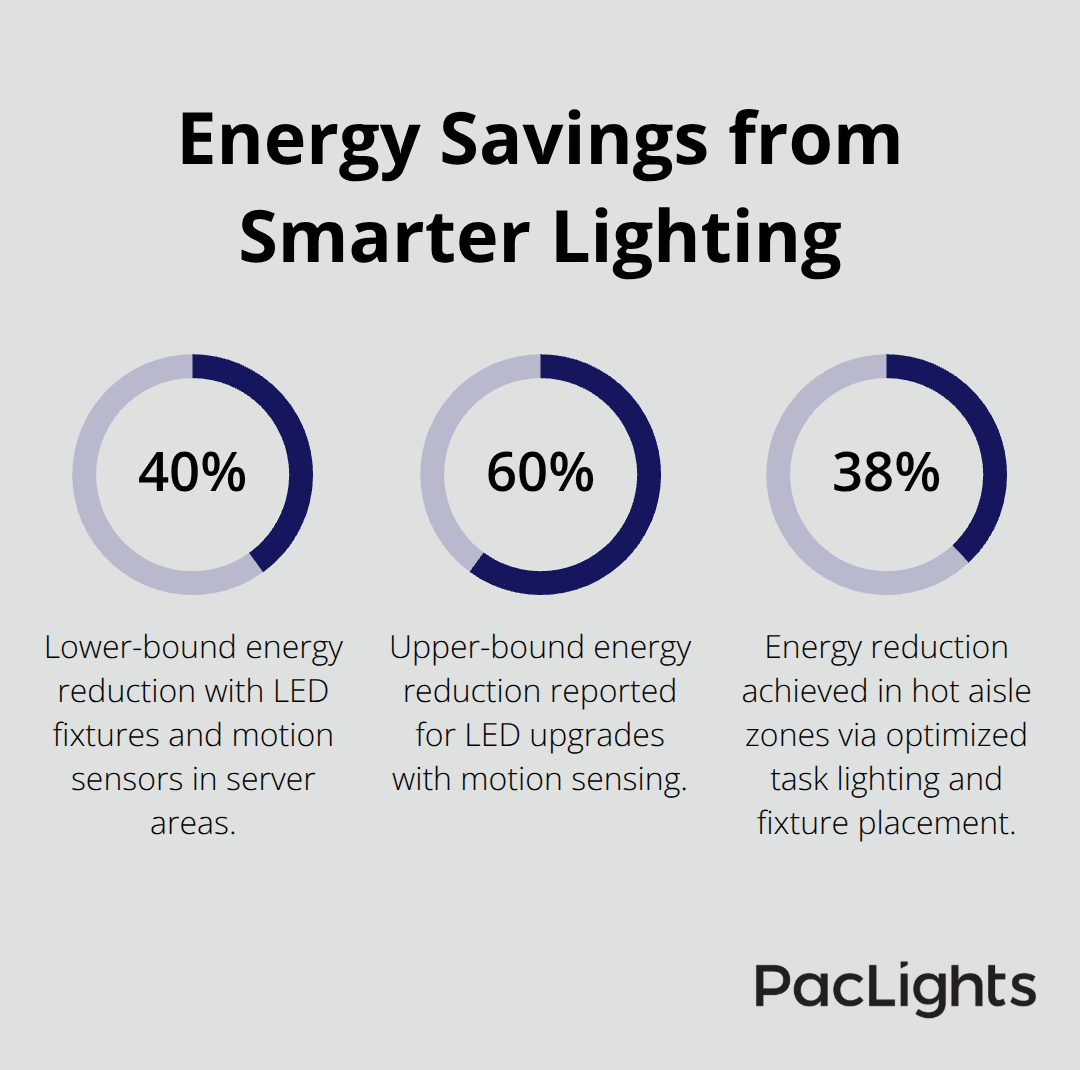
The solution proves cost-effective. LED fixtures with motion sensors cut energy use by 40 to 60 percent while delivering consistent brightness.
A 500-watt fluorescent system consuming roughly 4,380 kilowatt-hours annually drops to 440 kilowatt-hours with LED upgrades, saving approximately 527 dollars per year at average US electricity rates. Payback typically occurs within 2 to 4 years, meaning compliance and safety improvements pay for themselves. The real cost comes from ignoring the problem and accepting preventable errors, compliance violations, and safety incidents that damage your operation far more than proper lighting investment ever could.
With safety risks, error rates, and compliance requirements all pointing toward the same conclusion, the question shifts from whether to upgrade maintenance lighting to how to implement solutions effectively. The next section examines specific lighting technologies and control strategies that address these challenges in active server environments.
Choosing the Right Fixtures and Controls for Server Maintenance
Fixture Selection and Proper Placement
Linear strip lights and high-bay fixtures deliver the even coverage that server areas demand, but fixture selection alone solves only half the problem. The spacing-to-height ratio matters more than most installers realize. Mount fixtures at 2.8 to 3.5 meters and maintain a ratio below 1.4 to eliminate shadows in maintenance zones where technicians identify cables and troubleshoot equipment. Volkswagen’s data facility in Malaysia achieved a 38 percent energy reduction in hot aisle zones through targeted task lighting combined with optimized fixture placement at the correct height. Position vertical strip lighting directly over racks to minimize shadowing under cables and components, then layer uniform ambient lighting across aisles.
Achieving Uniform Illumination
Try for 500 lux in active maintenance areas as TIA-942 recommends, but recognize that uniform coverage matters more than raw brightness. A space with 400 lux and even distribution outperforms one with 600 lux concentrated in hot spots and dark corners. Uniform illumination prevents technician eye strain and reduces the risk of missed details during cable identification and equipment troubleshooting. The DHL logistics hub in Thailand reduced night-time docking errors by 25 percent using optimized fixture placement paired with motion-triggered task lighting, demonstrating how proper uniformity directly impacts operational accuracy.
Motion Sensors and Occupancy Detection
Motion-activated controls cut energy waste without sacrificing visibility when technicians work in server areas. Motion sensors reduce annual runtime from 8,760 hours to roughly 2,000 hours in rarely used zones, and combining occupancy detection with dimming achieves energy reductions exceeding 40 percent within six months in compliant facilities. Configure motion sensors with Auto On/Auto Off in server rooms and set timeout values within the 20-minute maximum suggested by ASHRAE 90.1 to balance safety and energy savings. High-end trim at 70 to 80 percent of full output prevents over-lighting during routine maintenance while reducing annual consumption.
Daylight Harvesting and Smart Controls
Daylight harvesting delivers substantial savings when server areas have windows or skylights; typical studies show 30 to 40 percent lighting energy reductions in suitable conditions. Networked lighting controls enable precise scheduling aligned with maintenance windows, giving you data-driven control across multiple zones rather than one-size-fits-all timers. These systems collect occupancy and energy data across zones, revealing patterns that inform layout optimization and control refinement. PacLights offers fixtures with optional motion control and advanced networked lighting controls that integrate these capabilities into a cohesive system tailored to your facility’s specific needs.
Building an Adaptive Lighting Strategy
This layered approach-proper fixture placement, occupancy sensing, dimming capability, and smart scheduling-transforms maintenance lighting from a static expense into an adaptive system that protects technicians while cutting operating costs year after year. The real performance gains emerge when you combine all these elements rather than implementing them in isolation. With the right fixtures, controls, and placement strategy in place, the next challenge involves integrating your lighting system with the broader building infrastructure to maximize both safety and efficiency across your entire data center operation.
Installing and Managing Maintenance Lighting Without Compromising Performance
Fixture Placement and Shadow Elimination
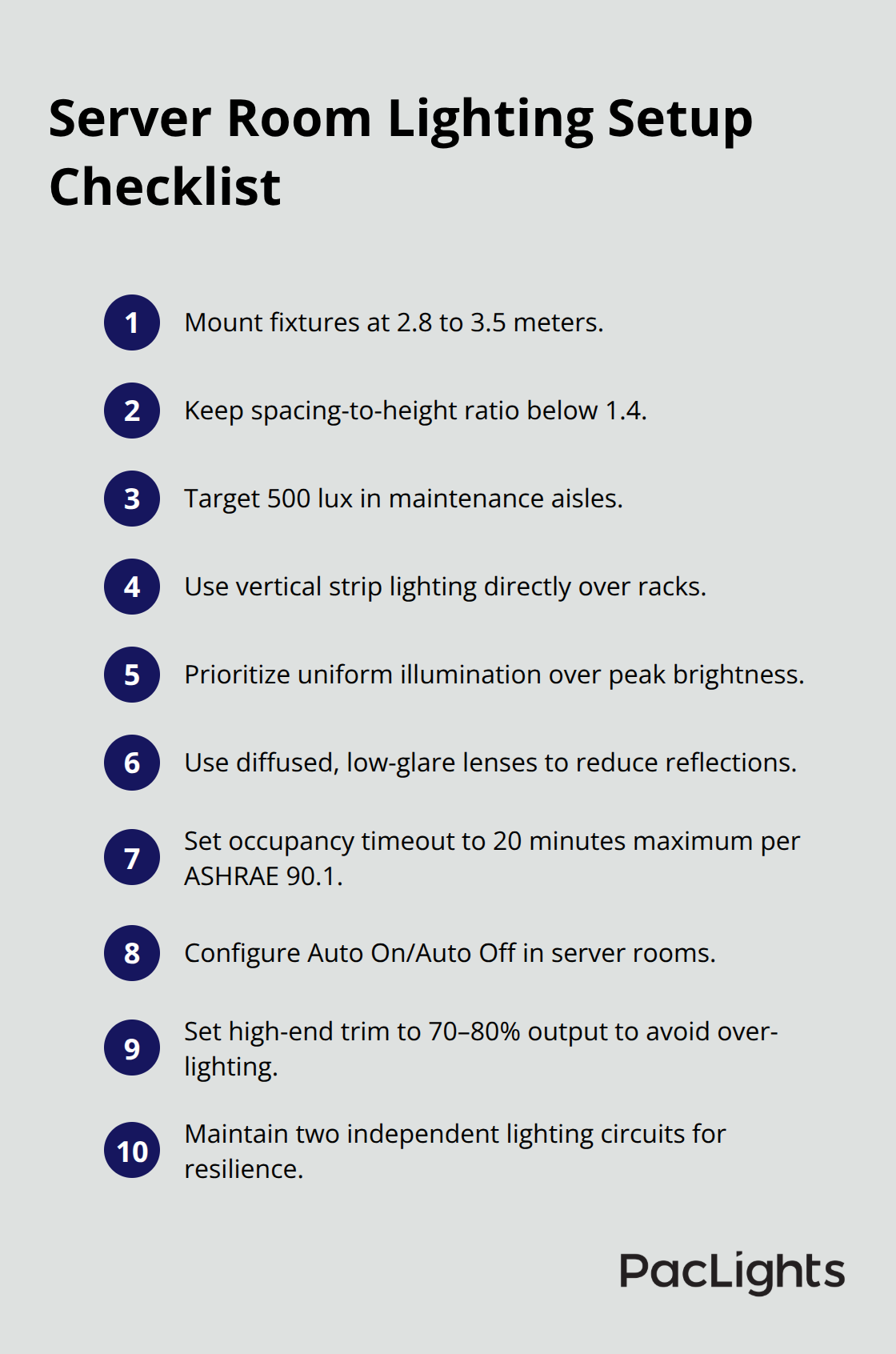
Proper placement determines whether your lighting investment protects technicians or creates new problems. Mount fixtures at 2.8 to 3.5 meters and keep the spacing-to-height ratio below 1.4 to eliminate shadows in aisles where technicians work. Position vertical strip lighting directly over racks to minimize shadowing beneath cables, then layer uniform ambient lighting at 500 lux across aisles. Mount fixtures to deliver light where technicians need it most-directly above cable trays, patch panels, and PDUs where detailed work happens. Avoid positioning lights near equipment access points to prevent head-strike hazards, and maintain seven feet of vertical clearance between fixtures and server infrastructure.
Controlling Glare and Optimizing Visibility
Glare represents your biggest enemy during installation-it causes eye strain, reduces visibility of status indicators, and interferes with camera monitoring systems in server areas. Use diffused lenses or low-glare fixtures to reduce reflections on equipment panels and displays. TIA-942 specifies 500 lux in equipment maintenance areas, but uniformity matters more than peak brightness; a space with 400 lux distributed evenly outperforms one with 600 lux concentrated in hot spots. Flicker-free operation requires high-quality LED drivers; poor-quality drivers cause eye strain and interfere with security camera monitoring, so specify fixtures with verified driver quality when upgrading your system.
Occupancy Sensing and Energy Optimization
Networked lighting controls enable automatic adjustment between lighting levels based on occupancy, scheduling, and maintenance windows rather than relying on timers or manual switches. Implement occupancy sensing with Auto On/Auto Off configuration in server rooms and set timeout values at 20 minutes maximum per ASHRAE 90.1 standards to balance safety and energy savings. Deploy high-end trim at 70 to 80 percent of full output to prevent over-lighting during routine maintenance. These systems collect occupancy and energy data across zones, revealing patterns that inform optimization opportunities and layout refinement. Track energy use across zones through smart controls to identify high-usage areas and opportunities for further optimization.
Maintenance Schedules and Compliance
Schedule regular maintenance every six months to clean fixtures-dust accumulation reduces light output by up to 30 percent-and test emergency lighting circuits to maintain safety compliance with NFPA 101 requirements. Build redundancy with at least two independent lighting circuits covering different zones to maintain partial lighting during maintenance work and power outages. These dual circuits protect your operation during both routine maintenance and unexpected power events, ensuring technicians retain visibility when they need it most.
Assessment and Customization
Free lighting assessments quantify potential savings and deliver customized layout plans based on your facility’s specific needs and maintenance workflows. This evaluation process identifies high-usage zones, calculates energy reduction opportunities, and recommends fixture types and control strategies tailored to your server room configuration. Professional assessment prevents costly installation mistakes and ensures your lighting system aligns with both safety standards and operational efficiency goals from day one.
Final Thoughts
Maintenance lighting in server areas directly impacts three critical outcomes: technician safety, operational reliability, and compliance adherence. Proper illumination reduces injury rates by 50 percent, cuts maintenance errors by 66 to 75 percent, and eliminates compliance violations that damage your facility’s reputation and bottom line. These improvements compound over time as your team works more efficiently and your infrastructure experiences fewer preventable outages.
The financial case strengthens when you factor in energy savings. LED fixtures with motion sensors and smart controls reduce annual consumption from 4,380 kilowatt-hours to roughly 440 kilowatt-hours, saving approximately 527 dollars yearly at average US electricity rates. Payback occurs within 2 to 4 years, after which your maintenance lighting system generates pure savings while simultaneously improving safety and performance.
We at PacLights understand these challenges because we work with data centers daily. Our fixtures include optional motion control and advanced networked lighting controls designed specifically for server environments, and we provide free lighting assessments that quantify your potential savings and deliver customized layout plans based on your facility’s needs.
Disclaimer: PacLights is not responsible for any actions taken based on the suggestions and information provided in this article, and readers should consult local building and electrical codes for proper guidance.