

Datacenter lighting is often an afterthought, but it shouldn’t be. Getting the fundamentals right-from power efficiency to thermal management-determines whether your facility runs smoothly or faces costly problems down the line.
At PacLights, we’ve seen too many datacenters struggle with poorly planned LED layouts. This guide covers the essentials you need to know about datacenter LED layout basics, from design principles to common pitfalls that drain your budget.
Understanding Datacenter Lighting Costs and Compliance
What Your Datacenter Lighting Actually Costs to Run
Datacenter lighting consumes 10–15% of total facility energy, according to Energy Innovation. A 10,000 square foot datacenter with inefficient fixtures burns through 50,000–100,000 kilowatt-hours annually. At the average industrial rate of $0.12 per kilowatt-hour, that translates to $6,000–$12,000 per year for lighting alone.
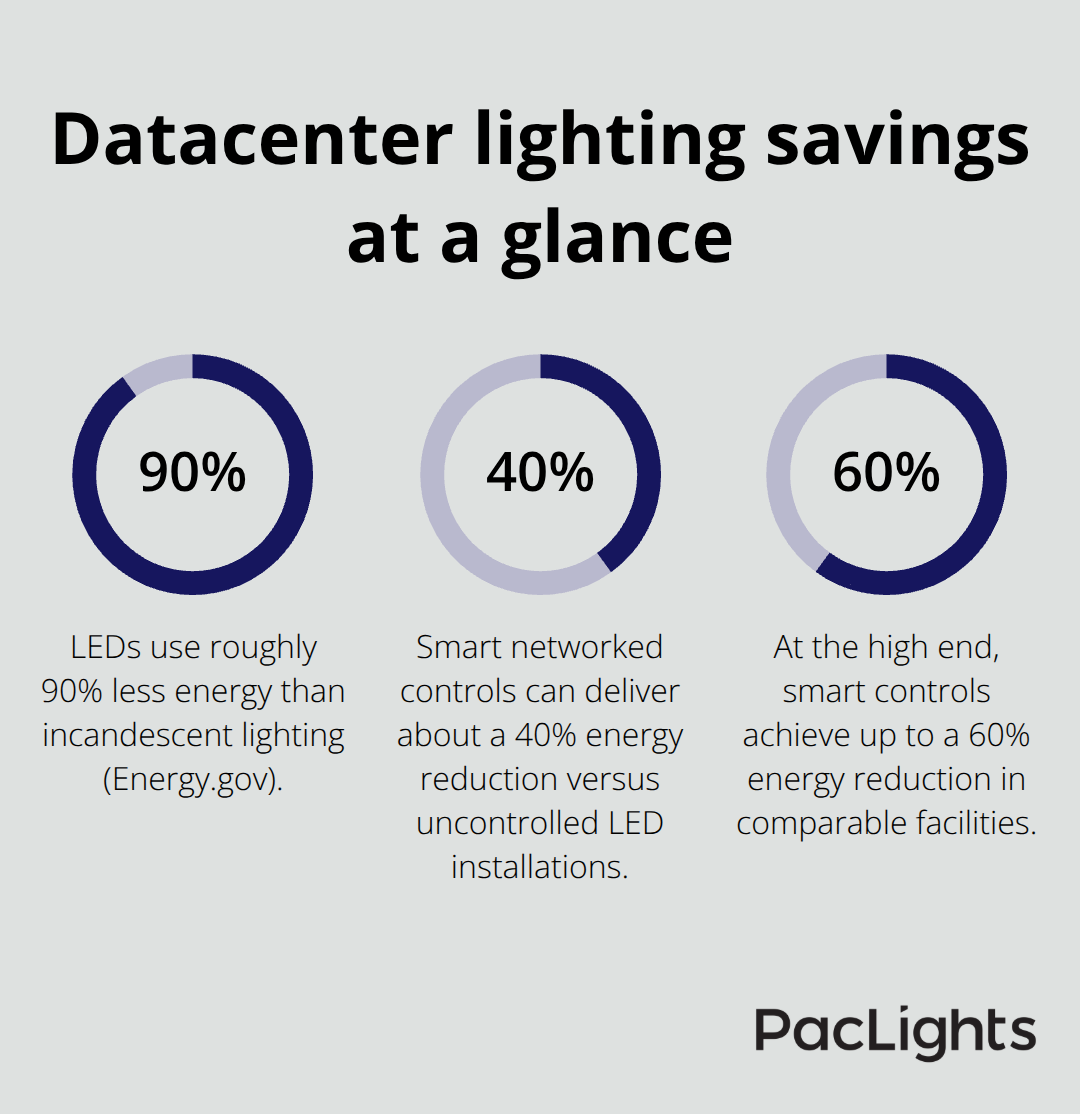
Most facilities never baseline their current consumption, so waste goes undetected. LED technology uses roughly 90% less energy than incandescent lighting, according to Energy.gov, but real savings emerge when you combine efficient fixtures with smart controls. Smart networked controls achieve 40–60% energy reductions compared to standard uncontrolled LED installations across facilities ranging from 5,000 to 50,000 square feet.
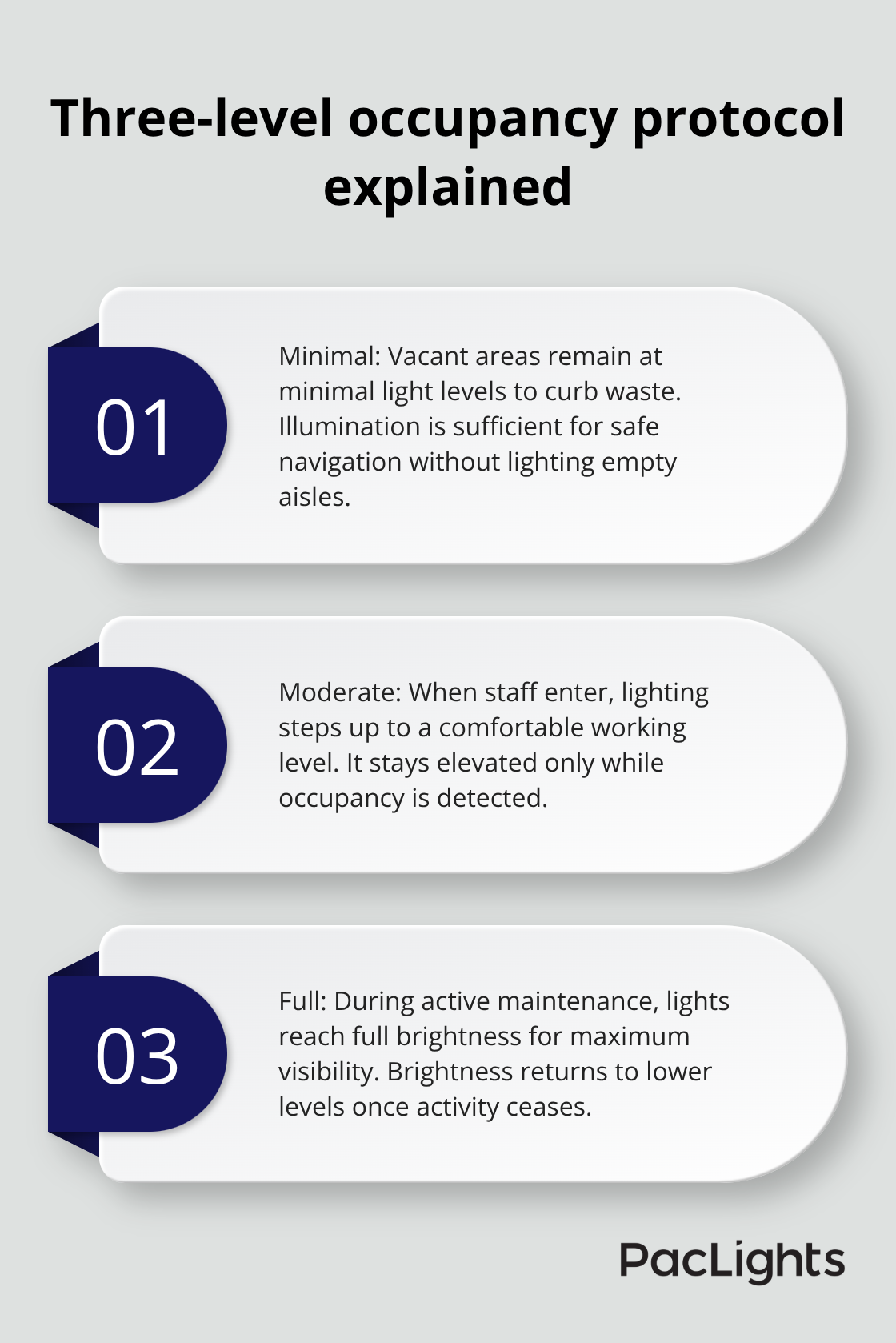
A three-level occupancy protocol cuts costs dramatically. Minimal lighting occupies vacant areas, moderate lighting activates when staff enter, and full brightness appears only during maintenance work. This approach reduces energy use from roughly 440 kilowatt-hours to 220 kilowatt-hours in a typical facility-the difference between $7,000 and $3,500 annually for lighting expenses.
How Thermal Management Affects Your Total Energy Bill
Traditional lighting generates significant waste heat that forces cooling systems to work harder. Switching to LEDs reduces cooling energy consumption by 2–3%, which matters because cooling typically consumes 30–40% of datacenter energy budgets. LED lighting indirectly cuts total facility energy use beyond the lighting circuit itself. Poorly positioned fixtures create hot spots above equipment and disrupt airflow patterns, forcing HVAC systems to compensate with higher fan speeds and increased compressor load.
Proper alignment locks in efficiency for 15–20 years. Place fixtures at the centerline of hot and cold aisles, space them 8–10 feet apart, and mount them at 8–12 feet high. This configuration reduces overall energy waste by 20–30% compared to retrofits without grid alignment. Temperature consistency prevents thermal stress on equipment, which shortens lifespan and increases failure rates. The layout phase determines whether your facility runs efficiently or wastes energy for decades.
Safety Standards and Illumination Requirements
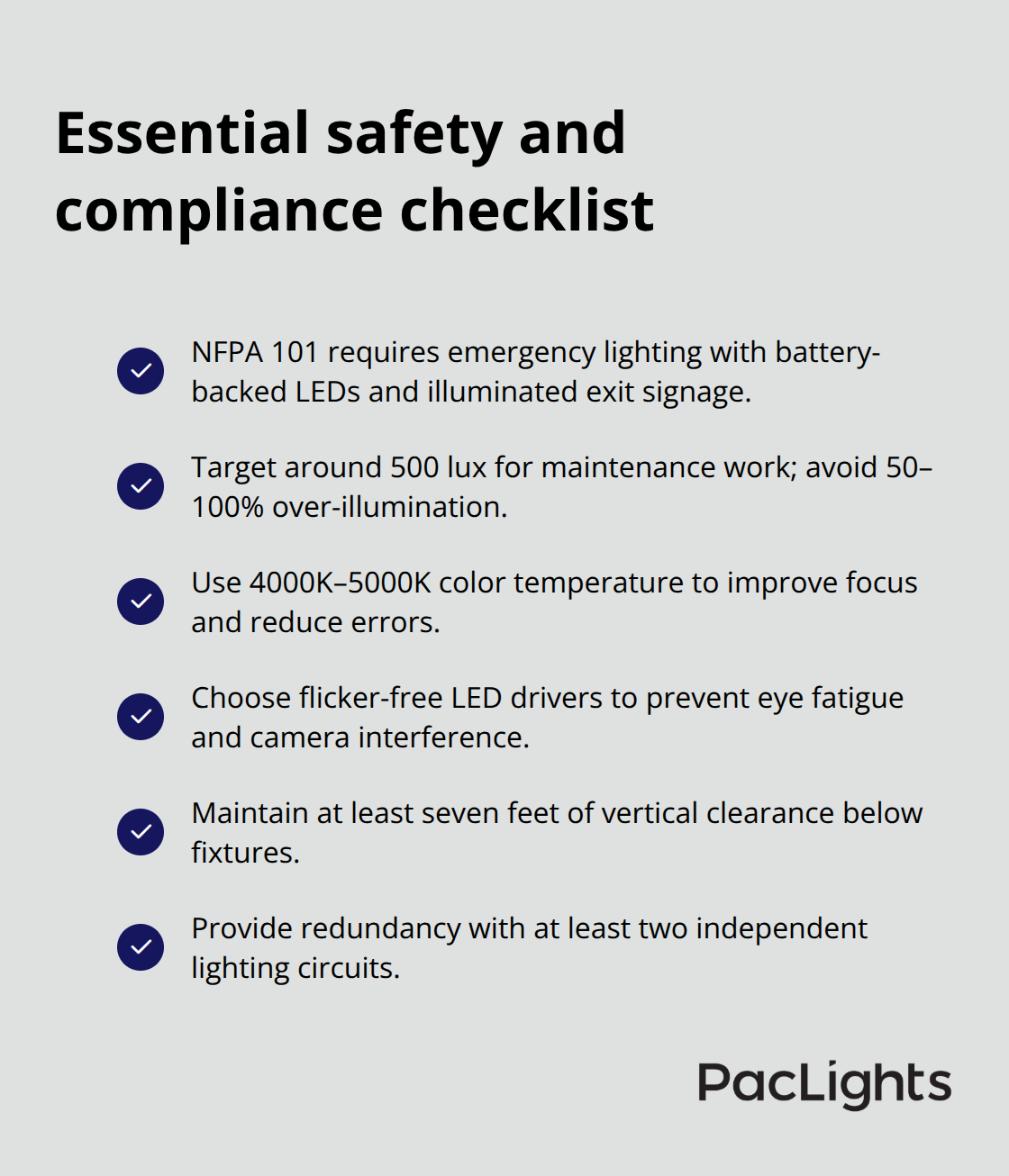
NFPA 101 requires emergency lighting with battery-backed LEDs and clearly illuminated exit signage-you cannot dim your way to zero energy use in occupied spaces. Target around 500 lux for server-room maintenance work, but avoid over-illuminating by more than 50–100% because excess light wastes energy and creates glare on screens. Color temperature between 4000K and 5000K improves focus and reduces errors during cable terminations and troubleshooting.
This choice directly impacts technician productivity and mistake rates.
Flicker-free LED drivers prevent eye fatigue and camera interference, which matters for facilities using surveillance systems. Maintain a minimum of seven feet of vertical clearance below fixtures to prevent head-strike hazards and avoid obstructing cable trays. Build redundancy with at least two independent circuits so a single failure doesn’t leave your datacenter in darkness. These compliance requirements form the foundation of a compliant facility and shape every decision in your lighting plan.
How to Position LED Fixtures for Maximum Efficiency
Centerline Alignment and Spacing Standards
Fixture placement determines whether your datacenter operates at peak efficiency or wastes energy for years. Position fixtures directly above the midpoint between hot and cold aisles, spacing them 8–10 feet apart at a mounting height of 8–12 feet. This configuration reduces energy waste by 20–30% compared to random placement, according to industry standards. Fixtures positioned off-center create dark zones over equipment and bright spots over aisles, forcing technicians to move around to see equipment clearly and wasting light energy in the process. Uneven illumination also disrupts airflow patterns, causing cooling systems to compensate with higher fan speeds. A 10,000 square foot datacenter with proper grid alignment uses roughly 30% less energy for cooling than one with haphazard fixture placement. Start with a scale map of your rack layout, mark aisle centerlines, and plot fixture positions before installation work begins. This planning step takes hours but prevents decades of wasted energy and thermal inefficiency.
Matching Lumen Output to Actual Work Tasks
Lumen output should match your actual work requirements, not some arbitrary brightness standard. Try 500 lux for server-room maintenance tasks according to industry guidance, but measuring lux at your specific rack heights and aisle widths matters more than following a generic number. Over-illumination beyond 50–100% above baseline creates glare on screens, wastes energy, and increases technician eye fatigue during extended troubleshooting sessions. Color temperature between 4000K and 5000K improves focus and reduces errors during cable terminations, which directly impacts maintenance speed and reliability. Flicker-free LED drivers are essential because flickering causes eye strain and interferes with surveillance camera operation in facilities using video monitoring.
Three-Level Occupancy Protocols for Real Energy Cuts
Smart controls with three-level occupancy protocols deliver the real efficiency gains. Minimal lighting occupies vacant areas, moderate brightness activates when staff enter, and full illumination appears only during active maintenance. This approach cuts energy consumption roughly in half compared to constant full brightness.
Sensor placement matters critically-mount occupancy sensors where they detect movement in aisles without obstruction from equipment cabinets, and test sensor sensitivity during commissioning to prevent false triggers or dead zones. A datacenter running three-level lighting consumes approximately 220 kilowatt-hours monthly for lighting versus 440 kilowatt-hours with static brightness, translating to annual savings of roughly $2,500 per facility at standard industrial rates.
With fixture placement locked in and occupancy controls operational, your next challenge involves preventing the common mistakes that undermine even well-designed layouts.
Mistakes That Lock in Inefficiency for Decades
Expansion Kills Poorly Planned Fixture Grids
Most datacenters fail during the planning phase, not installation. The fixture grid you install today determines energy waste for 15–20 years because retrofitting costs far more than correct placement from the start. Expansion exposes the first major flaw in poor planning. A datacenter built for 50 racks without considering future growth to 100 racks forces you to either leave fixtures in place that no longer align with your new aisle layout or spend $15,000–$30,000 ripping out and reinstalling the entire system.
Fixture placement locked into a ceiling grid creates alignment problems that compound over time. When you add equipment rows, your original centerline positioning becomes useless, forcing technicians to work in shadows or accept massive over-illumination in some areas. Start by mapping your rack layout for the next three to five years, not just current capacity. Position fixtures to accommodate 50% growth before installation begins. This forward thinking costs nothing during initial design but saves tens of thousands when expansion arrives.
Maintenance Access Requires Proper Clearance Planning
Maintenance access gets sacrificed to tight spacing and poor fixture design. Fixtures mounted too low obstruct cable trays and force technicians to work around lighting infrastructure instead of accessing equipment efficiently. The seven-foot minimum clearance below fixtures prevents head strikes, but many facilities ignore this requirement and create hazardous conditions that slow troubleshooting and increase injury risk.
Narrow aisle datacenters amplify this problem because fixture placement in tight spaces leaves almost no room for service work. Test your fixture height and spacing with actual technicians performing real maintenance tasks before final installation. Have them pull cables, replace equipment, and troubleshoot while you observe what clearances they actually need. This field validation prevents the expensive mistakes of discovering too late that your fixtures block access to critical equipment.
Thermal Positioning Determines Long-Term Efficiency
Poor heat dissipation planning creates a cascading efficiency failure that no amount of smart controls can fix. Fixtures positioned directly above hot equipment radiate heat downward into cabinets, forcing cooling systems to work harder while technicians experience uncomfortable working conditions. The placement strategy matters more than the fixture efficiency rating because even efficient LEDs positioned poorly generate localized thermal stress.
Align fixtures at aisle centerlines, not above equipment rows. This simple shift keeps heat away from sensitive components and maintains consistent airflow patterns. Thermal imaging during commissioning reveals hot spots before they become chronic problems. If you detect areas exceeding 5 degrees Fahrenheit above baseline temperatures, adjust fixture positions immediately rather than accepting the inefficiency.
Final Thoughts
Datacenter LED layout basics rest on three core principles: position fixtures at aisle centerlines with proper spacing, match brightness to actual work tasks, and implement smart controls that respond to occupancy. A 10,000 square foot datacenter wastes $6,000–$12,000 yearly on inefficient lighting alone, but smart networked controls cut that by 40–60% while three-level occupancy protocols reduce energy use by roughly 50%. Proper fixture alignment also reduces cooling energy consumption by 2–3%, which amplifies savings across your entire facility budget.
Thermal efficiency and maintenance access both depend on decisions made during the layout phase. Fixtures positioned at aisle centerlines keep heat away from equipment, maintain consistent airflow, and prevent the thermal stress that shortens component lifespan, while proper clearance planning ensures technicians can work efficiently without obstruction. Forward planning costs nothing during design but prevents expensive retrofits later when expansion or maintenance problems force you to rip out and reinstall systems.
We at PacLights help facilities implement these fundamentals correctly through free lighting layout designs and ROI assessments tailored to your specific datacenter needs. Our team provides energy-efficient fixtures and retrofit solutions with optional motion controls and advanced networked lighting controls that deliver payback in 18–24 months. Contact PacLights today to start planning your efficient datacenter lighting system.
Disclaimer: PacLights is not responsible for any actions taken based on the suggestions and information provided in this article, and readers should consult local building and electrical codes for proper guidance.