

Datacenter operators face mounting pressure to cut energy costs while maintaining peak performance. At PacLights, we’ve watched the 2025 trends in datacenter lighting shift dramatically toward smarter, more efficient systems.
This shift isn’t optional anymore. The datacenters that adopt modern lighting infrastructure today will outpace competitors on both operational costs and reliability.
How LED and Smart Controls Cut Datacenter Energy Use
The Case for LED Lighting in Modern Datacenters
LED lighting has moved from optional to mandatory in modern datacenters. A 100,000-square-foot datacenter running fluorescent fixtures consumes 50–100 kW just for lighting, translating to 438,000–876,000 kWh annually. Switching to LED cuts that consumption by up to 75 percent compared to incandescent and roughly 50 percent versus fluorescent. That matters because lighting directly impacts Power Usage Effectiveness, or PUE, which The Green Grid defines as total datacenter energy divided by IT equipment energy.
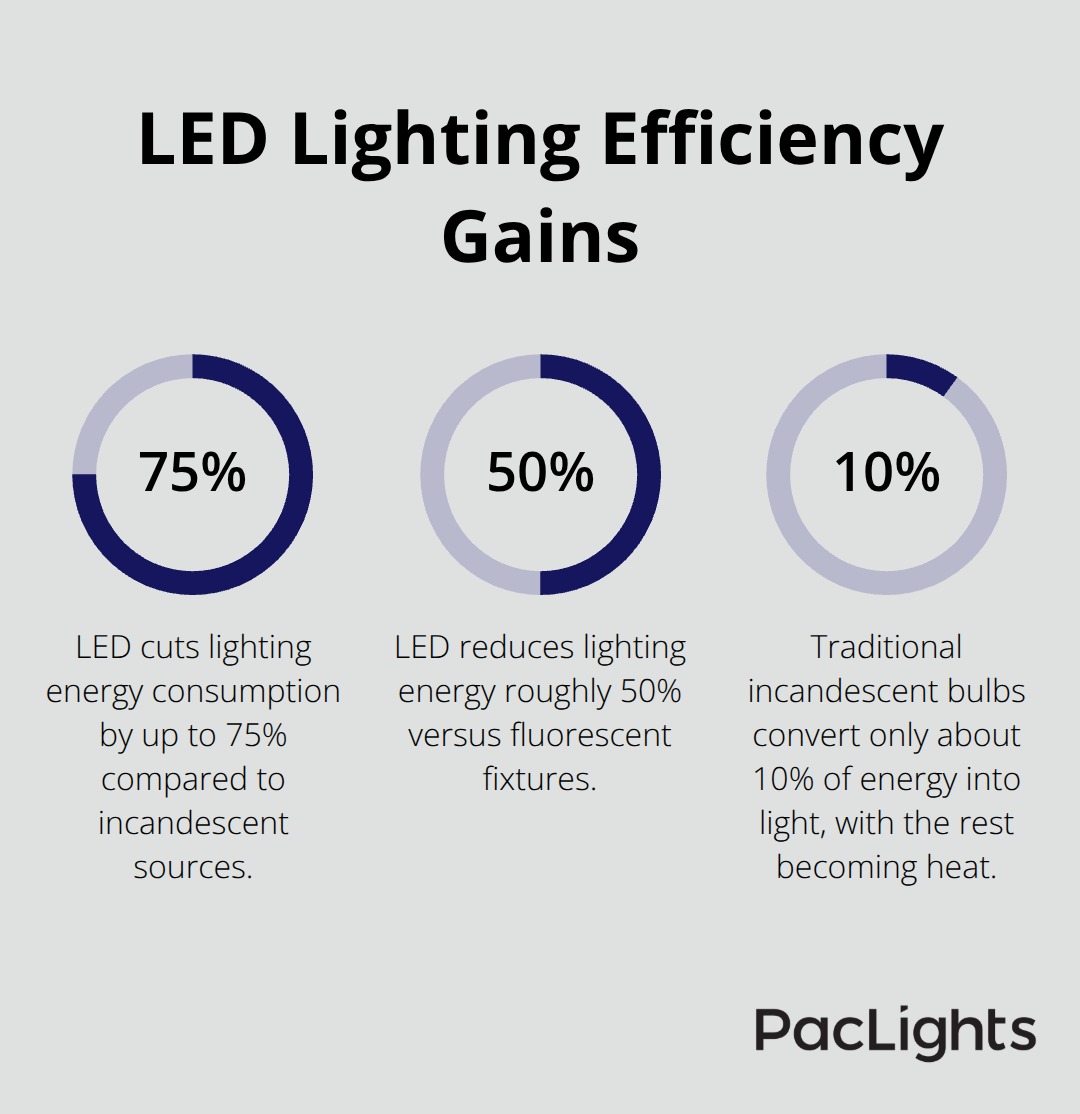
Lower PUE means less energy wasted on non-IT systems. Most datacenters operate between a PUE of 1.2 and 1.8, and lighting plays a measurable role in that range. Beyond raw energy reduction, LED fixtures emit significantly less heat than legacy sources. Traditional incandescent bulbs convert only about 10 percent of energy into light, with the rest becoming waste heat that forces cooling systems to work harder.
How Lighting Heat Compounds Cooling Costs
This cascading effect matters because cooling typically accounts for 30–50 percent of total datacenter energy consumption. Reducing lighting heat directly lowers cooling load, creating a compounding efficiency gain. LED fixtures also last up to 25 times longer than conventional sources, according to Signify, which cuts maintenance frequency and the operational disruptions associated with bulb replacements. Instant illumination and flicker-free output at selectable color temperatures further improve working conditions for technicians in server aisles.
Smart Controls Layer On Additional Savings
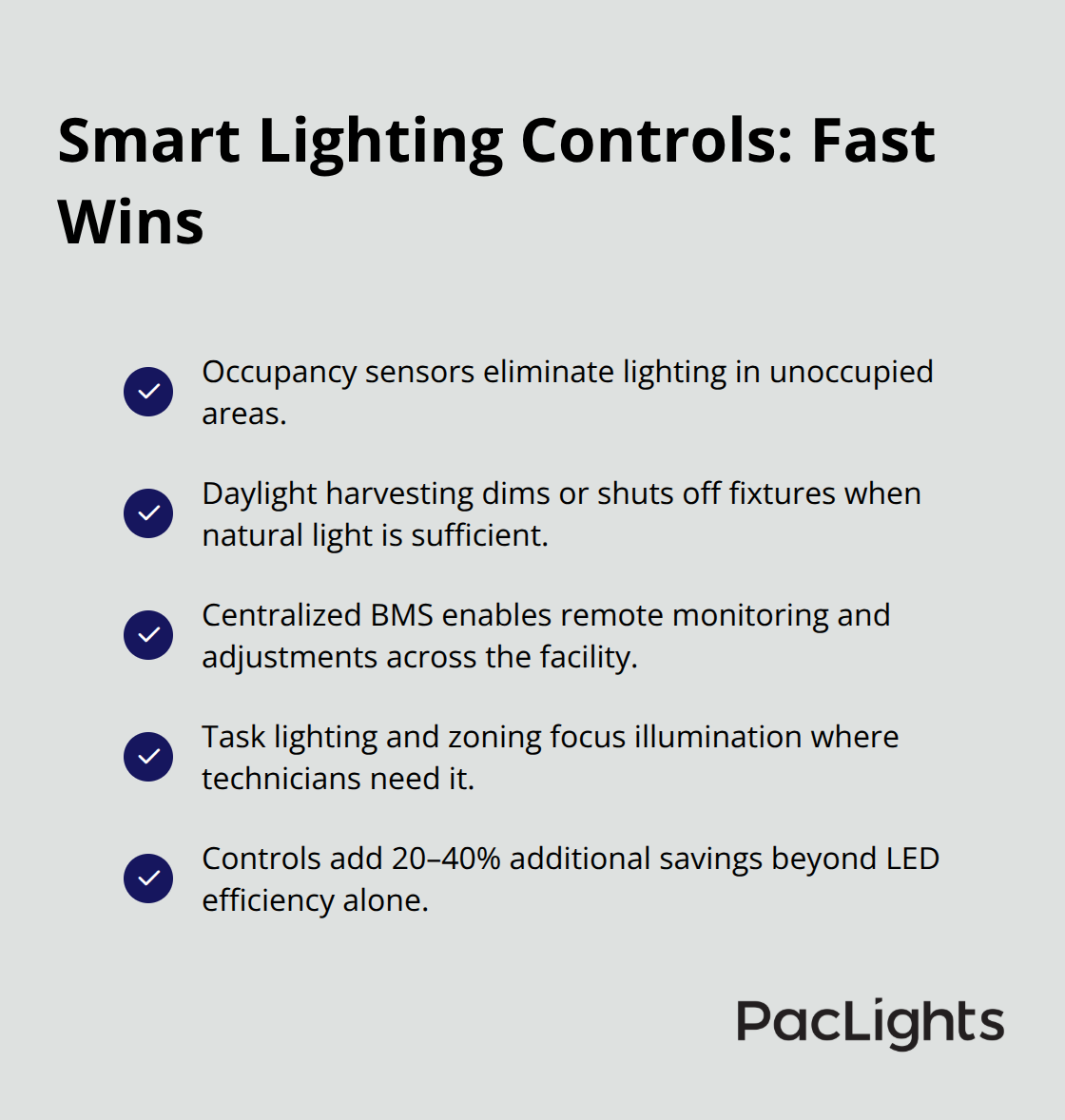
Deploying LED alone captures only part of the opportunity. Smart lighting controls add another layer of energy reductions that separate high-performing datacenters from average ones. Occupancy sensors eliminate lighting waste in unoccupied areas, while daylight harvesting in office-adjacent zones dims or switches off fixtures when natural light suffices. Centralized Building Management Systems enable remote monitoring and adjustment across the entire facility, catching inefficiencies in real time.
Task lighting and zoning strategies focus illumination exactly where needed-above racks and in specific work areas-rather than flooding the entire space. These controls typically add 20–40 percent additional savings beyond LED efficiency alone. The economic argument is straightforward: upfront LED and control investments pay for themselves through lower operating costs, reduced maintenance labor, and extended fixture lifespans.
Measuring and Validating Energy Performance
Measuring progress requires tracking total facility energy and IT equipment energy over the same periods, preferably across seasons, to establish accurate PUE trends and validate the return on investment. Datacenters that integrate lighting upgrades with cooling and power distribution strategies see the strongest results because energy systems operate interdependently. This integrated approach-combining efficient fixtures, smart controls, and coordinated facility management-positions operators to capture maximum savings while maintaining the reliability their mission-critical environments demand.
Thermal Management and Cooling Integration
How Lighting Heat Drives Cooling Demand
Cooling consumes 30–50 percent of total datacenter energy, making it the largest non-IT energy drain after power distribution and security. Lighting sits upstream of this equation because every watt of heat generated by inefficient fixtures forces cooling systems to work harder. When a 100,000-square-foot datacenter operates with fluorescent or incandescent lighting, cooling systems must remove that excess heat continuously. LED cuts lighting heat output dramatically, which directly reduces the cooling burden. Facilities that upgrade to LED see measurable reductions in cooling runtime and compressor cycles. The relationship between lighting and cooling is so direct that optimizing one without considering the other leaves money on the table.
Integrated Systems Outperform Single-Focus Upgrades
Modern datacenters that treat lighting and cooling as an integrated system-not separate domains-capture efficiency gains that single-focus upgrades cannot achieve. Advanced cooling designs work best when paired with low-heat lighting because variable-speed fans and precision temperature controls modulate more effectively when the baseline heat load is lower. Datacenters running LED fixtures with smart controls report cooling energy reductions of 10–20 percent beyond the LED efficiency gain alone because the cooling infrastructure operates in a more stable, lower-demand environment. This compounding effect means your cooling investment becomes more effective when lighting efficiency improves first.
Zone-Based Lighting Reduces Thermal Load
Task lighting and zoning strategies amplify this advantage by concentrating illumination only where technicians need it-above racks, in work aisles, and in control rooms-rather than flooding the entire facility uniformly. Focused lighting reduces overall heat generation while maintaining safety and visibility where it matters. Datacenters that implement zone-based lighting designs can reduce cooling load in non-critical areas significantly, freeing cooling capacity for high-heat server zones. Centralized Building Management Systems enable real-time coordination: as occupancy sensors detect activity in specific zones, lighting activates and cooling adjusts accordingly. This synchronized approach prevents the common waste pattern where facilities cool and light entire spaces even when only small sections are actively used.
Maintenance Quality and Thermal Stability
Thermal management also benefits from LED’s superior color rendering and flicker-free output because technicians working in optimally lit environments make fewer errors during maintenance, reducing unplanned downtime and heat-generating emergency interventions. When you measure progress, track cooling energy separately from total facility energy so you can isolate the impact of your lighting upgrades on thermal management. Datacenters that document this correlation build a strong business case for reinvesting savings into additional efficiency improvements, creating a cycle of continuous optimization that compounds year over year. This data-driven foundation positions operators to make informed decisions about scalability and infrastructure expansion as demand grows.
Scalability and Future-Ready Lighting Infrastructure
Modular Design Prevents Expansion Bottlenecks
Datacenters rarely stay static. Capacity demands shift, server layouts change, and cooling infrastructure evolves. A lighting system designed for today’s footprint often becomes a constraint when expansion happens. Operators invest heavily in efficient LED and control systems, only to face costly rewiring and fixture replacement when they scale operations. The solution is architecting modular lighting infrastructure from day one, paired with networked controls that adapt without requiring complete system overhauls.
Modular systems use standardized fixtures and mounting points that allow technicians to add, relocate, or upgrade luminaires without disrupting the entire installation. When a datacenter expands into adjacent space or reconfigures server racks, modular designs activate new zones quickly and cost-effectively. Datacenters that plan for modularity from installation see 30–40 percent faster deployment timelines during expansions compared to facilities locked into rigid, monolithic lighting designs.
Networked Controls Enable Remote Management
Networked lighting controls enable scalable management from a single control point across an entire campus, supporting growth without reconfiguring the underlying system. This matters because every month of delayed expansion due to lighting infrastructure constraints costs operators revenue and competitive position.
Networked controls separate physical lighting infrastructure from operational management. Traditional hardwired systems require technicians to physically access each zone to adjust settings, creating bottlenecks during rapid scaling. Cloud-based platforms enable remote adjustments across thousands of fixtures, supporting dynamic load balancing and emergency protocols without on-site intervention. Datacenters operating networked systems detect equipment failures 20–30 days earlier than facilities relying on manual inspections, translating directly to avoided downtime and unplanned emergency repairs.
Real-Time Data Drives Scaling Decisions
When you implement networked controls, you gain real-time visibility into fixture performance, energy consumption by zone, and maintenance needs across the entire facility. This data drives informed decisions about where to allocate cooling resources, how to optimize task lighting during peak operations, and when predictive maintenance prevents unexpected outages.
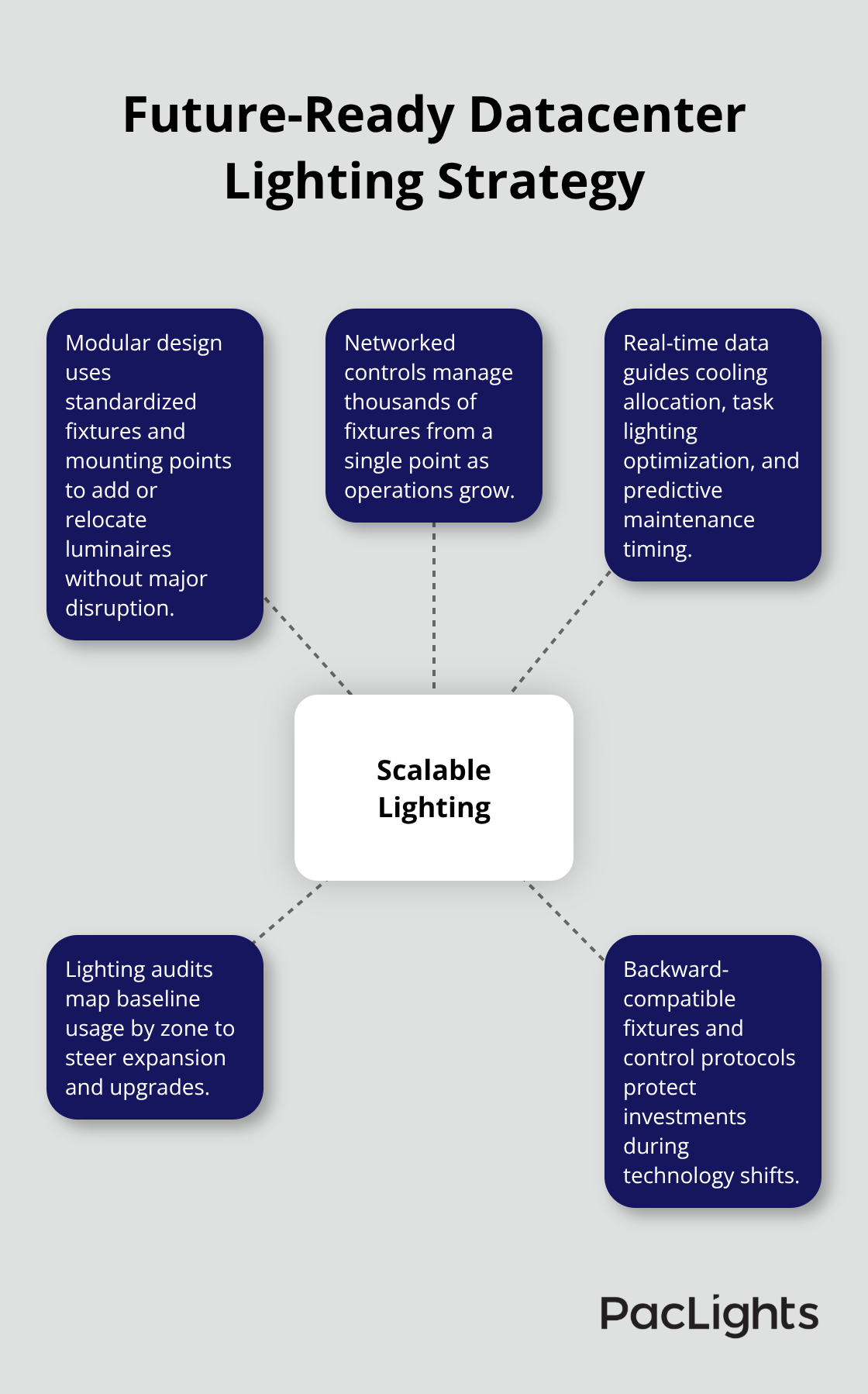
Conduct a lighting audit before expansion to map current energy consumption by zone, identify underutilized fixtures, and establish baseline metrics for measuring efficiency gains post-upgrade. This data becomes your roadmap for intelligent scaling decisions and helps you avoid costly mistakes during infrastructure growth.
Backward Compatibility Protects Your Investment
Planning for upgrades means selecting luminaires and control platforms designed for backward compatibility with emerging technologies. LED fixtures that support both wired and wireless control protocols remain relevant as your facility evolves, avoiding premature obsolescence. This approach protects your capital investment and ensures your lighting infrastructure adapts to future innovations without complete replacement.
Final Thoughts
The 2025 trends in datacenter lighting point toward a clear winner: operators who combine LED efficiency, smart controls, and modular infrastructure outperform those clinging to legacy systems. LED fixtures cut lighting energy consumption by up to 75 percent compared to incandescent sources and roughly 50 percent versus fluorescent, which cascades directly into cooling savings because lighting heat accounts for measurable portions of your total facility energy demand. When you pair LED with occupancy sensors, daylight harvesting, and centralized controls, you gain additional efficiency gains that separate high-performing datacenters from average ones.
Networked lighting systems enable remote management across entire campuses, detect equipment failures weeks earlier than manual inspections, and provide real-time data to drive scaling decisions. Modular lighting design prevents expansion bottlenecks, allowing datacenters that architect systems for growth from day one to deploy capacity 30–40 percent faster when demand increases. Backward compatibility with emerging control protocols protects your capital investment and ensures your infrastructure adapts to future innovations without complete replacement.
We at PacLights understand datacenter operators need reliable, efficient lighting paired with controls that scale without costly overhauls. Upfront investments in LED and smart controls pay for themselves through lower operating costs, reduced maintenance labor, and extended fixture lifespans. Contact PacLights today to receive a free lighting layout design and ROI assessment tailored to your datacenter’s specific needs.
Disclaimer: PacLights is not responsible for any actions taken based on the suggestions and information provided in this article, and readers should consult local building and electrical codes for proper guidance.