

Data centers and server rooms lose thousands of dollars annually due to poor visibility during maintenance. At PacLights, we’ve seen firsthand how inadequate lighting creates safety risks, slows repairs, and leads to compliance violations.
The right rack cabinet lighting ideas transform how your team works. Better illumination means faster troubleshooting, fewer accidents, and equipment that lasts longer.
Why Proper Rack Cabinet Lighting Matters
The Real Cost of Poor Visibility
Poor lighting in data centers and server rooms costs facilities real money. Technicians working in dim enclosures make mistakes that damage expensive equipment, miss critical warning indicators, and spend twice as long on routine maintenance tasks. ASHRAE 90.1 energy standards and IECC codes require adequate illumination in equipment spaces, meaning inadequate lighting exposes your facility to compliance violations and potential fines. Facilities that tracked technician time discovered their teams spent an extra 30 minutes per shift simply searching for cable connections and equipment labels in poorly lit racks. That’s not a minor inconvenience-it’s lost productivity across your entire team.

Motion-Activated LED Lighting Solves Visibility Problems
Motion-activated LED lighting eliminates visibility issues immediately. When technicians approach a rack, lights activate automatically, removing the need to fumble for switches or work in shadows. This approach also cuts energy waste significantly since lights operate only during actual maintenance windows, not during idle periods. The result: your facility pays less for electricity while your team works faster and safer.
Safety Hazards in Dark Enclosures
Safety hazards multiply in dark enclosures. Technicians trip over cables, miss equipment damage, and fail to notice overheating components that could fail catastrophically. LED fixtures with proper heat dissipation prevent thermal buildup that shortens equipment lifespan and causes unexpected downtime.
Strategic Positioning and Color Temperature
A practical strategy involves mounting LED strip lights at the back edge of enclosures about one inch from the panel, delivering even illumination across cable faces and connector labels without creating glare on screens or displays. Color temperature matters here-4000K to 5000K cool white lighting maximizes visibility for detailed work and reduces eye strain during extended maintenance sessions.
Low-Voltage Systems and Flexible Control
Low-voltage 12V or 24V LED systems with centralized drivers offer superior safety compared to line voltage options in dense cabinet spaces, reducing electrical hazards and heat output simultaneously. Dimmable drivers enable technicians to adjust brightness for different tasks, switching from bright task lighting during repairs to softer illumination when simply monitoring systems. This flexibility, combined with motion sensors that activate lights only when cabinet doors open, delivers both immediate safety improvements and measurable energy savings that compound over months and years of operation. These efficiency gains set the stage for understanding how LED technology specifically addresses the unique demands of rack environments.
LED Lighting Solutions That Work in Rack Environments
Strip Lights and Panel Lights for Confined Spaces
LED strip lights and panel lights deliver the practical performance that rack cabinet spaces demand. Interior cabinet strip lights mount directly under shelves or along the edges of enclosures, casting light onto cable runs, connector labels, and equipment faces where technicians actually need visibility. Panel lights sit flush against cabinet surfaces and provide even illumination across larger areas without the depth requirements of traditional fixtures. Strip lights excel in tight spaces where every inch counts, while panel lights work better in wider cabinets where you need consistent brightness across an entire wall. Most facilities find that 300 to 800 lumens per fixture provides adequate visibility for standard maintenance tasks, though larger enclosures or those housing sensitive equipment may require brighter output.
Color Temperature and Visual Clarity
The color temperature you select directly impacts technician performance. Cool white lighting at 4000K to 5000K reduces eye strain during extended work sessions and ensures cable labels and equipment indicators render clearly without color distortion. Warm white lighting below 3000K looks inviting in office spaces but creates visibility problems in technical environments where accuracy matters. This distinction separates effective rack lighting from inadequate solutions that compromise both safety and efficiency.
Motion Sensors and Dimmable Controls
Motion-activated LEDs and dimmable drivers transform how facilities manage both energy consumption and operational flexibility. Motion sensors eliminate the inefficiency of lights running 24/7 in spaces accessed only during scheduled maintenance windows, cutting lighting energy consumption by up to 75 percent compared to always-on incandescent or fluorescent systems. Dimmable LED drivers allow technicians to adjust brightness on demand-full intensity for detailed troubleshooting work, reduced brightness for routine monitoring tasks.

Low-voltage 12V or 24V systems with centralized drivers outperform line voltage alternatives in rack spaces because they generate less heat, reduce electrical hazards in dense cabinet layouts, and allow easier integration with motion sensors and programmable controls.
Thermal Performance and Long-Term Reliability
Heat dissipation becomes critical in enclosures where ambient temperatures already run warm from equipment operation. LED fixtures with aluminum housings and proper ventilation paths prevent thermal buildup that degrades light output and shortens component lifespan. Fixtures mounted one inch from the back panel allow air circulation behind the light, maintaining consistent performance over years of operation. This thermal management approach protects your investment while keeping technicians safe from overheating components.
Smart Controls and Energy Monitoring
Smart controls that integrate with building management systems enable predictive maintenance scheduling and real-time energy monitoring across multiple racks, giving facilities visibility into which enclosures consume the most power and when optimization opportunities exist. These networked systems transform lighting from a static installation into an active tool for facility management. Understanding how to position these lights correctly and route their power systems determines whether your installation delivers maximum efficiency or falls short of its potential.
Installing Rack Lights Where They Actually Matter
Positioning Lights for Optimal Visibility
Mounting position determines whether your lighting installation delivers crisp visibility or creates annoying shadows that force technicians to work around the lights themselves. The standard approach-placing LED strip lights one inch from the back panel of each enclosure-works because it positions the light source close enough to illuminate cable runs and connector labels without casting shadows across equipment faces or creating glare on display screens. This one-inch distance accounts for typical cabinet depth, airflow requirements behind fixtures, and the spread angle of LED light distribution. Facilities that position lights too far from the back panel discover their technicians still struggle to read fine print on labels, while lights mounted flush against panels trap heat and reduce fixture lifespan.
Technicians need horizontal strips along the back edge rather than vertical strips on side panels, since this orientation lights the areas where they actually look-cable connections, port numbers, and status indicators on equipment faces. For wider enclosures exceeding 36 inches, dual strips on opposite sides of the back panel eliminate dark zones in the center. Color temperature selection directly impacts how clearly technicians see equipment details; 4000K to 5000K cool white lighting renders cable labels and indicator lights with true color accuracy, while warm white options below 3000K create a yellowish cast that obscures color-coded wiring and status indicators. Technicians working with color-coded cables make fewer connection errors under proper color temperature, reducing the risk of equipment damage during maintenance work.
Cable Routing and Power Distribution Strategy
Cable routing and power distribution require deliberate planning to avoid creating fire hazards or maintenance nightmares. Low-voltage 12V or 24V systems with centralized drivers eliminate the need to run individual line voltage circuits to each fixture, reducing both the physical cable burden inside enclosures and electrical hazards in dense cabinet spaces. Power cables should run along the top or bottom perimeter of racks using cable trays or adhesive clips rated for the cable weight, staying away from equipment cooling airflow paths that could face obstruction. Junction boxes or accessible connection points inside cabinets allow future upgrades without rerouting cables through entire enclosure runs.
Calculating Brightness Requirements
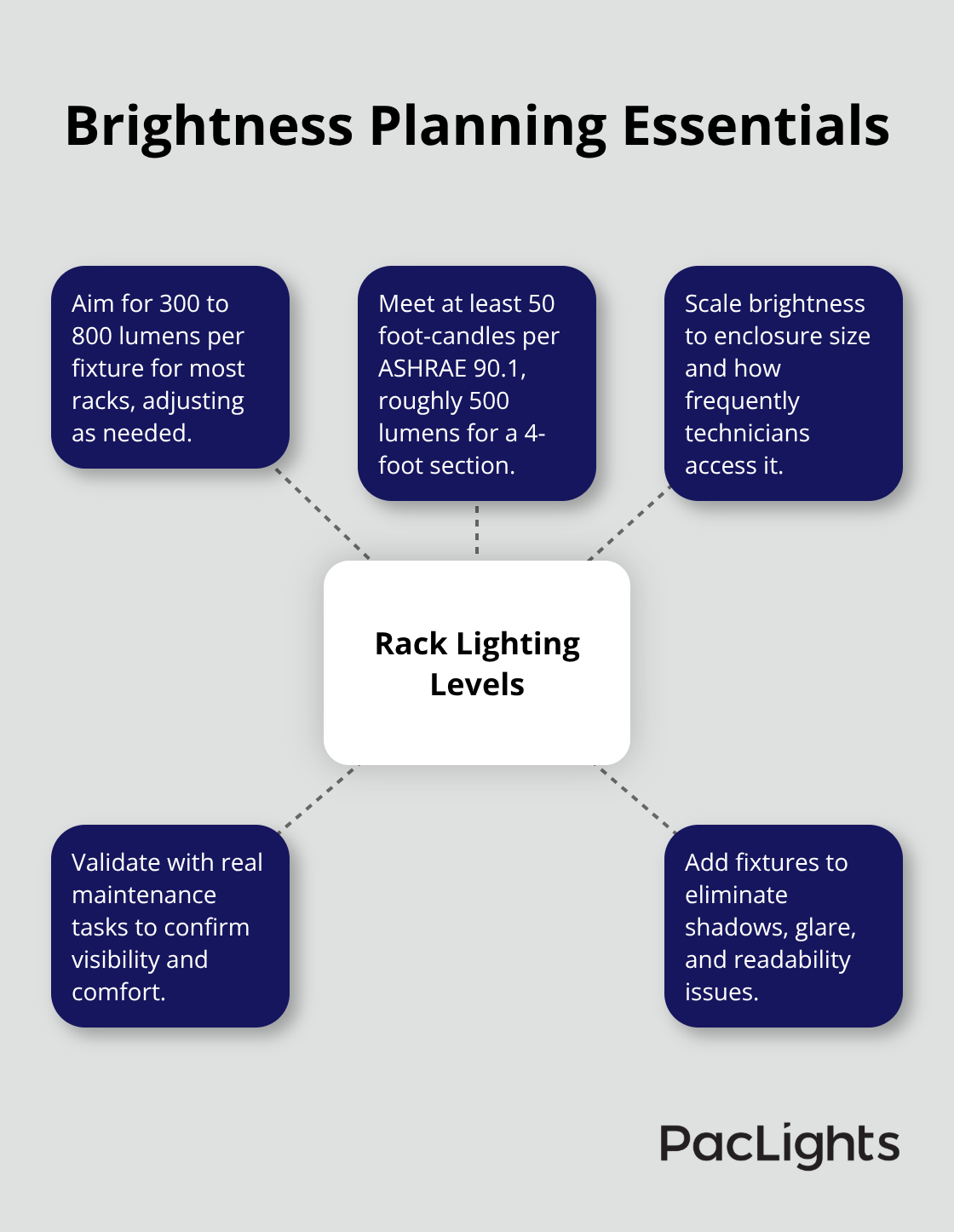
Lumens calculations must account for actual enclosure dimensions and maintenance frequency. A cabinet housing primarily passive equipment accessed monthly needs less brightness than a densely packed server enclosure where technicians work daily. Standard guidance suggests 300 to 800 lumens per fixture for most racks, but verification against your specific cabinet layout and the visual acuity demands of the work matters significantly. ASHRAE 90.1 standards require minimum 50 foot-candles of illumination in equipment spaces, which translates to roughly 500 lumens for a typical 4-foot cabinet section. Test your installation before finalizing by having technicians perform actual maintenance tasks under the new lighting; if they request higher brightness or complain about shadows, add additional fixtures rather than accepting a suboptimal setup that forces workarounds for months or years.
Final Thoughts
Modern rack cabinet lighting ideas deliver measurable returns that extend far beyond improved visibility. LED strip lights with motion sensors and dimmable controls cut lighting energy consumption by up to 75 percent compared to always-on incandescent systems, translating to real savings on your electricity bill month after month. A typical data center with 50 racks spending $5,000 annually on lighting reduces that figure to $1,250 through efficient LED installation with motion activation.
The financial case strengthens when you factor in reduced maintenance time. Technicians working under proper illumination complete routine tasks 30 percent faster than those struggling in dim enclosures, and this efficiency gain compounds across your entire team over a year, recovering installation costs within 12 to 18 months for most facilities. Equipment lasts longer too, since proper thermal management in LED fixtures prevents the overheating that shortens component lifespan and protects your expensive server investments.
We at PacLights provide free lighting layout designs and ROI assessments that show exactly what your facility can save with upgraded rack cabinet lighting. Our LED retrofit solutions integrate seamlessly with existing systems, and our advanced lighting controls including motion sensors and networked options optimize energy use across your entire installation. Contact us to schedule your facility assessment and transform both your bottom line and your team’s working conditions.
Disclaimer: PacLights is not responsible for any actions taken based on the suggestions and information provided in this article, and readers should consult local building and electrical codes for proper guidance.