

Datacenters face constant pressure to balance operational efficiency with safety. Poor lighting creates hazards that lead to accidents, equipment damage, and compliance violations.
At PacLights, we know that datacenter safety lighting standards aren’t optional-they’re the foundation of a secure facility. This guide covers the standards you need to follow and how to implement them effectively.
Why Safety Lighting Protects Your Bottom Line
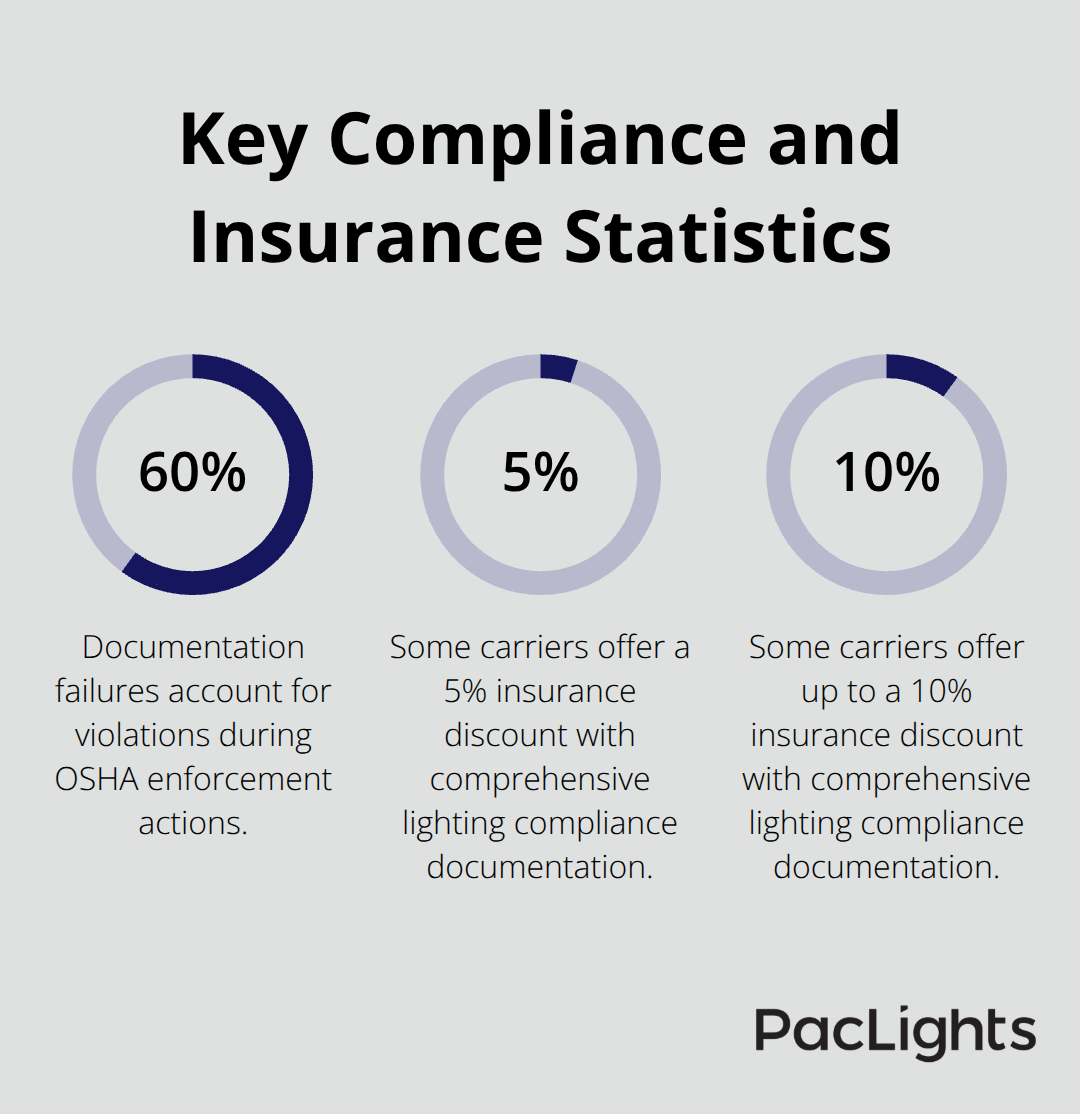
Poor lighting in datacenters causes tangible financial damage that extends far beyond the initial accident. OSHA enforcement data show average fines of about $15,000 per violation for non-compliance with emergency lighting standards, and documentation failures account for roughly 60% of violations. Most facilities don’t fail because they lack equipment-they fail because they don’t maintain proper records.
A single audit gap costs thousands.
The Real Cost of Inadequate Illumination
Inadequate illumination creates immediate operational risk. When technicians work in server aisles with insufficient lighting, they miss cable connections, install equipment incorrectly, or damage hardware during maintenance. A misaligned fiber optic cable or a poorly seated component cascades into equipment failures that take hours to diagnose and repair. Downtime in a datacenter costs roughly $5,600 to $9,000 per minute depending on facility size and client contracts, so even a 30-minute incident driven by a maintenance error in dim lighting destroys profitability.
NFPA 101 Life Safety Code mandates at least 1.0 foot-candle on all egress paths during normal operation, dropping to 0.6 foot-candles under emergency power. This standard reflects the minimum illumination needed to prevent falls, equipment strikes, and disorientation during evacuation. The illumination ratio between brightest and dimmest areas must not exceed 40:1 to prevent dangerous shadows that disorient evacuees. Meeting these standards requires deliberate fixture placement and maintenance discipline.
Compliance Obligations in High-Density Facilities
Datacenters with power densities exceeding 100 watts per square foot in white space face amplified life-safety obligations because confined spaces, raised floors, and isolated hot and cold aisles complicate egress design. OSHA standards 1910.37 and 1910.38 override local codes and mandate emergency lighting in all occupied datacenter areas. Emergency lighting must activate within 10 seconds of power loss and provide at least 90 minutes of illumination. Monthly 30-second functional tests and annual 90-minute tests are required, with records kept for at least three years. Facilities that skip these tests or fail to document them end up in violation.
Security systems that restrict egress-such as electromagnetic locks or card readers on emergency exits-must coordinate with NFPA 101 and include fail-safe mechanisms. Doors must open from the egress side even during power loss. This integration is often overlooked during facility upgrades, leaving a dangerous gap between security and safety.
Proper emergency lighting demonstrates operational maturity to clients and regulators. Enterprise customers conducting due diligence audits expect comprehensive lighting documentation, tested backup systems, and clear egress routes. Facilities that demonstrate three years of maintenance logs and recent compliance testing close deals faster and negotiate better terms because perceived risk drops significantly.
How Illumination Protects Assets and Reduces Claims
Adequate lighting directly protects expensive equipment and reduces insurance claims. When technicians see clearly during maintenance windows, they avoid accidental damage to circuits, components, and cabling. The cost of replacing a damaged network switch or server motherboard ranges from $2,000 to $15,000 per unit; preventing even one accident per year pays for a comprehensive lighting upgrade.
Environmental monitoring equipment and fire suppression systems also depend on visibility during inspection and activation. If a technician cannot see a battery backup unit or UPS room clearly, they miss signs of corrosion, leakage, or overheating that trigger catastrophic failures. Lighting in UPS rooms, generator spaces, and battery storage areas is explicitly required under NFPA 101 because these spaces contain both ignition hazards and life-safety infrastructure. Proper illumination allows staff to identify problems before they escalate into facility-wide outages.
Insurance carriers increasingly scrutinize emergency lighting compliance as part of their risk assessment. Facilities with documented, tested emergency systems and clear maintenance records qualify for lower premiums and faster claims processing. Some carriers offer 5–10% discounts on coverage when comprehensive lighting compliance documentation is provided during renewal.
These financial and operational pressures make lighting standards non-negotiable. The next section examines the specific standards that govern datacenter lighting and how to implement them effectively.
Standards That Actually Govern Your Datacenter Lighting
NFPA 101 Life Safety Code controls emergency lighting in datacenters, not ANSI/IES RP-7 or ISO 14644. This distinction matters because many facility managers waste time chasing the wrong standards. NFPA 101 specifies exactly what you need: 1.0 foot-candle average on egress paths during normal operation, with a minimum of 0.1 foot-candles in the darkest spots, and a 40:1 maximum ratio between brightest and dimmest areas to prevent disorienting shadows. Under emergency power after 90 minutes, the standard drops to 0.6 foot-candles average and 0.06 foot-candles minimum. These numbers are not suggestions-they define the illumination your facility must maintain during evacuation. The International Building Code allows 1 foot-candle initially but permits dimming to 0.06 foot-candles after 90 minutes under emergency power, though stricter local rules often override this.
How Emergency Power and Electrical Standards Apply
NFPA 70, the National Electrical Code, governs how emergency power connects to lighting systems and requires that Level 1 emergency power restore within 10 seconds and sustain the load for at least 90 minutes. UL 924 certification matters because it mandates self-diagnostic capabilities in emergency lighting inverters-these systems automatically log test results and battery status, eliminating manual tracking headaches. The practical takeaway: stop researching cleanroom standards unless your datacenter actually operates as a cleanroom facility. Most datacenters classify as Business Occupancies under IBC, which means NFPA 101 governs your life-safety obligations, not specialized cleanroom codes.
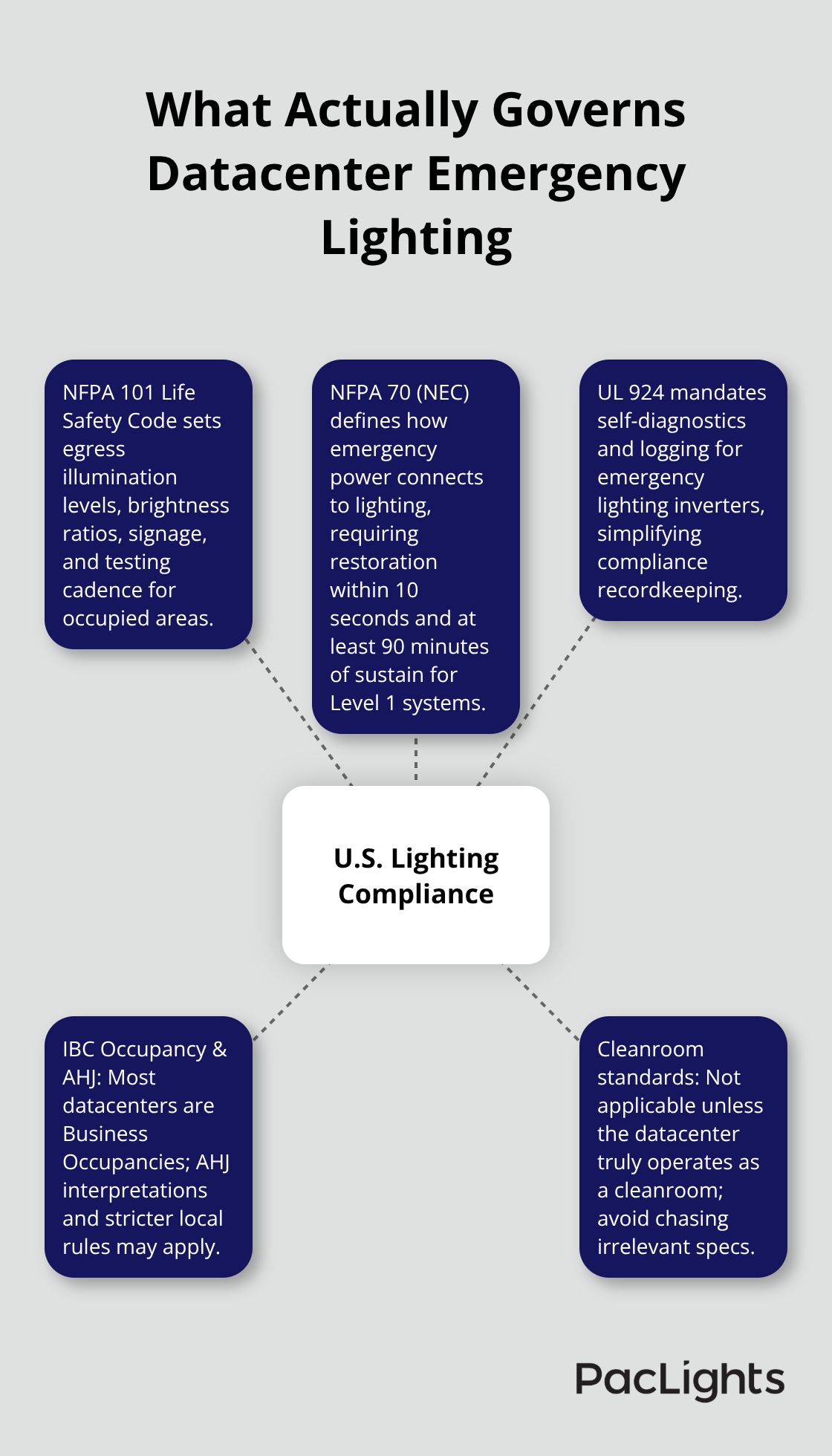
Your Authority Having Jurisdiction (AHJ) may interpret occupancy classification differently, so early engagement with your local building official prevents costly redesigns later.
Fixture Placement Determines Compliance, Not Just Wattage
Mounting height and spacing directly control whether you meet the 40:1 illumination ratio. Wall-mounted emergency fixtures belong at 80–84 inches high in narrow corridors between equipment racks, while ceiling-mounted fixtures work best in cold aisles wider than 12 feet and should be spaced roughly 10 feet apart to maintain uniform coverage. Many facilities install fixtures randomly and then fail inspections because dark zones create dangerous shadows. The 40:1 ratio exists because evacuees moving quickly cannot adapt to sudden darkness-a person moving from a 500-lux area into a 10-lux shadow stops, disoriented, creating bottlenecks.
Testing and Verification Requirements
Quarterly lux verification with a calibrated meter proves compliance; try 500+ lux in data halls during normal operation and at least 54 lux on exit signs. NFPA 101 requires exit signage to display the word Exit plainly legible, at least 6 inches high with strokes no less than 0.75 inches wide. LED exit signs outperform incandescent because they maintain brightness through dust and smoke, and photoluminescent backup materials allow some visibility during complete power loss. IP65-rated fixtures resist condensation and dust accumulation, which matters because moisture in datacenters degrades non-sealed fixtures within months.
Battery Systems and Maintenance Protocols
Battery-backed systems must undergo monthly 30-second functional tests and annual 90-minute duration tests, with records kept for at least three years. Nickel-metal hydride batteries last 7–10 years versus 3–5 years for sealed lead-acid, and they tolerate temperature swings better in high-density facilities. Automatic test reporting notifies staff roughly 60 days before battery replacement is necessary, preventing failures during actual outages. These maintenance protocols transform emergency lighting from a compliance checkbox into a reliable safety system that protects both occupants and assets during power loss.
Implementing Lighting That Actually Works in Your Datacenter
Map Your Facility and Measure Baseline Illumination
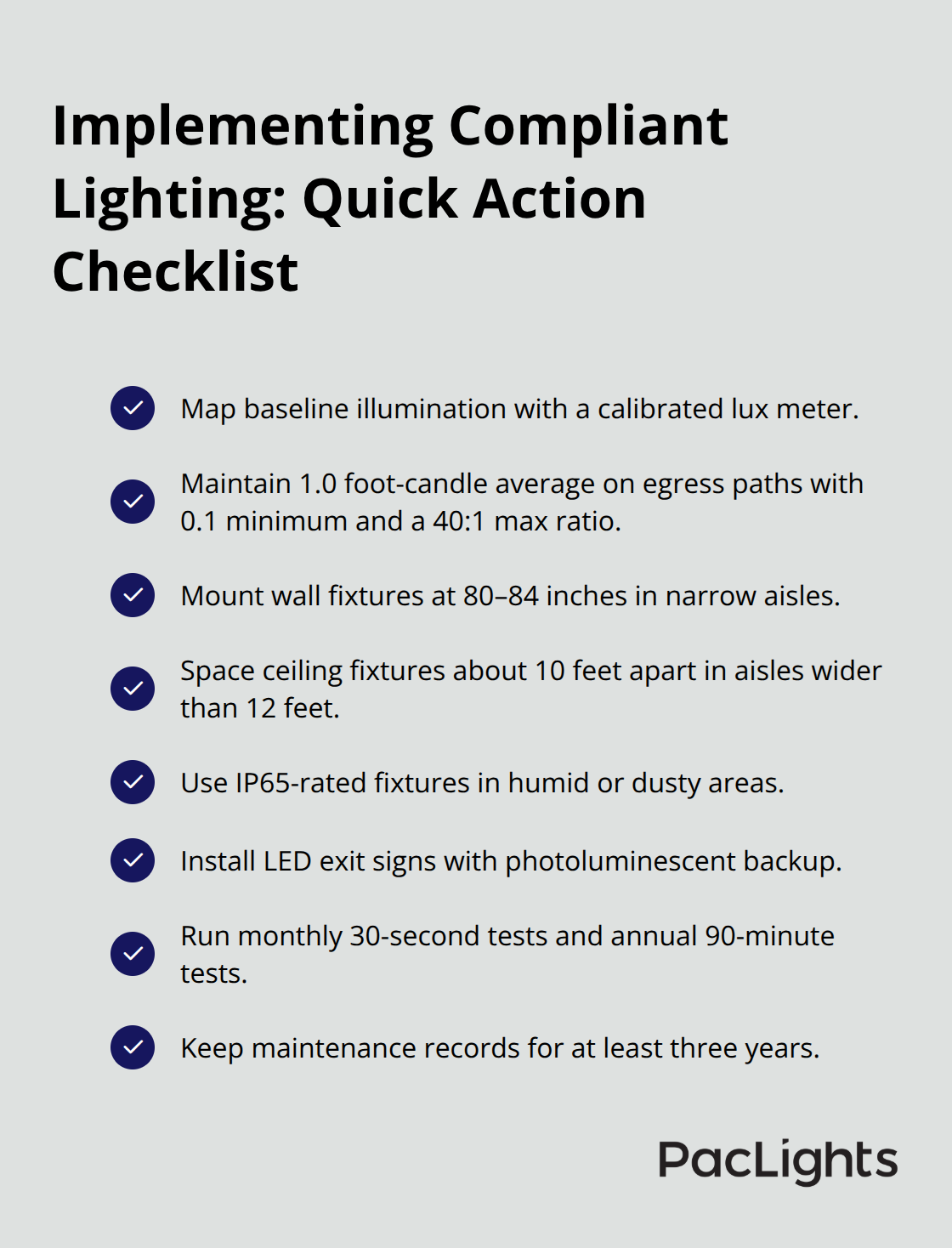
Start with a site survey that measures existing illumination levels across every critical zone. Use a calibrated lux meter to map your server aisles, UPS rooms, generator spaces, and exit routes during normal operation. You need at least 1.0 foot-candle average on all egress paths, with no area dropping below 0.1 foot-candles and no ratio exceeding 40:1 between the brightest and darkest spots. Most facilities discover dark zones they never noticed because technicians adapted to poor conditions rather than reporting them. These shadows are exactly where accidents happen during evacuations. Measure at floor level where people move, not at eye height. Once you have baseline data, you can prioritize fixture placement strategically instead of relying on guesswork.
Position Fixtures to Eliminate Shadows and Maintain Compliance
Wall-mounted emergency fixtures at 80–84 inches high work best in narrow corridors between equipment racks, while ceiling-mounted units spaced roughly 10 feet apart illuminate cold aisles wider than 12 feet effectively. IP65-rated fixtures prevent condensation and dust buildup that degrade non-sealed units within months in humid datacenters. The goal is uniform coverage that maintains the 40:1 ratio without creating shadows that disorient evacuees moving quickly through tight spaces. Proper placement prevents the dangerous illumination gaps that cause falls and disorientation during power loss.
Install and Verify Exit Signage
Exit signage requires at least 54 lux on the sign face and must display the word Exit plainly legible at 6 inches high minimum with strokes no less than 0.75 inches wide. LED exit signs outperform incandescent because they preserve brightness through smoke and dust, critical during actual fires. Photoluminescent backup materials provide some visibility during complete power loss without consuming battery power. After you install fixtures, establish a quarterly verification schedule with documented lux measurements. Try 500+ lux in data halls during normal operation and at least 54 lux on exit signs to confirm compliance.
Execute Monthly Tests and Annual Duration Verification
Monthly 30-second functional tests and annual 90-minute duration tests are mandatory under NFPA 101, and records must be kept for three years minimum. Automatic test reporting systems catch battery capacity degradation roughly 60 days before replacement becomes necessary, preventing failures during actual power loss. Nickel-metal hydride batteries last 7–10 years versus 3–5 years for sealed lead-acid, and they tolerate temperature swings better in high-density facilities.
Schedule tests during maintenance windows when you can simulate primary power loss and verify backup activation within 10 seconds while maintaining minimum illumination levels. Weekly walk-throughs identify flickering LEDs and dust accumulation before they trigger compliance violations.
Document Everything and Prevent Costly Violations
Document all test results meticulously because OSHA enforcement data show that documentation failures drive roughly 60% of violations, and a single missing test record can cost $15,000 in fines even if your fixtures meet standards. Maintain organized records that demonstrate three years of compliance history. This documentation protects your facility during audits and proves operational maturity to clients and regulators. Enterprise customers conducting due diligence expect comprehensive lighting records, tested backup systems, and clear egress routes. Facilities that demonstrate consistent maintenance logs and recent compliance testing close deals faster and negotiate better terms because perceived risk drops significantly.
Final Thoughts
Datacenter safety lighting standards form the backbone of operational safety and regulatory compliance. NFPA 101 Life Safety Code mandates 1.0 foot-candle average illumination on egress paths during normal operation, dropping to 0.6 foot-candles under emergency power, with a maximum 40:1 brightness ratio to prevent disorienting shadows. Emergency lighting must activate within 10 seconds and sustain for 90 minutes minimum, and these requirements exist because poor lighting directly causes accidents, equipment damage, and compliance violations that cost thousands in fines and downtime.
The financial impact proves immediate and measurable. OSHA enforcement averages $15,000 per violation, with documentation failures driving 60% of violations, while a single maintenance error in dim lighting can trigger 30 minutes of downtime costing $5,600 to $9,000 per minute. Proper illumination prevents equipment damage, reduces insurance claims, and demonstrates operational maturity to enterprise clients conducting due diligence audits-facilities with three years of documented maintenance logs and recent compliance testing close deals faster and negotiate better contract terms because perceived risk drops significantly.
Implementation requires deliberate action across fixture placement, battery selection, and testing discipline. Map your facility with a calibrated lux meter to identify dark zones, position wall-mounted fixtures at 80–84 inches high in narrow corridors and ceiling-mounted units roughly 10 feet apart in wider aisles, install LED exit signs with photoluminescent backup materials, and execute monthly 30-second functional tests and annual 90-minute duration tests while maintaining organized records for three years. We at PacLights offer free lighting layout designs and ROI assessments to help you identify the fixtures and controls that maximize safety, efficiency, and cost savings for your facility.
Disclaimer: PacLights is not responsible for any actions taken based on the suggestions and information provided in this article, and readers should consult local building and electrical codes for proper guidance.