

Data center lighting directly impacts your operating costs and facility performance. Most operators overlook how much energy their lighting systems consume, missing significant savings opportunities.
At PacLights, we’ve seen facilities cut lighting energy use by 40% or more through smarter design and controls. This guide covers practical data center lighting tips you can implement immediately to reduce costs and improve efficiency.
Why LED Lighting Cuts Data Center Costs Faster Than Any Other Upgrade
Immediate Energy Savings from LED Conversion
LED lighting stands as the single most effective investment you can make in data center efficiency. LEDs consume 75% less energy than traditional fluorescent or incandescent fixtures, and that reduction takes effect immediately upon installation. A typical data center running 24/7 with older lighting systems cuts lighting energy costs by 40% to 60% within the first month of switching to LEDs.

If your facility spends $50,000 annually on lighting, switching to LEDs saves $20,000 to $30,000 per year without any operational changes required.
How LEDs Reduce Your Cooling Load
The real advantage extends beyond direct energy savings. LEDs produce significantly less heat than older technologies, which means your cooling systems work less hard to maintain server temperatures. Data centers account for roughly 1% of global energy consumption according to Energy Innovation, and cooling represents 30% to 40% of total facility energy use. When you reduce heat from lighting, you lower cooling demands proportionally. A 40% reduction in lighting energy often translates to a 5% to 10% reduction in overall cooling load, depending on your facility layout and current system efficiency. For a mid-sized data center, this secondary cooling benefit adds another $8,000 to $15,000 in annual savings.
Extended Fixture Lifespan Reduces Maintenance Costs
LEDs last approximately 30 times longer than incandescent bulbs and five times longer than CFLs, meaning you replace fixtures far less frequently. That translates to lower maintenance labor costs and fewer service disruptions during bulb changes. Most LED fixtures maintain at least 70% of their initial brightness after 50,000 hours of operation, which typically represents 5 to 7 years of continuous use in a data center environment. Your technicians spend less time on maintenance ladders and more time on critical infrastructure work.
Selecting the Right LED Fixtures for Your Space
Choosing between high bay and linear lighting solutions depends on your aisle layout and ceiling height. High bay fixtures work well for taller spaces with wide aisles, while linear fixtures suit narrow aisles and lower ceilings. PacLights offers energy-efficient LED fixtures tailored to data center needs, including high bays, linear strip lights, and flat panel options that you can customize with motion sensors or daylight controls. A professional lighting layout assessment helps you identify which fixture types deliver the best return on investment for your specific facility configuration.
How to Position Fixtures for Maximum Visibility and Efficiency
Align Fixtures with Your Aisle Layout
Fixture placement determines whether your data center lighting actually illuminates what technicians need to see. Position lights directly above open aisles between equipment rows, not centered over cabinets themselves. This placement strategy prevents shadows that hide cables and connector ports where technicians spend time troubleshooting. A grid-aligned layout matching your aisle structure ensures uniform coverage across all rows. When fixtures align with equipment spacing rather than generic warehouse patterns, visibility improves dramatically and maintenance time drops.
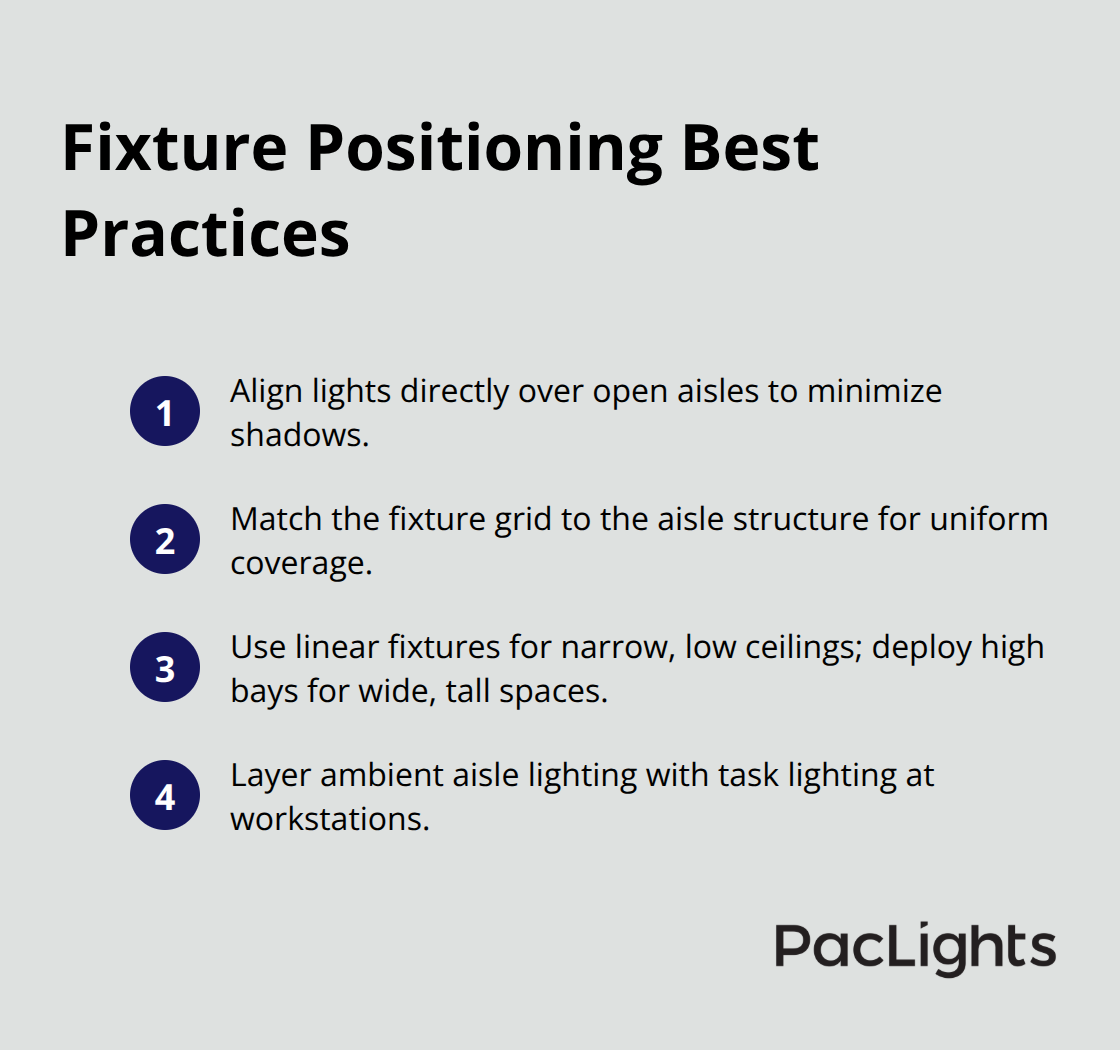
Narrow pendant or linear fixtures work better than large panel lights in tight spaces because they concentrate light where it matters most.
Choose Between Linear and High Bay Solutions
The choice between high bay and linear solutions hinges on your actual aisle dimensions and ceiling height. Linear fixtures excel in narrow aisles under 10 feet wide and ceilings below 12 feet, delivering focused illumination without wasting light on areas technicians never access. High bay fixtures suit wider aisles and taller ceilings where you need to illuminate larger floor areas. If your facility uses traditional drop ceilings, consider upgrading to suspended ceiling tracks that let you reposition fixtures as your equipment layout evolves. This flexibility saves thousands in installation costs when you add or reconfigure cabinet rows.
Layer Ambient and Task Lighting
Task lighting near maintenance stations and equipment inspection areas adds a second layer of brightness where concentrated work happens. Place these focused lights at eye level or slightly above to minimize glare on monitor screens and control panels. This layered approach combines ambient aisle lighting with task-specific brightness, reducing overall energy consumption while keeping critical work areas fully illuminated. Most data center aisles function well at 200 to 300 lux during maintenance windows, compared to 500 to 750 lux in administrative spaces.
Calibrate Brightness to Actual Needs
Avoid over-lighting by calibrating lumen levels to actual visibility requirements rather than installing maximum brightness everywhere. Dimmable fixtures let you adjust brightness during different operational phases, cutting energy waste during low-activity periods while maintaining safety standards. Motion sensors automatically dim lights when aisles sit empty, further reducing unnecessary consumption. These controls work best when paired with networked systems that monitor occupancy across your entire facility and adjust illumination in real time based on actual technician movement and activity patterns.
Automating Your Data Center Lighting for Real Energy Gains
Motion Sensors Cut Energy Waste in Empty Aisles
Automated controls separate data centers that waste money from those that operate efficiently. Motion sensors transform static lighting installations into responsive environments that adjust to actual occupancy patterns. A facility running lights at full brightness around the clock, regardless of whether anyone occupies the space, throws away thousands annually. Motion sensors alone cut lighting energy use by 20% to 35% in typical data centers because aisles sit empty during nights and weekends. Occupancy sensors detect when technicians enter a space and trigger brightness to full levels within seconds, then gradually dim or switch off after detecting no movement for 10 to 15 minutes.
Position sensors with an unobstructed view of your aisle layout so they capture all traffic patterns accurately. This placement ensures the system responds to actual technician movement rather than triggering on false signals from equipment vibration or air currents. Proper sensor positioning multiplies the energy savings you achieve compared to poorly placed units that miss occupancy changes.
Daylight Harvesting Reduces Daytime Lighting Costs
Daylight harvesting works through photoelectric sensors that measure incoming natural light and automatically reduce fixture brightness proportionally. This approach cuts daytime lighting energy consumption by 30% to 50% depending on your geographic location and window orientation. Data centers in southern regions with significant natural light gain more from daylight harvesting than facilities in northern climates with minimal daylight penetration, but even modest daylight integration reduces annual lighting costs measurably.
Facilities with skylights or large window areas see the fastest payback from daylight harvesting systems. The sensors continuously monitor light levels and adjust fixture output in real time, eliminating the need for manual brightness adjustments throughout the day. This continuous optimization prevents the energy waste that occurs when operators forget to dim lights during bright afternoons.
Networked Controls Coordinate Your Entire Lighting System
Networked lighting controls represent the most powerful approach because they coordinate motion sensors, daylight sensors, and manual overrides across your entire facility while collecting real-time data on energy consumption patterns. These systems track which aisles consume the most energy, identify fixtures operating inefficiently, and flag maintenance issues before they impact facility operations.
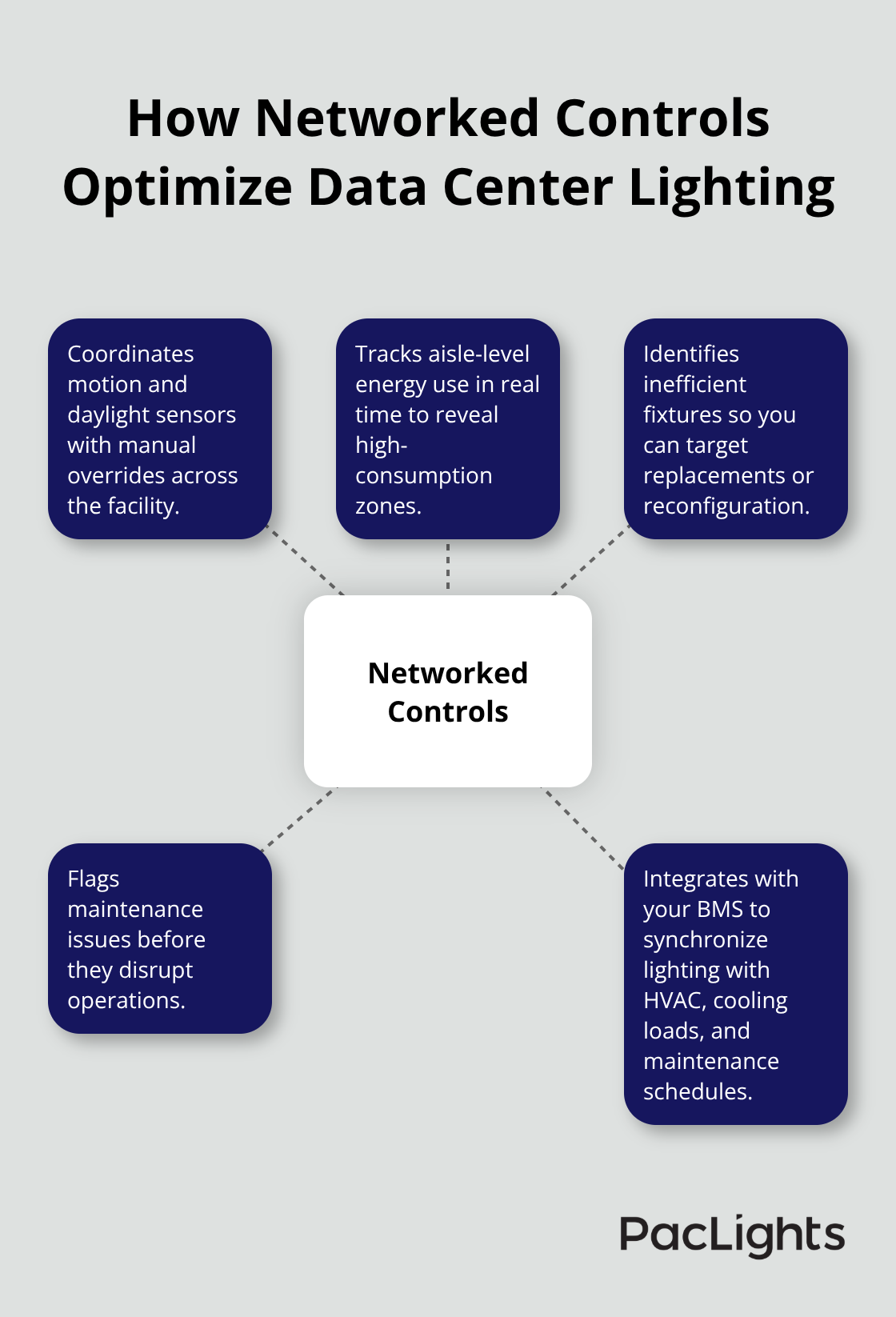
A networked system might reveal that your backup generator area runs at full brightness 24/7 when dimmable fixtures could maintain safety standards at 40% brightness during unoccupied periods.
Advanced platforms integrate with your building management system to synchronize lighting with HVAC operations, cooling loads, and scheduled maintenance windows, optimizing energy across multiple systems simultaneously. This integration prevents conflicts between lighting schedules and equipment maintenance cycles, ensuring technicians always have adequate visibility when they need it.
Installation Costs and Payback Timelines
Installation costs for networked controls typically range from $8,000 to $20,000 for a mid-sized data center, but payback periods of 2 to 3 years are standard because the energy savings compound across thousands of fixtures operating continuously. PacLights offers advanced lighting controls to further optimize energy use, with optional daylight or motion control features that you can customize to your facility’s specific operational patterns.
The financial case for automation strengthens when you factor in reduced maintenance labor and extended fixture lifespan. Automated dimming reduces thermal stress on LED components, extending their operational life beyond standard expectations. Lower operating temperatures mean fewer premature failures and less unplanned maintenance downtime.
Final Thoughts
Data center lighting tips work best when you combine three core strategies: switching to LEDs, positioning fixtures strategically, and automating controls. These changes deliver measurable results immediately and compound over time through reduced energy consumption, lower cooling demands, and minimal maintenance disruption. A facility spending $50,000 annually on lighting saves $20,000 to $30,000 per year by converting to LEDs alone, and adding motion sensors plus daylight harvesting reaches 40% to 50% total energy reductions.
Installation costs for networked controls typically pay back within 2 to 3 years, after which every year represents pure savings. Over a decade, a mid-sized data center recovers $100,000 or more in lighting and cooling costs while extending fixture lifespan and reducing maintenance labor. Efficient lighting also reduces your facility’s carbon footprint meaningfully since data centers consume roughly 1% of global energy, and cutting lighting energy by 40% to 50% eliminates tons of annual carbon emissions while improving technician safety and visibility during maintenance work.
We at PacLights offer free lighting layout designs and ROI assessments to identify which fixtures and controls deliver the best return for your specific configuration. Our energy-efficient LED fixtures, retrofit solutions, and advanced lighting controls including motion sensors and networked systems are tailored to data center operations. Contact PacLights to schedule your facility assessment and begin capturing these savings immediately.
Disclaimer: PacLights is not responsible for any actions taken based on the suggestions and information provided in this article, and readers should consult local building and electrical codes for proper guidance.