

Poor lighting in server racks costs time and creates safety risks. Technicians struggle to identify cables, spot equipment issues, and work efficiently in dim spaces.
We at PacLights know that the right rack cabinet lighting ideas transform maintenance workflows. Better visibility means faster troubleshooting, fewer mistakes, and equipment that lasts longer.
Why Proper Lighting Transforms Rack Maintenance
The Real Cost of Dim Server Racks
Dim server racks force technicians to work blind. They squint at cable labels, struggle to seat components correctly, and miss warning indicators on equipment. This isn’t a minor inconvenience-it directly impacts safety and costs. Data center downtime ranges from about $5,600 to $9,000 per minute depending on facility size and client contracts, according to industry analysis. Poor lighting accelerates that downtime by inflating maintenance duration and multiplying error rates.
A technician working in inadequate light takes significantly longer to trace a cable, identify a loose connection, or swap a failed module. Each extra minute spent troubleshooting adds real expense. Beyond speed, visibility errors carry serious consequences. Misseated network cards, incorrectly routed cables, and overlooked bent pins all stem from poor lighting conditions. These mistakes cascade into equipment failures, unplanned outages, and expensive emergency repairs.
Meeting Industry Standards for Rack Illumination
ASHRAE standards recommend minimum 200 lux vertical illuminance on rack faces and 500 lux on equipment tops to guide rack lighting design. Meeting these targets directly reduces technician error rates and accelerates problem resolution.
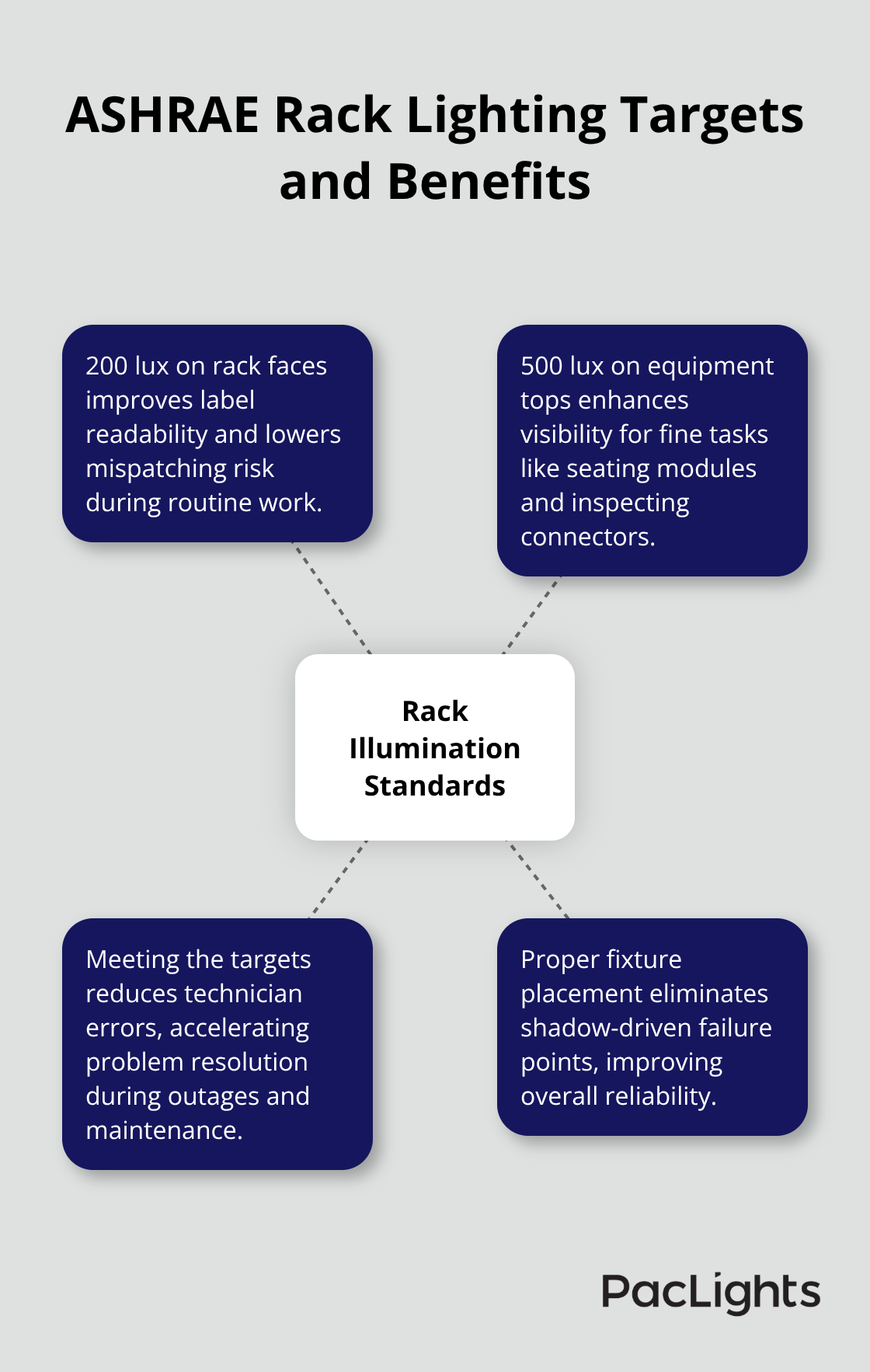
Bright, properly positioned rack lighting eliminates failure points that dim conditions create.
How Better Visibility Protects Your Equipment
Equipment lasts longer under proper maintenance conditions. When technicians can clearly see what they’re working on, they handle components with greater care. They avoid physical damage from fumbling in darkness and catch early signs of wear or thermal stress that preventive maintenance can address. Heat-sensitive components benefit enormously from this attention.
Proper visibility also supports cable management discipline. Technicians who can see their work maintain neater, more efficient cable runs that support better airflow. Cooler equipment runs more reliably and requires fewer emergency interventions.
The Financial Case for Rack Cabinet Lighting
The investment in rack cabinet lighting reduces maintenance time, prevents costly errors, and extends equipment life. These benefits compound across a facility with dozens or hundreds of racks. A single prevented equipment failure typically justifies the lighting investment many times over. Understanding which lighting solutions fit your specific rack configurations helps you maximize these returns and accelerate your maintenance operations.
Choosing the Right Fixture Type for Your Rack Layout
LED Strip Lights for Compact Installations
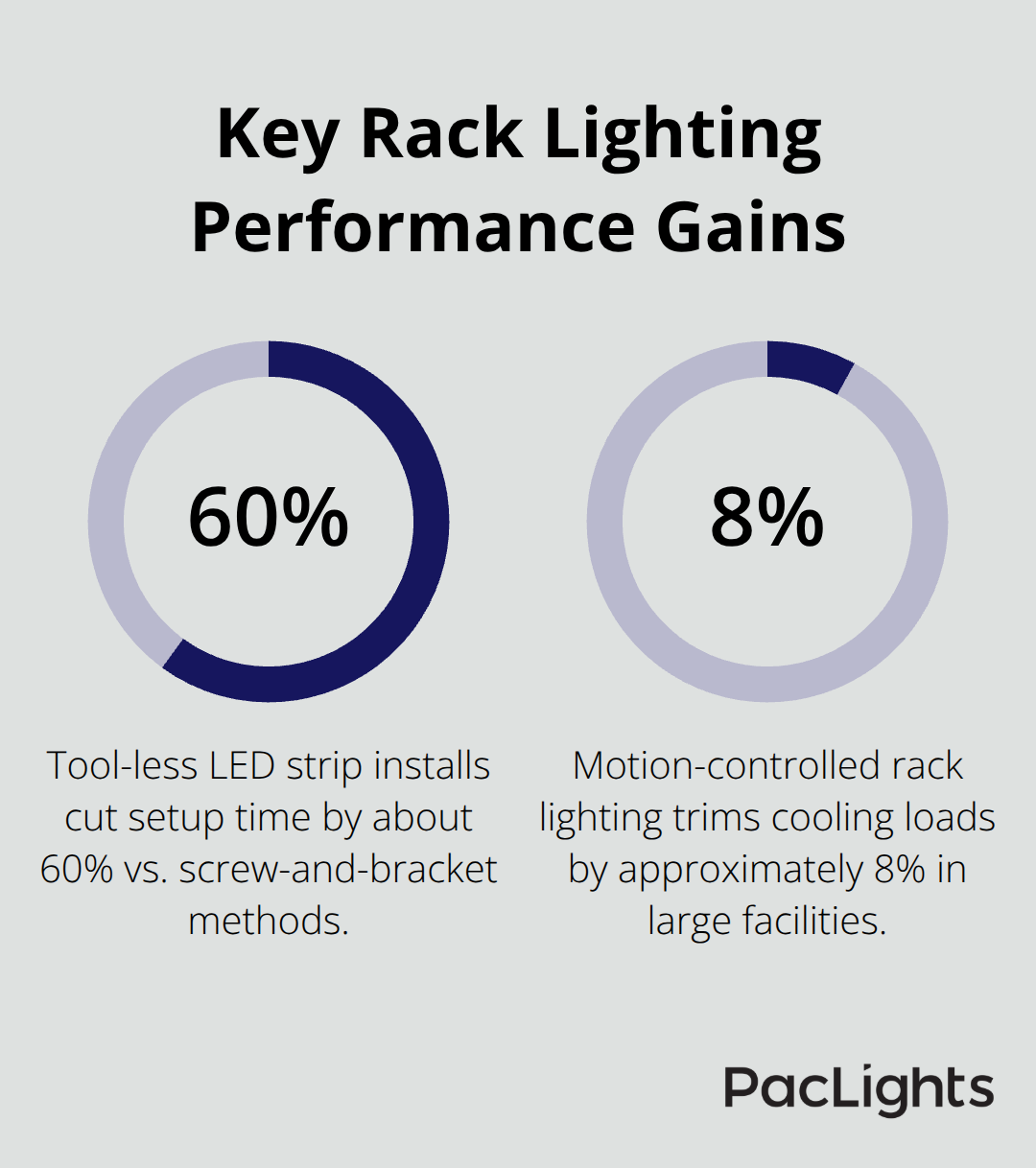
LED strip lights dominate compact rack installations because they deliver 300–600 lumens per 1U fixture while consuming only 15–30 watts. Direct-mount strips fit snugly within tight spaces where traditional fixtures create obstruction or airflow problems. A 1U LED multicolor and white rack light costs around $199.56, making them cost-effective for dense deployments across multiple cabinets. Installation speed sets strips apart: tool-less designs cut setup time by roughly 60% compared to screw-and-bracket methods. PowerCON connectors secure the connection against vibration without requiring additional fasteners.
Adjustable brightness from 10% to 100% lets technicians reduce illumination for routine inspections or increase it for detailed component replacement work.
Spot Lights for Targeted Equipment Access
Spot lights target specific equipment bays rather than illuminating entire rack faces. This targeted approach works exceptionally well in facilities where only certain sections require frequent access. Motion-activated variants reduce energy consumption substantially. Studies show motion-controlled rack lighting cuts cooling loads by approximately 8%, translating to roughly $11,000 annual savings in large facilities because LED fixtures emit far less heat than incandescent alternatives.
Energy Savings and Long-Term ROI
An average 30-watt LED fixture costs about $26 per year in electricity versus roughly $87 for an equivalent incandescent unit at $0.10 per kilowatt-hour. This difference delivers ROI commonly within 2–3 years when factoring in both energy and cooling savings. Aluminum construction withstands temperature fluctuations from 32°F to 104°F, whereas plastic alternatives deteriorate faster in server environments.
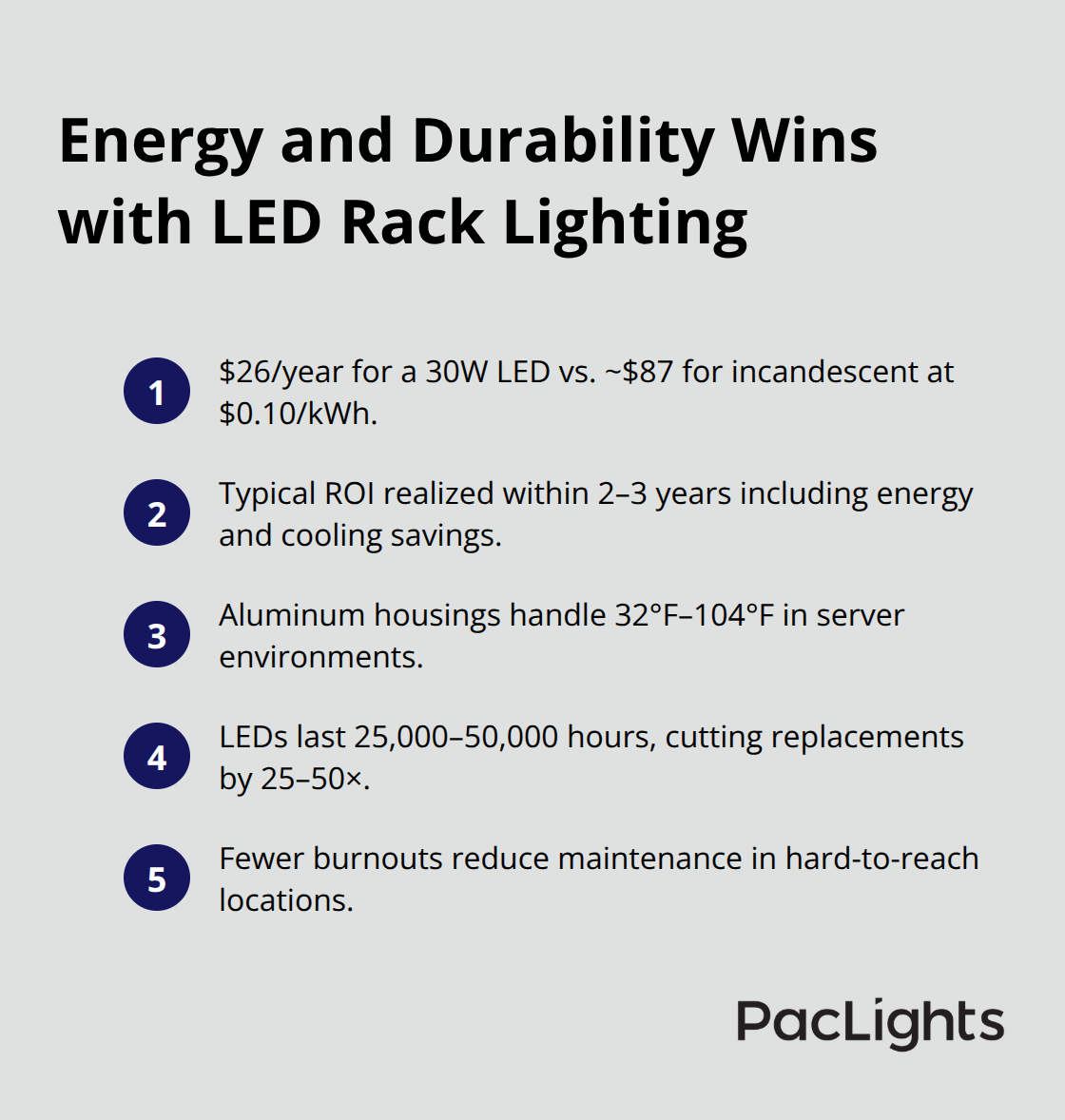
LED lifespans of 25,000–50,000 hours reduce replacement frequency by 25–50 times compared with incandescent, eliminating the frustration of frequent burnouts in hard-to-reach locations.
Validating Performance Before Full Deployment
ASHRAE recommends starting with pilot installations in critical areas to validate performance before facility-wide deployment. This staged approach prevents costly mistakes and confirms that your chosen fixtures meet the 200 lux vertical illuminance standard on rack faces and 500 lux on equipment tops. Testing in real conditions reveals whether your selected fixtures handle your specific thermal environment and maintenance workflows effectively, positioning you to scale confidently across your entire facility.
Getting the Installation Right from Day One
Select the Optimal Color Temperature for Technician Comfort
Color temperature shapes how technicians perceive detail and reduces eye fatigue during extended maintenance sessions. A 4000K color temperature enhances contrast and reduces eye fatigue during maintenance compared with 3000K or 6500K options, making it the superior choice for rack work. Cooler temperatures in the 3500K–5000K range improve visibility of labels, connectors, and cable routing, while warmer 2700K–3000K tones sacrifice contrast for ambiance your technicians do not need. Choose 4000K fixtures from the start rather than retrofitting later when eye strain complaints emerge.
Build Fixtures That Survive Your Environment
Aluminum construction withstands temperature fluctuations from 32°F to 104°F in server environments, whereas plastic alternatives deteriorate faster and fail sooner under thermal stress. Mount fixtures securely using tool-less systems that cut installation time by roughly 60% compared to screw-and-bracket methods, and verify connectors seat firmly to resist vibration. Position lights to minimize glare on indicator panels and polished surfaces; try illuminating toward the back or top of enclosures for uniform coverage rather than creating bright spots that obscure readability.
Validate Performance Before Scaling Across Your Facility
Test the setup by simulating maintenance tasks to confirm fixtures deliver the recommended 200 lux on rack faces before scaling deployment across your facility. This validation step prevents costly mistakes and confirms that your chosen fixtures meet performance standards in your specific thermal environment.
Maintain Cable Discipline to Protect Airflow and Performance
Cable management discipline directly impacts airflow efficiency and fixture longevity. Route power and data cables away from fixture mounting points to prevent heat concentration and interference with equipment ventilation. Use cable ties and management clips to maintain clear separation between lighting circuits and server infrastructure, reducing electromagnetic noise that can degrade network performance.
Track Brightness Degradation Through Scheduled Verification
Schedule quarterly lux verification with a calibrated meter to confirm fixtures maintain 500 lux on equipment tops where technicians perform detailed work, since dust accumulation and thermal cycling degrade brightness over time. Clean fixture lenses and diffusers every three months in high-traffic maintenance areas, more frequently in facilities with poor air filtration. LED strips and puck lights typically maintain 25,000–50,000 hour lifespans, meaning quarterly cleaning extends this performance window and delays the 25–50 times fewer replacements compared with incandescent alternatives. Document baseline illumination measurements and maintenance dates in a simple spreadsheet to track performance trends and catch failing fixtures before they compromise your maintenance workflows.
Final Thoughts
Proper rack cabinet lighting transforms maintenance from a frustrating, error-prone process into a streamlined operation that protects your equipment and your bottom line. Technicians work faster when they can see clearly, mistakes drop dramatically, and equipment lasts longer under proper care. Data center downtime costs $5,600 to $9,000 per minute, making even small improvements in maintenance speed and accuracy worth thousands of dollars annually.
LED fixtures cost roughly $26 per year to operate versus $87 for incandescent equivalents, and they last 25 to 50 times longer, eliminating frequent replacements in hard-to-reach locations. Motion-activated variants cut cooling loads by approximately 8%, delivering roughly $11,000 in annual savings across large facilities. These savings pay for your lighting investment within 2 to 3 years while reducing your facility’s energy footprint.
Start with a pilot installation in critical areas to validate your approach before scaling across your facility. Test your chosen fixtures against the ASHRAE standard of 200 lux on rack faces and 500 lux on equipment tops, and verify that 4000K color temperature reduces eye fatigue for your team. We at PacLights help you implement rack cabinet lighting ideas that maximize visibility while minimizing costs.
Disclaimer: PacLights is not responsible for any actions taken based on the suggestions and information provided in this article, and readers should consult local building and electrical codes for proper guidance.