

Poor aisle lighting costs warehouses and retail facilities thousands in accidents, lost productivity, and inventory errors every year. At PacLights, we’ve seen firsthand how inconsistent visibility creates real operational problems.
Aisle lighting standards exist for a reason-they protect your team and your bottom line. This guide covers what you need to know about regulations, the measurable impact of proper lighting, and how to fix common visibility problems in your facility.
What OSHA and Industry Standards Actually Require for Aisle Lighting
OSHA’s walking-working surfaces rule under 29 CFR 1910.22 is performance-based and does not mandate a single illuminance number. That said, the agency’s construction standard 1926.56 establishes 5 foot-candles as a baseline minimum, while most warehouses and industrial facilities target 10 foot-candles on the floor for safe movement. The real problem is that many facilities misinterpret these numbers and measure only horizontal illuminance on the floor, assuming compliance without checking uniformity or vertical surfaces.
Why Uniformity Trumps Raw Brightness
OSHA requires exit routes to be adequately lit with uniformity around 10:1 to prevent worker disorientation. If your aisle averages 15 foot-candles but drops to 2 foot-candles in shadowed corners, you’ve created a hazard that regulations do not tolerate. Field measurements show that conventional round high-bay fixtures with 120-degree beams waste 40 to 60 percent of light on rack tops in narrow aisles, leaving lower aisle levels and vertical surfaces underlit. Your horizontal floor reading might meet the 10 foot-candle baseline, but vertical illuminance on rack faces and pedestrians sits at only 3 to 5 foot-candles, degrading depth perception and hazard recognition. Vertical illuminance should be about 50 to 70 percent of horizontal average to reliably distinguish people, forks, and pallet edges.
ANSI/IES RP-7: The Standard That Guides Best Practice
Industry best practice leans on ANSI/IES RP-7 guidance, which targets 30 to 50 foot-candles horizontal average in order-picking zones, 20 to 30 foot-candles in general storage aisles, and 40 to 60 foot-candles at cross-aisles and intersections. RP-7 emphasizes vertical illuminance on rack faces and a uniformity ratio no worse than 3:1 between average and minimum.

Aisle-optic lighting with Type III or Type V asymmetric distributions directly address this gap. These fixtures stretch light along the aisle rather than circling rack tops, improving floor-to-face uniformity and reducing wasted light. When you upgrade to aisle-optimized optics, horizontal illuminance in narrow aisles typically increases 20 to 40 percent for the same wattage, while vertical illuminance on rack faces often doubles. Uniformity improves from roughly 4 to 5:1 with generic high bays down to 2 to 3:1 with aisle-optic solutions, eliminating deep shadow bands that create hazards.
Emergency Lighting and Egress Compliance
NFPA 101 Life Safety Code requires emergency lighting for at least 90 minutes along your egress path, starting at 1 foot-candle and tapering to an average of 0.6 foot-candles. For large facilities, centralized inverter systems are preferred over scattered battery units because they maintain consistent voltage during outages and prevent patchy lighting. Occupancy sensors must bypass emergency mode during a power failure; if your controls delay emergency activation, you violate code and expose workers to real risk. Specify fixtures with instantaneous emergency response and pair them with a 90-minute battery pack or inverter that integrates seamlessly into your aisle design.
Moving Beyond Generic High Bays
The shift from conventional UFO fixtures to aisle-optimized linear solutions directly addresses OSHA egress mandates and improves picking accuracy. Aisle-optic designs deliver higher horizontal illuminance, higher vertical illuminance on rack faces, better uniformity, and clearer pallet-edge visibility compared to traditional configurations. This transition requires photometric validation before installation-request IES LM-79-19 reports and use software like AGi32 to confirm floor-level illuminance and uniformity. Proper aisle lighting also qualifies for utility rebates through DLC 5.1 Premium programs, which can cover 30 to 70 percent of initial fixture costs.
Your facility’s lighting design directly influences how workers navigate aisles, detect hazards, and complete tasks safely. The next section explores how proper aisle lighting reduces accidents and boosts operational performance across your entire warehouse.
How Better Aisle Lighting Cuts Accidents and Boosts Warehouse Performance
Reducing Forklift-Pedestrian Incidents Through Visibility
Proper aisle lighting directly reduces forklift-pedestrian incidents. Facilities that upgraded to aisle-optic distributions report 20 to 40 percent reductions in near-misses when paired with floor striping and worker training. The reason is measurable: when vertical illuminance on rack faces and pedestrians reaches 10 to 20 foot-candles-roughly 50 to 70 percent of horizontal floor illuminance-workers detect pallet edges, forks, and people in motion far faster. In warehouses where vertical illuminance dropped below 5 foot-candles, workers visually blended into the racks, slowing hazard recognition by seconds. Those seconds matter.
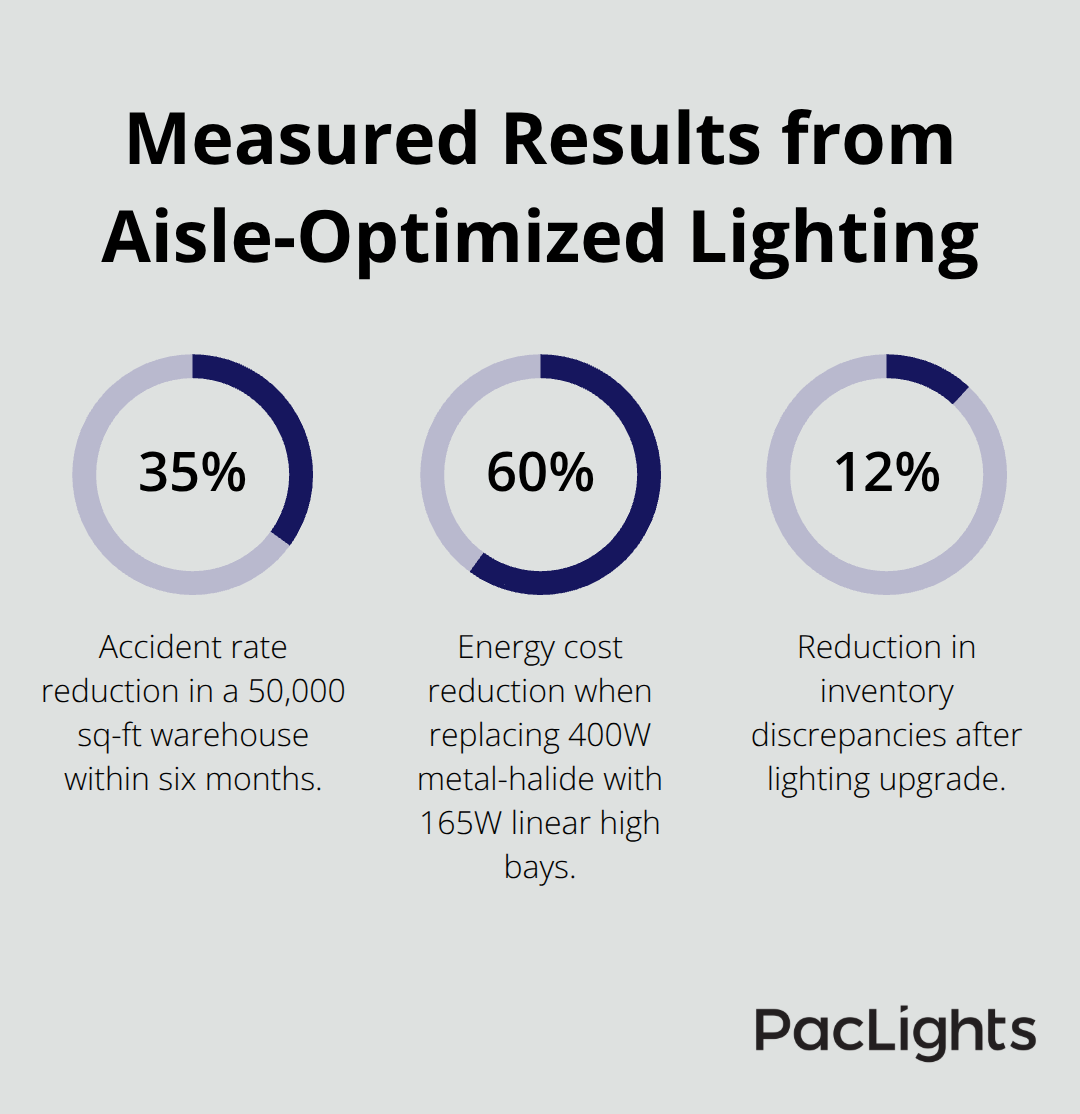
OSHA data on warehouse injuries shows that poor visibility correlates directly with slip, trip, and fall incidents, as well as equipment collisions. The cost per incident averages between 30,000 and 50,000 dollars when you factor in medical expenses, lost productivity, and insurance claims. One 50,000 square-foot warehouse operating 12 hours daily reduced accident rates by 35 percent within six months of replacing aging metal-halide fixtures with aisle-optimized linear high bays. That facility also saw a measurable drop in picking errors because staff could read labels and identify inventory more accurately under improved vertical lighting on rack faces.
Accelerating Task Completion and Worker Confidence
Productivity gains follow lighting improvements because workers move faster and with greater confidence through well-lit aisles. Research from the Illuminating Engineering Society shows that adequate vertical illuminance and uniformity reduce task completion time by 10 to 15 percent in picking and packing operations. When uniformity improves from a 4:1 ratio to a 2:1 ratio (typical when switching from generic high bays to aisle-optic solutions), workers spend less mental energy adapting to shadow zones and focus on accuracy instead.
Morale also improves; staff consistently report feeling safer and less fatigued when lighting is uniform and shadows disappear. Workers navigate aisles with greater confidence, and fatigue from squinting or straining to see in dim corners drops noticeably. This shift in worker experience translates to retention and engagement gains that extend beyond the warehouse floor.
Energy Savings Without Sacrificing Visibility
Energy efficiency does not suffer in this upgrade. Aisle-optic retrofits typically reduce energy consumption by 30 to 60 percent compared to older metal-halide systems while delivering superior visibility. In a 50,000 square-foot warehouse example, replacing 400-watt metal-halide fixtures with 165-watt linear high bays cut energy costs by roughly 60 percent, with a payback period of 14 to 18 months even before utility rebates. DLC 5.1 Premium rebates covered an additional 30 to 70 percent of initial fixture costs, accelerating the financial case for upgrading.
Improving Inventory Accuracy Through Better Label Visibility
Inventory accuracy improves because staff verify product labels, serial numbers, and expiration dates without squinting or moving pallets to catch better light angles. One facility tracked a 12 percent reduction in inventory discrepancies after upgrading their aisle lighting, directly attributable to clearer visibility of labeling and barcode scanning zones. Accurate inventory management reduces shrinkage, improves order fulfillment speed, and strengthens customer satisfaction.
The financial and operational case for upgrading aisle lighting extends beyond safety compliance. Facilities that invest in proper visibility see measurable returns across accident prevention, productivity, energy costs, and inventory management. The next section addresses the obstacles that prevent many warehouses from achieving consistent aisle visibility and offers practical solutions to overcome them.
Why Warehouses Struggle to Fix Aisle Visibility Problems
The Mismatch Between Floor Readings and Actual Safety
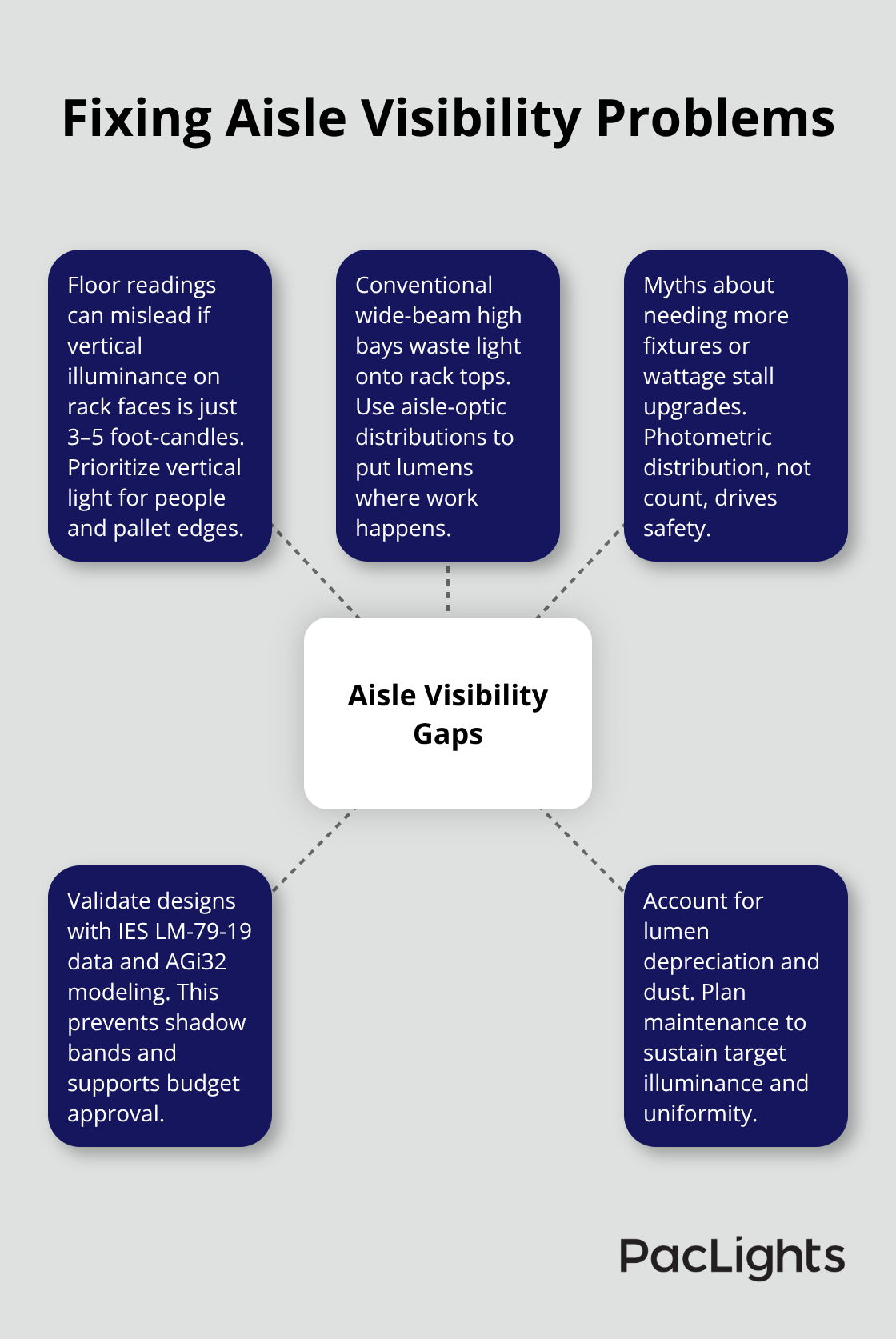
Most warehouses inherit lighting systems designed decades ago, when metal-halide fixtures and wide-beam optics were industry standard. Those systems were never optimized for aisle visibility-they were optimized for raw lumen output in the cheapest way possible. Facilities measure 15 to 20 foot-candles on the floor and assume they meet OSHA compliance, only to find their vertical illuminance on rack faces sits at 3 to 5 foot-candles. That gap creates the real problem: workers can see the floor but cannot see people, forks, or pallet edges clearly enough to move safely.
The challenge isn’t always that lighting is too dim-it’s that light hits the wrong surfaces.
Conventional round high-bay fixtures with 120-degree beams push 40 to 60 percent of their light onto the tops of racks in narrow aisles, starving the walking zones below. Fixing this requires understanding that your existing fixture count and wattage do not determine safety; photometric distribution does. Many facilities avoid upgrading because they believe they need to install twice as many fixtures or double their energy spend. That’s false. Switching from generic high bays to aisle-optic designs with Type III or Type V asymmetric distributions delivers 20 to 40 percent more horizontal illuminance on the floor and often doubles vertical illuminance on rack faces-without increasing overall wattage.
Why Photometric Validation Remains Overlooked
The real barrier is that most warehouse managers and maintenance teams have never seen a photometric report or used software like AGi32 to model what their aisle actually looks like under different lighting configurations. Request IES LM-79-19 photometric reports and model your specific aisle layout before committing to any retrofit. That single step-validating your design with real photometry instead of guessing-eliminates most visibility failures and justifies the upgrade cost to finance and operations teams.
How Aging Infrastructure Compounds Visibility Decline
Aging infrastructure compounds the visibility problem in ways that spreadsheets rarely capture. Metal-halide and older LED fixtures lose lumen output over time; lumen depreciation can reduce illuminance by 20 to 40 percent over five to ten years, according to IES maintenance guidance. A facility that measured 25 foot-candles when fixtures were new might hit only 15 foot-candles after a decade, slipping below safety targets without anyone noticing until an incident occurs. Dirt and dust accumulation on fixtures accelerates this decline-warehouse dust reduces transmitted light by 10 to 30 percent depending on your environment.
Re-measure critical aisles every two to three years to reveal these trends before they become safety liabilities, yet most facilities skip this step entirely. The maintenance burden also deters upgrades; if your fixtures require lifts to access or battery-backed emergency lighting, maintenance becomes expensive and disruptive. Specify fixtures with L90 ratings of 100,000 hours or longer and ensure they mount at heights that allow ground-level inspection and cleaning without equipment.
The False Energy Efficiency Trade-Off
Energy efficiency concerns often stall decisions, but they shouldn’t. Facilities assume that raising illuminance means raising energy costs proportionally. In reality, upgrading to aisle-optimized LED fixtures with proper optics reduces energy consumption by 30 to 60 percent while delivering superior visibility. A 50,000 square-foot warehouse replacing 400-watt metal-halide with 165-watt linear high bays achieved 60 percent energy savings and recovered the investment in 14 to 18 months, even before DLC 5.1 Premium rebates covered 30 to 70 percent of fixture costs (utility rebates vary by region and program). The financial case is strong; the hesitation usually stems from upfront capital concerns rather than lifecycle economics.
Wrapping Up
Aisle lighting standards protect your workers and your bottom line through measurable outcomes. Facilities that upgrade to aisle-optimized lighting report 20 to 40 percent reductions in forklift-pedestrian near-misses, 10 to 15 percent faster task completion, and 30 to 60 percent energy savings. A 50,000 square-foot warehouse replacing aging metal-halide with aisle-optic linear high bays recovers its investment in 14 to 18 months through energy savings alone, then qualifies for DLC 5.1 Premium rebates covering 30 to 70 percent of initial costs.
Your team works safer and with greater confidence when vertical illuminance on rack faces reaches 10 to 20 foot-candles and uniformity improves from 4:1 to 2:1 ratios. Workers detect hazards faster, read labels accurately, and navigate aisles without fatigue from squinting through shadows. The path forward starts with validation: request IES LM-79-19 photometric reports and model your specific aisle layout using software like AGi32 before committing to any retrofit.
We at PacLights provide aisle-optimized lighting fixtures and free lighting layout designs and ROI assessments to help you make informed decisions. Our team understands that proper aisle lighting isn’t just about compliance-it’s about protecting your workers and maximizing operational performance. Start with a photometric assessment of your facility and compare your current uniformity against ANSI/IES RP-7 targets to take the next step toward consistent visibility across your aisles.
Disclaimer: PacLights is not responsible for any actions taken based on the suggestions and information provided in this article, and readers should consult local building and electrical codes for proper guidance.