

Corridor lighting in datacenters isn’t just about visibility-it directly impacts safety, operational efficiency, and your bottom line. Poor lighting leads to accidents, slows maintenance work, and wastes energy on unnecessary illumination.
At PacLights, we’ve seen firsthand how the right lighting strategy transforms datacenter operations. This guide covers the standards, technologies, and practical steps you need to implement corridor lighting that works.
Why Corridor Lighting Matters in Datacenters
Safety and Risk Reduction
Datacenter corridors demand lighting that balances three competing demands: staff safety, equipment visibility, and energy cost control. Get this wrong and you pay for accidents, slow maintenance responses, and wasted electricity. Get it right and your facility runs smoother while your energy bills drop. The stakes are higher than most facility managers realize because datacenter lighting directly affects both operational risk and financial performance.
Safety in datacenters hinges on visibility. Technicians navigate corridors between racks and need to see cables, connectors, and potential hazards clearly to avoid trips, falls, and equipment damage. The Occupational Safety and Health Administration reports that poor lighting in industrial facilities contributes to slip-and-fall incidents that cost facilities thousands in lost productivity and liability. In datacenters, this translates to maintenance work that takes longer, emergency response times that suffer, and staff confidence that erodes. Emergency lighting and clearly marked exits are non-negotiable. The National Fire Protection Association standard NFPA 101 sets minimum requirements for emergency egress lighting, and compliance isn’t optional-it’s a legal baseline. Beyond compliance, proper corridor lighting at 20-30 foot-candles in hallways and 50-75 foot-candles in repair areas allows technicians to identify small cables and input sockets quickly, which matters during critical troubleshooting when seconds count.
Equipment Visibility and Maintenance Efficiency
Equipment visibility connects directly to maintenance efficiency and cost control. Technicians need to read labels, trace cable runs, and inspect connections without squinting or repositioning equipment. Under-lit corridors extend maintenance windows, which translates to longer service disruptions and higher labor costs. LED fixtures aligned above aisles between racks eliminate shadows and provide consistent illumination across equipment faces. The Department of Energy reports that LED lighting reduces energy consumption by 65-70% compared to traditional fluorescent or metal halide fixtures, and the heat reduction from LEDs lowers cooling costs by an additional 15-25%.

Long-Term Cost Benefits Through LED Technology
Since data centers account for roughly 1% of global energy consumption, even modest improvements in lighting efficiency compound across the facility. LED bulbs last 50,000 hours or more-up to 30 times longer than incandescent bulbs-which means fewer maintenance interruptions in a mission-critical environment. When a fixture fails in a datacenter, replacing it disrupts operations; longer-lasting LEDs reduce that risk substantially. These efficiency gains and durability improvements form the foundation for the specific design standards that separate adequate corridor lighting from optimal corridor lighting.
Lighting Design Standards for Datacenter Corridors
Illumination Levels and Color Temperature
The Illuminating Engineering Society recommends specific foot-candle targets based on task type: 20-30 foot-candles for general hallways, 50-75 foot-candles for repair and maintenance areas, and 30-50 foot-candles in server rooms where technicians read labels and trace connections. These numbers matter because under-lighting forces staff to work slower and make mistakes, while over-lighting wastes energy in spaces that don’t demand it. Color temperature between 4000K and 5000K delivers the visibility technicians need without the harshness of cooler 6500K lighting or the fatigue-inducing warmth of 3000K fixtures. This range supports accurate cable identification and reduces visual strain during extended troubleshooting sessions.
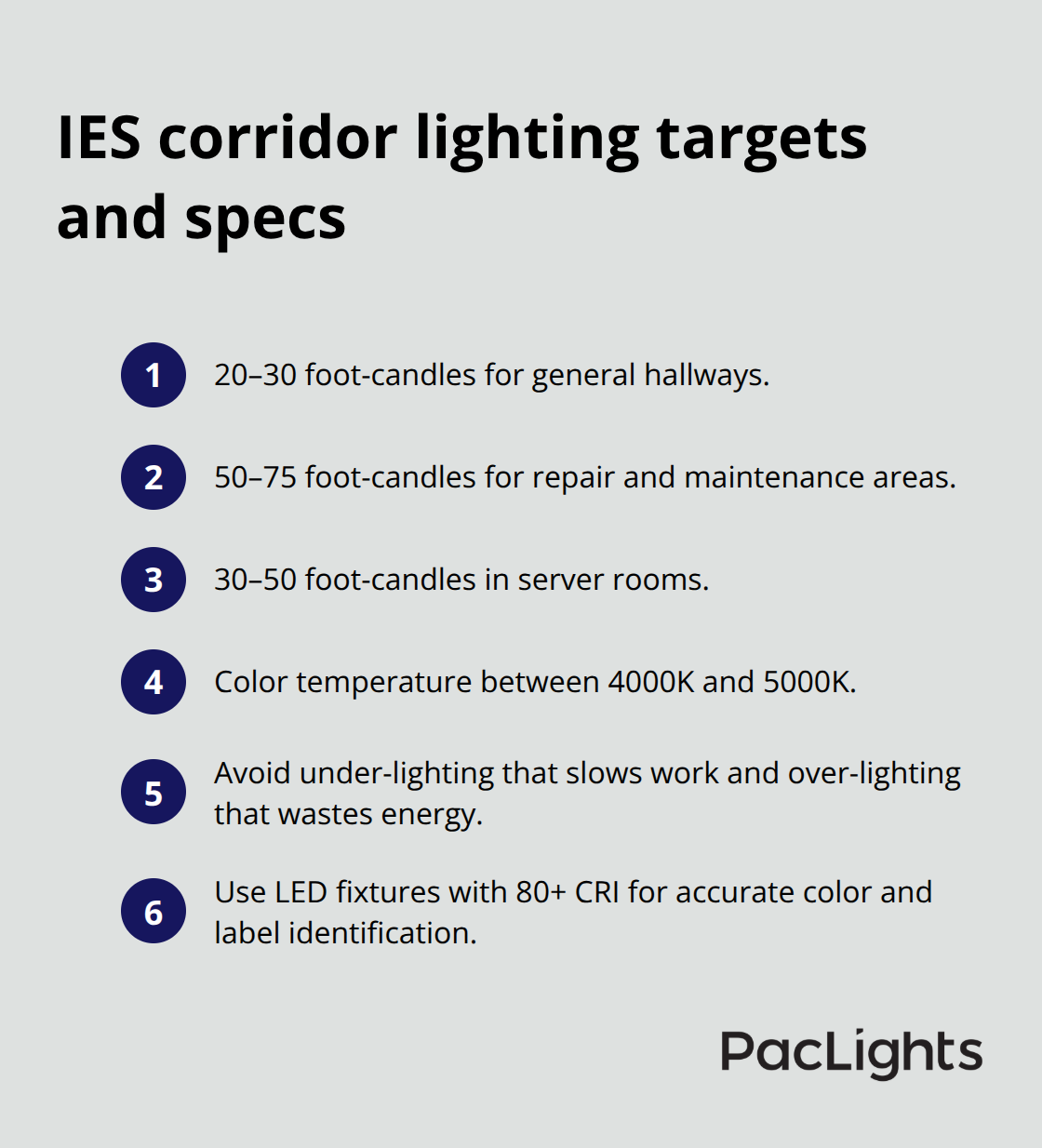
LED fixtures with 80+ color rendering index produce crisp, accurate colors that make it easier to distinguish cable types and equipment labels at a glance.
Strategic Fixture Placement Above Aisles
Fixture placement drives performance more than raw wattage does. Narrow pendant lights or linear strip fixtures aligned directly above aisles between racks eliminate the shadows created by large drop-ceiling panels. Traditional 2×2 or 2×4 panel fixtures positioned between equipment create dark zones where technicians cannot see inside cabinets or trace cables effectively. You must place fixtures to match your rack spacing during the design phase, not as an afterthought. This coordination prevents the common mistake of lighting the walkway while leaving the equipment faces in shadow.
Hot and Cold Aisle Coordination
In hot and cold aisle configurations, position fixtures above the cold aisles where staff spend time accessing equipment. Hot aisles typically contain only exhaust air and require minimal illumination, so directing light there wastes energy and heat. You should coordinate fixture placement with your cable management trays and overhead infrastructure early; retrofitting lighting into a congested ceiling costs significantly more and often produces inferior results. Proper alignment between your lighting design and aisle layout prevents costly installation errors and ensures technicians can work efficiently when they access equipment. The next section covers how automated controls and motion sensors transform this static lighting foundation into a dynamic system that adapts to actual occupancy patterns and further reduces energy waste.
Advanced Lighting Control Solutions for Datacenters
Automated controls transform corridor lighting from a static energy drain into a responsive system that adapts to actual occupancy patterns. Motion sensors and occupancy-based dimming deliver measurable results without requiring complex infrastructure. Motion sensors detect staff movement and trigger full illumination only when corridors are actively in use. During vacant periods, lighting drops to a minimal level or switches off entirely, which cuts energy waste substantially.
Motion Sensors and Occupancy-Based Dimming
The Department of Energy reports that integrating occupancy sensors with building management systems yields an additional 25-30% energy savings in unoccupied zones beyond what standard LED fixtures alone provide. Sensor placement determines effectiveness: sensors must have an unobstructed view of the corridor and should cover the entire passage to detect movement patterns accurately. Infrared security cameras operate in complete darkness, which means you can reduce corridor lighting to near-zero during vacancy without sacrificing security monitoring. This combination of infrared surveillance and motion-activated lighting creates a corridor that remains secure while consuming minimal power when staff are absent.
Many facilities implement a three-level lighting protocol that prevents the common mistake of running corridors at maximum brightness around the clock. Level 1 applies minimal or no lighting to vacant spaces. Level 2 activates moderate brightness when staff enter for safe navigation. Level 3 provides full illumination during active maintenance work.
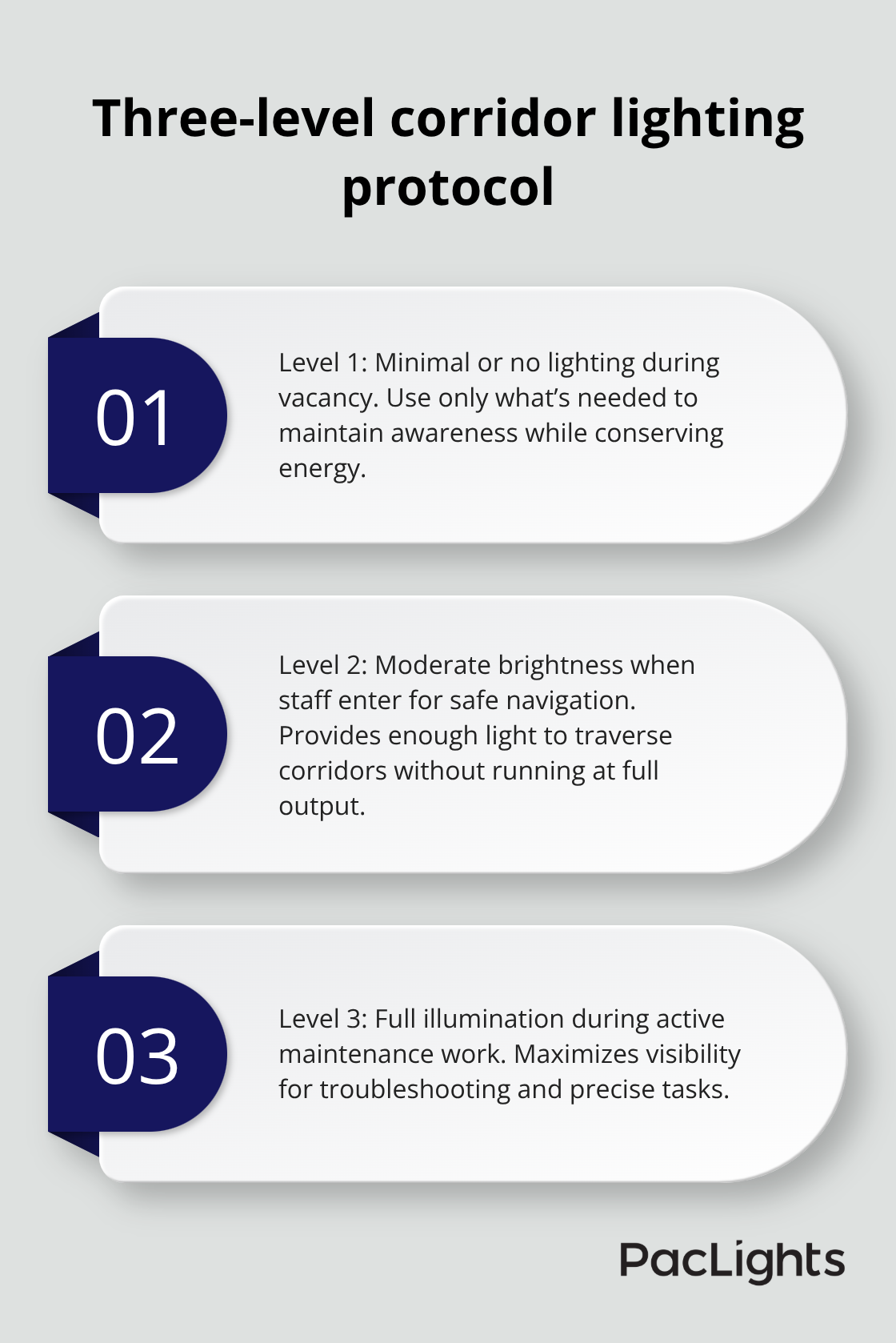
This tiered approach matches lighting output to actual facility activity and reduces unnecessary energy consumption.
Daylight Harvesting and Natural Light Integration
Daylight harvesting in multi-floor datacenters near windows or skylights captures natural light and reduces artificial lighting accordingly. Most datacenters benefit more from consistent interior dimming strategies than from daylight harvesting, since server rooms typically have limited window exposure. However, facilities with skylights or perimeter windows can capture significant energy savings by allowing natural light to reduce artificial fixture output during daylight hours.
Network-Connected Lighting Systems and Remote Management
Network-connected lighting systems represent the most powerful control option because they allow remote monitoring and adjustment across your entire facility from a central interface. These systems report fixture performance metrics, detect failed bulbs before they darken a corridor, and enable demand response during peak energy periods. You can dim lighting during high-demand hours to balance power consumption and reduce demand charges, which often represent 30-50% of datacenter energy costs. Color-adjustable LED panels allow post-installation tuning of brightness and color temperature without costly retrofits if staff feedback indicates visibility issues.
Centralized control improves security by enabling targeted illumination during incidents and maintaining consistent lighting across corridors. When selecting controls, avoid residential dimmers and specify commercial 0-10V dimming systems rated for continuous operation and compatible with your building management system. Ensure emergency lighting integrates with your UPS systems so that exit signs and safety fixtures maintain power during outages. Test emergency fixtures under actual UPS power before accepting the installation because failures in emergency lighting create liability and safety risks that far exceed the cost of thorough testing.
Final Thoughts
Corridor lighting in datacenters delivers measurable returns that extend far beyond simple visibility. LED fixtures reduce energy consumption by 65-70% compared to traditional fluorescent or metal halide lighting, and the lower heat output cuts cooling costs by an additional 15-25%. Motion sensors and occupancy-based dimming add another 25-30% in energy savings, which means your facility consumes significantly less power when lighting adapts to actual occupancy patterns rather than running at full brightness around the clock.
The financial case justifies immediate action. A datacenter corridor with LED fixtures, strategic aisle placement, and automated controls recovers its investment within two to three years through energy savings alone, then continues to reduce operating costs for the remainder of the fixture lifespan. Technicians work faster when they can see equipment clearly, emergency response times improve when corridors stay properly lit, and your maintenance labor decreases through longer-lasting bulbs that require fewer replacements.
Implementation starts with a clear assessment of your current corridor lighting and a realistic ROI projection based on your actual utility rates and occupancy patterns. We at PacLights provide free lighting layout designs and ROI assessments that show exactly what your facility can save with optimized corridor lighting solutions. Our team helps you select the right fixtures, controls, and placement strategy for your specific datacenter layout, whether you design new construction or retrofit an existing facility.
Disclaimer: PacLights is not responsible for any actions taken based on the suggestions and information provided in this article, and readers should consult local building and electrical codes for proper guidance.