

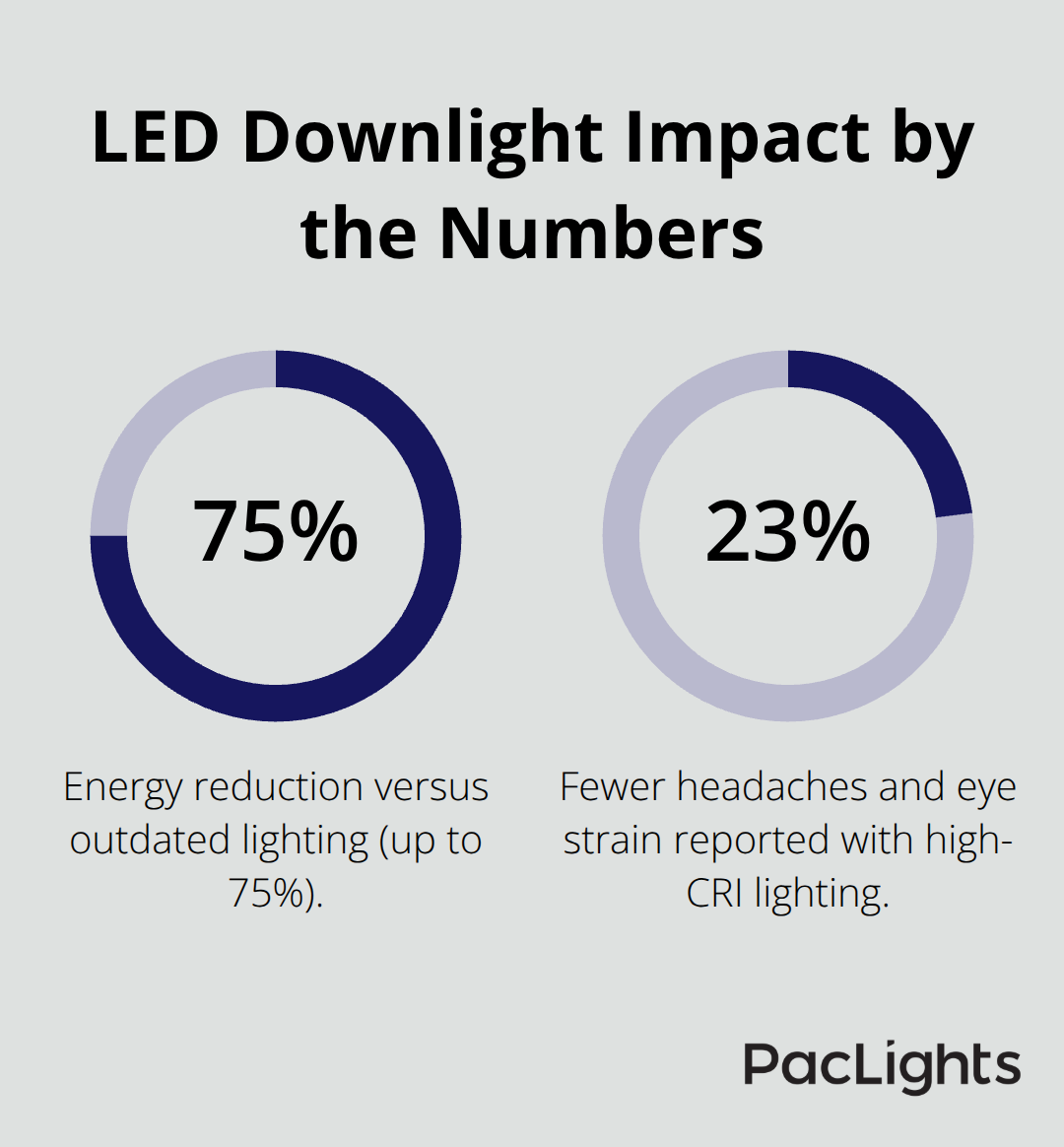
Commercial facilities waste thousands of dollars annually on outdated lighting systems. LED commercial downlights cut energy consumption by up to 75% while delivering superior brightness and control.
At PacLights, we’ve helped businesses transform their spaces with efficient lighting solutions that pay for themselves. This guide shows you exactly how to select, install, and maximize the benefits of modern LED downlights for your operations.
Why LED Downlights Cut Your Facility’s Operating Costs
Commercial facilities spend enormous budgets on electricity, and outdated lighting consumes far more than necessary. LED commercial downlights slash energy consumption by 60-75% compared to traditional fluorescent or incandescent systems, which translates directly to measurable savings on your monthly utility bills.
The math behind immediate savings
A facility with 100 downlights running 12 hours daily saves between $8,000 and $15,000 annually just on electricity costs. The payback period for LED retrofits typically ranges from 2-4 years, after which your facility operates with dramatically lower energy expenses for the next 15-25 years. The U.S. Department of Energy confirms LED lighting systems deliver immediate ROI through reduced consumption.
Maintenance drops to nearly zero
Traditional downlights require frequent replacements, which means labor costs, service interruptions, and ongoing inventory management. LED downlights last 25,000-50,000 hours-roughly 2-3 times longer than fluorescent alternatives. Your facility’s maintenance team spends less time on ladder work and bulb changes, freeing them for higher-value tasks. You’ll also eliminate the expense of stocking replacement bulbs and scheduling emergency repairs when lights fail during business hours.
Environmental responsibility improves your bottom line
Reducing your facility’s carbon footprint isn’t just good practice-it increasingly affects your operational costs and reputation. A commercial facility switching 200 downlights to LED reduces annual CO2 emissions by approximately 100-150 metric tons (depending on your regional power grid). Many municipalities now offer rebate programs for LED upgrades, and some utilities provide direct incentives that lower your installation costs further. Businesses with lower energy consumption qualify for better insurance rates and increasingly attract tenants or clients who prioritize sustainability.
What comes next in your upgrade journey
These financial and environmental benefits only materialize when you select the right fixtures for your specific space. The next section walks you through the key features that separate high-performing LED downlights from standard options, and how those features directly impact your facility’s lighting quality and operational efficiency.
What Makes Modern LED Downlights Perform Better
Color rendering transforms how your space actually looks
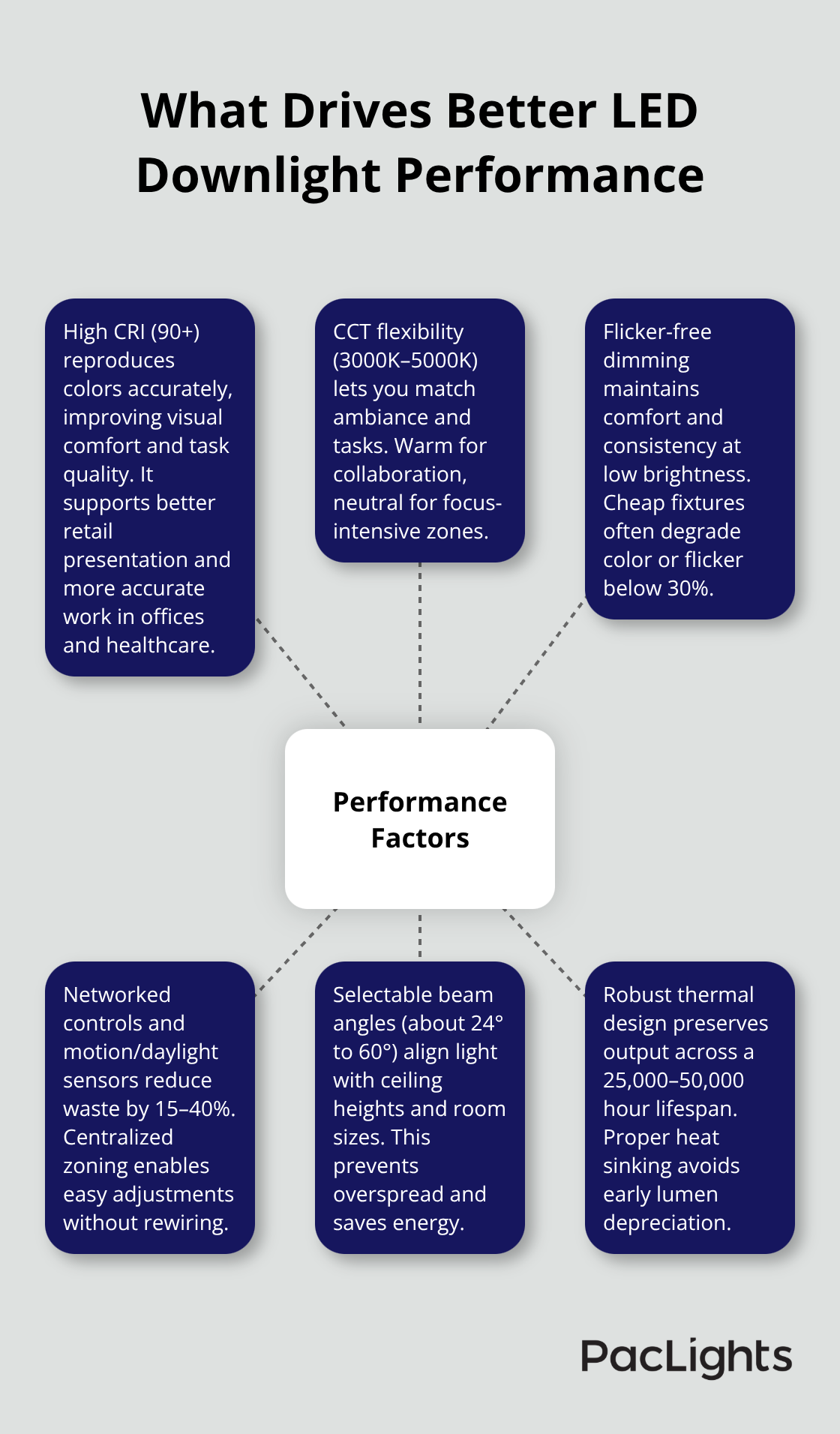
The difference between standard LED downlights and high-performance models lies in measurable technical specifications that directly affect your facility’s usability and operating costs. Color Rendering Index (CRI) matters far more than most facility managers realize-downlights with CRI ratings of 90 or higher reproduce colors accurately, which is essential in retail environments, offices, and healthcare facilities where color accuracy affects both employee productivity and customer perception. Research from the American Lighting Association shows that employees in spaces with high-CRI lighting report 23% fewer headaches and eye strain compared to facilities using standard 70-80 CRI fixtures. Poor color rendering forces your facility to compensate with excessive brightness, wasting the energy savings you gained by switching to LED.
Temperature flexibility adapts to your operational needs
Correlated Color Temperature (CCT) flexibility matters equally-spaces perform better when you shift between 3000K warm white for collaborative areas and 4000K-5000K neutral white for task-intensive work zones. The ability to dim downlights without color shift or flickering adds genuine value that cheap fixtures cannot deliver; many budget LED options flicker below 30% brightness, creating visible discomfort and defeating the purpose of upgrading your lighting system. This performance gap separates facilities that maintain consistent lighting quality from those that experience degraded performance as brightness decreases.
Control systems and beam angles maximize efficiency
Control flexibility separates facilities that optimize their lighting from those that simply install fixtures and forget about them. Networked lighting controls allow you to adjust brightness and color temperature across zones without rewiring, and motion sensors in low-traffic areas reduce energy waste by 15-40% according to data from the Lawrence Berkeley National Laboratory. Customizable beam angles-ranging from 24 degrees for accent lighting to 60 degrees for general illumination-mean you select downlights matched to your actual ceiling heights and room dimensions rather than oversizing fixtures that consume unnecessary power.
Installation and thermal design determine long-term performance
Installation considerations affect long-term performance significantly; downlights designed with shallow trim profiles fit existing cavities in retrofits without extensive ceiling work, while thermal management through proper heat sink design maintains full brightness output for the entire 25,000-50,000 hour lifespan rather than degrading to 70% brightness within five years. PacLights offers recessed downlights with optional daylight harvesting sensors and motion control, allowing your facility to reduce consumption further while maintaining consistent lighting levels throughout operating hours. These technical specifications form the foundation for selecting fixtures that actually deliver on LED’s efficiency promise.
The next step involves matching these performance features to your specific facility layout and operational requirements-a process that determines whether your LED investment achieves maximum ROI or falls short of its potential.
Matching LED Downlights to Your Facility’s Actual Requirements
Measure your space before selecting fixtures
Start with a handheld light meter (under $50) to measure your ceiling height, room dimensions, and current light levels rather than guessing what your space needs. The meter shows you exactly what illumination your facility currently receives in different zones-retail areas typically require 300-500 lux, offices need 300-500 lux for general work, and storage areas function adequately at 150-200 lux according to the Illuminating Engineering Society. This data prevents you from oversizing fixtures that waste energy and money. Document which areas experience glare issues, where employees struggle with visibility, and which zones sit unused during certain hours. This assessment identifies opportunities for motion sensors that reduce energy consumption by 15-40% in low-traffic spaces.
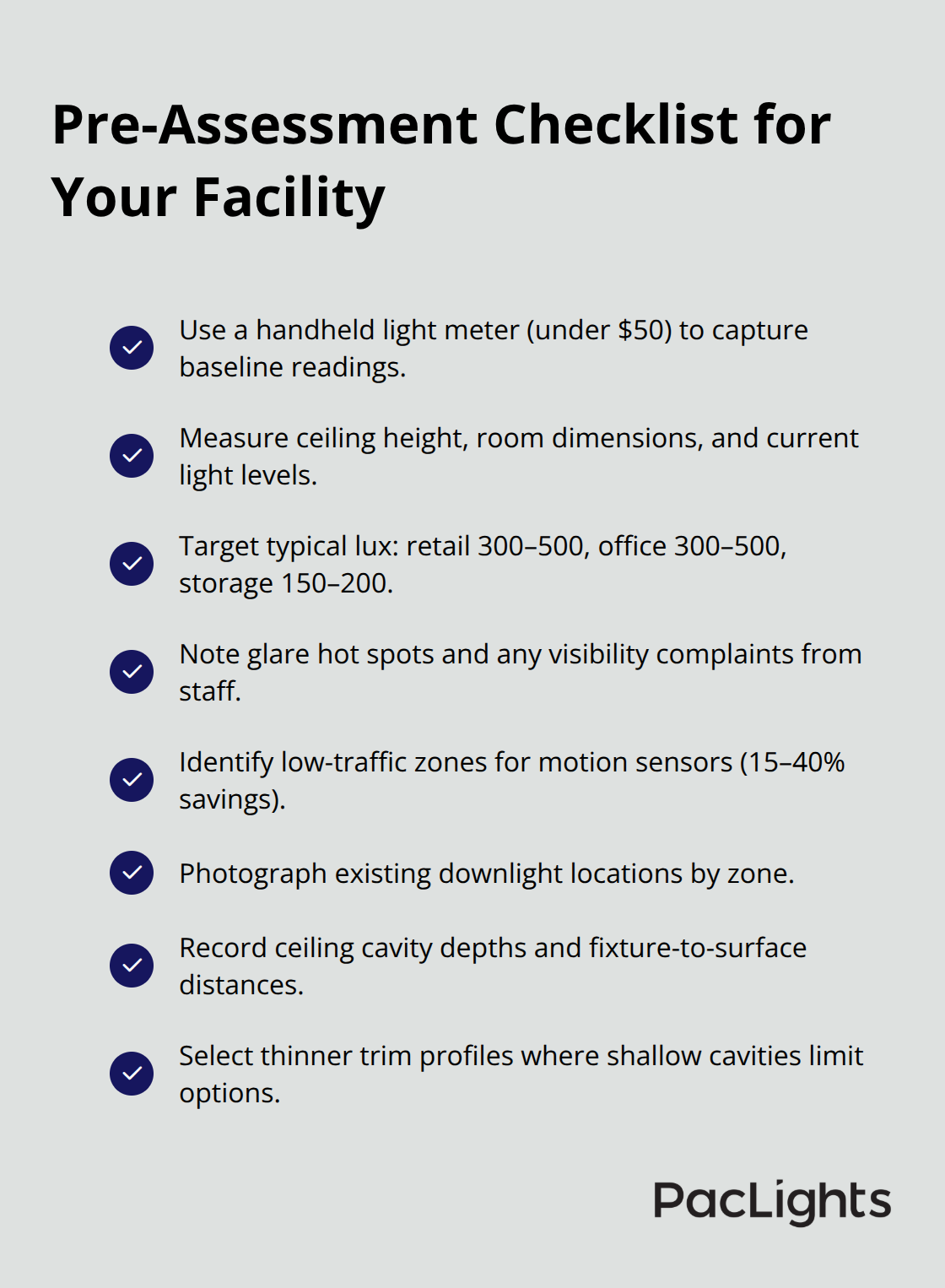
Photograph your existing downlight locations, note the ceiling cavity depths, and measure the distance from fixtures to work surfaces-shallow recessed cavities limit your fixture options and may require thinner trim profiles to avoid expensive ceiling modifications.
Work with professional designers to optimize performance
Professional lighting designers bring expertise that prevents costly mistakes, and the investment typically pays back within your first year of operation through optimized fixture selection and control strategies. A qualified designer analyzes your facility’s operational schedule, identifies zones where dimming improves both comfort and efficiency, and specifies fixtures with appropriate beam angles rather than defaulting to standard 40-degree options that overspread light beyond your actual needs. Free lighting layout designs and ROI assessments calculate your specific payback period based on your facility’s usage patterns, local electricity rates, and existing conditions-this removes guesswork from the decision.
Integrate controls that respond to real conditions
Integration with networked lighting controls transforms your downlights from static fixtures into responsive systems that adjust brightness based on daylight availability and occupancy, reducing energy waste without sacrificing functionality. Motion sensors and daylight harvesting capabilities (available through quality LED products) adapt your lighting to actual facility conditions rather than maintaining constant output regardless of need. Installation quality matters enormously; poor thermal management or incorrect driver configuration degrades performance significantly, so working with experienced installers who understand LED-specific requirements prevents the common failure modes that plague budget retrofit projects.
Final Thoughts
LED commercial downlights deliver measurable financial returns that extend far beyond your initial installation investment. The combination of 60-75% energy savings, minimal maintenance requirements, and extended fixture lifespan creates a financial advantage that compounds year after year. A facility with 100 downlights saves $8,000-$15,000 annually on electricity alone, with payback periods typically falling between 2-4 years.
Motion sensors, daylight harvesting, and networked lighting controls reduce consumption an additional 15-40% in appropriate applications, accelerating your ROI timeline and maximizing the efficiency gains that LED technology provides. Professional lighting design prevents the costly mistakes that plague rushed retrofit projects, ensuring your facility receives fixtures matched to actual operational requirements rather than oversized systems that waste energy and money. These control strategies transform static fixtures into responsive systems that adapt to your facility’s real conditions.
Your next step involves assessing your facility’s current lighting conditions and connecting with experienced professionals who understand LED-specific performance requirements. Visit PacLights to explore retrofit solutions tailored to your facility’s requirements and begin capturing the substantial savings that modern LED commercial downlights deliver.
Disclaimer: PacLights is not responsible for any actions taken based on the suggestions and information provided in this article, and readers should consult local building and electrical codes for proper guidance.