

Generator enclosure lighting is often overlooked, yet it directly impacts safety, compliance, and operational efficiency in your datacenter. Most facilities get this wrong because they treat it as an afterthought rather than a critical infrastructure decision.
At PacLights, we’ve seen firsthand how proper lighting specifications prevent accidents, reduce maintenance costs, and extend equipment lifespan. This guide walks you through the exact requirements and best practices you need.
What Lighting Standards Actually Apply to Generator Enclosures
Standards That Govern Generator Enclosure Lighting
Generator enclosures demand lighting that handles extreme conditions most facilities underestimate. The National Fire Protection Association sets clear expectations through NFPA 110, which governs emergency power systems and their surrounding infrastructure. NFPA 110 requires adequate illumination for safe operation, maintenance, and emergency response around generator equipment, but the standard itself doesn’t specify exact lux levels-that’s where facility managers get confused. OSHA guidelines and your local electrical code fill this gap. Most jurisdictions require a minimum of 50 foot-candles (around 540 lux) in generator rooms during normal operations, with higher intensity needed for maintenance tasks. When technicians work on fuel lines, filters, or control panels, they need at least 100 foot-candles in those specific areas. Anything less creates a safety liability. Your local building codes vary by region, so you must verify requirements with your authority having jurisdiction before specifying any fixture.
Why Heat Management Changes Everything
Heat management in generator enclosures separates good lighting specifications from bad ones. Generators produce significant thermal output, and cooling accounts for up to 40 percent of total data center energy consumption according to industry benchmarks. Traditional incandescent or fluorescent lighting adds thermal load into an already-hot enclosure, forcing your cooling system to work harder and raising operational costs. LED fixtures solve this problem directly because they generate substantially less heat than older technologies. A 30-watt LED fixture produces a fraction of the thermal load compared to a 150-watt incandescent fixture delivering similar light output. This matters in confined spaces where heat accumulation creates hotspots that damage electronics or reduce generator lifespan.
Fixture Selection and Airflow Protection
Your fixture choice impacts airflow patterns inside the enclosure. Vapor-tight and enclosed-and-gasketed luminaires protect against dust and moisture ingress while allowing proper ventilation around the generator. Position lighting fixtures to avoid blocking natural airflow paths or creating dead zones where heat concentrates. Test your enclosure temperature at different points during operation to confirm your lighting choice doesn’t create thermal problems. This testing phase determines whether you need additional cooling upgrades or can operate efficiently with your current system. The right fixture selection prevents expensive retrofits later and keeps your generator running at peak performance.
Specifying Fixtures That Survive Generator Enclosure Conditions
Lumen Output and Color Accuracy Requirements
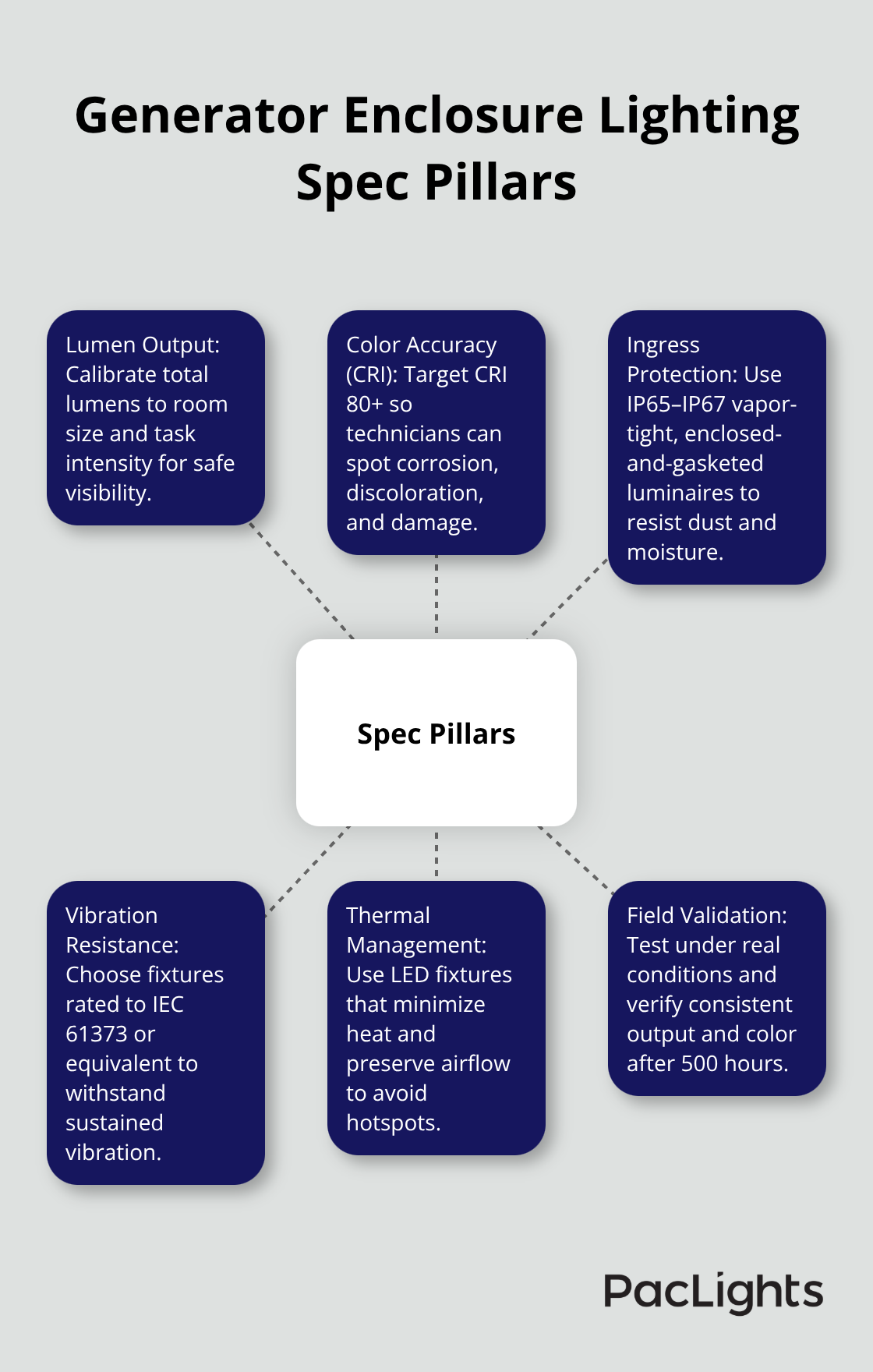
Generator enclosures demand fixtures engineered for hostile environments, not standard commercial lighting. The specification process starts with lumen output calibrated to your exact space dimensions and maintenance tasks. A 500-square-foot generator room needs roughly 25,000–50,000 lumens depending on whether technicians perform routine checks or deep maintenance work. Task areas around fuel filters and control panels require 100 foot-candles minimum, translating to approximately 1,000 lumens per 100 square feet in those zones. Color Rendering Index matters more than most facility managers realize-try for CRI 80 or higher so technicians accurately identify corrosion, fuel discoloration, or equipment damage during inspections. Poor CRI creates a false sense of security because problems remain visually hidden under inadequate color accuracy.
Protection Ratings for Moisture and Dust
IP ratings determine whether your fixture survives moisture and dust without premature failure. IP65-rated fixtures withstand dust ingress and water spray, making them suitable for generator enclosures where humidity and particulate matter accumulate. IP67 ratings provide even greater protection if your enclosure experiences occasional flooding or high-pressure washdowns. Vapor-tight and enclosed-and-gasketed luminaires specifically designed for harsh industrial spaces outperform standard enclosed fixtures because they maintain gasket integrity under thermal cycling-a reality in generator rooms where temperatures swing between 90°F and 130°F depending on load conditions.
Vibration and Shock Resistance Standards
Vibration and shock resistance separate fixtures that last five years from those that fail within eighteen months. Generators create sustained vibration at 1,200 to 1,800 RPM depending on fuel type, and this constant movement loosens standard fasteners and degrades solder joints in LED driver circuits. Select fixtures rated for IEC 61373 vibration testing or equivalent mechanical durability standards, which confirm the luminaire survives extended exposure to industrial vibration without optical degradation or electrical failure. Shock resistance becomes critical during generator startup, when inrush current creates electromagnetic pulses that damage unshielded electronics. Fixtures with potted LED drivers and reinforced internal components withstand these transient events.
Field Validation Before Full Deployment
Test your chosen fixture under actual operating conditions before full deployment-measure vibration levels at the mounting surface using a vibration meter, then verify the fixture maintains light output and color consistency after 500 operating hours. This field validation prevents costly replacements and confirms your specification aligns with real-world conditions rather than theoretical assumptions. Once you validate fixture performance in your specific enclosure environment, you can move forward with confidence that your lighting will support both safety and longevity.
The next step involves strategic placement decisions that maximize coverage while respecting the thermal and operational constraints of your generator space.
Placement, Power Redundancy, and Control Strategy
Strategic Fixture Placement for Complete Coverage
Generator enclosure lighting placement determines whether your technicians work safely or struggle in shadows during critical maintenance. Position fixtures to eliminate dark corners where equipment details disappear and maintenance becomes guesswork. Mount primary fixtures 8 to 10 feet above the generator unit if ceiling height allows, angling them to cast light across fuel systems, control panels, and exhaust areas without creating glare on LCD screens or instrument displays. Secondary fixtures should target task-specific zones around filter access points and fuel connections where technicians spend most hands-on time.
A 500-square-foot enclosure typically needs three to four strategically placed LED high bays rather than one central fixture that creates uneven illumination. Test your layout by walking the space during simulated maintenance work-if you cannot read gauge values or inspect fuel lines clearly, your placement needs adjustment. Strategic placement prevents dark zones and creates safety liabilities when uneven illumination forces technicians to use flashlights, defeating the purpose of permanent lighting infrastructure.
Dedicated Power Circuits and Backup Systems
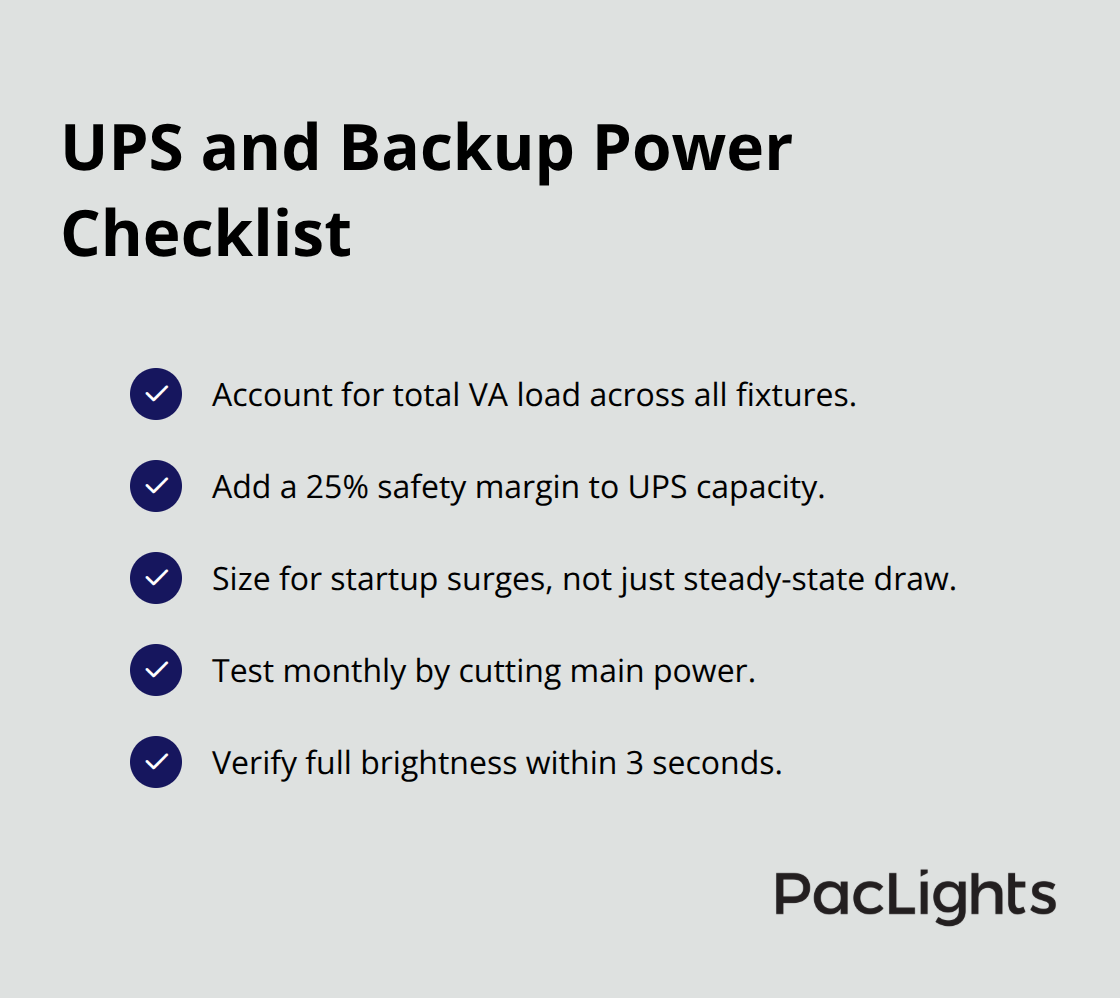
Redundancy in power delivery separates professional installations from those that fail during emergencies. Generator enclosures require dedicated circuit protection independent from the generator’s primary output, meaning your lighting circuit must source power from a separate utility feed or an uninterruptible power supply that activates instantly when main power fails. Standard backup battery systems designed for emergency egress lighting work here, but size them for your actual lumen output rather than nominal wattage.
A 30-watt LED fixture draws approximately 48 volt-amps according to industry load calculations, so your UPS must handle total VA across all fixtures plus a 25 percent safety margin. If your enclosure contains four fixtures, plan for roughly 192 VA of continuous draw plus headroom, requiring a UPS rated for at least 250 VA to handle startup surges. Test your battery backup system monthly by cutting main power and confirming lights reach full brightness within three seconds-anything slower indicates insufficient capacity or degraded battery health.
Motion Sensors and Occupancy-Based Controls
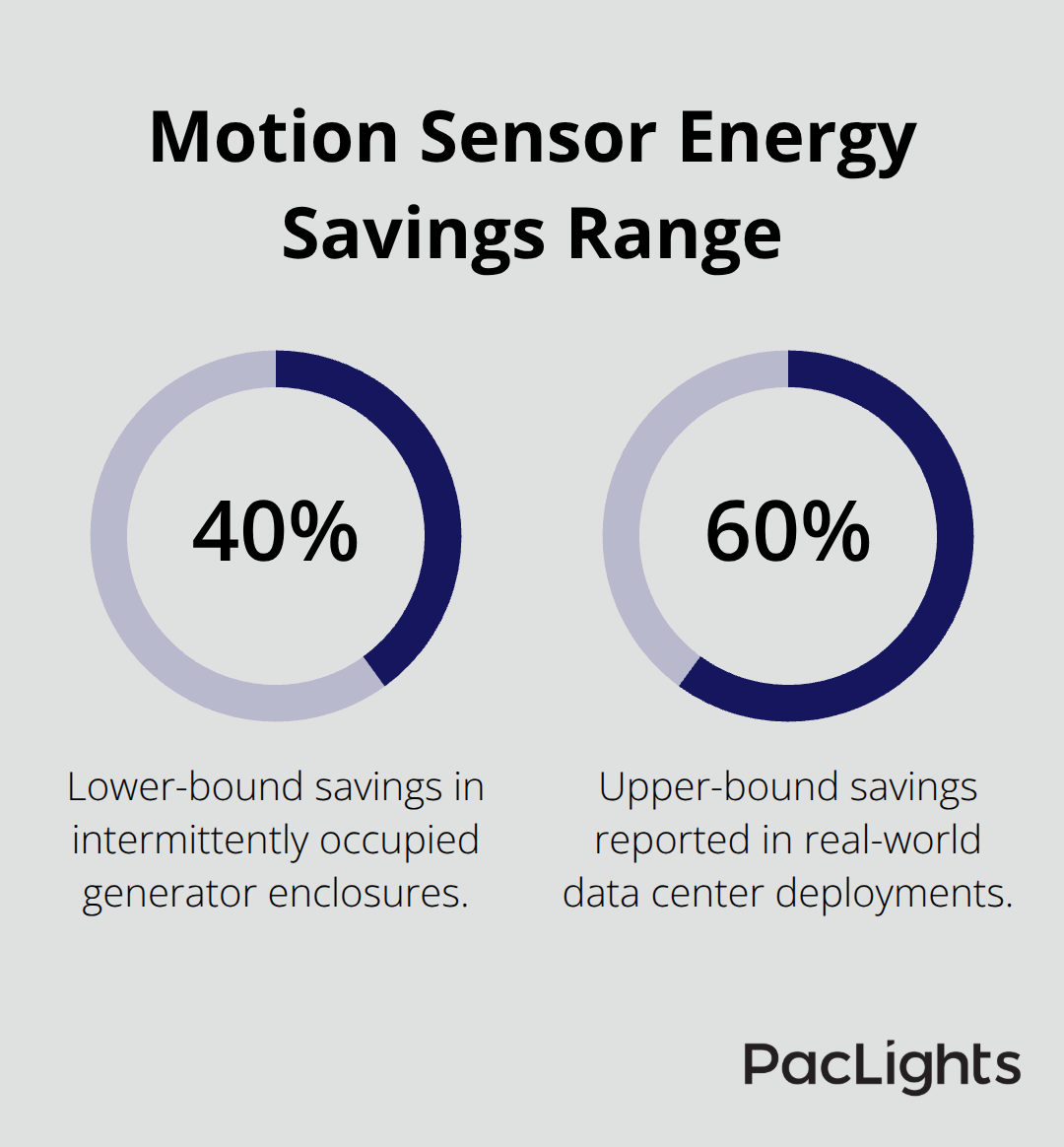
Control systems transform generator enclosure lighting from static installations into responsive infrastructure that adapts to actual usage patterns. Motion sensors reduce energy consumption by 40 to 60 percent in spaces with intermittent occupancy, according to real-world data center deployments, because technicians visit generator enclosures only during scheduled maintenance or emergencies rather than continuously. Set motion sensor sensitivity to detect movement within 15 feet of the generator unit and program a 10-minute timeout so lights extinguish if no motion occurs during that window.
Daylight harvesting works poorly in fully enclosed generator rooms, but if your enclosure includes skylights or translucent roof panels, photocells can reduce lighting intensity during daylight hours and boost it at night. Control strategies allow you to integrate these capabilities without rewiring after installation.
Network-Connected Monitoring and Alerts
Network-connected lighting controls provide real-time visibility into enclosure conditions and enable remote adjustments if thermal or operational issues emerge. A connected lighting system records fixture run hours, detects premature failures before they occur, and alerts your maintenance team when LED drivers approach end-of-life. This visibility costs approximately 15 to 20 percent more than basic controls but prevents surprise failures that could leave technicians working in darkness during emergency generator startup. Real-time monitoring also identifies hotspots or uneven illumination patterns that manual inspections might miss, allowing you to optimize fixture placement or add supplemental lighting before problems affect operations.
Final Thoughts
Your specification process for generator enclosure lighting prevents safety failures and reduces operational costs through three concrete actions. Validate that your chosen fixtures meet IEC 61373 vibration standards and maintain optical performance under thermal cycling between 90°F and 130°F, then design your placement strategy to eliminate dark corners where technicians cannot safely inspect fuel systems or control panels. Implement redundant power delivery with battery backup sized for actual volt-amp draw, not nominal wattage, plus motion sensors that reduce energy consumption by 40 to 60 percent in spaces with intermittent occupancy.
Network-connected monitoring transforms generator enclosure lighting from static infrastructure into responsive systems that alert your team to premature failures before they occur. This visibility costs 15 to 20 percent more than basic controls but prevents surprise outages during critical maintenance windows. Real-time data on fixture run hours and LED driver health allows you to schedule replacements proactively rather than react to failures in darkness.
Professional assessment prevents costly retrofits and aligns your lighting specification with real-world conditions rather than theoretical assumptions. We at PacLights provide free lighting layout designs and ROI assessments that identify the exact fixtures and control strategies your generator enclosure requires, and our vapor-tight luminaires combined with advanced controls deliver the durability and efficiency your facility demands.
Disclaimer: PacLights is not responsible for any actions taken based on the suggestions and information provided in this article, and readers should consult local building and electrical codes for proper guidance.