

Datacenter lighting consumes roughly 20% of total facility energy, yet most facilities still rely on outdated technology. A datacenter lighting retrofit isn’t just about swapping bulbs-it’s about reclaiming operational efficiency and cutting costs significantly.
At PacLights, we’ve seen firsthand how the right lighting upgrade transforms facility performance. This guide walks you through the entire process, from planning to implementation.
How Much Can You Actually Save With LED Lighting
Fluorescent and metal halide fixtures waste enormous amounts of energy in data centers. A mid-sized facility consuming 5 MW annually spends roughly $200,000 to $300,000 per year on lighting alone before upgrades. That figure exists because legacy fixtures operate at 1.0 to 1.5 watts per square foot, while modern LEDs run at just 0.1 to 0.3 watts per square foot.
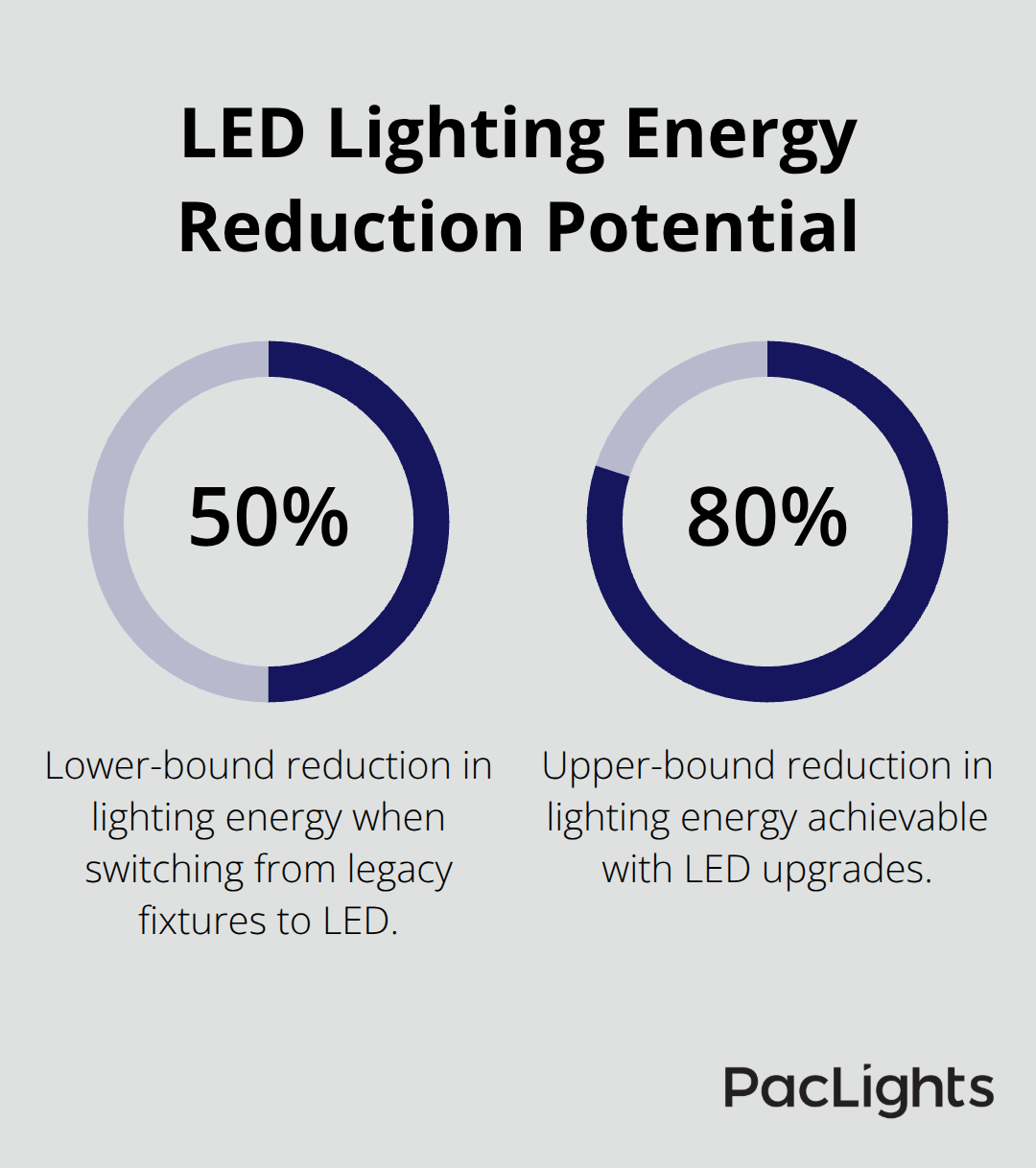
Switching to LED cuts lighting energy consumption by 50 to 80 percent. For a facility spending $250,000 annually on lighting, that translates to $125,000 to $200,000 in direct savings every single year.
The Real Numbers Behind LED Conversion
Government rebates in many jurisdictions range from $0.50 to $1.00 per watt, which dramatically accelerates payback timelines. Most data centers recoup their LED retrofit investment in 2 to 3 years, making this one of the fastest-returning infrastructure upgrades available. The payback speed matters because it frees capital for other facility improvements and reduces financial risk.
How Cooling Costs Drop Immediately
Older fixtures generate excessive heat alongside wasted light energy. That excess heat forces cooling systems to work harder, driving up HVAC costs significantly. LEDs produce almost no wasted heat, which means your cooling infrastructure operates more efficiently immediately after installation. A facility that previously spent $100,000 annually on cooling can expect measurable reductions once lighting heat load drops. This dual benefit-lower lighting energy plus reduced cooling demand-compounds your ROI substantially.
Industry data shows that high bay LED fixtures rated for 15 to 25-foot ceilings deliver 150 to 300 lux across server aisles without generating the thermal burden of traditional alternatives. Linear LED strips work equally well for corridors and equipment rooms where high bays aren’t practical. The result is uniform illumination that improves technician visibility for maintenance tasks while simultaneously reducing your total facility energy footprint.
Smart Controls Multiply Your Savings
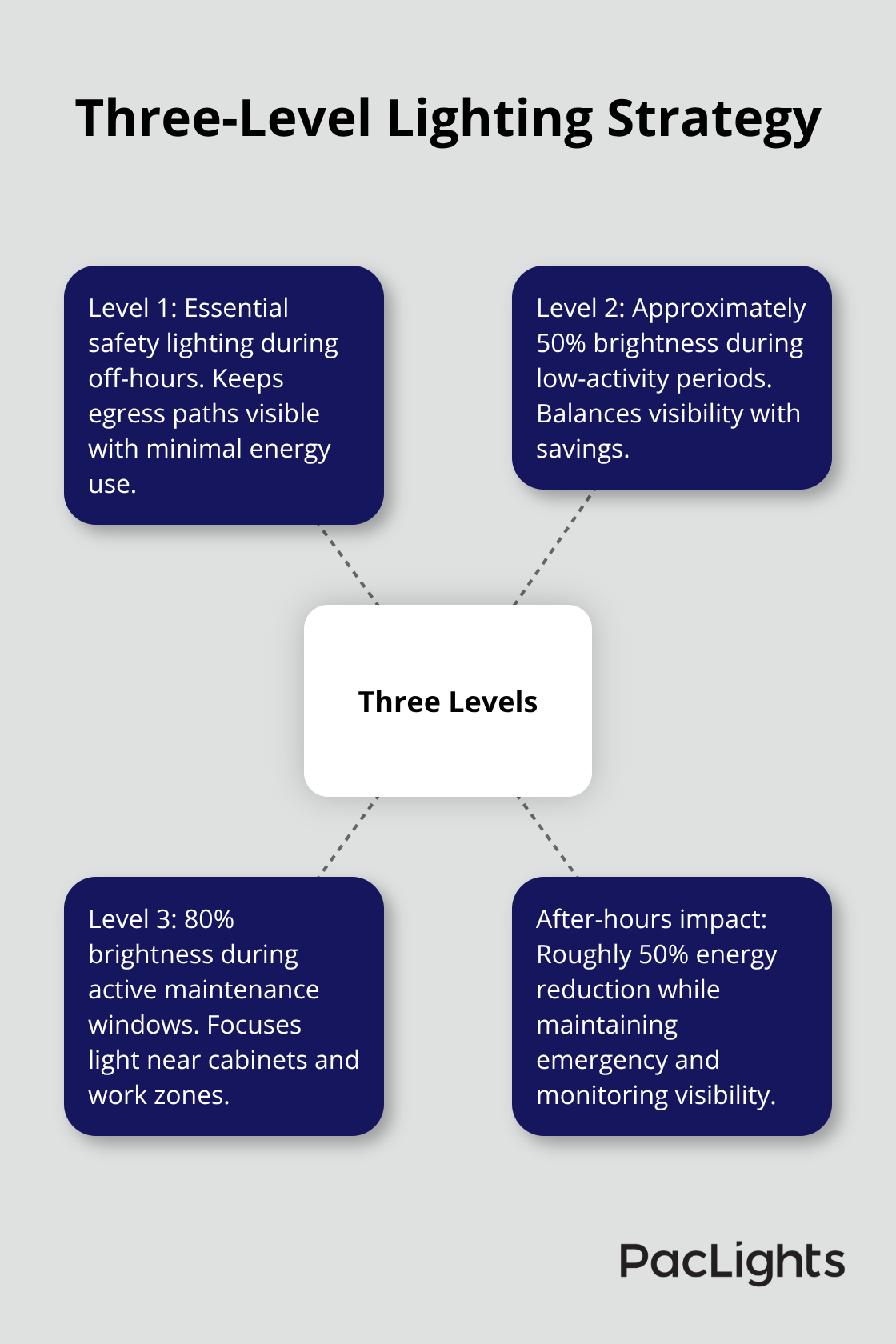
Motion sensors and daylight harvesting reduce lighting energy use by another 30 to 50 percent beyond LED efficiency alone. Networked lighting controls enable real-time occupancy data and per-fixture monitoring, allowing you to optimize performance across the entire facility. A three-level lighting approach proves particularly effective in data centers: Level 1 uses only essential safety lighting during off-hours, Level 2 operates at roughly 50 percent brightness, and Level 3 delivers 80 percent brightness where staff work near cabinets. This strategy cuts after-hours energy use by approximately 50 percent while maintaining necessary visibility for emergency response.
Integration with your building management system coordinates lighting adjustments with HVAC and cooling systems, maximizing overall facility efficiency. The net financial impact of LED retrofits combined with occupancy and networked controls reaches $100,000 to $180,000 in annual savings for mid-sized facilities.
Planning Your Control Strategy
Advanced lighting controls transform retrofit economics. Networked systems provide real-time data on energy consumption and occupancy patterns, revealing opportunities to optimize further. You can adjust lighting levels remotely, respond to facility changes instantly, and track performance against baseline metrics. This visibility into your lighting system’s actual behavior (rather than assumptions) drives continuous improvement and prevents energy creep over time.
Your next step involves conducting a comprehensive lighting audit to establish your baseline consumption and identify which areas offer the greatest savings potential.
Planning Your Retrofit Strategy
Establish Your Baseline With a Lighting Audit
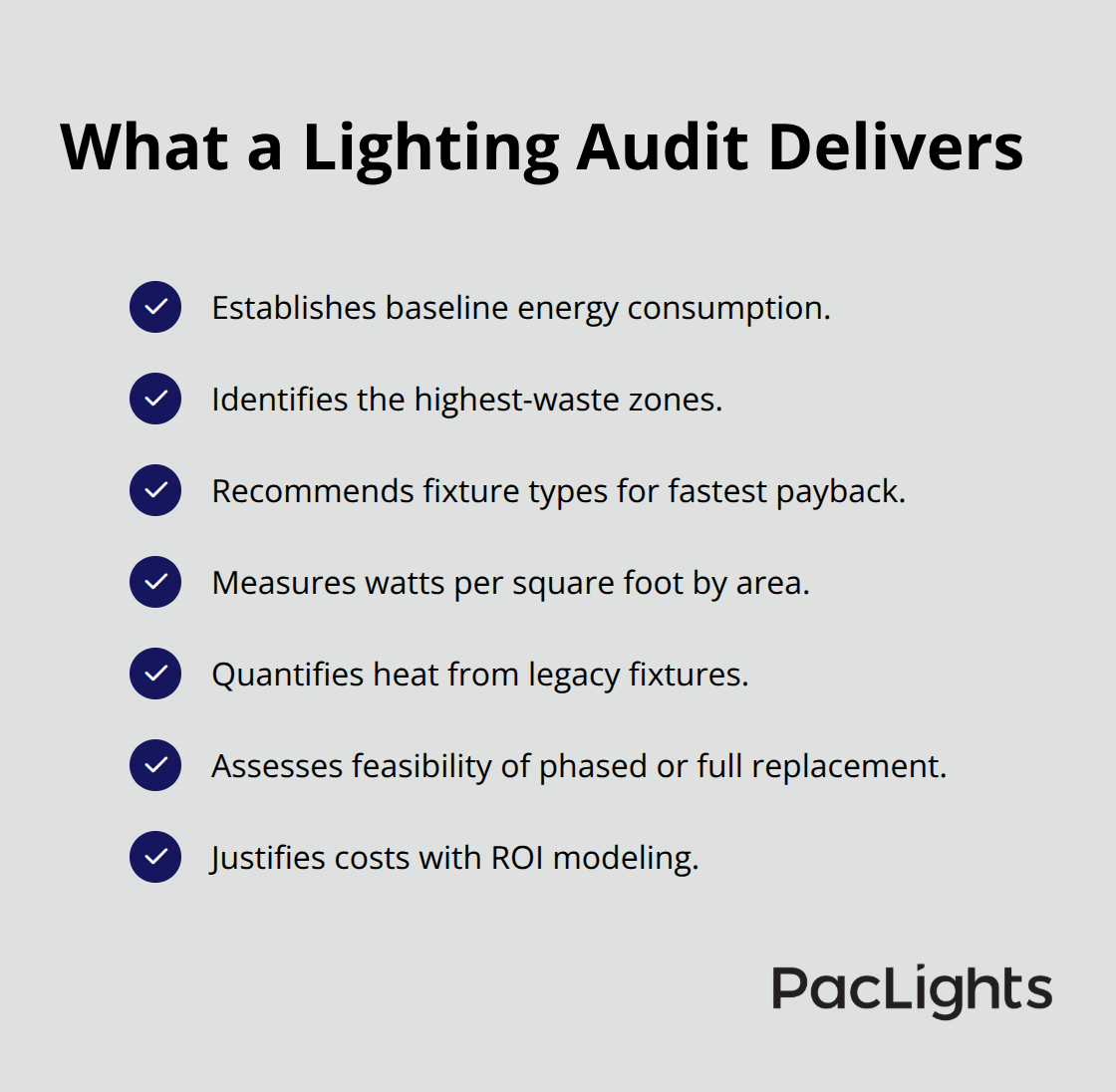
A comprehensive lighting audit must happen before you commit to any retrofit investment. A typical mid-sized facility audit takes 2 to 3 days and establishes your baseline energy consumption, identifies which areas waste the most power, and reveals which fixture types will deliver the fastest payback. This audit becomes your financial roadmap-without it, you’re guessing at savings rather than calculating them. An auditor will measure your current wattage per square foot across different zones, identify heat generation from legacy fixtures, and assess whether your existing infrastructure can support phased upgrades or requires full replacement.
The audit cost typically ranges from $2,000 to $5,000, but the data justifies itself immediately when you model ROI against concrete numbers rather than industry averages.
Calculate Your Payback Period With Real Numbers
Once you have baseline data, calculate your actual payback period using real facility numbers. A data center spending $250,000 annually on lighting that reduces consumption by 60 percent gains $150,000 in direct savings yearly. Add government rebates of $0.50 to $1.00 per watt available in most jurisdictions, and your retrofit investment shrinks significantly. Most facilities achieve payback in 2 to 3 years, but your specific timeline depends entirely on your current energy spend, local electricity rates, and rebate availability.
Choose Between Full Replacement and Phased Upgrades
The decision between full replacement and phased upgrades hinges on capital availability and operational tolerance for disruption. Full replacement delivers faster total ROI because you eliminate all legacy equipment immediately and consolidate installation costs, but it requires larger upfront capital and creates more concentrated downtime. Phased retrofits targeting high-traffic corridors and break areas first show quick wins within 6 to 12 months, justifying broader deployment to stakeholders while spreading costs across multiple budget cycles. Phased approaches minimize operational risk, allow you to validate energy savings projections against real performance data, and provide flexibility to adjust your strategy based on actual results rather than assumptions.
Match Fixtures to Your Facility Zones
Your audit data should guide fixture selection too. High bays work best for 15 to 25-foot aisles, while linear strips suit corridors and equipment rooms where high bays aren’t practical. This zone-specific approach ensures you install the right technology for each area rather than oversizing or undersizing illumination and wasting retrofit dollars. Once you’ve selected your fixtures and upgrade approach, implementation planning determines whether your retrofit succeeds or creates operational headaches.
Implementation Strategy Determines Retrofit Success
Start With Low-Traffic Zones to Validate Performance
Retrofit success depends entirely on execution discipline. Your phased approach means coordinating installation across multiple zones while maintaining 24/7 facility operations, which demands precise scheduling and communication. Start with low-traffic areas during maintenance windows to validate your fixture performance and control system integration before tackling critical infrastructure zones. This validation phase typically runs 2 to 4 weeks and reveals real-world performance gaps that audits miss. Document actual energy consumption during this pilot phase against your baseline metrics. If your pilot shows 55 percent energy reduction instead of the projected 60 percent, adjust your full-rollout ROI calculations accordingly rather than discovering surprises after major capital deployment.
Leverage Direct-Replacement Fixtures for Minimal Disruption
Direct-replacement LED tubes with existing ballasts and wireless controls avoid major rewiring, making phased rollouts genuinely feasible without extensive infrastructure disruption. Many data centers complete high-traffic corridors and break areas within 6 to 12 months using this approach, generating quick wins that justify broader deployment to finance and operations teams. This strategy spreads costs across multiple budget cycles while allowing you to validate energy savings projections against real performance data before committing to facility-wide installation.
Position Motion Sensors and Daylight Controls Strategically
Motion sensors and daylight harvesting reduce lighting energy beyond LED efficiency alone, but only if you configure them correctly for your specific facility layout. Sensors placed too far from occupancy zones trigger false negatives and leave critical areas dark, while sensors positioned too close create constant on-off cycling that frustrates staff and defeats energy savings. The three-level lighting strategy proves most effective in data centers: Level 1 activates only essential safety lighting during off-hours, Level 2 operates at approximately 50 percent brightness during low-activity periods, and Level 3 delivers 80 percent brightness during active maintenance windows. This tiered approach cuts after-hours energy consumption by roughly 50 percent while maintaining necessary visibility for emergency response and equipment monitoring.
Integrate Controls With Building Management Systems
Networked lighting controls enable real-time occupancy data and per-fixture monitoring, allowing you to optimize performance across your entire facility without manual adjustments. Integration with your building management system coordinates lighting with HVAC and cooling systems, maximizing overall facility efficiency. Advanced controls reveal occupancy patterns you never anticipated, exposing opportunities for additional savings through targeted zone adjustments or schedule refinements based on actual facility usage rather than assumptions about when areas need illumination.
Final Thoughts
A data center lighting retrofit delivers measurable financial returns that extend far beyond energy savings alone. Your facility gains immediate cooling cost reductions as LED fixtures eliminate excess heat, improved equipment visibility for maintenance teams, and faster response times during emergencies thanks to reliable, flicker-free illumination. LED fixtures rated for 50,000 to 200,000 hours reduce maintenance intervals dramatically compared to legacy fluorescent systems that require replacement every 10,000 to 20,000 hours, translating directly into lower labor costs and fewer unplanned outages.
Your facility also strengthens its sustainability profile, reducing greenhouse gas emissions and supporting ESG goals that increasingly matter to stakeholders and customers. ENERGY STAR certification and ISO 50001 frameworks provide formal recognition of your efficiency improvements while enabling ongoing performance tracking. The retrofit path supports scalability for larger workloads and future growth, helping your data center stay competitive without requiring complete infrastructure rebuilds.
Conduct a comprehensive lighting audit to establish your baseline consumption and identify which areas offer the greatest savings potential. We at PacLights provide free photometric layouts and ROI assessments to help you quantify savings and optimize your datacenter lighting retrofit strategy, with turnkey solutions that cover assessment, design, installation, and ongoing maintenance.
Disclaimer: PacLights is not responsible for any actions taken based on the suggestions and information provided in this article, and readers should consult local building and electrical codes for proper guidance.