

Commercial downlights energy efficiency isn’t a luxury-it’s a financial necessity. Most businesses are hemorrhaging money through outdated lighting fixtures that waste energy and demand constant maintenance.
At PacLights, we’ve seen firsthand how LED upgrades transform operating budgets. This guide shows you exactly where your energy costs are leaking and how to plug them with smart, proven solutions.
Why Your Current Downlights Drain Your Budget
Traditional Fixtures Waste Energy as Heat
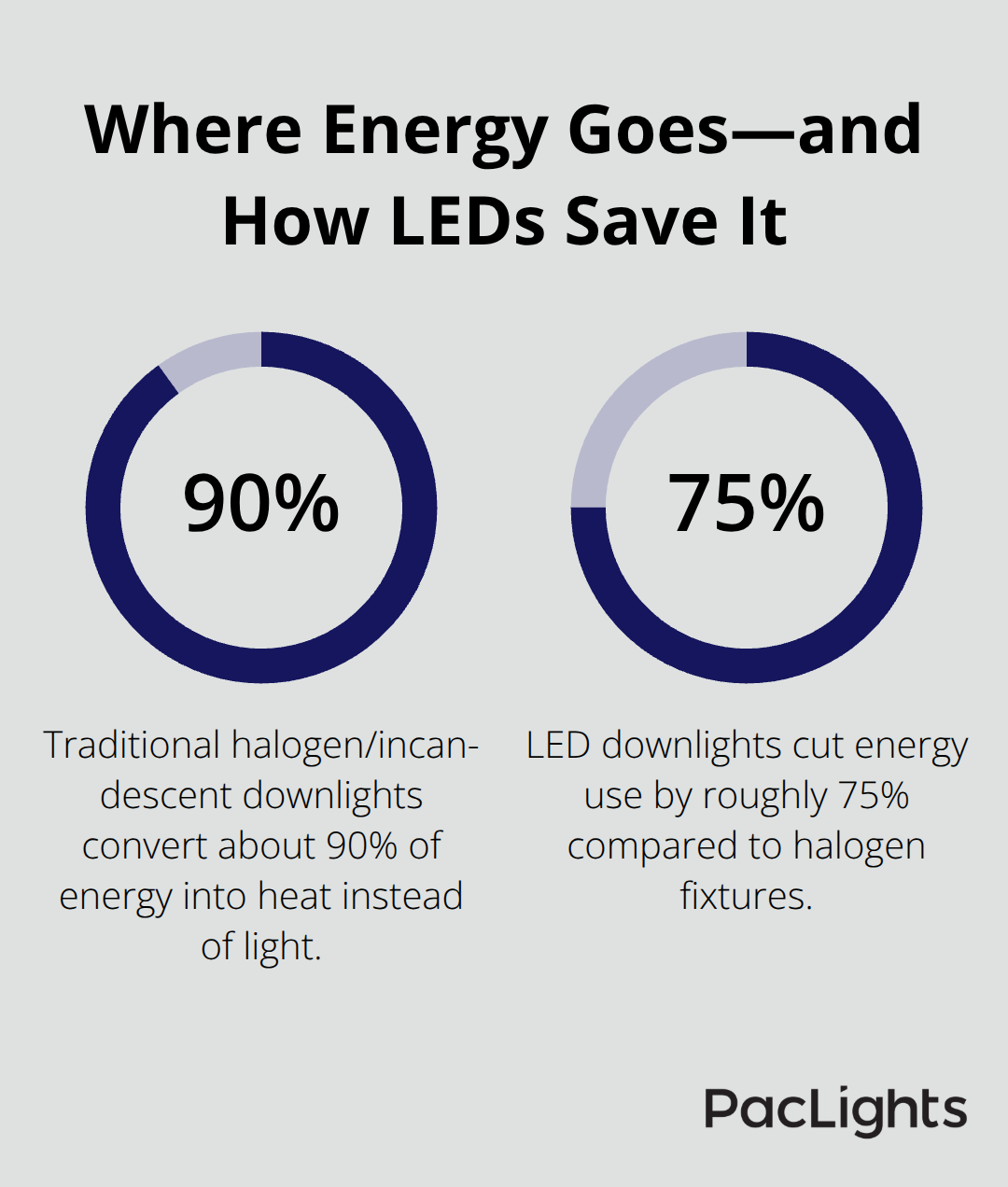
Traditional halogen and incandescent downlights convert roughly 90 percent of their energy into heat rather than usable light. A 75-watt halogen downlight produces barely 10 watts of actual illumination while the rest escapes as thermal waste. Commercial buildings with dozens or hundreds of these fixtures running eight to twelve hours daily face staggering energy bills. A typical office building with 200 halogen downlights operating ten hours per day consumes approximately 150,000 kilowatt-hours annually just for downlighting. That translates to roughly $18,000 to $24,000 in annual electricity costs depending on your regional rates. Most facility managers don’t realize they’re essentially running space heaters disguised as lighting fixtures.
Uncontrolled Lighting Wastes 20 to 30 Percent of Energy
Older commercial spaces lack occupancy sensors or daylight harvesting systems. Lights remain on in empty conference rooms, storage areas, and hallways regardless of occupancy. Studies show that 20 to 30 percent of commercial lighting energy gets wasted in unoccupied areas. When motion sensors exist in older installations, they often lack integration with dimming capabilities, so lights operate at full brightness even when natural daylight could supplement the illumination. Manual override switches compound the problem since employees frequently leave lights on for convenience. Without networked controls that provide real-time monitoring, facility managers gain no visibility into which areas consume the most energy or when peak usage occurs. This blindness makes targeted efficiency improvements impossible.
Outdated Fixtures Fail Modern Efficiency Standards
Downlights installed before 2015 typically fail to meet current energy codes because efficiency standards have tightened significantly. Older magnetic ballasts consume 10 to 15 percent more energy than modern electronic alternatives. Reflector designs in vintage fixtures scatter light inefficiently, requiring higher wattage to achieve adequate illumination levels. Many older installations use standard A-lamp or PAR-lamp technology that generates excessive heat and requires replacement every 1,000 to 2,000 hours of operation. This constant maintenance cycles through bulbs, labor costs, and supply chain expenses that compound your total cost of ownership. Your lighting infrastructure silently drains resources year after year while competitors who’ve upgraded to LED systems enjoy dramatically lower operating expenses. These cost differences create a widening gap that makes upgrading from outdated fixtures not just sensible but financially urgent.
LED Downlight Upgrades Deliver Immediate Cost Savings
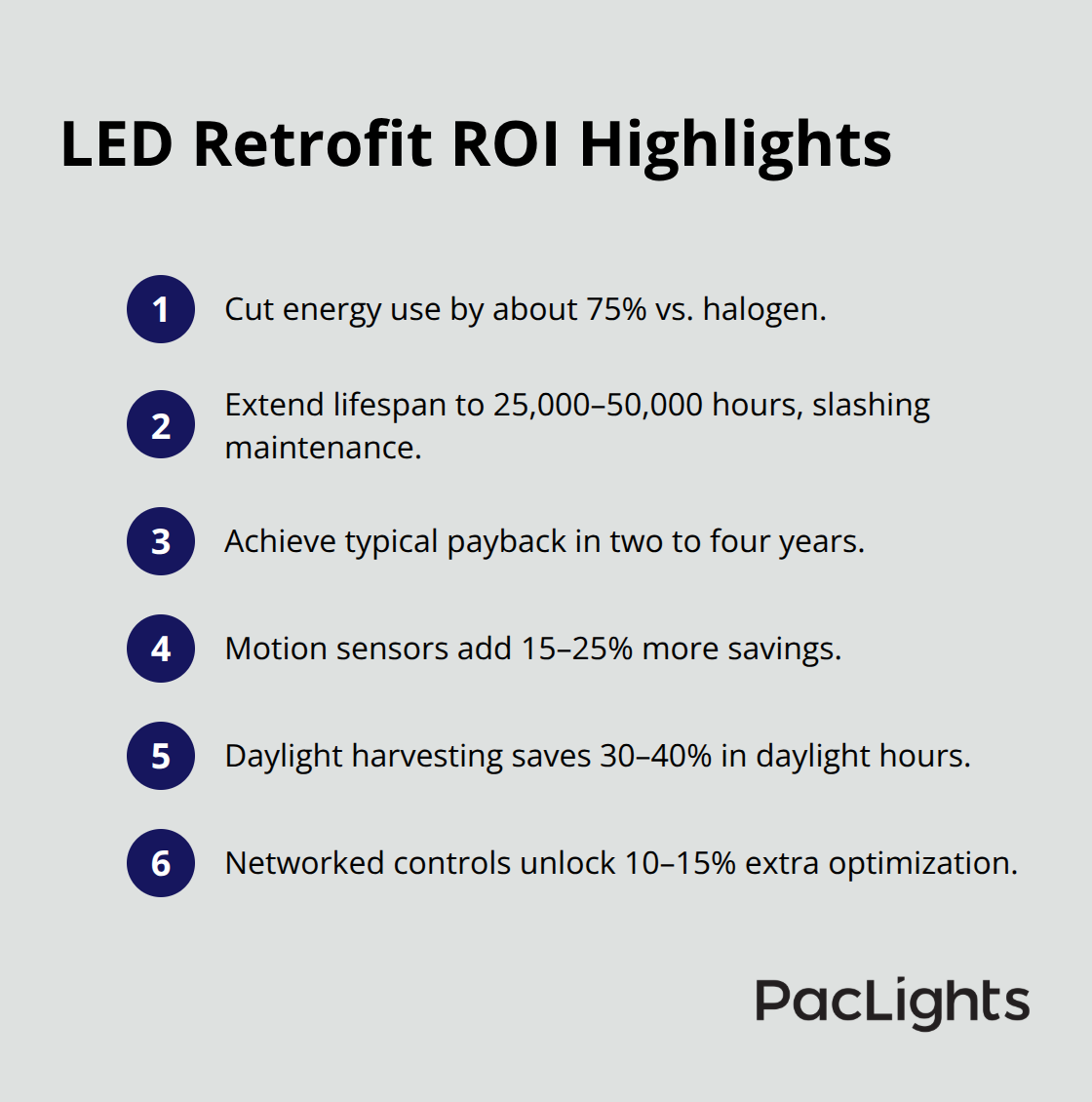
LED downlights slash energy consumption by 75 percent or more compared to traditional halogen fixtures, and this isn’t theoretical savings. A commercial space running 200 halogen downlights at 75 watts each for ten hours daily spends roughly $18,000 to $24,000 annually on downlighting alone. Switching those same fixtures to LED equivalents consuming just 10 to 12 watts each drops that bill to approximately $2,400 to $3,200 per year. That’s a reduction of $15,600 to $20,800 annually from a single lighting category.
Energy Consumption Drops Dramatically
Most facility managers underestimate how quickly these numbers compound across their entire facility. When you multiply this impact across parking areas, hallways, offices, and outdoor spaces, the total energy reduction becomes substantial enough to reshape your operating budget. The payback period typically ranges from two to four years depending on your current fixture count and local electricity rates, meaning your lighting system essentially pays for itself while generating ongoing savings.
Maintenance Costs Disappear With LED Lifespan
LED downlights operate for 25,000 to 50,000 hours compared to the 1,000 to 2,000 hour lifespan of halogen bulbs. This means you replace LED fixtures roughly once per decade instead of every few months. A facility with 200 downlights replacing halogen bulbs every eighteen months spends approximately $3,000 to $5,000 annually on replacement bulbs and labor. LED fixtures eliminate most of this expense since replacements become rare events rather than routine maintenance cycles.
Your maintenance team stops climbing ladders for routine bulb swaps and redirects labor toward actual facility improvements. Reduced maintenance cycles also mean fewer supply chain disruptions and lower inventory costs for replacement bulbs.
Real ROI Numbers Change Facility Priorities
The financial case for LED upgrades strengthens when you calculate total cost of ownership across ten years. A 200-fixture installation costs roughly $8,000 to $12,000 for LED fixtures and installation but generates $156,000 to $208,000 in energy savings plus another $30,000 to $50,000 in avoided maintenance costs over the same period. That’s a net benefit of $174,000 to $246,000 from a single decision.
Facilities that combine LED upgrades with motion sensors and daylight harvesting controls achieve even faster returns because the controls prevent wasted energy in unoccupied spaces and reduce consumption during daylight hours. This combination typically accelerates payback to eighteen to thirty months. Most facility managers hesitate on upgrades because they focus on upfront costs rather than the complete financial picture. Once you calculate genuine ROI (including energy and maintenance savings), LED retrofits become one of the highest-return capital investments available for commercial facilities.
The real question isn’t whether to upgrade-it’s how to maximize those savings even further through intelligent lighting controls.
Maximizing Savings With Smart Lighting Controls
Motion Sensors Eliminate Wasted Light in Unused Spaces
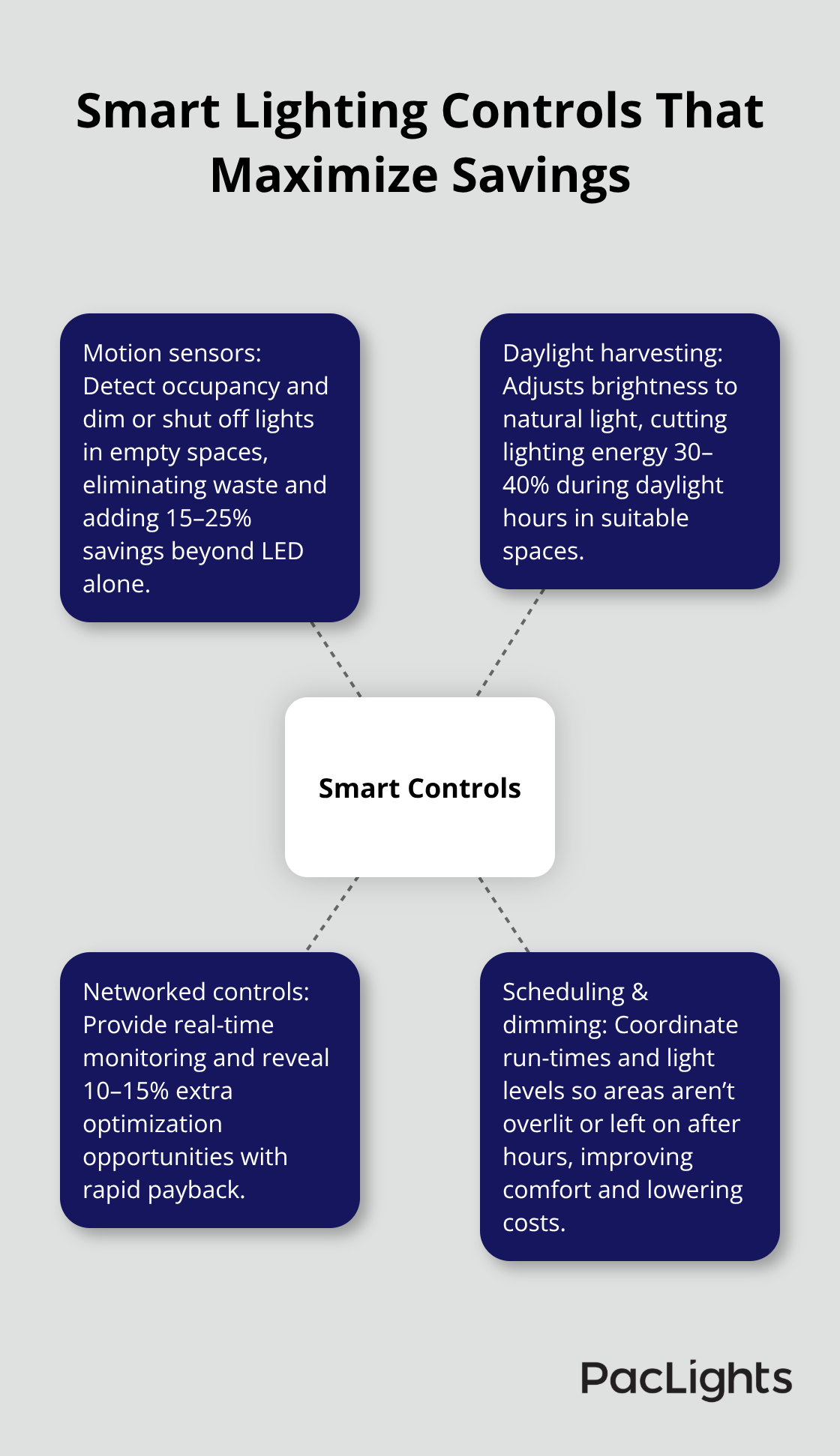
LED fixtures alone cut energy consumption dramatically, but motion sensors amplify those savings significantly. Motion sensors detect occupancy and dim or shut off lights in unoccupied spaces, eliminating the 20 to 30 percent energy waste that plagues most facilities. A commercial facility with motion sensors installed in conference rooms, storage areas, and hallways typically reduces lighting energy by an additional 15 to 25 percent beyond the LED baseline. Consider a 200-fixture installation where LED alone saves $15,600 annually. Adding motion sensors to half those fixtures generates another $2,300 to $3,900 in yearly savings. These sensors cost roughly $40 to $80 per unit installed, meaning they pay for themselves within six to twelve months.
Daylight Harvesting Adapts Brightness to Natural Light Levels
Daylight harvesting systems measure natural light levels and automatically adjust fixture brightness to maintain consistent illumination while consuming less energy. Office spaces with south-facing windows can reduce lighting energy consumption by 30 to 40 percent during daylight hours using harvesting controls. A typical office building saves approximately $4,000 to $6,000 annually through daylight harvesting alone depending on window orientation and geographic location. The combination of LED fixtures, motion sensors, and daylight harvesting creates a layered efficiency approach that most facility managers overlook. PacLights offers lighting controls including motion and daylight features that work together to optimize energy consumption across your facility.
Networked Controls Provide Real-Time Energy Monitoring
Networked lighting controls provide real-time visibility into energy consumption patterns and identify which areas waste the most energy. These systems track fixture usage, energy draw, and occupancy data across your entire facility through a centralized dashboard. Facilities using networked controls typically identify 10 to 15 percent additional savings opportunities that remain invisible without monitoring systems. For example, networked controls reveal that conference rooms on certain floors remain lit during non-business hours or that outdoor area lighting runs longer than necessary due to sensor timing issues. Once you identify these inefficiencies, adjusting schedules or sensor sensitivity takes minutes rather than requiring facility walkthroughs and guesswork. A 200-fixture installation with networked controls costs approximately $3,000 to $5,000 but generates $8,000 to $12,000 in annual savings from optimization adjustments alone. The payback period for networked controls typically ranges from four to eight months, making them one of the fastest-returning facility investments available.
Final Thoughts
The financial case for LED downlight retrofits stands on solid ground. You’ve seen the numbers throughout this guide: 75 percent energy reductions, $15,600 to $20,800 in annual savings from a single 200-fixture installation, and payback periods of two to four years. Motion sensors eliminate the 20 to 30 percent of energy wasted in unoccupied spaces, while daylight harvesting reduces consumption by 30 to 40 percent during daylight hours. Networked controls identify an additional 10 to 15 percent in optimization opportunities that would otherwise remain invisible.
The real barrier to upgrading isn’t the technology or the financial justification-it’s taking the first step. Most facility managers lack visibility into their current lighting performance and struggle to calculate genuine ROI across their specific facility. At PacLights, we remove that barrier through free lighting layout designs and ROI assessments that analyze your current infrastructure and calculate your specific energy and cost savings.
We provide LED retrofit solutions tailored to your facility’s needs, whether you’re upgrading recessed downlights, high bays, or outdoor area lighting. Our fixtures feature optional motion and daylight controls, plus advanced networked lighting controls that give you real-time visibility into energy consumption patterns. Visit PacLights to request a free assessment of your facility and start your commercial downlights energy efficiency transformation today.
Disclaimer: PacLights is not responsible for any actions taken based on the suggestions and information provided in this article, and readers should consult local building and electrical codes for proper guidance.