

Warehouse high bay lights are the backbone of any industrial facility that needs to operate safely and efficiently. At PacLights, we know that poor lighting in large spaces leads to accidents, wasted energy, and lost productivity.
Modern LED solutions have changed the game, offering warehouses dramatic energy savings without sacrificing brightness or durability. This guide walks you through everything you need to know to upgrade your facility.
Why Warehouses Need Specialized High Bay Lighting
Warehouses operate in three dimensions, not two. A 40-foot ceiling means you light volume, not floor area. Standard commercial fixtures designed for office buildings fail in this environment because they concentrate light downward in ways that leave upper shelving dark and create harsh shadows on work surfaces. High bay lighting must handle vertical distribution differently, projecting light across large areas while maintaining foot-candle levels that meet OSHA standards of 30 foot-candles for general warehouse areas and up to 50 foot-candles for detailed picking and packing zones.
The Safety Reality of Poor Visibility
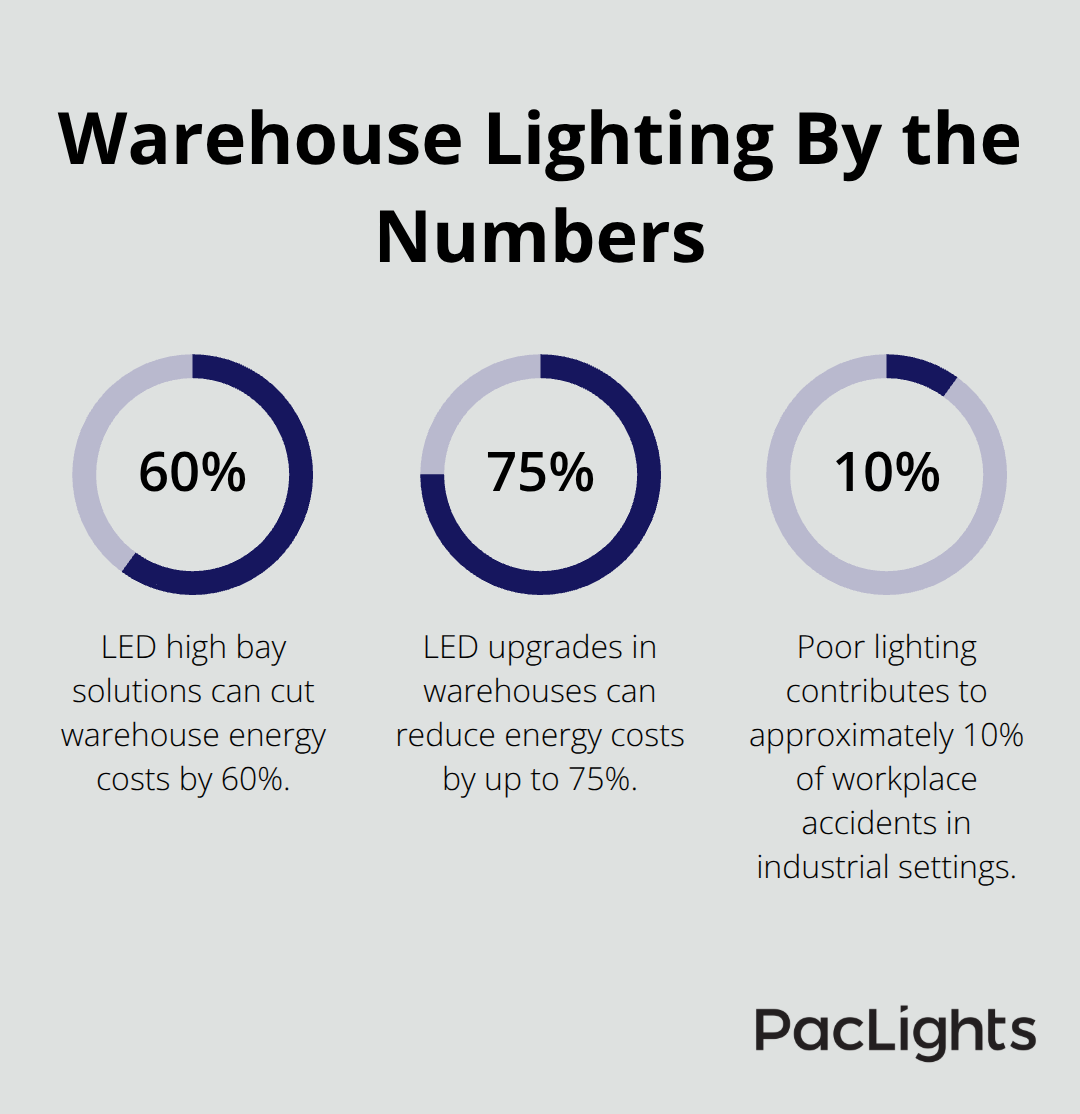
Inadequate lighting directly correlates with workplace injuries. According to the Bureau of Labor Statistics, poor lighting contributes to approximately 10% of workplace accidents in industrial settings. When workers cannot see clearly at height, they miss hazards on upper shelves, misjudge distances, and make picking errors that cascade into safety problems. Motion and movement detection become harder-a forklift operator working in shadows has slower reaction times. High bay fixtures must deliver uniform illumination across the entire vertical space, not just the floor level. This isn’t about comfort; it’s about preventing accidents that cost warehouses thousands in lost time and workers compensation claims.
Energy Consumption That Demands Attention
Traditional metal halide high bay lights consume 400 to 1000 watts per fixture and last only 10,000 to 20,000 hours. A warehouse with 50 fixtures running 16 hours daily replaces them multiple times annually while spending roughly $15,000 to $25,000 yearly on energy alone. LED high bay solutions reduce consumption to 100 to 200 watts per fixture while delivering comparable or superior brightness, cutting energy costs by 60% to 75%. The payback period typically falls between 18 and 36 months, after which you operate with minimal maintenance and replacement expenses for years. Warehouses that switch to LED systems often recover their investment faster than expected, then enjoy a decade or more of lower operational costs.
What Modern High Bay Fixtures Offer
The shift to LED technology has transformed what high bay lights can do. Modern fixtures deliver brightness without the heat and maintenance burden of older systems. They last 40,000 to 50,000 hours (versus the 10,000 to 20,000 hours of metal halide), which means fewer replacement cycles and less operational disruption. Advanced controls-motion sensors and daylight harvesting-allow warehouses to reduce consumption even further by turning lights off in unused zones or dimming when natural light enters through skylights or windows.
These improvements matter because they stack. Lower energy consumption plus longer fixture life plus reduced maintenance creates a financial advantage that compounds over time. The question isn’t whether to upgrade, but how to choose the right solution for your specific facility layout and operational needs.
What Makes Modern High Bay Lights Different
LED high bay fixtures operate on fundamentally different physics than the metal halide systems they replace, and this difference translates directly to warehouse performance. LED lights produce light through semiconductor technology that converts electrical current into photons with minimal heat waste, whereas metal halide bulbs generate light through an arc between electrodes and lose 80% of their energy as heat. This efficiency gap explains why LED high bay fixtures rated at 150 watts deliver the same brightness as 400-watt metal halide units. The U.S. Department of Energy reports that LED lighting in industrial facilities reduces energy consumption by 50% to 75% compared to traditional high bay systems, and these aren’t theoretical numbers-they come from actual facility audits and retrofit measurements. A warehouse running 50 high bay fixtures for 16 hours daily switches from consuming approximately 320,000 kilowatt-hours annually with metal halide to roughly 80,000 kilowatt-hours with LED, which at an average industrial rate of $0.12 per kilowatt-hour saves $28,800 yearly on energy costs alone.
Durability That Eliminates Constant Replacement
Modern LED high bays last 40,000 to 50,000 hours under normal operation, which translates to 10 to 12 years of continuous 16-hour-daily use without replacement. Metal halide fixtures fail at 10,000 to 20,000 hours, requiring replacement every 2 to 4 years in the same scenario. Replacing high bay fixtures creates operational disruption-warehouses must shut down sections, rent lifts, and coordinate installation work. Industrial-grade LED fixtures withstand temperature fluctuations and vibration from equipment operation, which extends real-world lifespan beyond lab ratings. A warehouse that replaces 50 metal halide fixtures every 3 years spends roughly $15,000 to $20,000 on replacement parts and labor costs annually. Switching to LED eliminates this recurring expense for a decade, freeing capital for other operational investments.
Smart Controls That Work Without Complexity
Motion sensors and daylight harvesting controls reduce energy consumption further through automatic adjustments based on actual facility conditions. Motion sensors detect worker and equipment movement, dimming or turning off lights in unused zones-a warehouse with storage aisles where workers spend 30% of the day can reduce consumption by 20% to 30% through motion control alone. Daylight harvesting systems measure natural light entering through skylights or clerestory windows and dim LED fixtures proportionally, which proves especially effective in facilities with significant roof glazing.
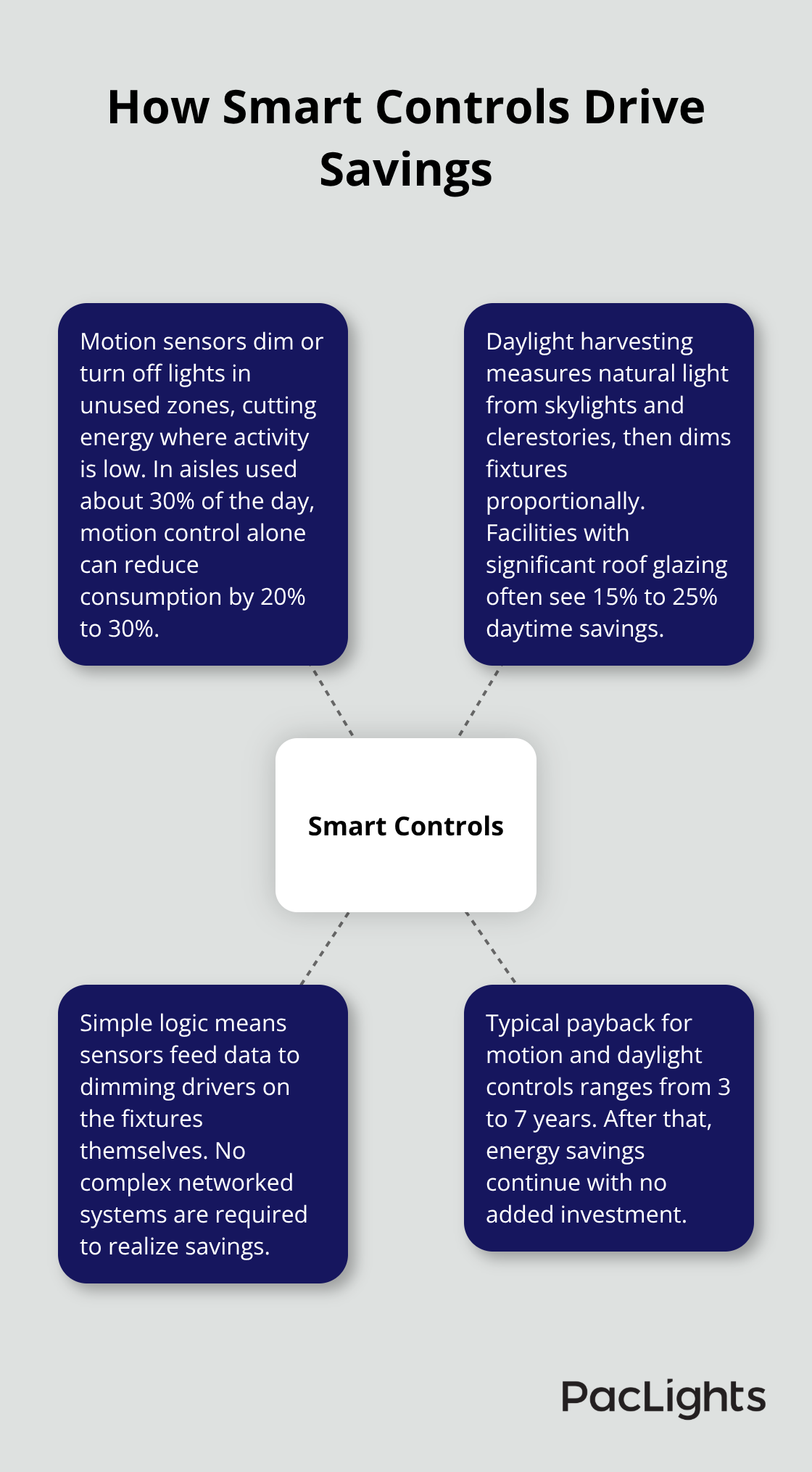
These controls operate on simple logic: sensors feed data to controls that adjust dimming drivers on the LED fixtures themselves, without complex networked systems. A warehouse with 40 feet of skylighting across 100,000 square feet can reduce high bay lighting energy use by 15% to 25% during daylight hours through harvesting alone. The payback on motion and daylight controls typically ranges from 3 to 7 years, after which energy savings accumulate with zero additional investment.
Choosing Controls That Match Your Facility
Different warehouses benefit from different control strategies depending on layout and natural light availability. A facility with minimal skylighting and consistent worker traffic throughout the day may prioritize motion sensors in low-traffic zones (storage areas, restrooms, loading docks) while maintaining constant illumination in active picking and packing areas. A warehouse with extensive roof glazing and variable daylight should implement daylight harvesting across the entire space to capture seasonal and hourly variations in natural light. PacLights offers LED retrofit solutions with optional daylight and motion control features, along with advanced lighting controls to optimize energy use for your specific layout. The right control combination depends on your operational patterns, not on generic best practices-a free lighting layout design and ROI assessment reveals which controls deliver the fastest payback for your warehouse.
Sizing Your Warehouse for the Right Lighting Solution
Start with Dimensions and Operational Zones
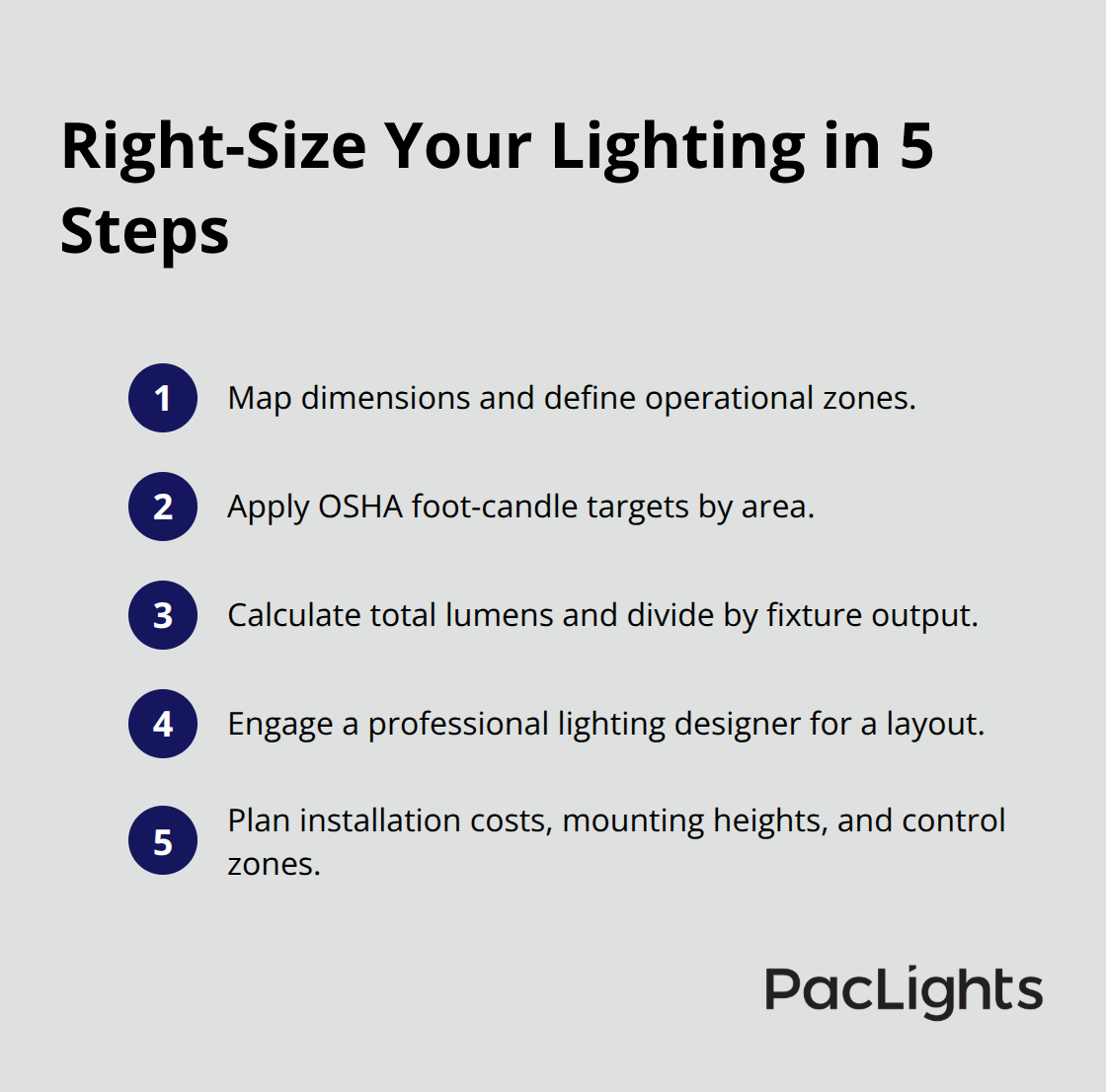
Measure your warehouse dimensions and operational zones before selecting fixture wattage. Identify areas by function-picking zones, storage aisles, loading docks, offices, and restrooms all require different light levels. OSHA mandates 30 foot-candles for general warehouse areas and 50 foot-candles for detailed work like order picking and packing. The foot-candle requirement determines how many fixtures you need and at what wattage. A 100,000-square-foot warehouse with 35-foot ceilings and general storage needs 30 foot-candles across the floor, which typically requires 80 to 120 LED high bay fixtures depending on reflectance (ceiling color and wall finishes affect how much light bounces back into the space). A warehouse with identical dimensions but extensive picking operations needs 50 foot-candles in those zones, which increases fixture count or requires higher-output units.
Calculate Lumens and Fixture Quantity
Calculate lumens by multiplying foot-candles by floor area, then divide by fixture lumens to determine quantity. A 100,000-square-foot space at 30 foot-candles requires 3,000,000 lumens total. LED high bays typically range from 8,000 to 20,000 lumens, so this warehouse needs roughly 150 to 375 fixtures depending on the model chosen. The variance matters financially-oversizing costs more upfront and wastes energy, while undersizing creates dark spots that workers compensate for by adding temporary lighting or making unsafe decisions in shadows.
Invest in Professional Lighting Design
Engage a professional lighting designer before purchasing fixtures. A proper lighting audit costs between $500 and $2,000 depending on warehouse size and complexity, but identifies the exact fixture count, placement, and control strategy needed for your space. A designer measures ceiling reflectance, wall color, floor material, and existing natural light sources, then models how different fixture counts and placements deliver foot-candles across your actual space. This prevents the common mistake of applying generic ratios that ignore your facility’s unique characteristics. For example, a warehouse with dark concrete walls and low ceilings requires more fixtures than one with white painted ceilings and light-colored walls, even at identical square footage.
Plan Installation Costs and Complexity
Installation costs typically range from $150 to $400 per fixture including labor, electrical connections, and mounting hardware, so a 150-fixture warehouse pays $22,500 to $60,000 for installation alone. Professional designers specify mounting heights, spacing patterns, and control zones that minimize installation complexity and reduce labor costs. A well-designed system installs faster, requires fewer electrical modifications, and operates more efficiently than one assembled from generic recommendations. The upfront investment in professional design pays back through faster installation, lower ongoing energy costs, and elimination of the undersized-system problem that forces expensive additions within 18 months. PacLights offers free lighting layout designs and ROI assessments that calculate energy savings, payback periods, and fixture placement specific to your warehouse dimensions and operational patterns.
Final Thoughts
Modern warehouse high bay lights transform facility operations through measurable financial and safety gains that stack over time. LED technology cuts energy consumption by 60% to 75%, saving a typical 50-fixture warehouse roughly $28,800 annually, while eliminating the replacement cycle that drains maintenance budgets every 2 to 4 years. Worker safety improves when uniform illumination across vertical spaces removes shadows and dark zones where accidents occur.
Smart controls amplify these advantages without adding complexity. Motion sensors and daylight harvesting reduce consumption another 15% to 30% depending on your facility layout and natural light availability, with payback periods typically falling between 18 and 36 months. Professional lighting design prevents costly mistakes by identifying exact fixture counts, placement patterns, and control strategies specific to your warehouse dimensions and operational zones, turning a $500 to $2,000 upfront investment into thousands in savings.
We at PacLights provide LED retrofit solutions with optional daylight and motion controls tailored to your specific layout. Visit PacLights to explore warehouse high bay lights options and schedule your facility assessment.
Disclaimer: PacLights is not responsible for any actions taken based on the suggestions and information provided in this article, and readers should consult local building and electrical codes for proper guidance.