

Data center aisle lighting is one of the most overlooked factors in facility management. Poor visibility leads to costly maintenance errors, safety risks, and wasted staff time-yet many facilities operate with outdated or inadequate systems.
At PacLights, we’ve seen firsthand how the right lighting setup transforms operations. This guide shows you how to cut energy costs, improve safety, and boost productivity through smarter aisle lighting choices.
Why Poor Aisle Lighting Costs You More Than You Think
Inadequate data center aisle lighting creates a cascade of expensive problems that most facility managers underestimate. When technicians cannot clearly see cable connections, rack labels, or equipment status, maintenance tasks take significantly longer and errors multiply. OSHA data shows that poor lighting in industrial facilities contributes directly to slip-and-fall incidents, and data centers are no exception. A technician working in dim conditions might misidentify a cable, accidentally disconnect the wrong connection, or miss critical warning signs on equipment. These mistakes translate into unplanned downtime, emergency repairs, and frustrated staff. The Department of Energy found that LED corridor lighting reduces energy use by 65 to 70 percent compared to traditional fluorescent or metal halide fixtures, yet many facilities still operate with outdated systems that consume far more power while delivering worse visibility.
Visibility Problems Slow Maintenance and Drain Productivity
Visibility directly affects how quickly and accurately your team performs maintenance. When aisles lack sufficient illumination, technicians move slowly, verify connections multiple times, and sometimes use flashlights or mobile devices to supplement inadequate overhead lighting. This inefficiency compounds across dozens of maintenance events each month. The Illuminating Engineering Society recommends 50 to 75 foot-candles in repair and maintenance areas, yet many data centers operate at half this level. Poor lighting also drains productivity. Staff fatigue increases when working in dim conditions, eye strain accumulates during long shifts, and decision-making slows. A cool color temperature of 4000K to 5000K with 80 or higher CRI improves visibility and helps technicians distinguish cables and labels more accurately, yet generic warehouse lighting typically falls short. The cost of these problems-lost time, errors, safety incidents-often exceeds the investment in proper aisle lighting by a significant margin.
Smart Controls Deliver Better Visibility and Lower Energy Costs
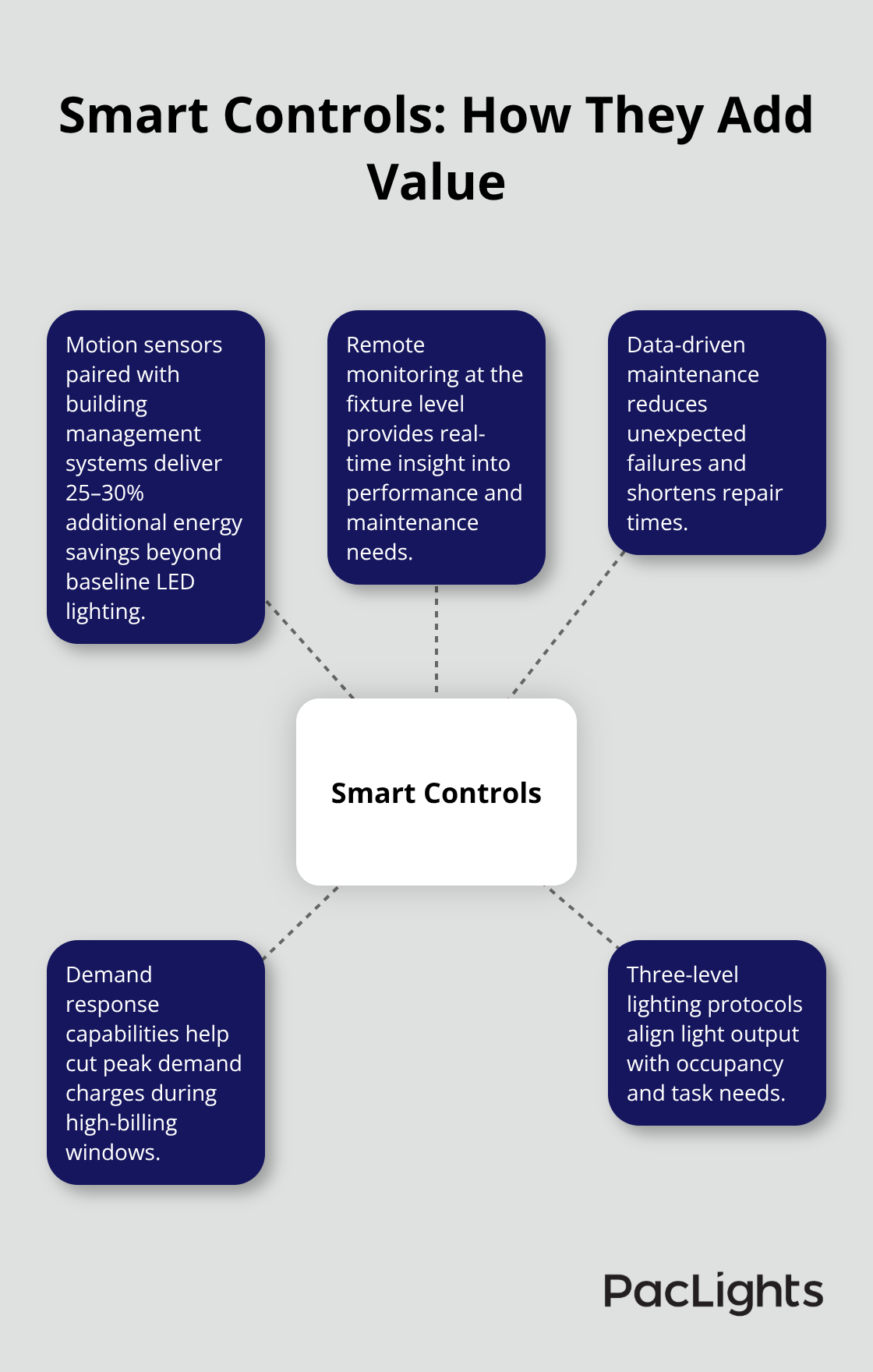
Well-designed aisle lighting supports your data center’s reliability and your team’s safety. Motion sensors paired with building management systems deliver 25 to 30 percent additional energy savings beyond baseline LED lighting, meaning you gain better visibility while lowering costs. Network-connected lighting enables remote monitoring and fixture-level data that simple on-off systems cannot provide, giving you real-time insight into performance and maintenance needs. These advanced controls (combined with LED technology) transform aisle lighting from a static utility into an active asset that responds to your facility’s actual needs.
Understanding Your Path Forward
The right aisle lighting system addresses both visibility and energy efficiency simultaneously. LED fixtures reduce power consumption and heat generation, while motion sensors and daylight controls optimize when and where light appears. Your next step involves assessing your current lighting performance and identifying the specific gaps that affect your operations.
How LED and Smart Controls Cut Data Center Energy Costs
LED Technology Slashes Energy Consumption and Heat Output
LED technology fundamentally changes the economics of data center aisle lighting. The Department of Energy reports that LED corridor lighting reduces energy use by 65 to 70 percent compared to traditional fluorescent or metal halide fixtures. Beyond power consumption, LED fixtures generate significantly less heat than older technologies, which triggers a secondary benefit: cooling costs drop by an additional 15 to 25 percent according to the same Department of Energy analysis. This dual savings mechanism means upgrading to LED addresses two major operating expenses simultaneously.
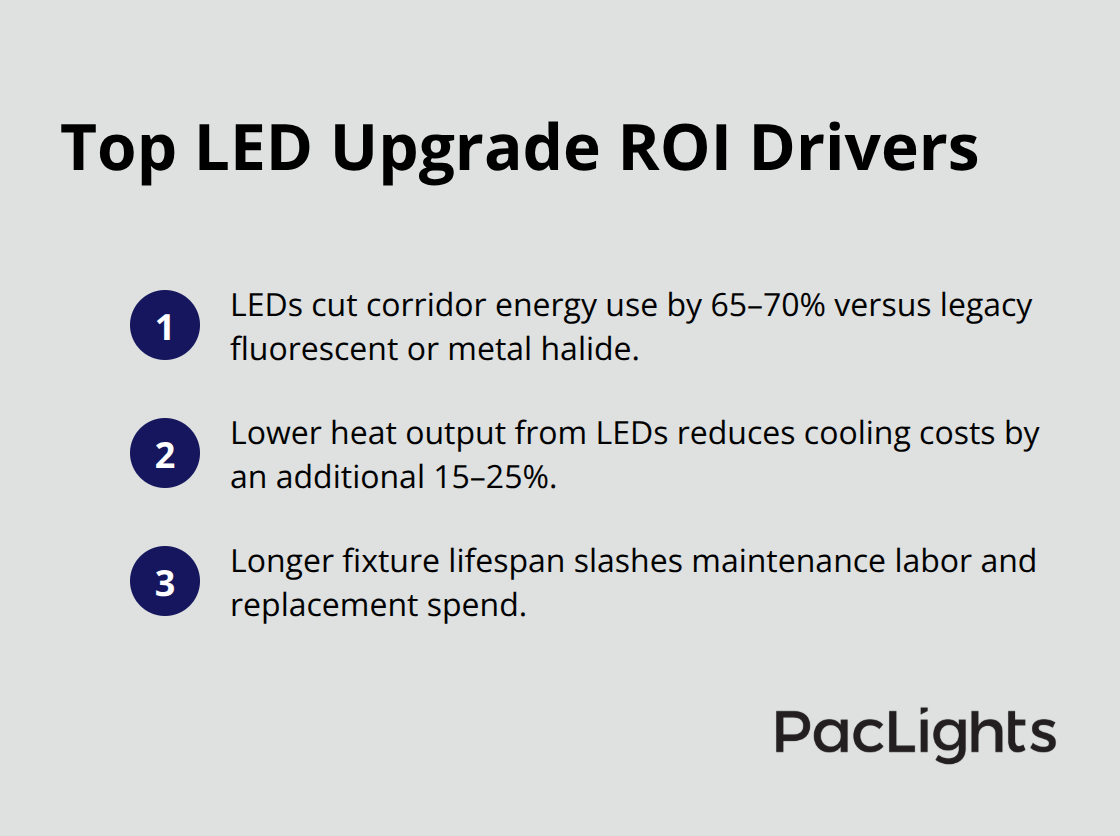
A typical data center corridor retrofit achieves full payback in 2 to 3 years through energy savings alone, after which every year delivers pure cost reduction. The math becomes compelling when you factor in fixture lifespan. LED fixtures last approximately 30 times longer than incandescent bulbs and 5 times longer than CFL options, which means fewer maintenance calls, less labor spent on replacements, and reduced inventory management overhead. For facility managers operating on tight budgets, this extended lifespan often justifies the upfront investment faster than energy savings calculations suggest.
Motion Sensors and Occupancy-Based Dimming Amplify Savings
Motion sensors and occupancy-based dimming amplify these savings without sacrificing visibility when technicians actually work in the aisles. The Department of Energy found that combining motion sensors with a building management system yields 25 to 30 percent additional energy savings beyond baseline LED lighting in unoccupied corridor zones. Network-connected lighting systems take this further by enabling remote monitoring at the fixture level, allowing you to track performance data, identify maintenance needs before failures occur, and adjust brightness dynamically based on real occupancy patterns rather than fixed schedules.
Three-level lighting protocols work particularly well in data centers: minimal illumination in vacant spaces, moderate brightness when staff are present, and full brightness during maintenance activities. Centralized controls enable demand response during peak billing periods, reducing demand charges that often represent 30 to 50 percent of total electricity costs in facilities with high consumption spikes.
Tuning Brightness and Color After Installation
Color-adjustable LED panels let you tune brightness and color temperature after installation without expensive retrofits, adapting to changing operational needs or discovering that certain areas require higher illumination than initially planned. This flexibility means you avoid costly guesswork during the design phase and respond to real-world conditions as your team works in the space. Network-connected controls connect to your building management system for seamless optimization across your entire facility, and products like those offered by PacLights integrate these advanced controls into fixture designs to support this integration.
The combination of LED efficiency, motion sensing, and networked controls transforms your aisle lighting from a static utility into a responsive system that matches your actual operational demands. With these technologies in place, your facility gains the visibility your team needs while the energy costs decline month after month. The next step involves selecting the right fixtures and planning your implementation to maximize these benefits.
Designing and Executing Your Lighting Upgrade
Start by auditing your current aisle lighting systematically rather than assuming problems exist everywhere. Walk your aisles during peak maintenance hours and note where technicians struggle to see clearly, where shadows fall across equipment faces, and where they resort to flashlights or mobile devices to supplement overhead lighting. Photograph these problem zones in normal operating conditions. Pay specific attention to areas between rack rows where fixtures sit between equipment rather than directly above aisles, creating dark zones that slow work and increase error risk. The Illuminating Engineering Society recommends 50 to 75 foot-candles in repair and maintenance areas, so measure actual illumination levels with a light meter in your current setup. This data tells you exactly where upgrades deliver the most value rather than lighting your entire facility uniformly. Many facilities discover that 30 to 40 percent of their aisles fall below recommended levels while others exceed requirements, meaning targeted upgrades cost far less than wholesale replacement.
Fixture Placement Determines Visibility More Than Total Wattage
Alignment matters more than brightness alone. Position narrow pendant or linear strip fixtures directly above aisles between racks, aligned with rack spacing to minimize shadows on equipment faces and cable connections. Avoid placing fixtures between equipment rows where they create dark zones and force technicians to work in shadows. Your ceiling design should accommodate suspended tracks that allow flexible alignment with aisles, cabling, and trays without interference. If your facility uses hot and cold aisle configurations, prioritize lighting the cold aisles where technicians actually access equipment and limit lighting in hot aisles to save energy without sacrificing functionality. Coordinate this placement early in your design phase or retrofit planning to prevent expensive post-installation adjustments. A well-planned layout aligned with your actual aisle configuration costs less to install and delivers superior results compared to generic warehouse-style installations.
Specify Fixtures Built for Data Center Demands
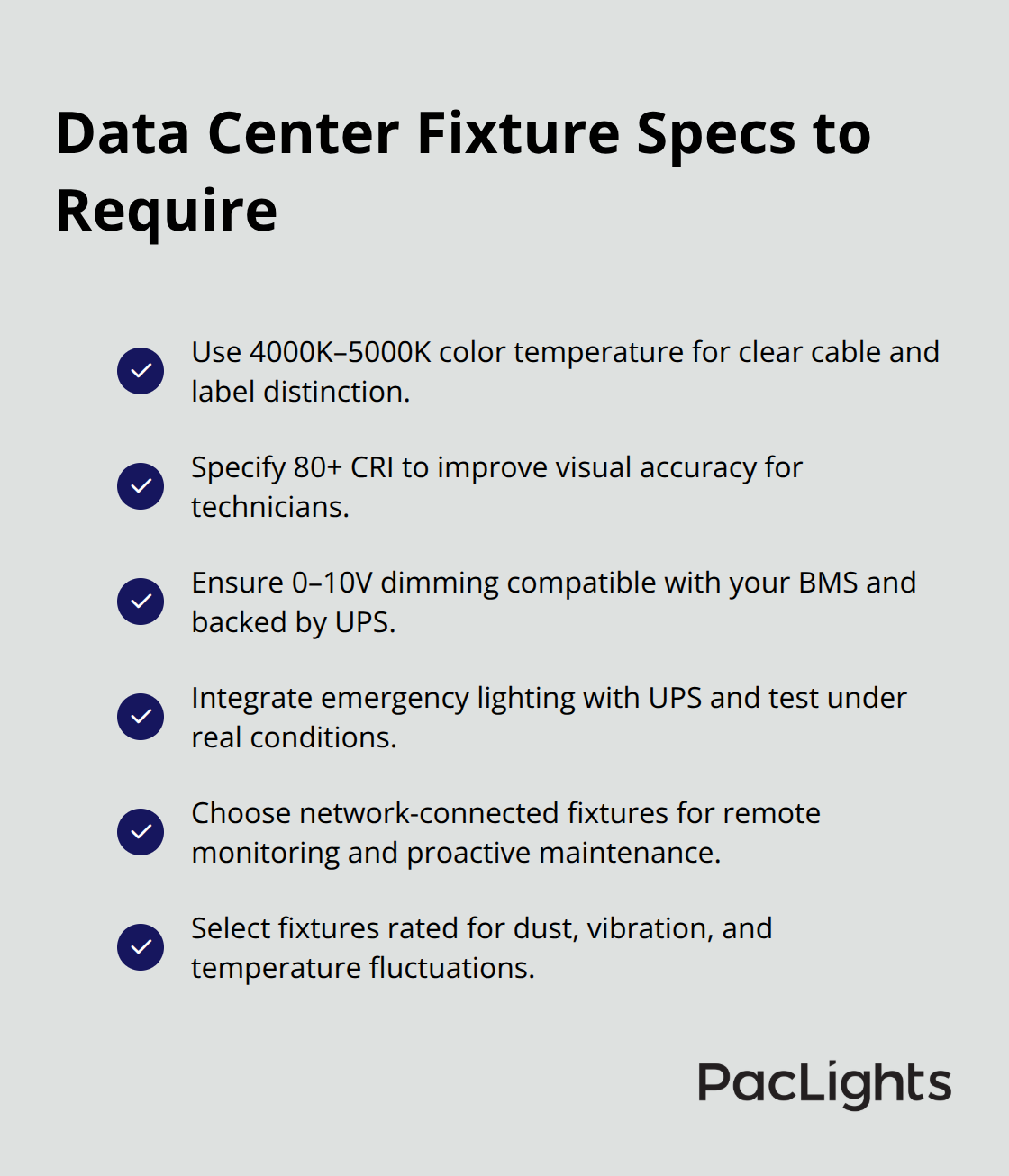
Standard commercial fixtures fall short in data centers. Choose LED fixtures rated for the specific environment, whether that means dusty conditions, vibration from cooling systems, or temperature fluctuations. Verify that fixtures support 0-10V dimming controls compatible with your building management system and UPS power during outages. Color temperature should be 4000K to 5000K with 80 or higher CRI to help technicians distinguish cables and labels accurately. Confirm that emergency lighting integrates with your UPS system and test fixtures under actual UPS conditions to verify reliability during power loss. Network-connected fixtures enable remote monitoring and fixture-level data collection, allowing you to track performance and schedule maintenance proactively rather than respond to failures.
PacLights offers free lighting layout designs and ROI assessments that quantify your specific savings potential based on your facility’s dimensions, current consumption, and operational patterns. This removes guesswork and provides concrete numbers for your business case.
Calculate Payback and Long-Term Operating Cost Reduction
A typical data center corridor LED upgrade delivers full payback in 2 to 3 years through energy savings alone, after which you realize pure cost reduction. Factor in the extended fixture lifespan (LEDs last approximately 30 times longer than incandescent bulbs) and reduced maintenance labor to strengthen your financial case. Motion sensors and occupancy-based dimming add 25 to 30 percent additional savings beyond baseline LED lighting according to the Department of Energy, accelerating payback further. Include demand response capabilities in your analysis if your facility faces demand charges that represent 30 to 50 percent of total electricity costs during peak periods. Centralized controls that reduce illumination during high-demand billing windows lower these charges measurably. When presenting this to leadership, show the annual energy cost reduction in dollars, not just percentage improvements, and highlight the safety and productivity gains that reduce maintenance errors and staff fatigue. This combination of financial and operational benefits makes aisle lighting upgrades one of the highest-ROI facility investments available.
Final Thoughts
Upgrading your data center aisle lighting delivers measurable returns across safety, productivity, and operating costs. Better visibility reduces maintenance errors that lead to unplanned downtime and emergency repairs, while your technicians work faster and more accurately when they can clearly see cable connections and equipment labels. LED fixtures reduce energy consumption by 65 to 70 percent compared to older technologies while cutting cooling costs by an additional 15 to 25 percent, and motion sensors add 25 to 30 percent more savings beyond baseline LED lighting.
A typical data center aisle lighting retrofit achieves full payback in 2 to 3 years through energy savings alone, after which you realize pure cost reduction year after year. The extended lifespan of LED fixtures-approximately 30 times longer than incandescent bulbs-means fewer maintenance calls and lower replacement labor costs over time. Proper aisle lighting supports your business operations by enabling faster maintenance cycles, reducing energy expenses, and improving staff safety and morale.
Audit your current aisle lighting by measuring illumination levels in maintenance areas and identifying dark zones where technicians struggle to see clearly. Contact PacLights for a free lighting layout design and ROI assessment tailored to your facility’s specific dimensions and operational patterns. With the right fixtures and controls in place, your data center gains the visibility your team needs while energy costs decline month after month.
Disclaimer: PacLights is not responsible for any actions taken based on the suggestions and information provided in this article, and readers should consult local building and electrical codes for proper guidance.