

LED high bay lighting retrofits are transforming industrial and commercial spaces across the globe.
At PacLights, we’ve seen firsthand how these upgrades slash energy costs while boosting light quality and worker productivity.
This guide will walk you through the process of retrofitting your existing high bay lighting to LED, from initial assessment to final installation.
What Are LED High Bay Retrofits?
The Power of LED High Bay Lighting
LED high bay retrofits revolutionize industrial and commercial spaces. These upgrades replace outdated lighting systems with energy-efficient LED technology, specifically designed for high-ceiling areas.
LED high bay lights illuminate large, open spaces from heights of 20 feet or more. They provide bright, uniform lighting across vast areas, making them ideal for warehouses, factories, and sports facilities.
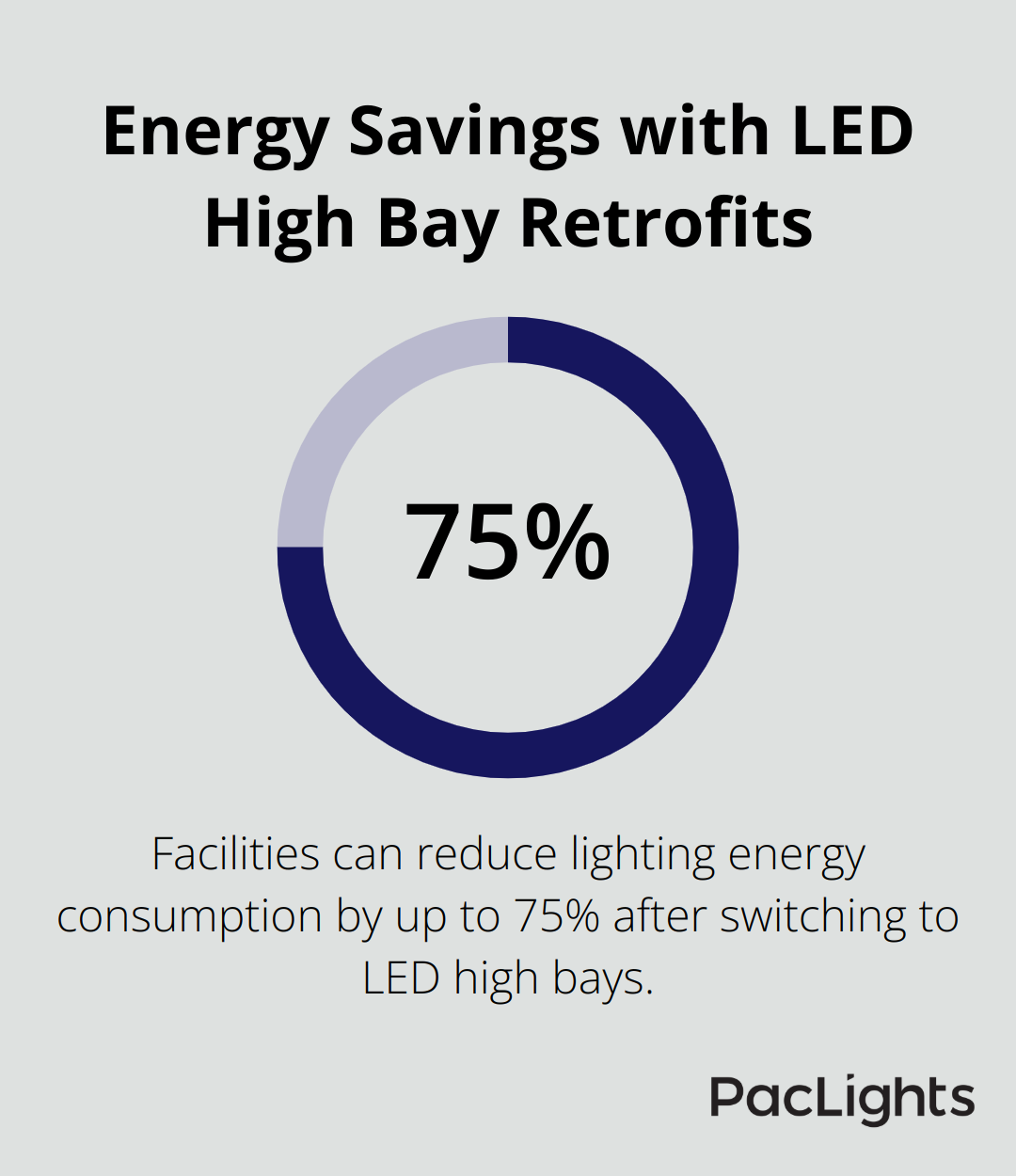
Facilities often cut their lighting energy consumption by up to 75% after switching to LED high bays. This dramatic reduction translates to significant cost savings (often thousands of dollars annually) for large spaces.
Benefits of LED High Bay Retrofits
LED high bay retrofits offer advantages beyond energy savings:
- Improved Light Quality: LED high bays offer superior color rendering and uniform light distribution, which enhances visibility and reduces eye strain for workers.
- Longer Lifespan: With a lifespan of up to 100,000 hours, LED high bays outlast traditional lighting by years, which slashes maintenance costs and downtime.
- Instant On/Off: Unlike metal halide lamps that require warm-up time, LEDs provide full brightness instantly, which improves safety in high-traffic areas.
- Reduced Heat Output: LEDs generate less heat than traditional high bay lighting, which potentially lowers HVAC costs in large facilities.
- Smart Control Options: Many LED high bays are compatible with advanced control systems, which allow for customized lighting schedules, occupancy sensing, and daylight harvesting.
Applications for LED High Bay Retrofits
LED high bay retrofits transform a wide range of industries and spaces:
- Manufacturing Plants: Improved visibility enhances worker safety and precision in assembly lines.
- Warehouses and Distribution Centers: Better lighting aids in inventory management and reduces errors in order fulfillment.
- Gymnasiums and Indoor Sports Facilities: High-quality, flicker-free lighting improves the experience for athletes and spectators alike.
- Retail Big Box Stores: Enhanced product visibility and reduced energy costs contribute to a better shopping experience and improved bottom line.
- Exhibition Halls: Flexible lighting options allow for customized setups for various events.
The power and versatility of LED high bay retrofits enable facility managers to make informed decisions about upgrading their lighting systems. To determine the best retrofit strategy for your space, you must first assess your current lighting setup. Let’s explore how to evaluate your existing system in the next section.
How to Assess Your Current Lighting System
Measure Your Energy Consumption
Start your assessment by collecting your facility’s energy bills from the past year. This data will provide a clear picture of your current lighting costs. For a more detailed analysis, use a power meter to measure the actual wattage draw of your existing fixtures. This step often reveals that fixtures consume more power than their rated wattage suggests.
Many facilities are surprised by the true energy consumption of their outdated lighting systems. In some cases, warehouses discover their metal halide high bays draw 15% more power than expected, significantly inflating their energy costs.
Map Out Your Lighting Needs
Create a detailed map of your facility, noting the function of each area and its specific lighting requirements. Consider factors like task complexity, safety concerns, and hours of operation. For example, a packaging area might need brighter, more focused light than a storage zone.
Use a light meter to measure current illumination levels throughout your space. Compare these readings to industry standards for your specific applications. The Illuminating Engineering Society (IES) provides recommended light levels for various tasks and environments.
Conduct a Comprehensive Lighting Audit
A professional lighting audit examines your current system’s performance and identifies opportunities for improvement. This process typically includes:
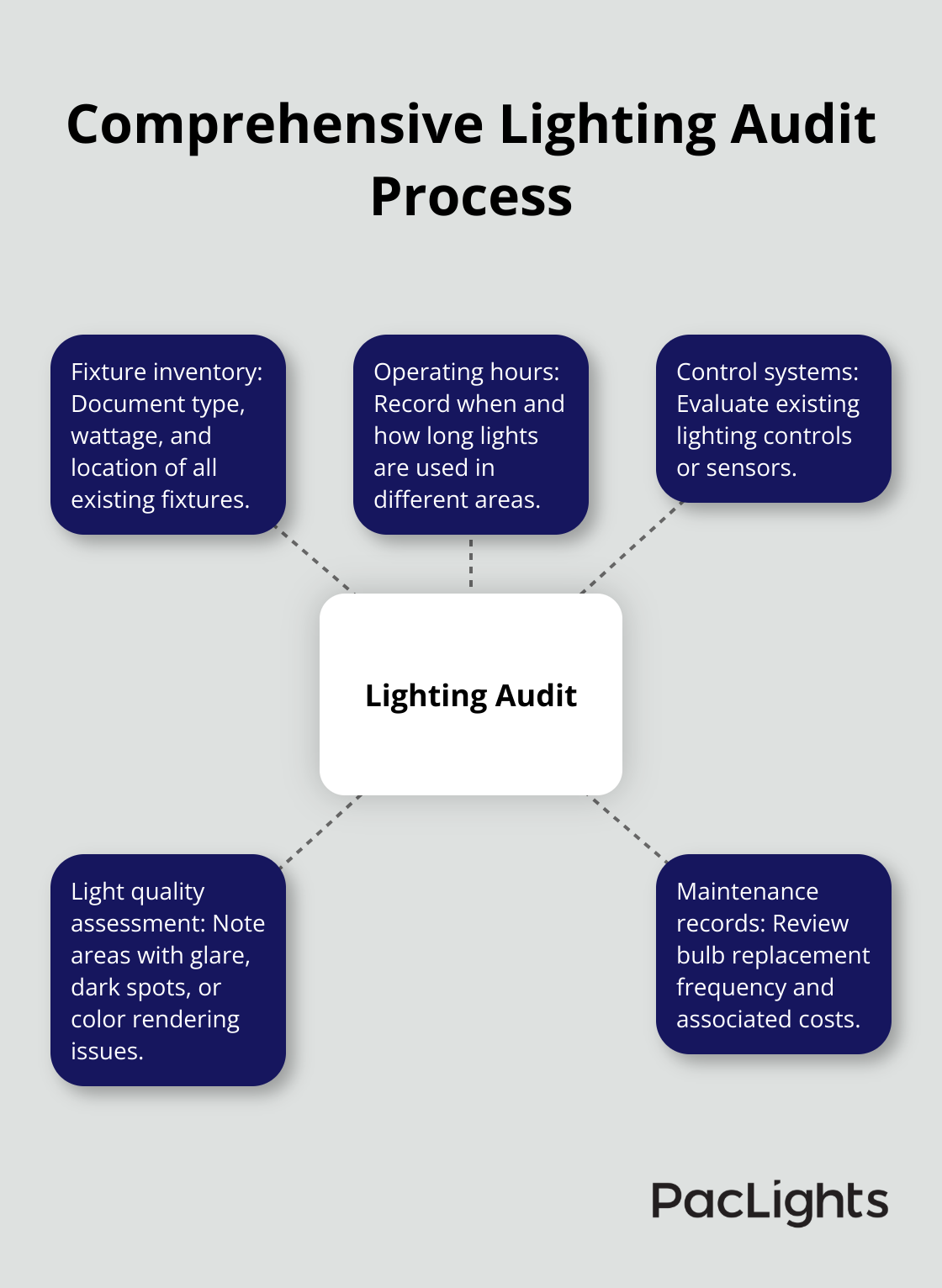
- Fixture inventory: Document the type, wattage, and location of all existing fixtures.
- Operating hours: Record when and how long lights are used in different areas.
- Control systems: Evaluate any existing lighting controls or sensors.
- Light quality assessment: Note areas with glare, dark spots, or color rendering issues.
- Maintenance records: Review bulb replacement frequency and associated costs.
Lighting audits often uncover inefficiencies that facility managers weren’t aware of. For instance, an audit of a manufacturing plant might reveal that 30% of their high bay fixtures have failed ballasts, significantly reducing light output while still drawing full power.
Analyze Potential Savings
With this data in hand, you can now calculate the potential energy and cost savings of an LED retrofit. Many utilities offer energy calculators to help with this process. Factor in not just energy savings, but also reduced maintenance costs and potential productivity gains from improved lighting.
A thorough assessment sets the stage for a targeted, effective LED high bay retrofit. It ensures you select the right fixtures and design a system that truly meets your facility’s needs while maximizing your return on investment. The next step in your retrofit journey involves choosing the right LED high bay fixtures for your specific requirements.
How to Execute Your LED High Bay Retrofit
Select the Ideal LED High Bay Fixtures
The success of your retrofit depends on choosing the right LED high bay fixtures. Consider these key factors:
Lumen output: Your new fixtures should provide adequate illumination for your space. Try to achieve 130-150 lumens per square foot in industrial settings.
Color temperature: For most industrial applications, 4000K-5000K provides a crisp, clean light that enhances visibility and worker alertness.
Efficacy: Select fixtures with high lumens per watt ratings. Top-tier LED high bays can deliver over 160 lumens per watt, significantly outperforming traditional lighting sources.
Durability: Industrial environments often expose fixtures to dust, moisture, and vibrations. Pick fixtures with appropriate IP ratings and robust construction to ensure longevity.
Optical design: Wide beam angles (120° or more) work well for open areas, while narrower beams suit aisles or racked storage better.
Calculate Your Return on Investment
To justify your retrofit project, you’ll need to calculate its ROI. Here’s a simplified approach:
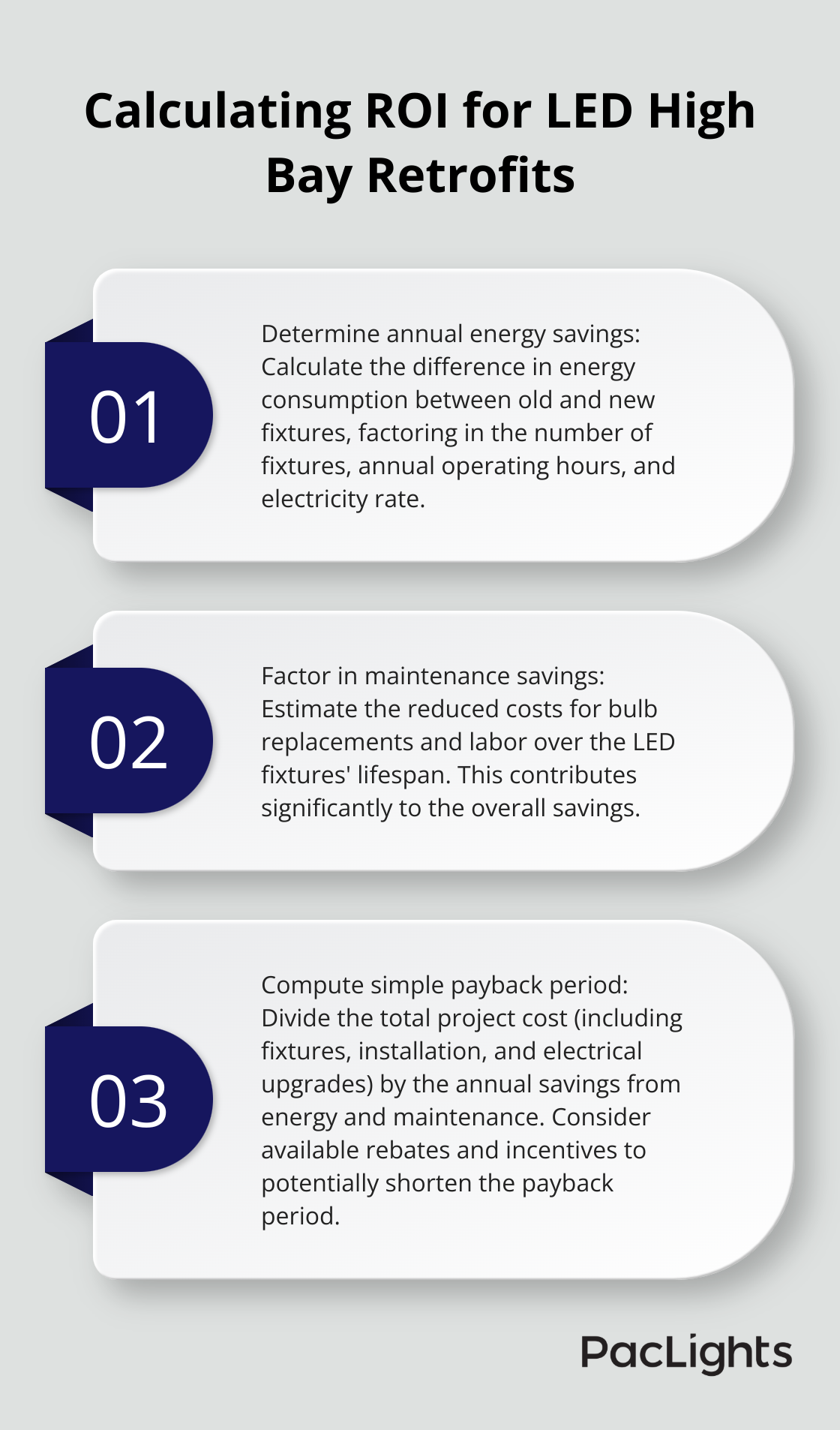
- Determine annual energy savings: (Old fixture wattage – New LED wattage) x Number of fixtures x Annual operating hours x Electricity rate
- Factor in maintenance savings: Estimate reduced costs for bulb replacements and labor over the LED fixtures’ lifespan.
- Calculate total project cost: Include fixture costs, installation labor, and any necessary electrical upgrades.
- Compute simple payback period: Total project cost ÷ Annual savings (energy + maintenance)
- Consider available rebates and incentives: Many utilities offer substantial rebates for LED upgrades, which can significantly shorten your payback period.
A typical LED high bay retrofit can yield a payback period of 1-3 years, with energy savings of 50-75% compared to traditional lighting systems.
Follow Installation Best Practices
Proper installation will help you realize the full benefits of your LED retrofit:
- Conduct a pre-installation survey: Verify existing electrical infrastructure and identify any necessary upgrades.
- Plan for minimal disruption: Schedule installations during off-hours or in phases to maintain operations.
- Ensure proper mounting: LED fixtures are often lighter than their predecessors. Adjust mounting hardware as needed to ensure secure installation.
- Address heat management: While LEDs generate less heat than traditional sources, proper thermal management remains important. Ensure adequate airflow around fixtures, especially in high-temperature environments.
- Optimize fixture placement: Use lighting design software to model your space and determine optimal fixture locations for even illumination.
- Test and commission: After installation, thoroughly test all fixtures and controls to ensure proper function and light levels.
Integrate Smart Controls
To maximize the efficiency of your new LED system, consider integrating smart controls:
Occupancy sensors: These can reduce energy use by 30-50% in areas with intermittent occupancy (such as warehouses or cold storage facilities).
Daylight harvesting: In spaces with natural light, sensors can automatically adjust artificial lighting levels, potentially saving an additional 20-40% on lighting energy costs.
Networked lighting controls: These systems allow for granular control and monitoring of your lighting, enabling strategies like task tuning and demand response participation.
Time-based controls: Programmable schedules ensure lights are only on when needed, which is particularly useful for facilities with predictable occupancy patterns.
When you implement controls, it’s important to properly commission the system and train facility staff on its use. A well-implemented control system can boost your energy savings by an additional 30-50% over the base LED retrofit.
Final Thoughts
LED high bay lighting retrofits transform industrial and commercial spaces. These upgrades slash energy consumption by 50-75%, leading to substantial cost reductions and a smaller carbon footprint. LED retrofits also enhance light quality, boost worker productivity, and reduce maintenance needs with lifespans up to 100,000 hours.
Smart control integration amplifies the benefits of LED high bay retrofits. Occupancy sensors, daylight harvesting, and networked controls can further reduce lighting energy use (by an additional 30-50%). These systems offer unprecedented flexibility, allowing facilities to match lighting to specific operational needs and schedules.
We at PacLights specialize in LED high bay retrofits and offer energy-efficient lighting solutions for diverse industrial needs. Our team guides you through every step of the retrofit process, from initial assessment to final installation. Contact PacLights today to start your LED high bay lighting retrofit journey and create a brighter, more productive work environment.
Disclaimer: PacLights is not responsible for any actions taken based on the suggestions and information provided in this article, and readers should consult local building and electrical codes for proper guidance.