

NSF certification lights guide standards can feel overwhelming if you’re new to facility compliance. At PacLights, we’ve helped countless businesses navigate these requirements, and we know the confusion stops here.
Food service kitchens, hospitals, and pharmaceutical labs all depend on NSF certified lighting to meet health and safety regulations. This guide breaks down exactly what you need to know.
What NSF Certification Actually Protects
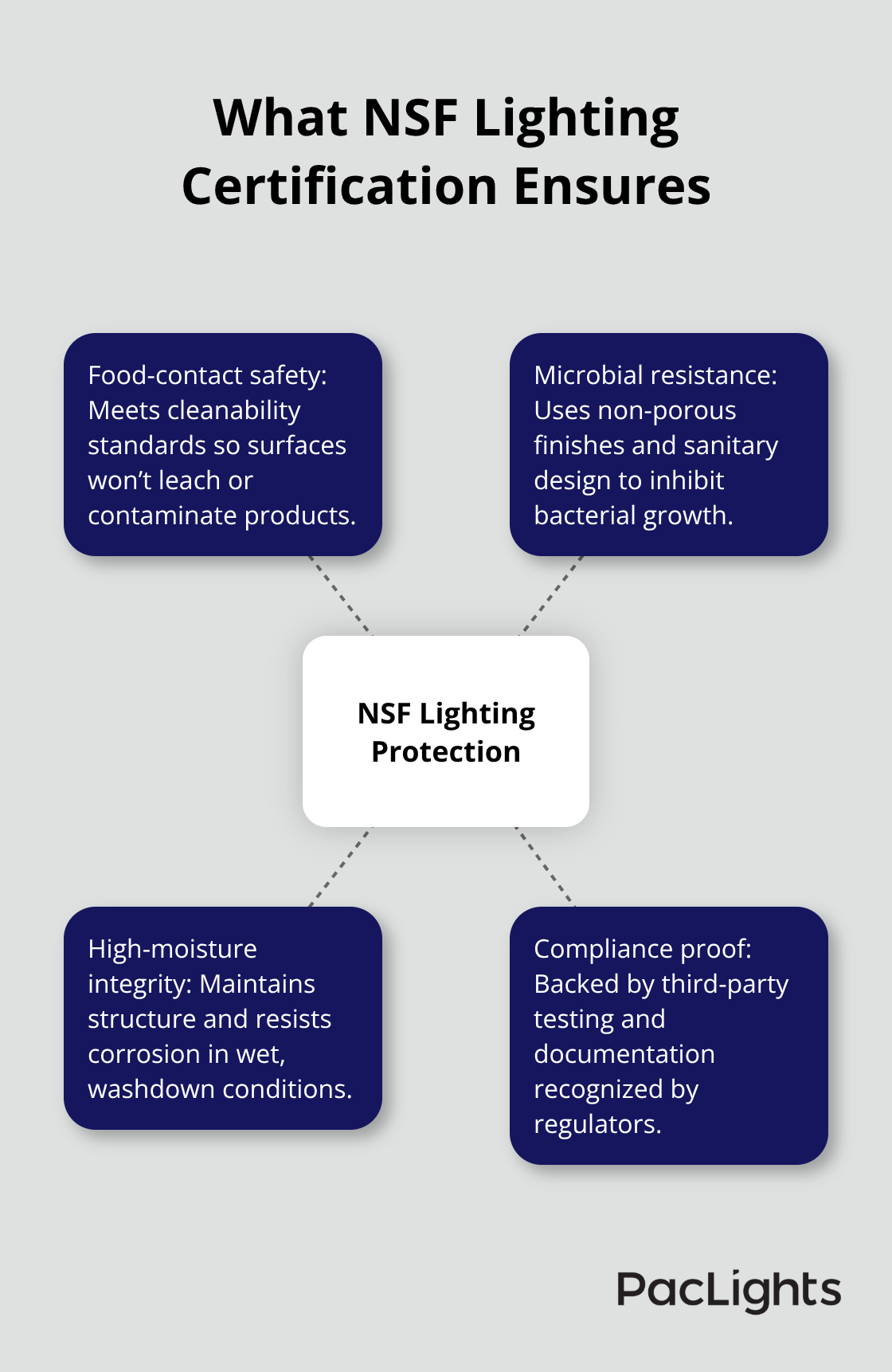
NSF International certification for lighting isn’t just a checkbox on a compliance form. It’s a guarantee that your fixtures meet strict standards for food contact surfaces, microbial contamination resistance, and structural integrity in high-moisture environments. The NSF mark confirms your lights have passed testing against specific criteria that directly impact facility safety and regulatory compliance.
How NSF certification prevents facility violations
Food service facilities face FDA inspections where non-compliant lighting can result in citations or operational shutdowns. Hospitals and pharmaceutical labs must meet even stricter requirements because contamination risks are higher and consequences more severe. NSF certification proves your fixtures won’t harbor bacteria, shed particles, or corrode in wet conditions.
Standard commercial lighting simply isn’t designed for these environments. A regular industrial fixture fails within months in a commercial kitchen or hospital setting, while NSF certified lights are engineered to last years under those exact conditions.
Material and design differences that matter
Food processing facilities operate under HACCP protocols and FDA guidelines that explicitly require NSF certified equipment. Hospitals follow infection control standards from organizations like The Joint Commission that mandate specific lighting performance in sterile areas. Pharmaceutical labs need lighting that won’t introduce contamination into controlled environments.
The difference between NSF and standard lighting comes down to material composition, sealing methods, and surface finish. NSF certified fixtures use non-porous coatings that resist microbial growth, sealed joints that prevent moisture intrusion, and materials that won’t corrode or degrade in sanitizing environments. Non-certified alternatives lack these features entirely.
The verification problem with unverified claims
Some manufacturers market their products as hospital-grade or food-safe without NSF backing, which creates real risk because there’s no independent verification. Your facility’s inspector won’t accept claims without documentation. NSF certification provides that documentation and the testing data to support it.
This independent verification separates legitimate compliance from marketing language. When you select NSF certified fixtures, you get proof that third-party testing confirmed performance standards. Understanding these material and performance requirements helps you evaluate what your facility actually needs before selecting specific fixtures.
NSF Certification Requirements for Lighting Fixtures
Material Composition and Construction Standards
NSF certification requires lighting fixtures to pass rigorous testing across three distinct areas that directly affect how your facility operates. The first involves material composition and construction methods that prevent contamination in sensitive environments. NSF standards mandate non-porous coatings, sealed seams, and corrosion-resistant materials because bacteria and contaminants hide in cracks, joints, and porous surfaces. Food processing facilities operating under FDA HACCP protocols need fixtures where moisture cannot penetrate and create microbial colonies. Hospitals following The Joint Commission standards require lighting that won’t shed particles or corrode in sterilizing environments where chemical disinfectants are used regularly.
Testing and Performance Validation
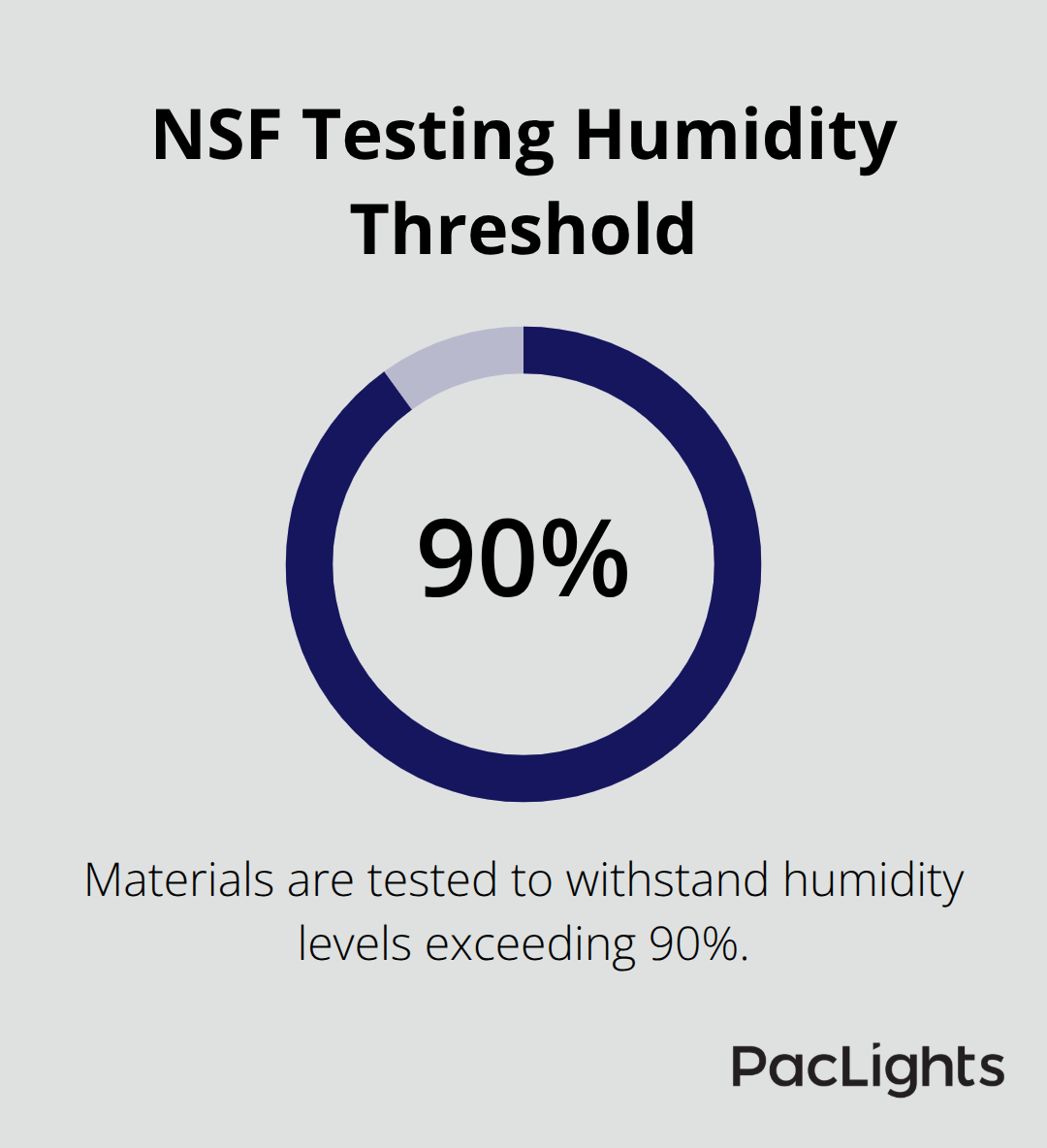
The NSF testing process evaluates how materials withstand repeated exposure to sanitizers, high-temperature cleaning cycles, and humidity levels exceeding 90 percent. Fixtures must maintain structural integrity after exposure to these conditions-welds won’t separate, coatings won’t peel, and fasteners won’t corrode. Performance specifications cover light output consistency, color temperature stability, and thermal management in these challenging environments. Safety specifications address electrical safety in wet locations, impact resistance for kitchen equipment areas, and compliance with UL and NEMA standards that govern commercial lighting.
Independent Laboratory Testing Procedures
Independent NSF International laboratories conduct testing that takes weeks, not days, and covers material composition analysis, microbial resistance testing, corrosion testing in sanitizing solutions, and performance validation under actual facility conditions. Manufacturers must submit detailed documentation showing exactly which materials were used, how construction methods prevent contamination, and test results proving performance claims. This independent verification costs manufacturers money, which is why some competitors skip it and market unverified products as food-safe or hospital-grade. Your facility inspector won’t accept those claims without NSF documentation backing them up.
When you specify NSF certified fixtures, you purchase proof that third-party testing confirmed every performance and safety claim. This verification becomes especially important when you evaluate which lighting solutions will actually meet your facility’s specific regulatory requirements and operational demands.
Industries and Applications That Require NSF Certified Lights
Food Processing and Kitchen Environments
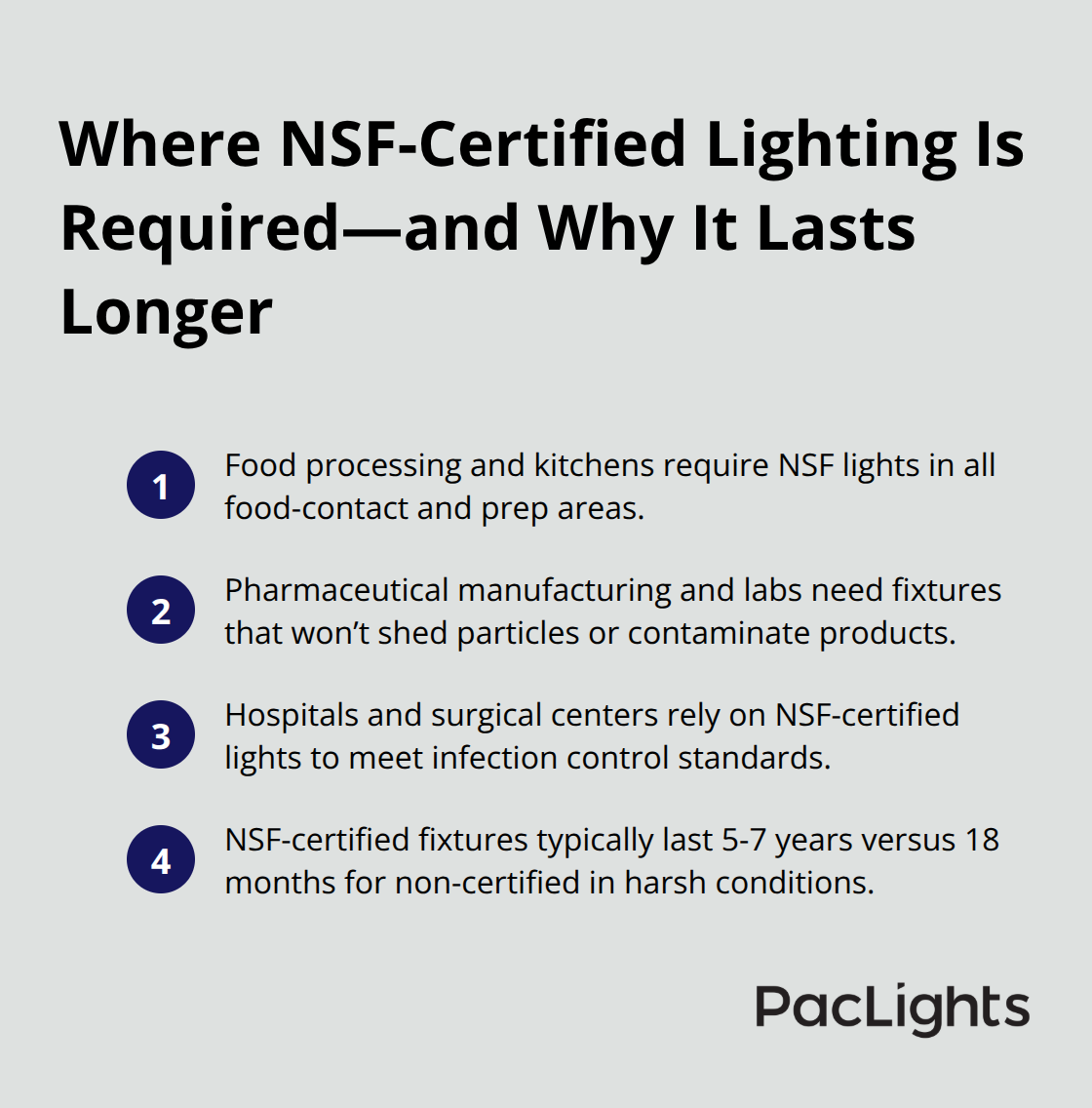
Food processing facilities operate under FDA HACCP protocols that explicitly require NSF certified lighting fixtures in all areas where food contact or preparation occurs. The FDA’s Food Safety Modernization Act mandates that equipment in these environments must resist microbial contamination and withstand frequent sanitization cycles. Commercial kitchens in hospitals, schools, and restaurants face similar requirements because cross-contamination from non-compliant lighting can trigger foodborne illness outbreaks. A single bacterial colony growing inside a light fixture’s unsealed joint spreads throughout a facility’s food supply, which is why inspectors reject standard commercial lighting immediately.
Pharmaceutical and Laboratory Settings
Pharmaceutical manufacturing and laboratory environments demand NSF certification because particle shedding or contamination from lighting fixtures directly compromises product quality and safety. The FDA’s Current Good Manufacturing Practice regulations require that all equipment in controlled manufacturing environments meets specific contamination resistance standards. Fixtures that lack NSF certification introduce unacceptable risk in spaces where product purity determines regulatory approval and market viability. Manufacturers cannot afford the liability that comes with non-compliant lighting in these controlled environments.
Healthcare Facilities and Hospitals
Hospitals and surgical centers need NSF certified fixtures in operating rooms, sterile processing areas, and intensive care units where infection control standards from The Joint Commission explicitly reference equipment that resists microbial growth. Non-compliant lighting in these spaces creates real liability because a surgical site infection or hospital-acquired infection traced to environmental contamination can result in lawsuits and regulatory action. Healthcare facilities that have experienced infection control violations often discover that non-certified lighting fixtures were contributing factors. The consequences of contamination in healthcare settings far exceed the cost of compliant fixtures.
Long-Term Cost Impact Across Industries
NSF certification directly impacts operational costs because facilities avoid replacement cycles that plague standard fixtures in harsh environments. A food processing facility using non-certified lighting replaces fixtures every 18 months due to corrosion and seal failure, while NSF certified fixtures typically last 5-7 years in the same conditions. That difference compounds significantly across dozens of fixtures. Hospitals and pharmaceutical labs benefit from this durability because downtime for fixture replacement in sterile areas requires expensive re-sterilization protocols and operational disruptions. The false economy of cheaper non-certified alternatives fails prematurely and costs far more in labor, replacement parts, and facility disruptions.
Final Thoughts
NSF certification for lighting isn’t optional in food service, healthcare, or pharmaceutical environments-it’s the foundation of regulatory compliance and facility safety. The standards exist because contamination from non-compliant fixtures creates real consequences: FDA citations, infection control violations, product recalls, and operational shutdowns. When you select NSF certified lighting, you purchase independent verification that your fixtures won’t harbor bacteria, shed particles, or fail under sanitizing conditions.
The financial case for compliance is straightforward. Facilities using standard commercial lighting in these environments face replacement cycles every 18 months due to corrosion and seal failure, while NSF certified fixtures typically last 5-7 years under identical conditions. That durability difference eliminates hidden costs of frequent replacements, labor disruptions, and re-sterilization protocols that compound significantly across dozens of fixtures and years of operation. Your facility’s inspector won’t accept marketing claims about hospital-grade or food-safe products without NSF documentation to back them up.
Work with manufacturers who understand your specific regulatory requirements and operational environment when selecting NSF certification lights. We at PacLights offer durable, customizable lighting fixtures tailored to industrial and commercial needs, including LED retrofit solutions to upgrade existing systems, and our team provides free lighting layout designs and ROI assessments to help you make informed decisions. Visit PacLights to explore NSF certified lighting options designed for your facility’s specific requirements.
Disclaimer: PacLights is not responsible for any actions taken based on the suggestions and information provided in this article, and readers should consult local building and electrical codes for proper guidance.