

Getting industrial enclosure lighting wrong costs money. Wrong fixtures fail in harsh environments, overheat, or need constant replacement.
At PacLights, we’ve seen manufacturers waste thousands on lighting that doesn’t fit their needs. The good news: specifying the right fixtures is straightforward once you know what to look for.
What Specifications Actually Matter for Enclosure Lighting
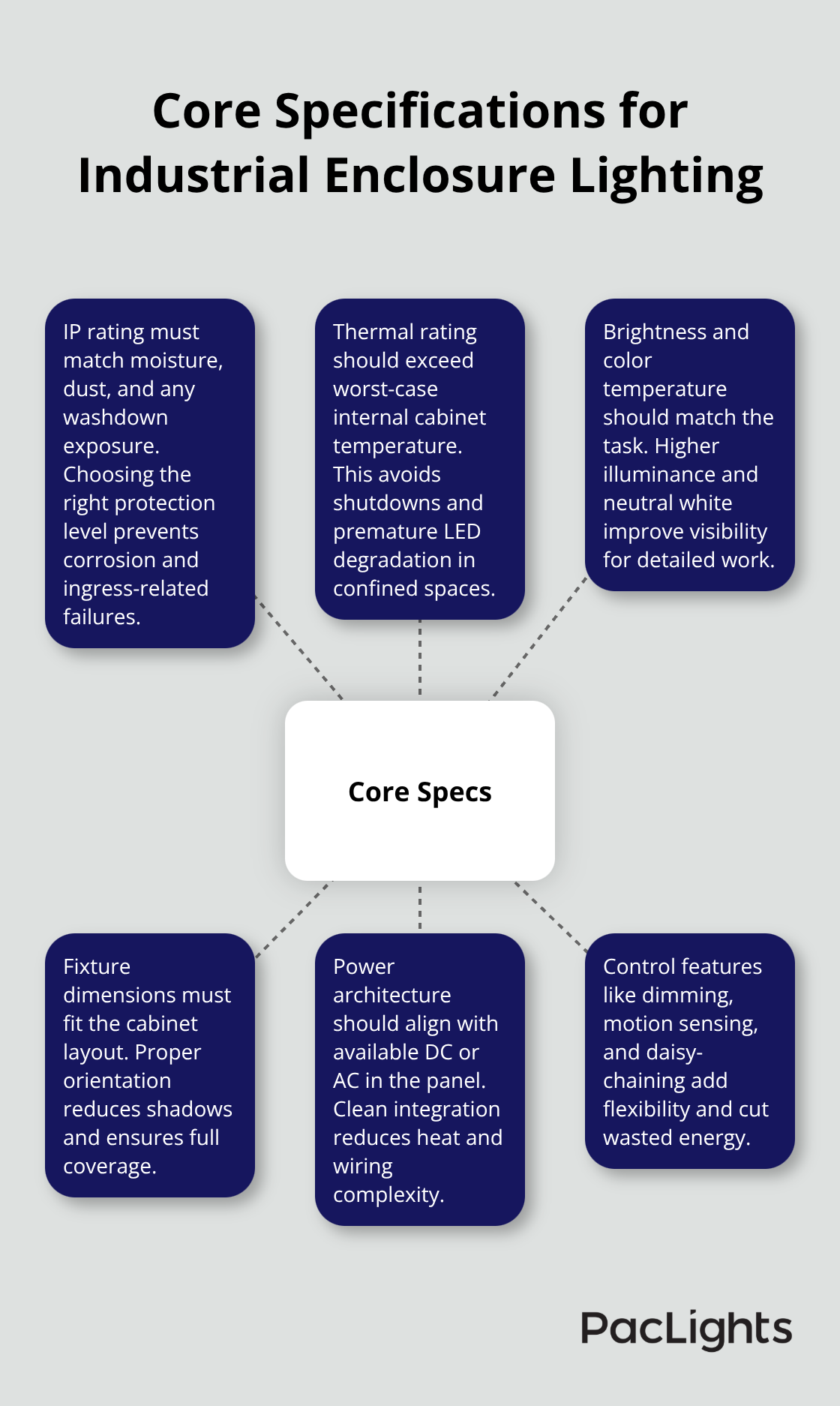
Industrial enclosures face three hard realities: moisture and dust penetrate inside, heat builds up fast, and operators need to see what they’re doing. Specification failures in any of these areas lead to fixture failure, safety risks, or wasted maintenance time.
IP Ratings: Protection Against Ingress
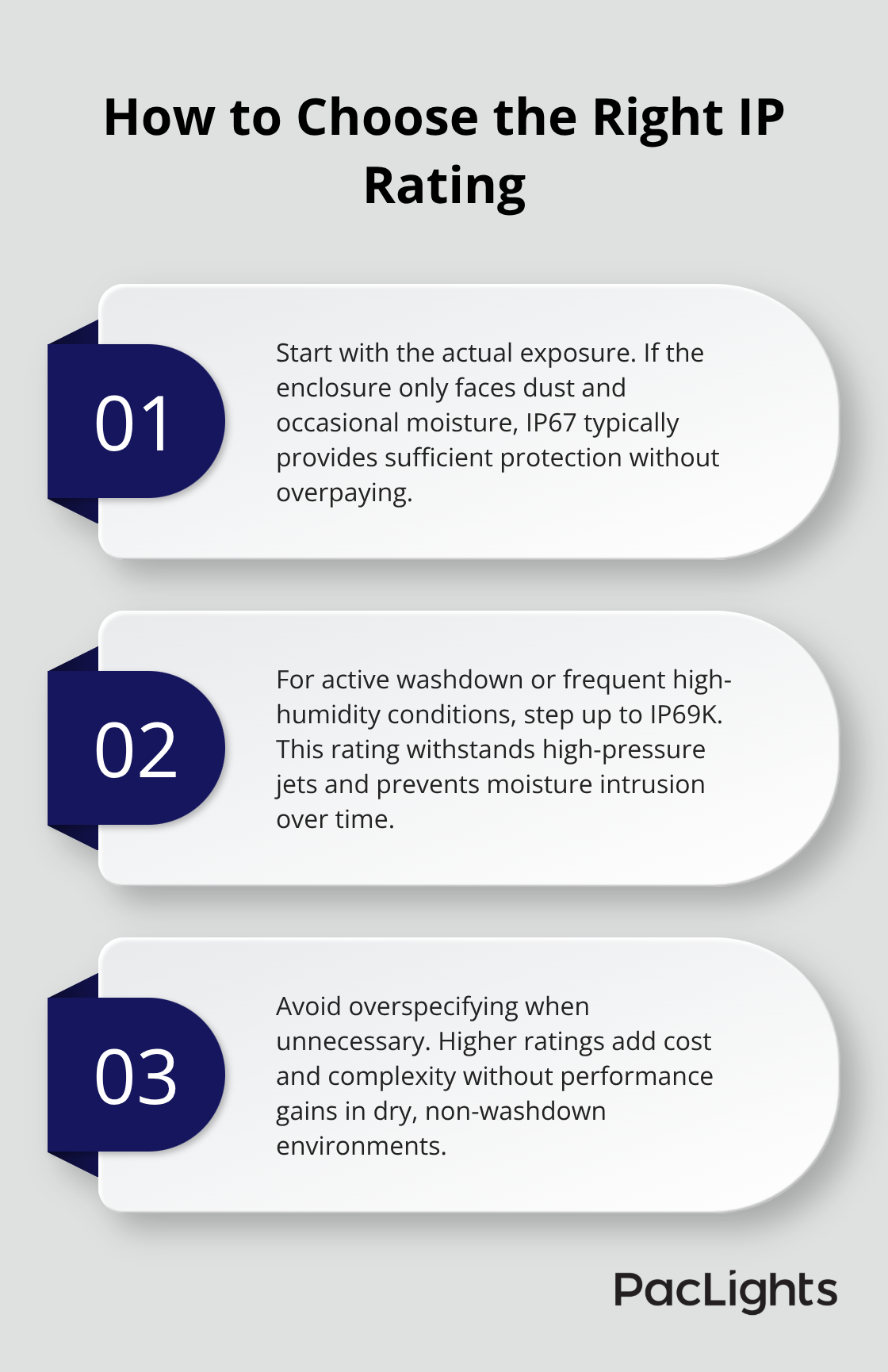
IP ratings tell you how well a fixture resists ingress, but the number alone means nothing without context. IP67 means dust-tight and can survive 1 meter of water immersion for 30 minutes, while IP69K handles high-pressure washdown jets. Pick IP67 for dry industrial enclosures with occasional moisture; pick IP69K only if your enclosure faces active washdown or sits in a wet production environment. Going higher than needed adds cost and complexity without payoff.
Thermal Performance in Confined Spaces
Heat matters more than most manufacturers admit. LEDs produce less heat than fluorescent fixtures, but enclosures trap air, and temperature rises fast in confined spaces. A 100-watt fixture in a sealed cabinet can push internal temperatures 15–20 degrees Celsius above ambient within hours. Check your fixture’s thermal rating and verify it matches your enclosure’s worst-case internal temperature. If your facility runs 24/7 in a warm climate, that 50-degree-Celsius ambient becomes 65–70 degrees inside the cabinet. Fixtures rated only to 60 degrees will fail.
Brightness and Color Temperature for Task Performance
Brightness requirements depend on the task, not the cabinet size. OSHA sets a floor of 5 foot-candles for general work areas, but the Illuminating Engineering Society recommends 50 foot-candles for detailed inspection and assembly tasks. Measure your actual task-are operators reading fine print on circuit boards or just checking connections? A 400-lumen fixture works fine for status checks; detailed troubleshooting needs 800–1200 lumens in a standard enclosure.
Color temperature shifts how operators perceive components. 4000–4500 Kelvin (neutral white) is the practical standard because it renders greens and blues accurately without the harshness of daylight white. Avoid warm white (3000K) in enclosures with color-coded wiring or component identification.
Power Architecture and Installation Speed
Your fixture choice should match the enclosure’s power architecture and available space. A 12–24 volt DC fixture integrates easily into modern industrial cabinets; a 120VAC fixture requires additional wiring and takes up more room. Mounting method matters for installation speed and maintenance access. Magnetic mounts save time; endcap mounting holes let you secure fixtures without tools. The fastest installers use fixtures that mount in under two minutes per unit, cutting total cabinet lighting installation from hours to minutes across a facility.
Once you’ve locked down these core specifications, the next step involves evaluating how different fixture types and control options align with your facility’s operational demands and long-term cost structure.
Fixture Size, Power, and Control Matter More Than You Think
Match Fixture Dimensions to Your Cabinet Layout
Fixture dimensions determine whether your lighting plan actually fits inside the cabinet. Standard enclosure depths range from 10 to 17 inches, and most LED strip lights come in matching lengths to fill that space efficiently. A 12-inch fixture in a 10-inch-deep cabinet forces awkward angles or protrusion; a 10-inch fixture leaves dark corners. Vertical mounting delivers even illumination from bottom to top, while horizontal mounting can create shadows on lower components. Magnetic mounts save installation time-typically two minutes per fixture versus five to ten minutes with traditional fasteners. Endcap mounting holes and snap clips eliminate the need for separate brackets. If your facility has multiple enclosures of different sizes, standardizing on one fixture family that offers three to five length options cuts procurement complexity and training time across your maintenance team.
Align Power Architecture With Your Cabinet’s Infrastructure
Power architecture should match your cabinet’s existing infrastructure. Modern industrial panels run 12–24 volt DC; older systems may use 120VAC or even 277VAC. A DC fixture integrates cleanly into contemporary cabinets without additional transformers or wiring complexity. AC fixtures require step-down power supplies that consume space and generate heat-two problems in confined enclosures. Wattage matters less than lumens; a 5-watt LED strip delivers 800 lumens while a 15-watt fluorescent fixture produces only 700 lumens. Energy efficiency translates directly to heat reduction in sealed cabinets. LEDs consume 50–70% less energy than fluorescent equivalents, cutting internal temperature rise and extending fixture life.
Optimize Control Features for Task Flexibility
Control features separate adequate lighting from optimized lighting. Dimmable fixtures let operators adjust output for different tasks without rewiring; motion sensors eliminate wasted power in cabinets opened sporadically for maintenance. Daisy-chaining capability lets you connect up to 8–16 fixtures on a single circuit, reducing installation cost and wiring clutter. Integrated outlets on some fixtures power maintenance tools directly, eliminating extension cords and tripping hazards. Temperature-rated power supplies prevent shutdown in high-heat environments; verify your fixture’s thermal rating exceeds your enclosure’s worst-case internal temperature by at least 10 degrees Celsius.
Ensure Electrical Safety and Long-Term Reliability
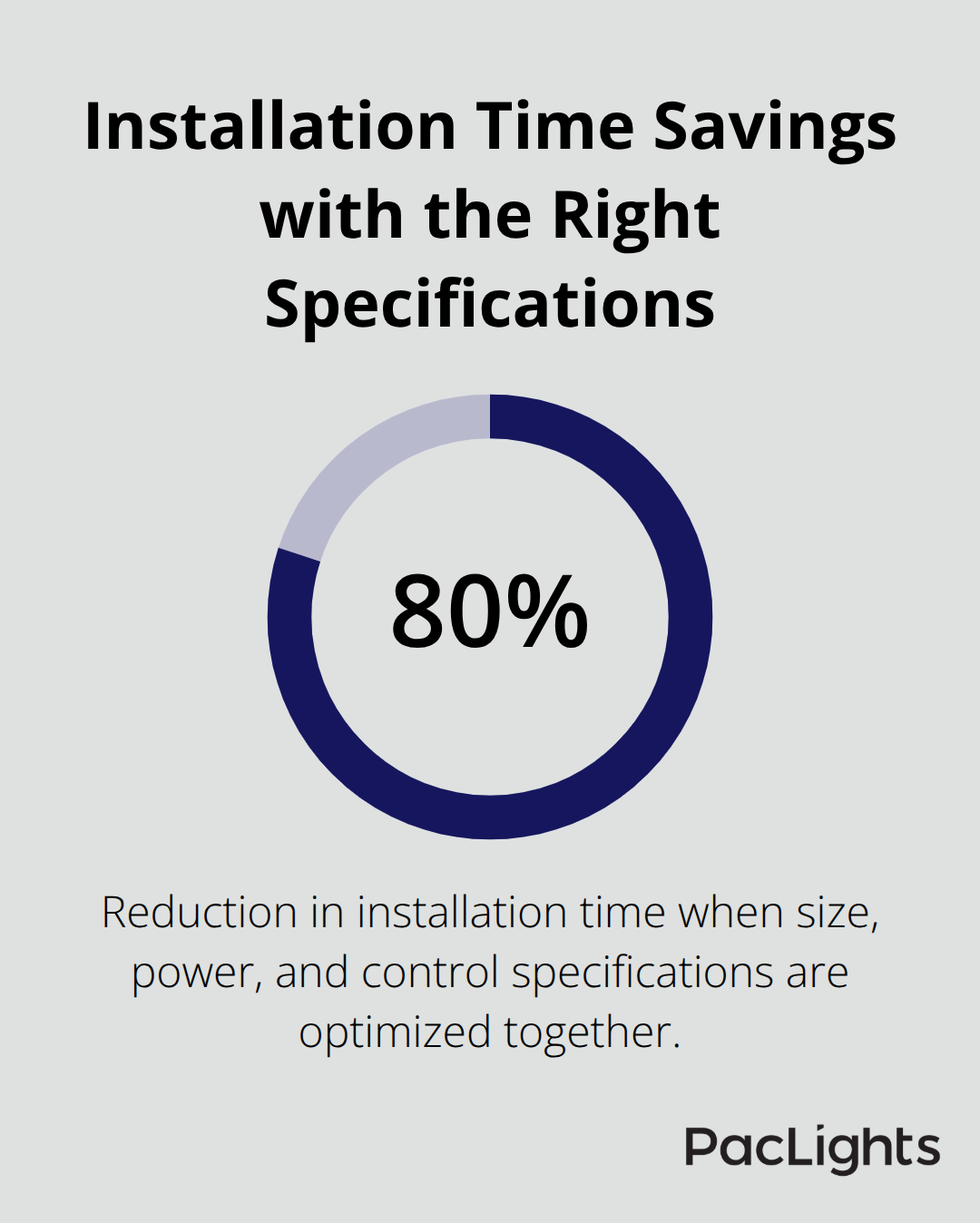
Fixtures with rotating connectors and flexible cable options fit crowded panels without bending wires at sharp angles, which degrades insulation over time. Choose fixtures with UL certification under IFAM or NITW2 for industrial control panels; this confirms electrical safety and compliance with industrial standards. These specification details compound: the right combination of size, power, and controls cuts installation time by 80% while improving long-term reliability and operator safety. Once you’ve selected fixtures that fit your cabinet’s physical and electrical constraints, the next challenge involves identifying which common mistakes derail lighting projects before installation even begins.
Common Mistakes in Industrial Enclosure Lighting Selection
Heat Buildup Destroys Fixtures Faster Than You Expect
Manufacturers fail at enclosure lighting for three specific, preventable reasons. First, they underestimate how fast temperature climbs inside sealed cabinets. A 5-watt LED fixture produces minimal heat, but in a 12-inch-deep enclosure with poor air circulation, internal temperature can rise 20 degrees Celsius above ambient within two hours of continuous operation. Fixtures rated to 60 degrees Celsius fail when cabinet internals hit 65–70 degrees.
Facilities install fixtures without checking thermal ratings against worst-case cabinet temperatures, then watch them shut down or degrade prematurely. The fix is simple but overlooked: measure your enclosure’s worst-case internal temperature under full load and 24/7 operation, then specify fixtures with thermal ratings at least 10 degrees higher. If your facility runs in a 40-degree ambient environment with sealed cabinets, add 20–25 degrees for internal rise, then choose fixtures rated to at least 75 degrees Celsius. This single step eliminates the majority of premature failures.
IP Ratings Must Match Your Actual Environment
Second, manufacturers choose fixtures without matching IP ratings to actual environmental conditions. IP67 is not a universal answer. It protects against dust and brief water immersion, but if your enclosure sits in a washdown area or faces routine humidity spikes above 95 percent, you need IP69K. The cost difference between IP67 and IP69K is typically 15–25 percent, yet many facilities choose the lower rating to save money, then replace corroded fixtures within 18 months.
One food processing client spent $3,200 replacing IP67 fixtures in a wash-down cabinet over three years; switching to IP69K would have cost $800 more upfront and eliminated replacement entirely. The math is clear: higher IP ratings cost more initially but save substantially over time in harsh environments.
Long-Term Maintenance Costs Exceed Purchase Price
Third, long-term maintenance costs crush budgets when manufacturers overlook fixture lifespan and replacement logistics. LEDs last 50,000 hours, roughly eight years at 24/7 operation, but fluorescent fixtures need replacement every three to five years. Calculate your facility’s total cost of ownership: fixture price plus installation labor, plus unplanned downtime when a fixture fails during production.
A $400 fixture that lasts eight years costs roughly $50 per year in amortized hardware; a $200 fixture that fails every three years costs $67 per year in hardware alone, before you count the maintenance technician’s time to replace it. Standardizing on one fixture family with modular lengths and quick-mount options cuts installation time to two minutes per unit. When you need to replace ten fixtures across your facility, that difference between quick-mount and traditional fasteners translates to three hours of labor saved per replacement cycle. Facilities that measure these costs upfront choose fixtures based on total cost of ownership, not purchase price, and consistently spend less over five years.
Final Thoughts
Specifying industrial enclosure lighting correctly means matching three core requirements: environmental protection through appropriate IP ratings, thermal performance that exceeds your worst-case cabinet temperature, and brightness levels tied to actual operator tasks. These specifications compound when you add fixture dimensions, power architecture, and control features into the equation. The difference between a lighting plan that fails within months and one that runs reliably for eight years often comes down to decisions made during specification, not during installation. A lighting partner who understands industrial environments asks about your enclosure’s actual operating conditions, worst-case temperatures, and maintenance workflows before recommending fixtures.
Start by measuring your enclosure’s worst-case internal temperature, documenting the actual tasks operators perform inside the cabinet, and listing your power architecture constraints. Then contact a lighting partner who can translate those requirements into a specification that works. The time you invest upfront in proper specification eliminates costly replacements, reduces maintenance labor, and keeps your operations running without interruption.
We at PacLights offer industrial enclosure lighting solutions tailored to your specific needs, including energy-efficient fixtures with optional motion control and advanced lighting controls to optimize performance and reduce costs. Visit PacLights to explore your options and request a free lighting assessment for your facility.
Disclaimer: PacLights is not responsible for any actions taken based on the suggestions and information provided in this article, and readers should consult local building and electrical codes for proper guidance.