

Datacenter safety lighting isn’t optional-it’s the foundation of safe operations and regulatory compliance. Poor visibility in server rooms leads to equipment damage, costly downtime, and safety violations that can result in significant fines.
At PacLights, we’ve seen firsthand how the right lighting solution transforms datacenter environments. This guide covers what makes effective safety lighting work and how to implement systems that protect your facility and your bottom line.
Why Datacenters Need Specialized Safety Lighting
Datacenter operators face a hard truth: standard commercial lighting fails in server environments. The combination of dense equipment, heat-sensitive components, and 24/7 operations demands lighting designed specifically for these conditions. Generic fixtures create problems that specialized datacenter lighting solves immediately.
Visibility That Prevents Expensive Mistakes
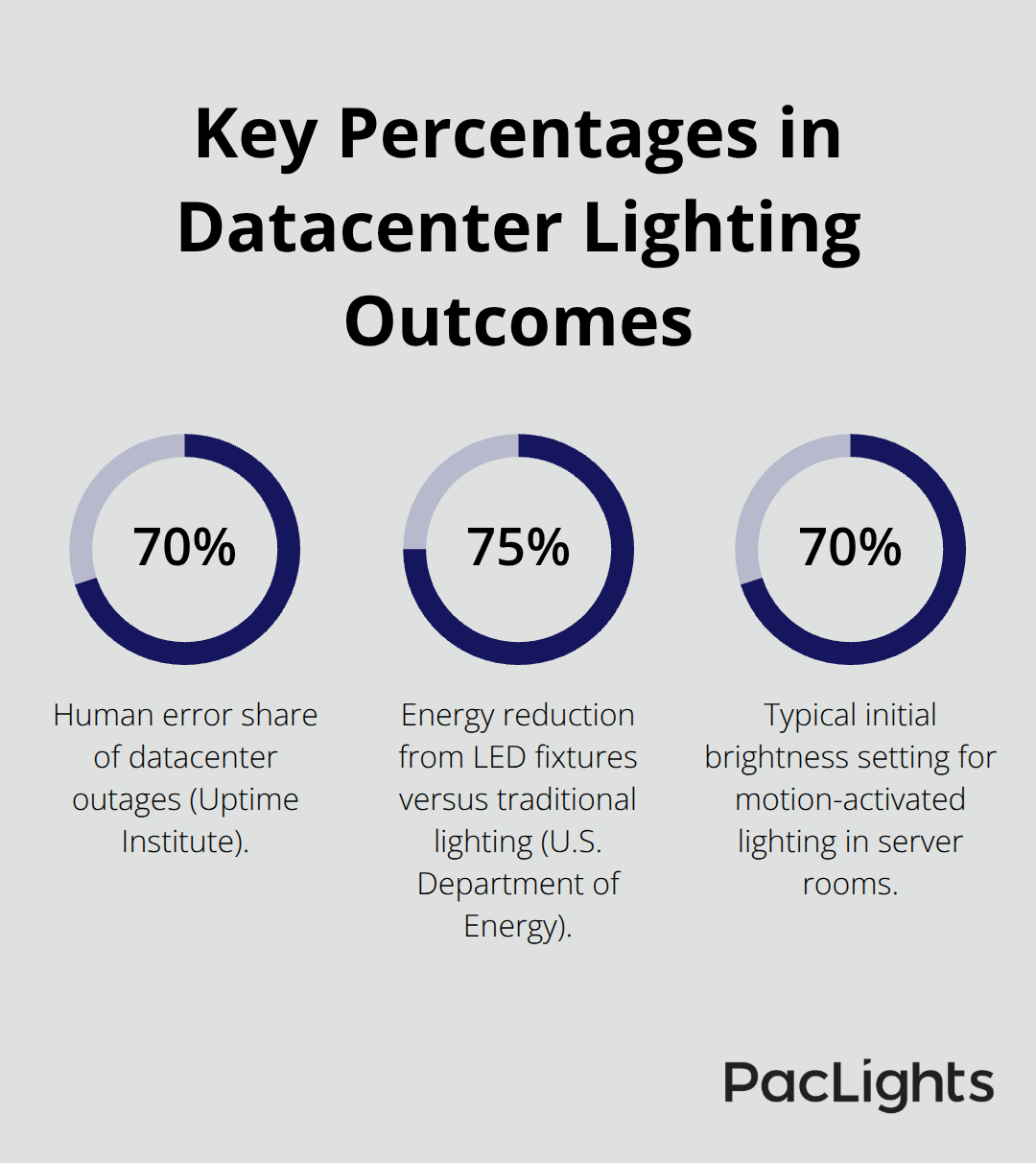
Poor visibility in server racks causes technicians to miss cable connections, which leads to equipment failures. A single misconfigured connection can take down services worth thousands per minute. The Uptime Institute reports that human error accounts for roughly 70% of datacenter outages, and inadequate lighting directly contributes to these mistakes.
Server rooms require lighting that eliminates shadows in the exact areas where technicians work most. Standard overhead fixtures create blind spots behind equipment and within rack enclosures, forcing workers to use flashlights and waste time. Specialized datacenter lighting positions illumination to reach into deep racks and along cable pathways where problems hide.
This targeted approach reduces maintenance time significantly. Technicians complete work faster because they see issues immediately rather than discovering them through trial and error. The financial impact matters: reducing maintenance time by even 10% on a large facility translates to substantial annual savings when multiplied across hundreds of service calls.
Compliance That Keeps You Protected
Datacenter lighting connects directly to regulatory requirements. OSHA standards mandate adequate illumination for safe work environments, specifically requiring 50 foot-candles in areas where detailed work occurs. Most server rooms fall into this category because technicians perform precision tasks regularly.
Facilities that fail OSHA inspections face citations starting at thousands of dollars and escalating with repeat violations. Beyond OSHA, many organizations must meet standards like NFPA 70 for electrical safety and industry-specific regulations depending on the data handled. Insurance providers increasingly scrutinize datacenter safety measures, including lighting systems. Substandard lighting can void coverage claims or increase premiums substantially.
Proper lighting documentation becomes your defense during audits and inspections, showing that your facility meets baseline safety standards. This protection matters when regulators or insurers question your operational practices.
Downtime Prevention Through Operational Reliability
Inadequate lighting forces technicians to work inefficiently, which extends the time spent in server rooms and increases the risk of accidental disconnections or equipment damage. When visibility is poor, workers rush to complete tasks, and rushing leads to mistakes.
The cost of datacenter downtime varies by industry, but averages between 5,500 and 15,000 dollars per minute according to various industry reports. Even a 30-minute outage caused by a technician error in poor lighting conditions costs your organization between 165,000 and 450,000 dollars. Specialized lighting systems reduce these risks substantially by enabling faster, more accurate work.
Better visibility also supports preventive maintenance programs because technicians spot potential issues before they become critical failures. This proactive approach prevents the expensive emergency repairs that poor lighting conditions typically trigger. The right lighting investment pays for itself through reduced downtime and fewer costly mistakes-which brings us to what actually makes datacenter lighting effective.
Key Features of Effective Datacenter Lighting Solutions
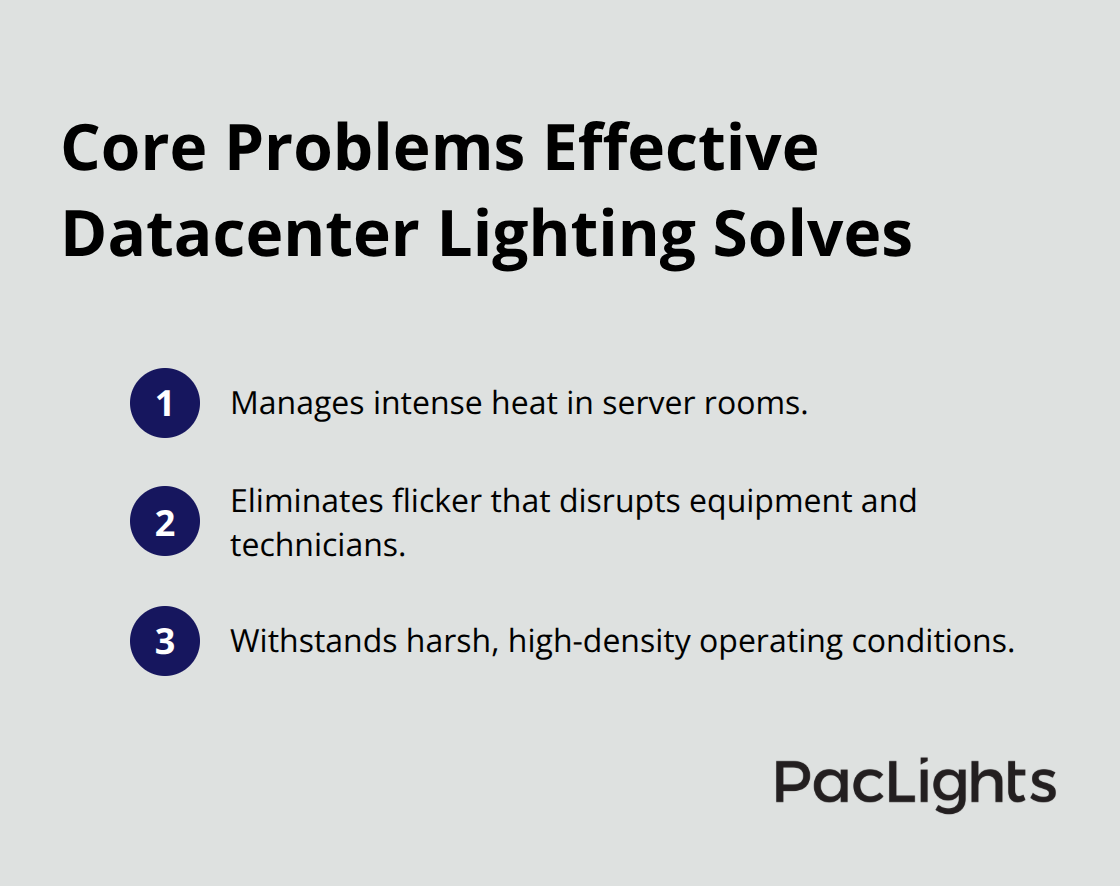
Effective datacenter lighting solves three problems that standard fixtures ignore: managing the intense heat server rooms generate, eliminating the flicker that disrupts sensitive equipment, and withstanding the physical demands of high-density installations. These aren’t optional features; they’re operational necessities that directly impact equipment lifespan and facility performance.
Heat Management That Protects Your Investment
Datacenters operate at temperatures between 64 and 80 degrees Fahrenheit according to ASHRAE standards, but equipment racks generate localized heat zones exceeding 95 degrees. Standard lighting fixtures worsen this problem because they emit significant thermal energy, forcing cooling systems to work harder and driving energy costs upward. Specialized datacenter lighting uses LED technology that produces minimal heat output, reducing the thermal load on your HVAC systems substantially.
The difference matters financially: LED fixtures consume approximately 75 percent less energy than traditional fluorescent or incandescent alternatives, according to the U.S. Department of Energy. On a 10,000 square foot datacenter running 24/7, this translates to annual energy savings exceeding 15,000 dollars depending on local electricity rates. Reduced heat generation means your cooling systems operate more efficiently, extending their lifespan and reducing maintenance frequency. Fixtures that run cooler also maintain consistent light output over time because heat degrades LED performance progressively.
Flicker-Free Operation for Equipment Stability
Flicker in lighting systems causes real problems in server environments. Many older fluorescent fixtures operate at 60 Hz, which creates imperceptible flicker that interferes with sensitive electronic equipment and causes eye strain for technicians working extended shifts. Quality datacenter lighting operates at frequencies above 3 kHz, eliminating flicker entirely.
This matters because server monitoring cameras require flicker-free lighting to capture accurate images for security and diagnostics, and sensitive monitoring equipment performs better in stable lighting conditions. Technicians also report significantly less fatigue when working in flicker-free environments, which improves accuracy and reduces errors during critical maintenance tasks. The practical impact appears immediately: technicians complete tasks faster and with fewer mistakes when lighting quality improves.
Durability That Justifies Long-Term Investment
Datacenter environments are harsh on lighting equipment. Vibration from cooling systems, temperature fluctuations, humidity, and dust accumulation all degrade standard commercial fixtures rapidly. Quality datacenter lighting uses sealed enclosures and robust materials that withstand these conditions without performance loss.
Many effective fixtures feature IP65 ratings or higher, meaning they resist dust and moisture ingress that would damage less protected components. The construction quality determines maintenance frequency: inferior fixtures require replacement every three to five years, while properly engineered solutions operate reliably for ten to fifteen years. This durability difference compounds over time because replacement fixtures cost money and require downtime to install. Fixtures rated for high-density environments also handle the vibration from equipment racks and cooling systems without loosening connections or degrading solder joints that fail prematurely in standard fixtures.
When you select lighting for datacenters, prioritize fixtures specifically engineered for these environments rather than adapted commercial alternatives. The next section covers how lighting controls and monitoring systems amplify these benefits, transforming passive fixtures into active tools that optimize your entire datacenter operation.
Implementing Lighting Controls and Monitoring Systems
Motion Detection Reduces Energy Waste
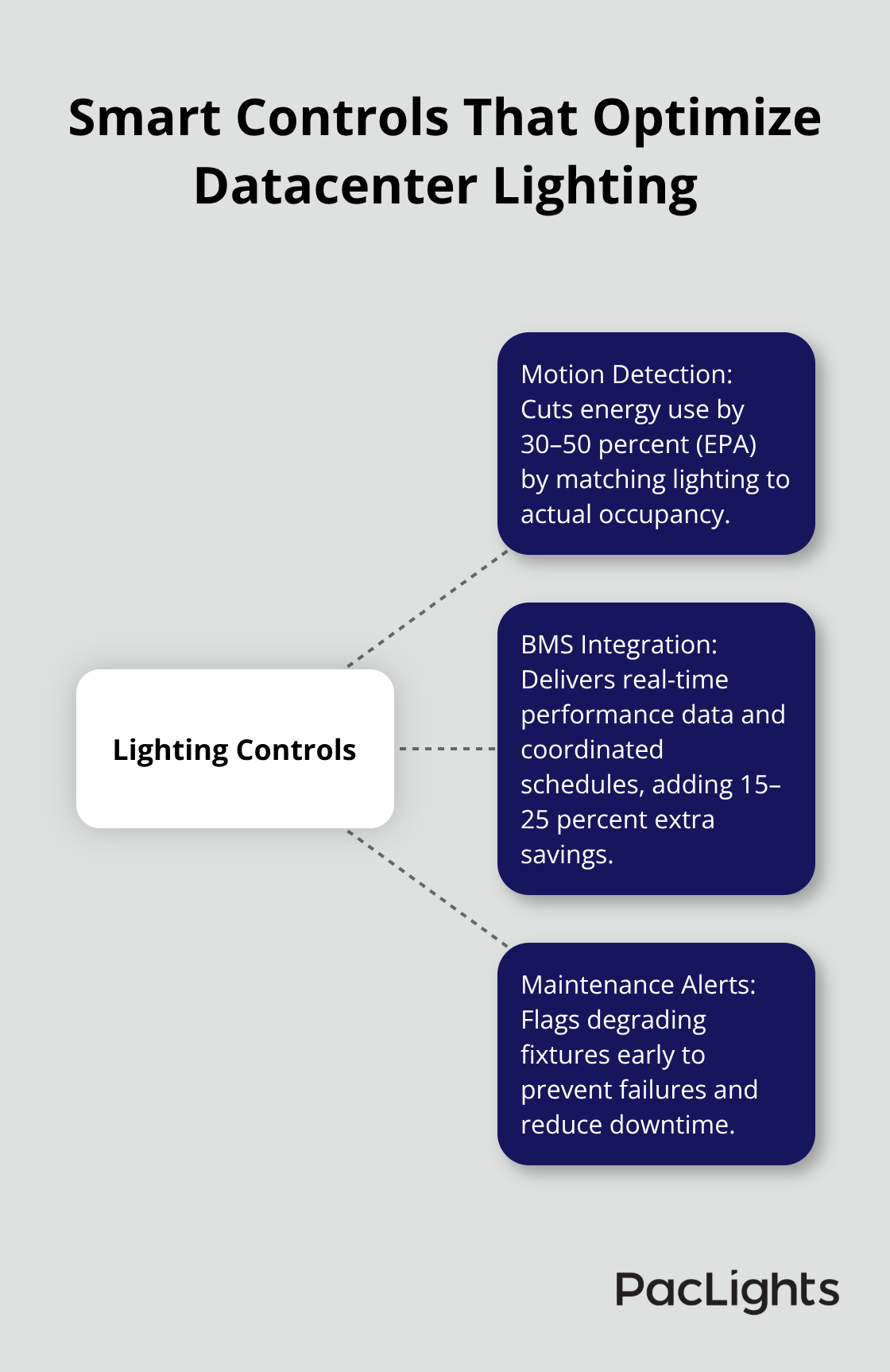
Static lighting wastes energy in datacenters where occupancy fluctuates dramatically. Server rooms sit empty for hours, yet fixtures burn at full brightness continuously. Smart lighting controls eliminate this waste by responding to actual facility use, cutting energy consumption by 30 to 50 percent according to the U.S. Environmental Protection Agency. Motion sensors detect technician presence and adjust lighting levels automatically, reducing unnecessary consumption during periods when the space remains unoccupied.
Occupancy-based systems work particularly well in datacenters because technicians typically work in specific zones rather than throughout the entire facility. A 5,000 square foot datacenter with motion-controlled lighting can reduce annual energy costs by 8,000 to 12,000 dollars depending on local electricity rates and usage patterns. Fixtures with adjustable brightness levels provide additional savings because technicians rarely need maximum illumination for routine inspections.
Many facilities set motion sensors to trigger 70 percent brightness initially, with manual controls allowing technicians to increase output only when detailed work demands full visibility. This approach balances energy savings with operational flexibility, ensuring adequate lighting when needed without maintaining wasteful constant brightness. The payback period for motion control systems typically ranges from two to four years through energy savings alone, making this investment financially sound beyond the operational benefits.
Building Management System Integration Optimizes Operations
Integration with building management systems transforms individual lighting fixtures into coordinated infrastructure that communicates with HVAC systems, power management, and security networks. When lighting connects to BMS platforms, facilities gain real-time visibility into fixture performance, energy consumption, and maintenance requirements across the entire datacenter.
This integration prevents failures because the system alerts maintenance teams immediately when fixtures underperform or consume abnormal power levels, allowing technicians to address problems before they impact operations. Advanced BMS integration also enables sophisticated scheduling that coordinates lighting with cooling cycles and equipment maintenance windows, optimizing overall facility efficiency. Datacenters using networked lighting controls report 15 to 25 percent additional energy savings beyond motion detection alone because the system learns usage patterns and adjusts proactively rather than reactively.
Maintenance Alerts Prevent Equipment Failures
Maintenance alerts generated through BMS monitoring reduce emergency repairs by identifying degrading fixtures before complete failure occurs. A fixture showing declining brightness output triggers maintenance scheduling before it fails entirely, preventing the disruption of emergency repairs in critical infrastructure. This proactive approach keeps your datacenter running reliably while minimizing unexpected downtime and repair costs.
PacLights offers advanced lighting controls including networked lighting control systems designed for integration with facility management platforms. These systems provide the data and automation necessary to maintain reliable operations while minimizing energy expenditure and maintenance costs.
Final Thoughts
Datacenter safety lighting delivers measurable returns that extend far beyond illumination. The systems covered in this guide reduce maintenance time, prevent costly errors, and keep your facility compliant with OSHA and industry-specific regulations. Technicians work faster and more accurately when visibility is optimized, directly lowering the risk of expensive downtime.
Energy-efficient LED fixtures cut consumption by 75 percent compared to traditional alternatives, translating to annual savings exceeding 15,000 dollars on larger facilities. Motion detection and building management system integration add another 15 to 25 percent in energy reduction through intelligent automation. Most facilities recover their initial investment within two to four years through operational efficiency alone, with savings compounding year after year.
Upgrading your datacenter safety lighting requires selecting fixtures engineered specifically for server environments rather than adapted commercial alternatives. Heat management, flicker-free operation, and durable construction separate effective solutions from inadequate compromises. PacLights offers lighting fixtures tailored to diverse industrial needs, including high bays and specialty lighting with optional motion control and advanced networked lighting controls designed for facility integration.
Disclaimer: PacLights is not responsible for any actions taken based on the suggestions and information provided in this article, and readers should consult local building and electrical codes for proper guidance.