

NSF listed LED fixtures aren’t just another certification label. They represent a commitment to meeting strict health, safety, and performance standards that matter in commercial and industrial settings.
At PacLights, we’ve seen firsthand how the right lighting choice protects your facility, reduces unexpected failures, and saves money over time. This guide walks you through what NSF listing means and how to make it work for your operation.
What NSF Listing Actually Means
NSF Certification: Independent Verification That Matters
NSF listing certifies that LED fixtures meet specific performance and safety criteria established by NSF International, a third-party organization that tests products against rigorous standards. The NSF mark indicates your fixtures have passed testing for electrical safety, light output consistency, color accuracy, and lifespan claims. Unlike manufacturer certifications or generic quality labels, NSF listing involves independent laboratory verification, meaning someone outside the company has confirmed the product performs as advertised.
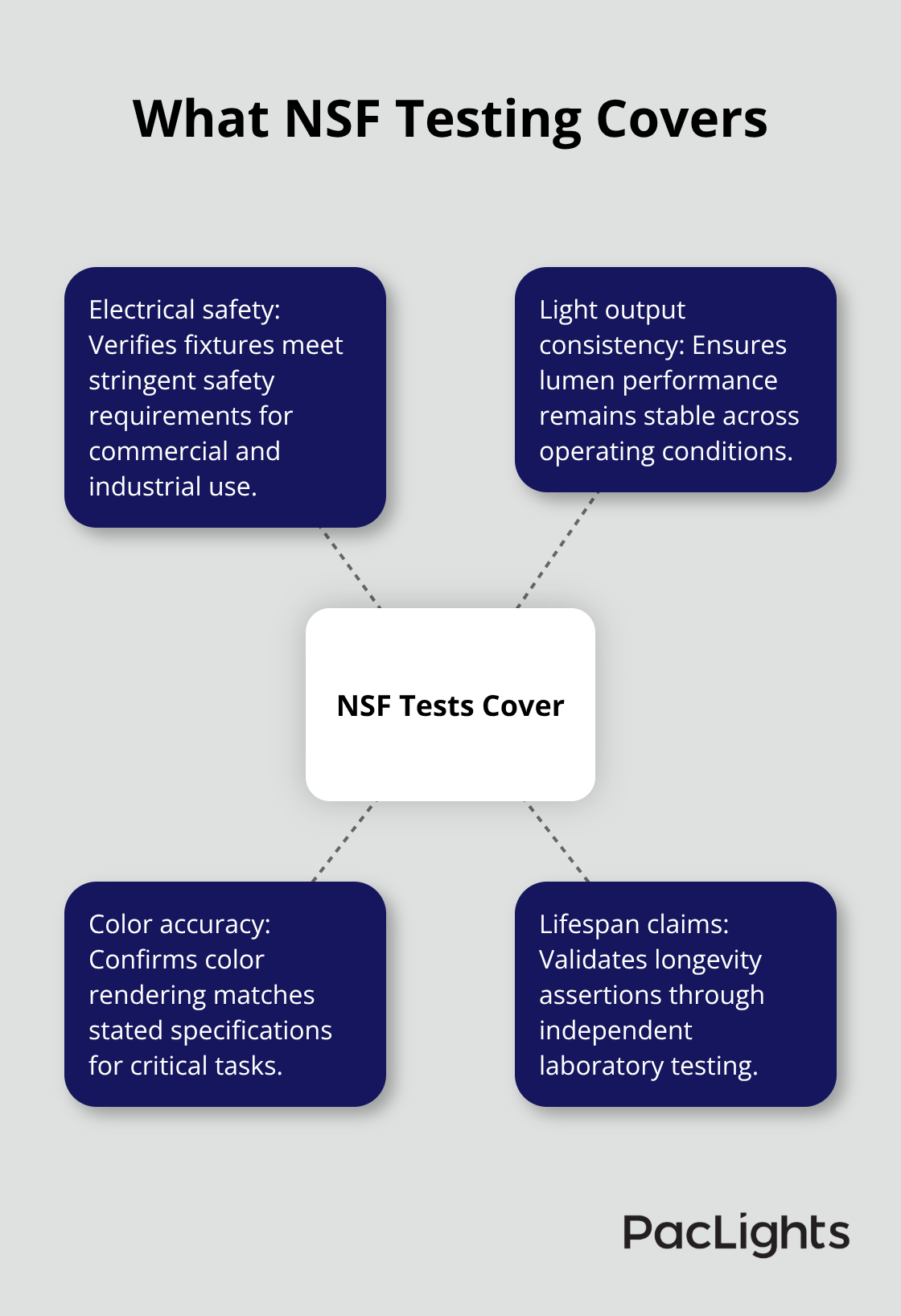
This matters because manufacturers can make claims about their products, but NSF certification proves those claims through documented testing. When you see the NSF mark on an LED fixture, it means the product has undergone evaluation for commercial and industrial use, not just residential applications where standards are considerably looser.
How NSF Differs from Other Quality Marks
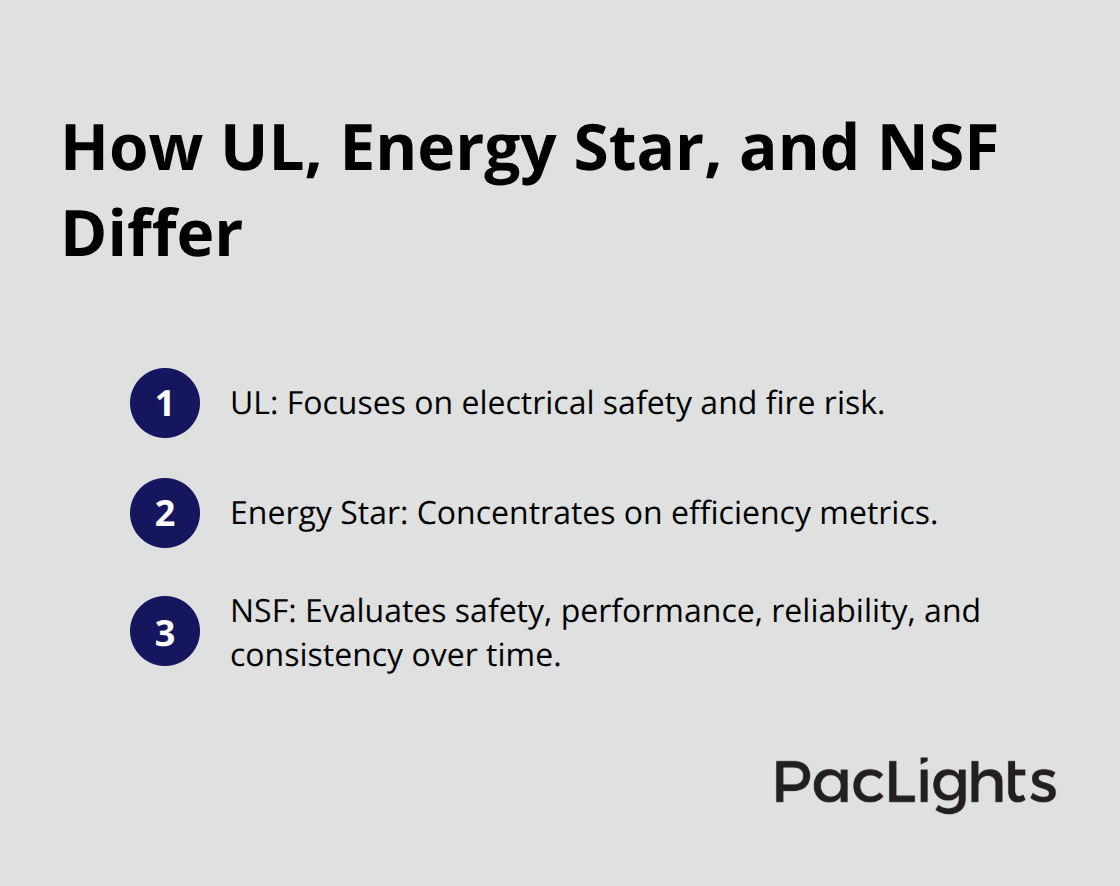
NSF certification differs fundamentally from other quality marks you’ll encounter. UL certification focuses primarily on electrical safety and fire risk, while Energy Star ratings concentrate on efficiency metrics alone. NSF, however, evaluates the complete package including safety, performance, reliability, and consistency over time.
Many facility managers mistake ISO certifications for performance guarantees, but ISO standards simply document that a company has processes in place, not that products actually perform better. For commercial kitchens, food processing facilities, and cleanroom environments, NSF listing carries legal weight because health codes specifically reference NSF standards.
Why NSF Listing Protects Your Operations
In industrial settings without strict regulatory requirements, NSF listing still matters because it reduces equipment failure risk and downtime costs. Third-party verification protects your investment and keeps operations running smoothly without unexpected lighting failures that disrupt workflows. The independent testing behind NSF certification means you avoid products that fail prematurely or underperform in real-world conditions.
When you select fixtures with proper third-party verification, you gain confidence that your lighting system will perform consistently. This reliability translates directly into fewer maintenance emergencies and more predictable operational costs. Understanding what NSF listing actually protects you against sets the foundation for recognizing the specific benefits these fixtures bring to your facility.
Key Benefits of NSF Listed LED Fixtures
Regulatory Compliance Becomes Automatic
Food processing plants, commercial kitchens, pharmaceutical manufacturing, and cleanroom environments operate under health codes that specifically mandate NSF certified equipment. The FDA references NSF standards for food contact surfaces and facility lighting in food safety modernization act inspections. NSF listed fixtures eliminate compliance uncertainty and protect your facility from citations or operational shutdowns. Choosing certified products means your facility meets regulatory requirements without additional verification steps or documentation burdens.
Equipment Reliability Cuts Downtime Dramatically
Industrial facilities that switched to NSF listed fixtures report fewer unexpected lighting failures during critical operations. A failed high bay light in a manufacturing plant costs far more than the fixture itself when production halts. NSF certification guarantees that fixtures meet performance standards for lifespan and output consistency, so you avoid premature burnouts that disrupt workflows. This reliability advantage compounds across your entire lighting system, reducing the frequency of emergency maintenance calls that drain resources and halt operations.
Total Cost of Ownership Favors NSF Listed Products
While NSF certified fixtures cost slightly more upfront (typically 15-20 percent higher than uncertified alternatives), the operational savings compound quickly. Facilities report maintenance costs drop by 30-40 percent because NSF listed fixtures fail less frequently and perform consistently throughout their rated lifespan. This means fewer emergency service calls, reduced labor expenses for replacements, and predictable energy consumption that simplifies budget forecasting.
The financial case strengthens when you calculate five-year operating costs. A 10,000 square foot warehouse using standard LED fixtures might experience three to five fixture failures annually, each requiring emergency replacement labor at premium rates. That same facility with NSF listed fixtures typically experiences zero to one failure over the same period. Over five years, the cumulative savings from fewer maintenance emergencies, reduced replacement parts inventory, and eliminated downtime easily exceed the initial premium paid for certified products.
Making the Investment Decision
NSF listing proves your fixtures will perform as promised, protecting your investment and keeping operations running without surprises. Health and safety regulations aside, the operational advantages and cost reductions make NSF certification a practical choice for any facility serious about lighting performance. Understanding these benefits positions you to select the right fixtures for your specific needs and operational requirements.
Selecting and Deploying NSF Listed Fixtures
Verify NSF Certification Before Purchase
Identifying NSF listed fixtures requires checking product documentation before purchase, not after delivery arrives at your facility. The NSF mark appears on product labels, specification sheets, and manufacturer websites, typically displayed prominently alongside the certification number. When you contact suppliers, ask specifically for NSF certification status rather than assuming certified products are standard offerings. Many distributors stock both certified and non-certified fixtures at different price points, so explicit requests prevent receiving uncertified alternatives.
Verify the certification covers your specific application, whether food service, pharmaceutical manufacturing, or general industrial use, since NSF maintains different standards for different environments. Check the NSF product directory online to confirm certification status independently before finalizing orders. This verification step takes fifteen minutes and eliminates the risk of purchasing fixtures that fail to meet your facility’s regulatory or operational requirements.
Partner with Installers Who Understand NSF Requirements
Working with installers who understand NSF requirements prevents costly mistakes during deployment. Inexperienced installation teams may not recognize that NSF listed fixtures require specific mounting heights, spacing, or electrical configurations to maintain certification validity. When you hire installation contractors, request proof they have installed NSF certified lighting systems previously and understand the documentation requirements your facility needs for compliance records.
Poor installation voids the certification benefits, so this step matters as much as selecting the right fixtures. Experienced installers know how NSF certification relates to your specific facility type and can position fixtures correctly from the start.
Establish Baseline Performance Metrics at Installation
Maintenance planning should start during installation, not months later when problems emerge. Establish baseline performance metrics at installation by recording light output levels, color temperature consistency, and electrical consumption across your facility. These measurements become your reference point for detecting performance degradation over time.
Schedule maintenance inspections quarterly during the first year to catch installation issues early when they are easiest to correct. After year one, shift to annual inspections unless your facility operates in harsh conditions like chemical processing environments where semi-annual checks prevent premature failures (this applies especially to facilities with corrosive atmospheres or extreme temperature fluctuations).
Document Maintenance and Preserve Compliance Records
Document all maintenance activities and fixture performance data to preserve your compliance records and demonstrate due diligence to regulators or auditors. This documentation also protects you during equipment warranty claims, since manufacturers can verify you maintained fixtures according to specifications. Facilities that maintain detailed records experience faster warranty resolutions and avoid disputes over maintenance responsibility.
Keep records organized by fixture location and installation date so you can track performance patterns across your facility. When you need to replace fixtures or upgrade sections of your lighting system, historical data shows which products performed best in your specific environment (this information proves invaluable for future purchasing decisions).
Final Thoughts
NSF listed LED fixtures represent a straightforward investment in operational reliability and regulatory compliance. Throughout this guide, we’ve covered what NSF certification protects-from independent verification of performance claims to documented proof that your fixtures meet strict health and safety standards. The financial case is equally clear: while certified fixtures cost more initially, the reduction in maintenance emergencies, fewer unexpected failures, and predictable energy consumption deliver measurable savings within two to three years of operation.
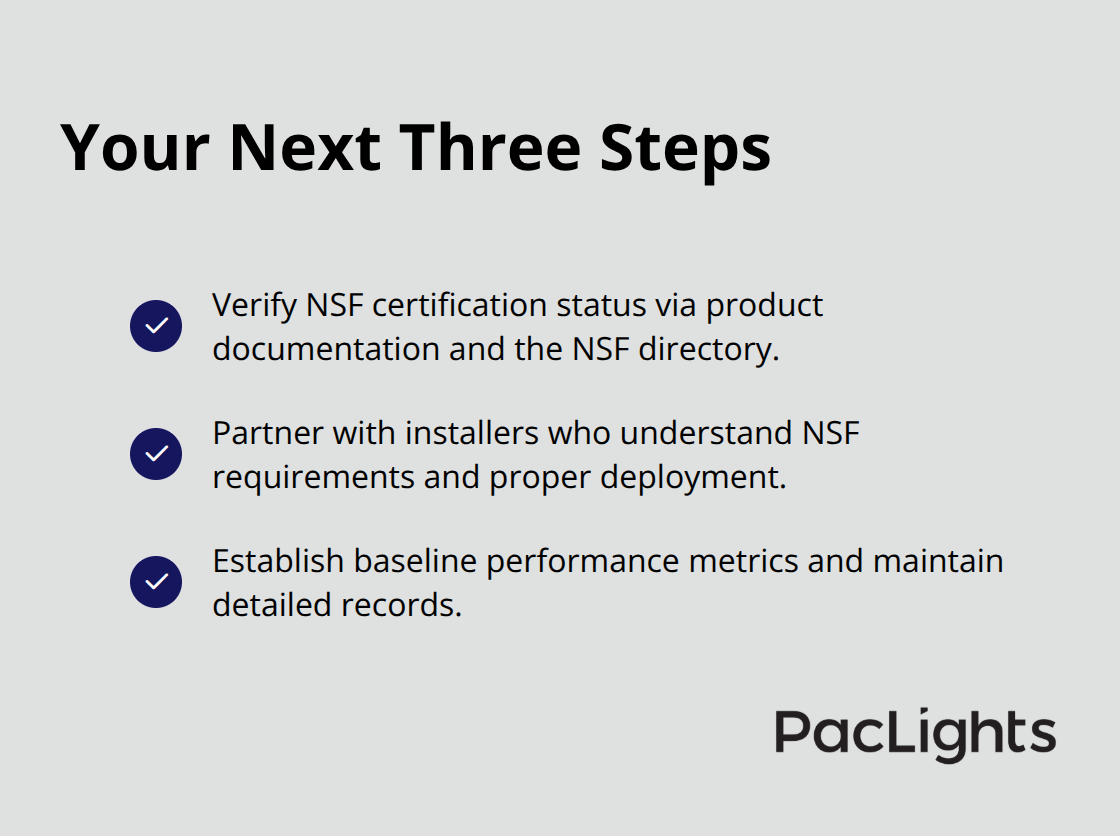
For facility managers, the path forward involves three concrete steps. First, verify NSF certification status before purchasing any fixtures by checking product documentation and the NSF directory independently. Second, partner with installation contractors who understand NSF requirements and can deploy fixtures correctly to maintain certification validity. Third, establish baseline performance metrics at installation and maintain detailed records throughout the fixture lifespan to preserve compliance documentation and track performance patterns specific to your facility environment.
At PacLights, we understand that facility managers need lighting solutions that perform consistently and meet regulatory requirements without complications. We offer energy-efficient LED fixtures for commercial and industrial facilities, including high bays, troffer lights, and specialty lighting tailored to your specific needs (with optional daylight and motion controls to optimize energy use further). Contact us today to discuss how NSF listed LED fixtures can improve your facility’s performance and reduce operational costs.
Disclaimer: PacLights is not responsible for any actions taken based on the suggestions and information provided in this article, and readers should consult local building and electrical codes for proper guidance.