

Commercial downlights energy savings aren’t just about cutting your electricity bill-they’re about making smart investments that pay for themselves. At PacLights, we’ve seen facilities reduce energy consumption by 40-70% simply by upgrading their lighting systems.
The best part? Modern downlights deliver these savings without sacrificing light quality or performance. Your facility gets brighter, more efficient lighting while your operating costs drop significantly.
Why LED Downlights Slash Energy Costs While Maintaining Superior Light Quality
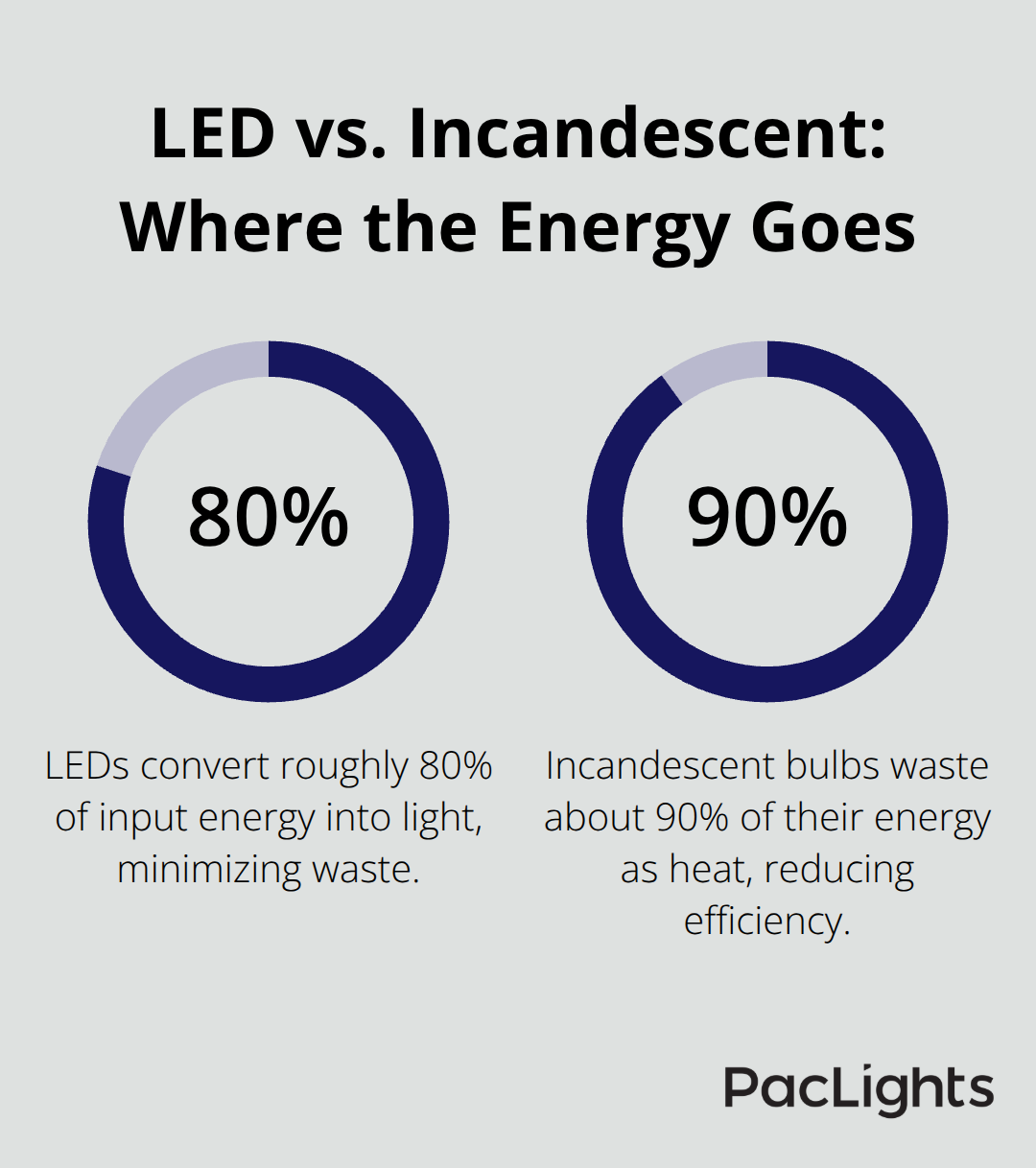
LED downlights achieve dramatic efficiency gains through fundamental physics. An 8-watt LED downlight replaces a 50-watt halogen fixture while delivering identical brightness, according to the Department of Consumer and Regulatory Affairs. LEDs convert roughly 80% of input energy into light, whereas incandescent bulbs waste about 90% of their energy as heat. This efficiency difference compounds across an entire facility.
A 10,000 square foot office typically spends $4,500–$8,500 annually on lighting electricity. Switching to LEDs cuts this by 65–80%, delivering annual savings of $2,925–$6,800 per year.
The thermal advantage extends your savings even further. Because LEDs dump far less heat into ceilings, your HVAC system works less hard, yielding an additional 10–15% energy savings in most climates. Per fixture, a 50-watt halogen costs roughly $15–$25 annually to operate, while an 8-watt LED costs $2–$4 per year, translating to $55–$115 in five-year energy savings per fixture.
Smart Controls Amplify Your Savings Further
Downlights paired with occupancy sensors and daylight harvesting deliver substantially more than LED efficiency alone. Occupancy sensors cut energy use by 20–30% in spaces with variable occupancy, while daylight harvesting adds another 10–15% savings for perimeter zones. The U.S. Department of Energy reports that advanced lighting controls can cut energy consumption in offices by up to 47%.
A NorthShore University Health System project using LED lighting with occupancy controls achieved 78.25% total energy savings with a payback period of just over one year. This real-world result demonstrates how control systems transform baseline LED efficiency into exceptional performance.
Lifespan Savings Extend Beyond Energy Bills
LED downlights last 50,000–100,000 hours compared with halogen bulbs at 4,000 hours and incandescent at 2,000–4,000 hours. This 15–25 times longer lifespan eliminates the constant cycle of maintenance visits and replacement labor. A Raleigh parking garage retrofit switching to LEDs saved approximately $3,325 annually in maintenance costs alone.
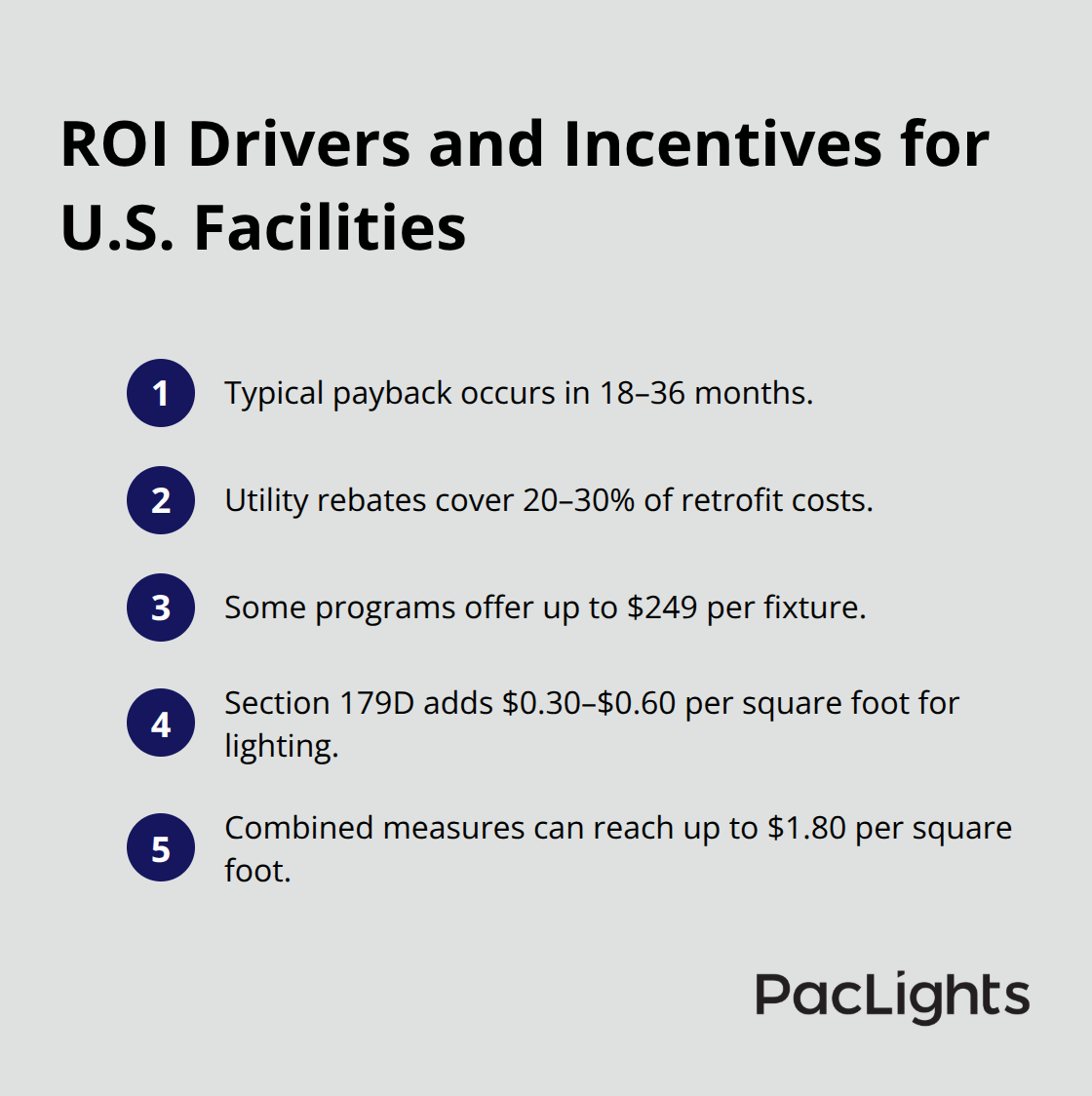
When you combine energy savings, reduced replacement frequency, and lower cooling demand, the total return on investment typically spans 18–36 months. Utility rebates offset 20–30% of retrofit costs, with some programs offering up to $249 per LED fixture, further accelerating payback. These financial incentives make the transition to LED downlights accessible for facilities of any size.
Understanding your current lighting layout and usage patterns positions you to maximize these savings when selecting the right downlights for your specific needs.
Real-World Energy Savings and ROI Data
LED downlight retrofits consistently deliver 40–70% energy reductions across diverse facility types, and these aren’t theoretical projections-they’re measured outcomes from actual installations. The Bristol Marriott Hotel replaced 145 halogen lamps with 4-watt LEDs and cut annual energy consumption by 43,822 kilowatt-hours while reducing air conditioning load by approximately $8,000 per year. NorthShore University Health System achieved 78.25% total energy savings using LED lighting with occupancy controls, reaching full payback in just over one year. Los Angeles committed to replacing 140,000 streetlights with LEDs, projecting $48 million in savings over seven years alongside 40,500 tons of annual CO2 reduction. These results span hospitals, hotels, municipalities, and parking facilities-different building types, same outcome: substantial, measurable savings.
Payback Periods Accelerate With Proper Controls
Most facilities see complete payback between 18–36 months, though high-use buildings achieve it faster. A 10,000-square-foot office spending $4,500–$8,500 annually on lighting electricity will save $2,925–$6,800 per year after converting to LEDs. Utility rebates typically cover 20–30% of retrofit costs, with some programs offering up to $249 per fixture, effectively cutting your net investment significantly. The Section 179D tax deduction provides an additional $0.30–$0.60 per square foot for lighting improvements, or up to $1.80 per square foot when combined with other efficiency upgrades.
A single 50-watt halogen fixture costs $15–$25 annually to operate; an 8-watt LED replacement costs $2–$4, generating $55–$115 in five-year savings per fixture alone. Facilities with hundreds or thousands of fixtures compound these savings dramatically-a warehouse with 500 downlights saves roughly $27,500–$57,500 over five years from energy costs alone, before accounting for maintenance labor elimination.
Maintenance Savings Transform Your Bottom Line
LED lifespan advantage fundamentally changes the payback calculation. Halogen and incandescent bulbs require replacement every 4,000–2,000 hours respectively; LEDs last 50,000–100,000 hours, reducing maintenance labor and inventory costs substantially. Raleigh’s parking garage retrofit saved $3,325 annually in maintenance expenses after switching to LEDs-this represents pure labor and replacement cost reduction, separate from energy savings. Multiply that across a multi-building portfolio and maintenance savings alone often justify the upgrade within two years.
Your facilities team spends less time on ladders replacing burned-out fixtures and more time on strategic projects. This operational benefit extends fixture reliability across the retrofit’s entire lifecycle, eliminating the constant cycle of emergency replacements and service calls.
Long-Term Compounding Creates Exceptional Returns
Five-year and ten-year projections reveal how LED investments compound. Energy savings, maintenance cost elimination, and reduced cooling demand work together to create returns that exceed initial projections. A facility that invests $50,000 in a comprehensive LED retrofit typically recovers that investment within two years, then generates pure savings for the remaining eight years of the fixture lifecycle. Over a decade, that same facility accumulates $200,000–$400,000 in combined energy and maintenance savings (depending on facility size and operating hours).
The financial case strengthens further when you factor in utility incentives and tax deductions available during the retrofit year. These mechanisms exist specifically to accelerate adoption, making the transition accessible for facilities of any size. Understanding your current lighting layout, usage patterns, and available incentives positions you to maximize these returns when selecting the right downlights for your specific needs.
Selecting Downlights That Match Your Facility’s Real Operating Conditions
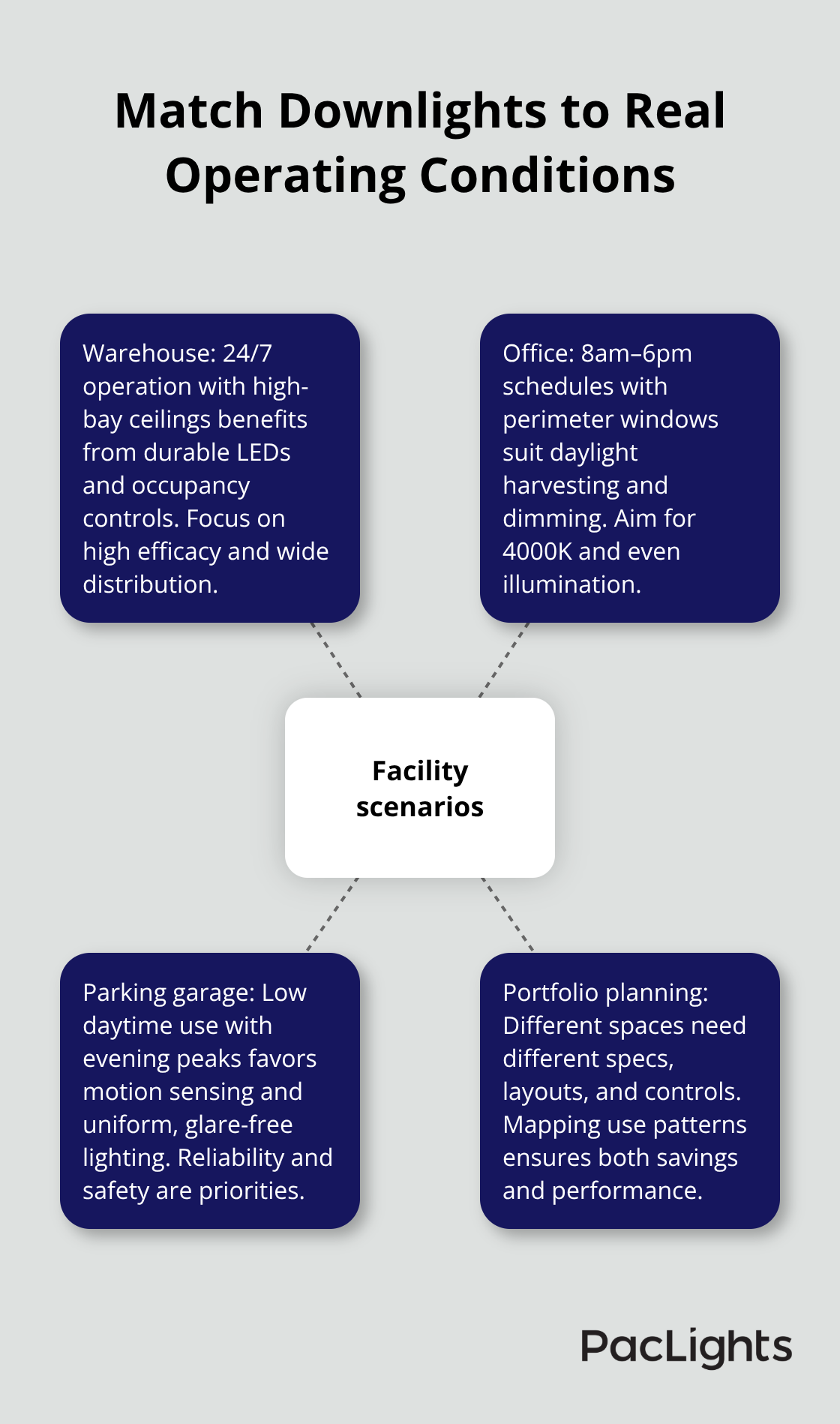
The most common mistake facilities make is treating all downlights as interchangeable. Your warehouse operates 24/7 under high-bay ceilings with intermittent foot traffic. Your office runs 8am–6pm with perimeter windows and variable occupancy. Your parking garage sits mostly empty except evenings. Each scenario demands different fixture specifications, controls, and layouts to maximize both savings and performance.
Map Your Current Lighting Consumption and Patterns
Start by measuring your actual lighting consumption and mapping where light actually gets used. A 10,000-square-foot office spending $4,500–$8,500 annually on lighting electricity gives you a baseline, but your specific facility likely differs significantly. Document current fixture types, wattages, and replacement frequency over the past year. This data reveals your true maintenance burden and energy profile far better than any generic estimate.
Walk your spaces during different times and seasons. Notice where employees position task lamps, where glare causes discomfort, and where corners stay dim despite overhead fixtures. These observations drive smarter fixture placement and wattage selection than spreadsheet calculations alone. Proper spacing matters considerably-fixtures positioned 8–10 feet apart deliver even illumination while reducing total fixture count by 15–25%, directly lowering both material and installation costs.
Calculate Footcandles Instead of Wattage
Stop thinking about wattage and start thinking about footcandles, the actual light intensity you need on work surfaces. Kitchens and active workspaces require 30–50 footcandles. Hallways and storage areas need only 10–20 footcandles. Over-lighting wastes energy and creates glare; under-lighting reduces safety and productivity.
When comparing LED downlight options, verify color temperature ranges that match your tasks-2700K for warmer hospitality spaces, 4000K for offices balancing warmth and alertness, 5000K or higher for detail work and retail. High-quality commercial LEDs with color rendering index ratings above 90 preserve product appearance and reduce eye strain. This matters more in retail and food service than generic specifications suggest.
Integrate Controls for Maximum Efficiency
Control integration separates exceptional retrofits from mediocre ones. Occupancy sensors cut energy use by 20–30% in variable-occupancy spaces, while daylight harvesting adds another 10–15% for perimeter zones. The U.S. Department of Energy reports that advanced lighting controls can cut energy consumption in offices by up to 47%.
Wireless control systems increasingly eliminate costly rewiring, making retrofit projects scalable across multi-building portfolios. Verify that your LED drivers support flicker-free dimming if you plan to integrate controls-low-quality drivers create barely perceptible flicker that causes headaches and fatigue even when you cannot consciously detect it.
Request Assessments Based on Your Actual Operating Hours
Request free ROI assessments and lighting layout designs from your supplier to quantify net costs and payback based on your actual electricity rates and operating hours. These assessments account for your facility’s genuine operating patterns rather than generic recommendations. PacLights provides customizable fixture options with integrated daylight and motion controls, helping you select specifications matched to your facility’s real conditions.
Final Thoughts
Commercial downlights energy savings represent far more than a line item on your utility bill-hospitals, hotels, municipalities, and warehouses all prove that upgrading to LED downlights delivers measurable cost reductions alongside improved light quality and operational reliability. Your facility gains brighter, more uniform illumination while your maintenance team spends less time replacing burned-out fixtures and more time on strategic work. Energy savings of 65–80% combined with maintenance cost elimination and reduced cooling demand create payback periods of 18–36 months for most facilities, with utility rebates and tax deductions accelerating that timeline further.
Quality and efficiency work together, not against each other. Modern LED downlights with proper color rendering preserve product appearance in retail spaces, reduce eye strain in offices, and deliver safety-critical illumination in parking garages and warehouses (occupancy sensors and daylight harvesting controls amplify baseline LED efficiency by another 20–47%, transforming good retrofits into exceptional ones). Your facility operates with the lighting performance you need while operating costs drop significantly.
The path forward requires matching fixture specifications to your actual operating conditions rather than generic recommendations. We at PacLights provide customizable downlight options with integrated motion and daylight controls, plus free lighting layout designs and ROI assessments tailored to your facility’s specific electricity rates and operating hours. Start your energy savings journey by requesting an assessment based on your actual conditions rather than industry averages.
Disclaimer: PacLights is not responsible for any actions taken based on the suggestions and information provided in this article, and readers should consult local building and electrical codes for proper guidance.