

Picking the wrong commercial downlights wastes money and creates poor lighting conditions that frustrate employees and customers alike. We at PacLights know that the right recessed lighting transforms a space while cutting energy costs significantly.
This guide walks you through every decision point, from LED versus halogen options to beam angles and installation layouts. You’ll learn exactly what to look for so your next lighting project delivers both performance and value.
Which Downlight Type Fits Your Commercial Space
LED downlights deliver superior performance and savings
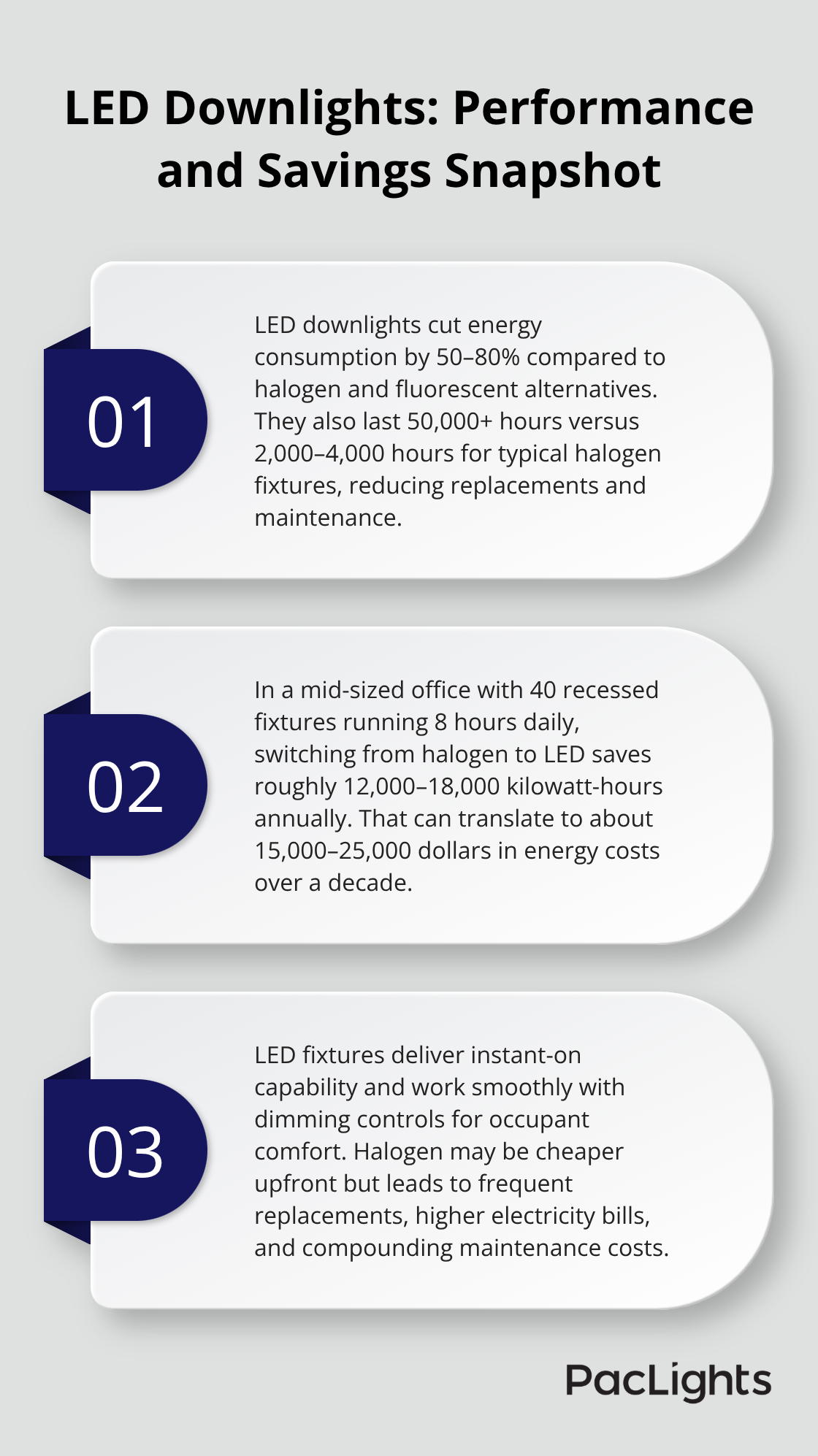
LED downlights dominate commercial applications because they cut energy consumption by 50-80% compared to halogen and fluorescent alternatives, according to industry efficiency data. An LED downlight lasting 50,000+ hours means you replace bulbs far less often than halogen fixtures, which typically burn out after 2,000-4,000 hours. For a mid-sized office with 40 recessed fixtures running 8 hours daily, switching from halogen to LED saves roughly 12,000-18,000 kilowatt-hours annually, translating to 15,000-25,000 dollars in energy costs over a decade. LED fixtures also deliver instant-on capability and work seamlessly with dimming controls, giving occupants comfort and flexibility that halogen cannot match. Halogen downlights remain cheaper upfront but trap you in a cycle of frequent replacements, higher electricity bills, and maintenance labor that compounds costs quickly.
Why halogen still appears in some spaces
Halogen fixtures survive in older buildings where retrofitting proves disruptive or when budget constraints force short-term thinking. Fluorescent recessed options have largely disappeared from new commercial projects because LEDs outperform them on every metric: lifespan, flicker, color rendering, and energy use. Specialty downlights like canless (wafer-style) fixtures address unique constraints, delivering ultra-thin profiles for low-clearance ceilings without sacrificing performance.
Specialty fixtures for targeted applications
Adjustable gimbal trims in recessed housings let you aim light toward artwork or architectural features, making them essential for retail galleries and hospitality venues where ambiance drives customer experience. Smart LED downlights with tunable white or RGB capabilities appeal to facilities managing large portfolios, offering app-based scheduling and dimming across zones. For most commercial spaces-offices, retail, schools, restaurants-standard LED downlights in 4-6 inch sizes with wide beam angles (100-120 degrees) and neutral color temperatures (3500-4000K) deliver the best balance of performance, cost, and reliability.
Installation advantages that matter
Installation simplicity matters because fixtures with built-in junction boxes reduce electrical work and speed deployment in drop-ceiling environments common to commercial buildings. This efficiency translates directly to lower labor costs and faster project completion. The right downlight type depends on your space’s constraints and performance needs, which brings us to the specific factors that shape every selection decision.
What Makes a Downlight Right for Your Space
Brightness and color temperature shape how occupants experience a space, and selecting both incorrectly costs money while creating discomfort. For offices and classrooms, try 3500-4000K (neutral white) with sufficient lumens to support focused work without causing eye strain. Hospitality venues like restaurants and hotels perform better at 2700-3000K (warm white), which encourages relaxation and appetite. Industrial and healthcare settings demand 5000K or higher for task accuracy and safety. Most facilities make the mistake of choosing one color temperature across all zones, ignoring how different activities require different lighting moods. A restaurant dining area at 4000K feels institutional and cold; the same fixture at 2700K transforms the experience entirely.
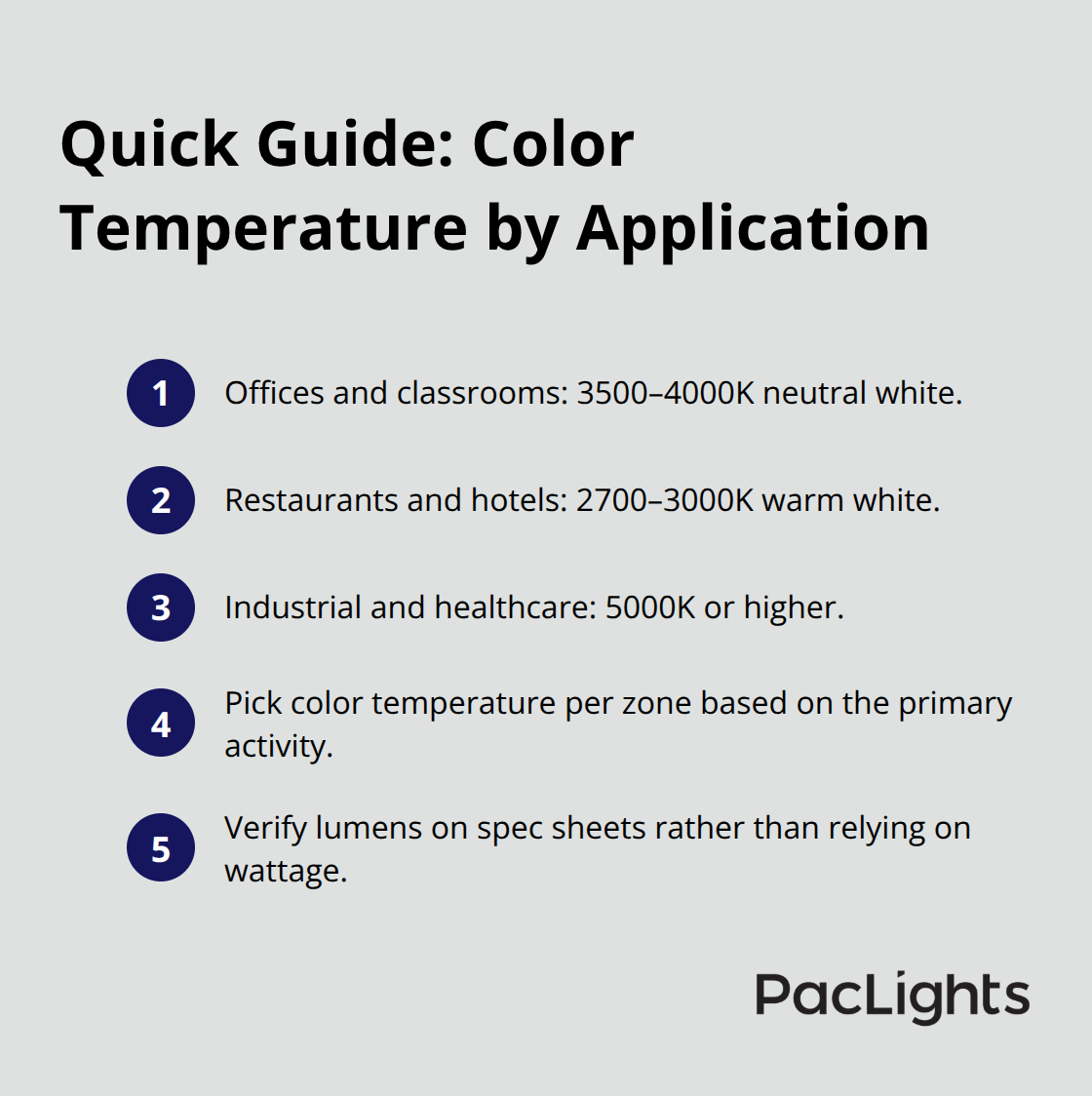
Start with the primary activity in each zone, then select color temperature accordingly. Brightness matters equally, but many decision-makers focus only on wattage rather than actual lumen output. A 10-watt LED downlight can deliver 800 lumens, while another 10-watt model produces only 600 lumens depending on optics and efficiency. Consult the IES Recommended Lighting Levels for Commercial and Industrial Spaces to determine specific lumen targets for your application, then verify actual output on product specification sheets rather than trusting wattage alone.
Fixture size determines coverage and aesthetics
Commercial spaces typically use 4-inch, 6-inch, or larger downlights, with 6-inch being the most popular choice for general lighting. Space fixtures roughly half the ceiling height apart and position them 2-3 feet from walls to avoid harsh shadows and dark corners. A 10-foot ceiling works well with fixtures spaced 4-6 feet apart, while 14-foot ceilings need wider spacing or larger 8-12 inch fixtures to achieve uniform coverage. Too small a fixture leaves dark patches and requires more units, increasing installation costs and complexity. Too large a fixture creates wasted light and inflexible layouts. Measure your ceiling height and square footage first, then calculate the spacing grid before ordering. For retrofit projects upgrading existing housings, match the current fixture diameter unless you’re willing to patch and repaint the ceiling.
Beam angle controls light distribution
Beam angle determines light distribution patterns, with wide angles (100-120 degrees) providing uniform wash lighting ideal for offices and retail, while narrow angles (30-60 degrees) concentrate light for accent or task applications. High ceilings need narrower beams to prevent light from spreading too thin across the floor; low ceilings benefit from wider beams to reduce dark spots. Pairing the right beam angle with ceiling height prevents both wasted light and inadequate illumination.
Dimming and control capabilities add flexibility
Dimmable LED fixtures reduce energy use by an additional 10-20% during off-peak hours. Verify that your LED selection explicitly supports dimming on your chosen driver type, as not all LEDs dim smoothly with standard dimmers. Smart LED downlights with networked controls let facilities manage lighting across multiple zones from a single interface, automatically adjusting brightness based on occupancy or daylight availability. These systems often reduce energy consumption by 15-30% compared to fixed-output fixtures. Advanced lighting controls optimize energy use across your entire facility.
Selecting the right combination for your project
For most commercial projects, standard dimmable LED downlights with wide beam angles and neutral color temperatures deliver reliable performance without unnecessary complexity or cost. The specific combination you choose depends on your space’s unique constraints-ceiling height, primary activities, occupancy patterns, and budget. Once you’ve identified the right fixture specifications, installation planning becomes critical to achieving the uniform coverage and performance your space demands.
Installation and Maintenance Best Practices
Plan your spacing grid before installation begins
Correct spacing prevents the dark patches and hot spots that plague poorly planned installations. Position fixtures roughly half your ceiling height apart-a 10-foot ceiling gets fixtures spaced 4-6 feet apart, while a 14-foot ceiling requires 6-8 foot spacing or larger 8-12 inch fixtures to maintain uniform coverage. Keep fixtures 2-3 feet from walls to avoid harsh shadows that make spaces feel cramped and unprofessional. Measure your entire ceiling grid before ordering anything, then mark fixture locations on a scaled floor plan so your electrician understands the layout precisely. Too many facilities skip this step and discover spacing problems mid-installation, forcing expensive corrections that derail budgets and timelines.
Simplify electrical work with the right fixture design
Built-in junction box downlights reduce electrical complexity since the fixture houses the wiring box internally, eliminating separate roughing-in work that adds labor costs and delays. For retrofit projects upgrading existing housings, can-light LED retrofit kits fit into your current 4-6 inch cutouts without ceiling patching, which saves money and minimizes disruption to occupied spaces. Verify that your electrical system supports the fixture voltage before installation-most commercial downlights run on standard 120V or 277V circuits, but some facilities use 347V systems for larger installations. Have your electrician confirm compatibility with your existing dimmer switches, as not all LED drivers work smoothly with older dimming infrastructure.
Maintain LED fixtures with minimal effort
LED downlights demand virtually zero maintenance compared to halogen fixtures that require bulb changes every 6-12 months. The 50,000+ hour lifespan means most commercial facilities never replace bulbs during normal ownership or tenancy, eliminating labor costs and disruption associated with frequent maintenance cycles.
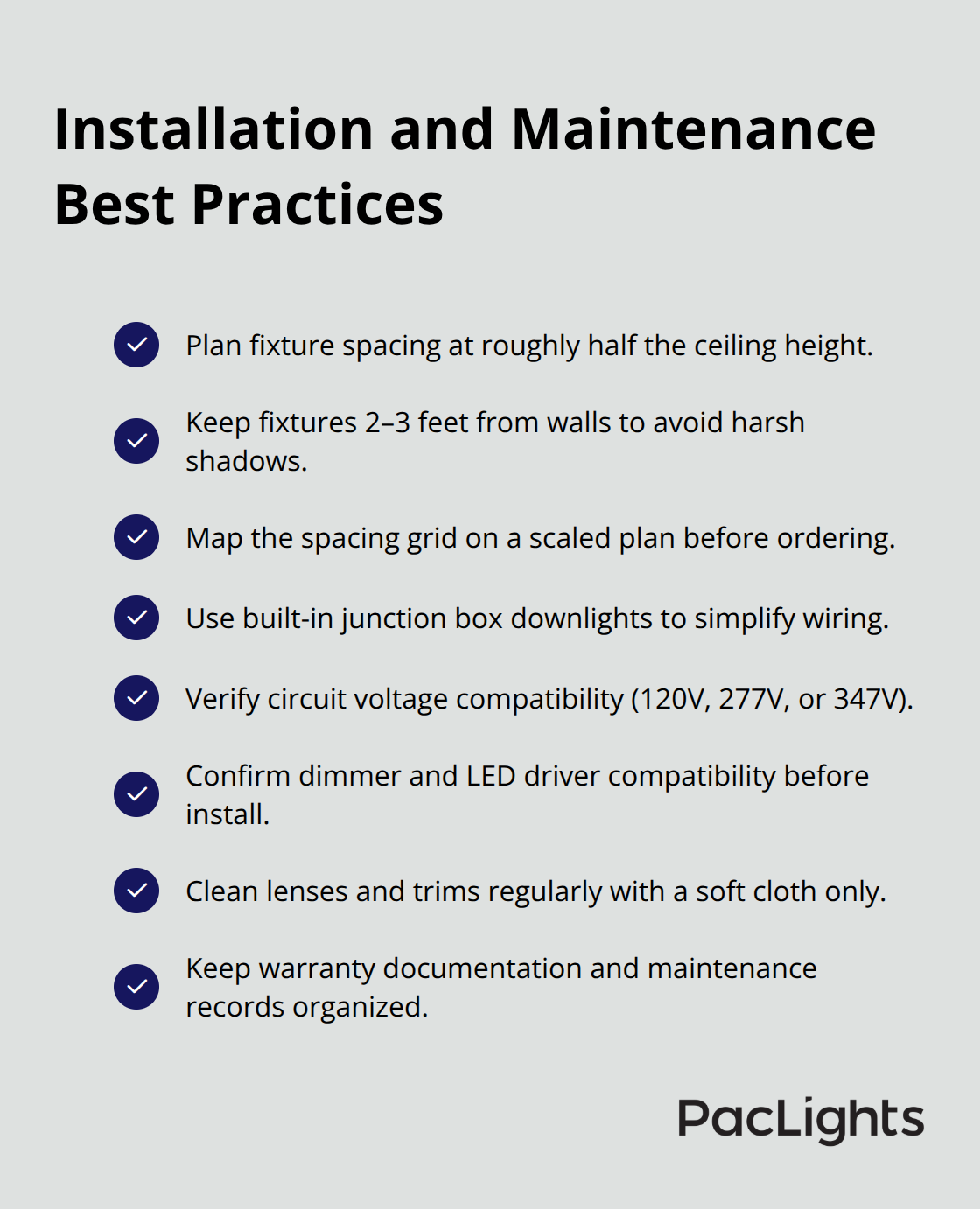
When cleaning recessed fixtures, turn off power first, then wipe the lens and trim with a soft cloth-avoid harsh chemicals that damage reflective surfaces and reduce light output. Dust accumulation in commercial spaces can reduce brightness by 10-15% annually, so quarterly cleaning in retail or hospitality settings prevents noticeable dimming without requiring fixture replacement.
Verify efficiency ratings and insulation contact
Check IC-rated housings annually to confirm they remain in contact with ceiling insulation, as gaps reduce energy efficiency and increase heating or cooling costs. Airtight-rated fixtures sealed with gaskets maintain their efficiency advantage over standard housings, so verify your specification includes AT certification if energy savings drive your selection. Most LED downlight warranties run 5-10 years, covering component failures but not normal wear or damage from improper installation. Keep documentation of your fixture models, installation dates, and any maintenance performed so warranty claims process smoothly if issues arise.
Final Thoughts
Selecting the right commercial downlights requires you to balance brightness, color temperature, fixture size, beam angle, and control capabilities against your space’s unique constraints and budget. LED downlights dominate this decision because they cut energy consumption by 50-80% compared to halogen alternatives while lasting 50,000+ hours, eliminating the constant replacement cycles that drain maintenance budgets. A mid-sized office switching from halogen to LED saves 12,000-18,000 kilowatt-hours annually, translating to substantial cost reductions over a decade.
Your commercial downlights guide should prioritize spacing grids that prevent dark patches, fixture sizes matched to ceiling height, and color temperatures aligned with occupant activities. Offices and classrooms perform best at 3500-4000K, while hospitality venues benefit from warmer 2700-3000K lighting that encourages relaxation. Dimmable fixtures reduce energy use by an additional 10-20% during off-peak hours, and smart controls with networked capabilities optimize consumption across multiple zones automatically.
Installation planning determines whether your project delivers uniform coverage or creates costly problems mid-deployment. Built-in junction boxes simplify electrical work, while retrofit kits upgrade existing housings without ceiling patching, and IC-rated housings maximize energy efficiency. Contact PacLights to discuss your commercial downlight project and discover how the right recessed lighting delivers reliable illumination and measurable cost reductions for years to come.
Disclaimer: PacLights is not responsible for any actions taken based on the suggestions and information provided in this article, and readers should consult local building and electrical codes for proper guidance.