

Industrial facilities face a constant battle against corrosive environments, equipment failures, and rising energy costs. Vapor tight industrial lighting addresses all three challenges at once, protecting your operations while cutting expenses.
At PacLights, we’ve seen firsthand how the right lighting solution transforms facility safety and efficiency. This guide walks you through everything you need to know about vapor tight fixtures and their impact on your bottom line.
Why Vapor Tight Lighting Protects Your Bottom Line
Moisture and corrosive elements destroy standard lighting fixtures faster than most facility managers expect. Water intrusion causes electrical failures, creates safety hazards, and forces expensive emergency replacements. Vapor tight fixtures seal out moisture, dust, and chemicals before they reach internal components. The NEC requires fixtures in wet or damp locations to be rated accordingly, which means vapor tight lighting isn’t optional in food processing plants, car washes, cold storage facilities, parking garages, or outdoor industrial areas. A sealed housing with proper gaskets prevents the corrosion that degrades ballasts, drivers, and wiring-the components that fail first when moisture penetrates standard enclosures. In environments where washdown is routine or humidity runs high, vapor tight construction directly prevents the equipment damage that halts production lines.
Real Costs of Moisture-Related Failures
Standard fixtures in harsh environments fail within 2-3 years, forcing replacement cycles that accumulate labor and material costs. Vapor tight fixtures rated IP66 or IP67 handle water jets and temporary immersion without compromising internal electronics. When you factor in the labor to replace failed fixtures (technicians climbing lifts, electrical work, downtime), the cost per failure easily exceeds $500. A food processing facility with 50 standard fixtures in wash-down areas replaces 15-20 fixtures annually due to moisture damage, spending thousands on labor alone. Vapor tight LED fixtures operate reliably for 50,000 to 100,000 hours-roughly 10-20 years-because the sealed design keeps moisture away from sensitive components. This extended lifespan dramatically cuts replacement frequency and the associated labor expenses.
Compliance and Safety Obligations
OSHA emphasizes adequate workplace illumination as a safety requirement, and moisture-damaged fixtures create electrical hazards that expose your facility to citations and liability. Vapor tight fixtures meet NEC Article 410 requirements for wet locations, ensuring your installation passes inspections and audits. Beyond regulatory compliance, sealed fixtures protect workers from the shock risks that come with corroded wiring and water-damaged enclosures. Insurance providers often recognize vapor tight installations as a risk-reduction measure, potentially lowering premiums. NSF certification matters if your facility handles food or pharmaceuticals, as sealed vapor tight designs support hygiene standards while preventing contamination from failed electrical components. When regulators or insurance auditors review your facility, vapor tight lighting demonstrates that you’ve taken deliberate steps to control hazards.
Why Energy Efficiency Matters Now
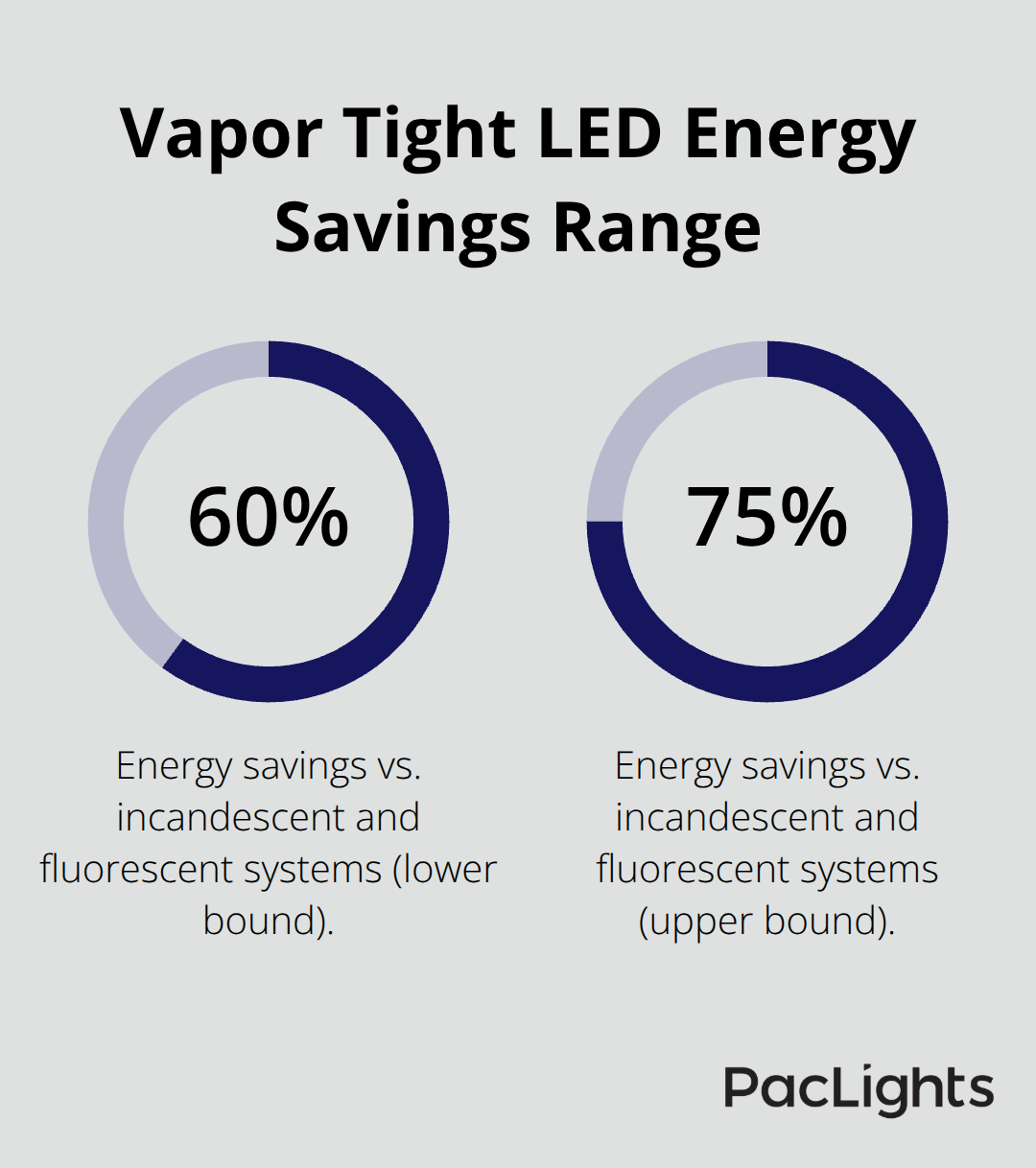
The upfront investment in vapor tight fixtures pays back through lower energy consumption and reduced maintenance labor. LED technology in vapor tight housings delivers 60-75% energy savings compared with incandescent and fluorescent systems, with typical payback ranging from 18 months to 5 years. Replacing 250W metal halide high bays with 100W LEDs across 200 fixtures saves approximately 131,400 kWh annually-translating to $13,000-$26,000 in reduced electricity costs.
Beyond energy savings, the sealed design extends component life, so you replace fixtures far less often than with traditional technology. Your facility moves from reactive replacement cycles to predictable, manageable maintenance schedules. This shift frees up maintenance budgets and reduces the operational disruptions that moisture-related failures create.
How Much Vapor Tight LED Lighting Actually Saves You
Vapor tight LED fixtures cut energy costs faster than most facility managers predict, and the financial impact compounds each year. Replacing metal halide or fluorescent systems with sealed LED units delivers 60-75% energy reductions. A facility running 200 high-bay fixtures at 250W each for 12 hours daily consumes roughly 730,000 kWh annually. Switching those fixtures to 100W LED equivalents cuts consumption to 292,000 kWh per year, eliminating 438,000 kWh of waste. At typical industrial rates between $0.10 and $0.20 per kilowatt-hour, that single change saves $43,800 to $87,600 annually.
Payback periods typically range from 18 months to 5 years, depending on your current equipment, local electricity rates, and fixture count. The sealed design also protects LED drivers and components from moisture damage, which means you avoid the premature failures that force expensive mid-cycle replacements. In food processing plants, car washes, and cold storage facilities where moisture accelerates traditional fixture degradation, this reliability advantage translates directly into lower total cost of ownership.
Maintenance Savings Compound Rapidly
Standard fixtures in harsh environments demand replacement every 2-3 years, and each replacement cycle consumes labor hours that cost far more than the fixture itself. Vapor tight LED fixtures operate reliably for 50,000 to 100,000 hours-roughly 10-20 years of service-which means you replace fixtures once instead of 5-10 times over the same period. A single fixture replacement involving technician labor, lift rental, electrical work, and downtime easily exceeds $500 per unit.
A 50-fixture installation in a food processing wash-down area facing 15-20 annual failures under old systems incurs $7,500-$10,000 in labor costs annually. With vapor tight LEDs, that facility replaces perhaps 2-3 fixtures per decade, reducing annual maintenance labor to nearly zero. Over a 20-year lifespan, this difference accumulates to $150,000 or more in avoided labor expenses. Sealed designs prevent the water damage that corrodes internal components, eliminating emergency repair calls that disrupt production schedules.
Rebates and Tax Incentives Accelerate Payback
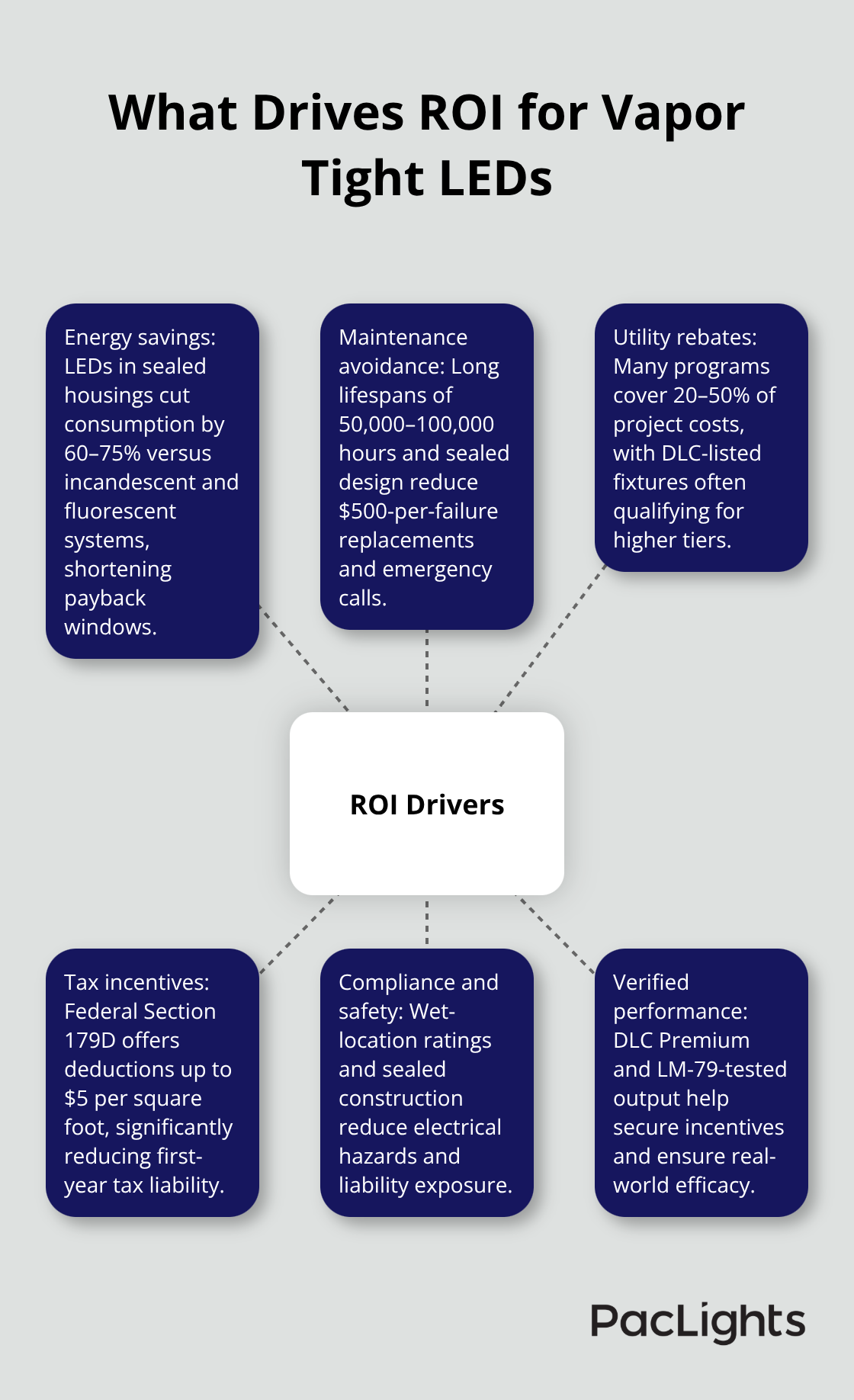
Utility rebates further improve the financial picture. Many utility companies offer rebates covering 20-50% of LED upgrade costs, and DLC-listed fixtures often qualify for higher incentive levels. Federal Section 179D deductions up to $5 per square foot apply to commercial lighting projects, reducing your tax liability. A 50,000-square-foot warehouse retrofit qualifies for up to $250,000 in tax deductions, which meaningfully offsets installation expense.
Calculate Your Facility’s True ROI
The complete financial picture includes energy savings, maintenance labor elimination, extended component life, utility rebates, and tax incentives working together. A practical example illustrates the scale: a 100,000-square-foot industrial facility with 150 high-bay fixtures currently running 400W metal halide units for 12 hours daily. Annual energy cost at $0.15 per kWh totals approximately $108,000. Upgrading to 150W vapor tight LED fixtures cuts that to $40,500 annually, saving $67,500 in electricity costs.
Eliminating 10-15 annual fixture replacements at $500 per replacement saves another $5,000-$7,500 in labor. A 30% utility rebate on $45,000 in fixture costs provides $13,500 back. Federal Section 179D deductions on the 100,000-square-foot facility yield $500,000 in deductible basis, or roughly $150,000 in tax savings at a 30% corporate rate. Total first-year savings and incentives exceed $236,000, with ongoing annual energy and maintenance savings of $72,500 continuing indefinitely.
This facility recovers its investment in under one year and captures $725,000 in cumulative savings over the next decade. Your actual numbers depend on current equipment wattage, operating hours, local electricity rates, and available rebate programs, but the magnitude of savings consistently justifies the upgrade in industrial environments where moisture and downtime carry high costs. Understanding your specific ROI requires accurate data about your facility’s current consumption and local incentive programs-information that shapes the next critical decision: selecting the right fixtures for your environment.
Matching Fixtures to Your Environment’s Real Demands
Assess Moisture, Temperature, and Chemical Exposure
Start with a site inspection that documents moisture exposure, chemical presence, temperature swings, and physical impact risks. Walk the areas where you’ll install fixtures and note whether water spray is occasional or constant, if corrosive chemicals sit nearby, and whether temperatures fluctuate between freezing and heat. Don’t rely on general facility descriptions-your observations on-site reveal conditions that office records miss.
IP ratings directly correspond to these environmental conditions. IP65 fixtures handle water jets from any direction but aren’t designed for immersion. IP66 withstands stronger jets. IP67 allows temporary submersion.
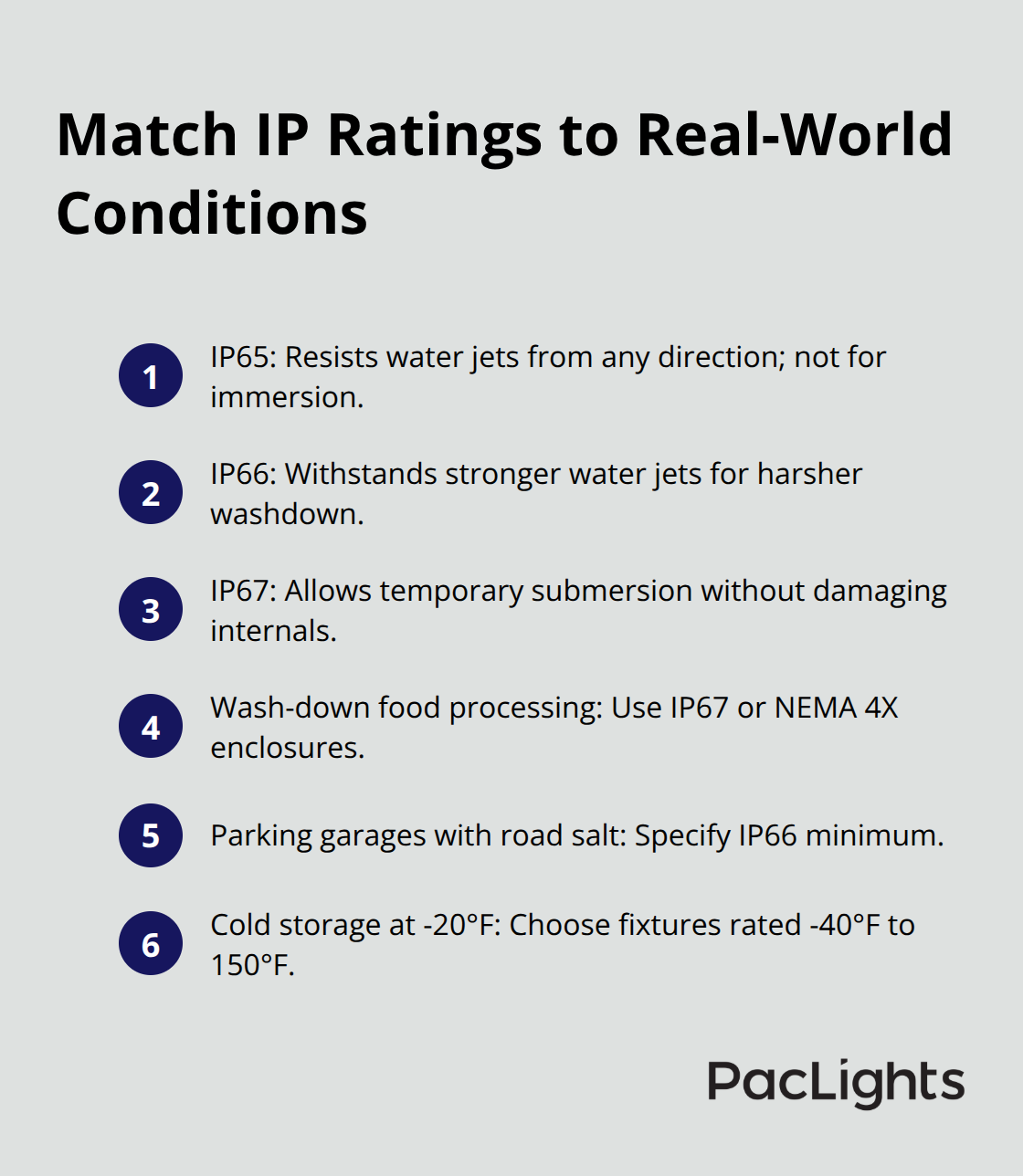
A food processing wash-down area where floors are hosed daily demands IP67 or NEMA 4X enclosures. A parking garage with occasional moisture and road salt exposure needs IP66 minimum. Cold storage at -20°F requires fixtures rated for that temperature range, typically -40°F to 150°F for industrial LEDs.
Most facilities underestimate moisture exposure. Areas that seem dry during normal operations can accumulate condensation during temperature swings or seasonal humidity changes. Your site assessment should include worst-case seasonal conditions, not just typical operating days. Mismatched ratings waste money twice: you buy fixtures that fail prematurely, then buy again when replacements become urgent.
Select Lumens and Color Temperature for Task Performance
Fixture selection also hinges on lumen output and color temperature appropriate for your tasks. Warehouses and manufacturing floors benefit from 5000K to 6500K color temperature, which sharpens visibility and reduces picking errors by 20–30% according to warehouse lighting studies. Office and administrative spaces perform better at 3500K to 4000K neutral white. Food processing areas often require 4000K to 4100K for hygiene inspection tasks.
Lumens-per-watt efficiency matters equally. Entry-level LED fixtures deliver 100–120 lumens per watt. Mid-range options reach 130–150 lumens per watt. Premium DLC-listed fixtures achieve 160–180 lumens per watt. Higher efficiency means lower wattage for the same brightness, which accelerates payback. A facility replacing 400W metal halide high bays should target 150W LED equivalents with 140+ lumens per watt, not 175W fixtures with lower efficiency that barely cut energy costs.
Verify Performance Data and Rebate Eligibility
Demand photometric data showing actual output under your mounting height and spacing. Generic lumen claims from manufacturers don’t account for real-world fixture losses. Request IES LM-79 test data that proves efficacy, and verify DLC Qualified Products List status to confirm rebate eligibility. DLC Premium listings require stricter efficiency standards and often unlock higher utility rebate percentages than standard QPL fixtures.
Confirm NSF Certification for Food and Pharmaceutical Facilities
NSF certification becomes mandatory if your facility processes food or pharmaceuticals, as sealed designs with NSF approval prevent contamination while meeting sanitary environment standards. The certification explicitly documents suitability for food contact areas-sealed vapor tight construction alone does not satisfy hygiene requirements without this third-party validation.
Final Thoughts
Vapor tight industrial lighting delivers measurable protection and financial returns that justify the upgrade investment. The sealed design eliminates moisture damage that forces expensive emergency replacements, extends fixture lifespan to 10-20 years, and cuts energy consumption by 60-75% compared with traditional systems. Your facility gains compliance with NEC requirements, reduces worker exposure to electrical hazards, and captures payback within 18 months to 5 years through energy savings, maintenance labor elimination, and utility rebates.
The long-term value compounds across decades as your facility shifts from reactive replacement cycles to predictable maintenance schedules with vapor tight LEDs. Energy savings alone accumulate to tens of thousands of dollars annually in large installations, while maintenance labor that once consumed hundreds of hours per year drops to near zero. Federal tax deductions and utility rebates offset upfront costs, making the financial case stronger than most facility managers initially expect.
Conduct a site assessment that documents moisture exposure, temperature conditions, and current fixture wattage to start your upgrade path. Calculate your facility’s specific energy consumption and local electricity rates to project realistic savings, then contact our team at PacLights to discuss your facility’s needs and explore how vapor tight industrial lighting transforms your operations.
Disclaimer: PacLights is not responsible for any actions taken based on the suggestions and information provided in this article, and readers should consult local building and electrical codes for proper guidance.