

Picking the wrong downlight can waste energy and create poor lighting conditions across your entire facility. The right commercial downlight options make a real difference in how your space functions and what you pay on energy bills.
At PacLights, we help businesses cut through the confusion and find lighting that actually works for their needs. This guide walks you through the main types, features to evaluate, and how to calculate what makes financial sense for your space.
Commercial Downlight Types for Your Ceiling
Recessed Downlights in Suspended Ceilings
Recessed downlights dominate commercial spaces because they sit flush with suspended ceilings, creating a clean appearance while saving overhead space. A recessed fixture consists of three parts: the integrated LED lamp housed above the ceiling, the housing that contains it, and the trim visible below that directs light downward. For drop ceilings in offices, retail stores, and hospitality venues, recessed models work exceptionally well because spring clips and built-in junction boxes simplify installation. Many commercial-grade recessed downlights support input voltages up to 347V, making them reliable in larger facilities without voltage concerns.
You’ll find these fixtures in 4-inch, 6-inch, and 8-inch sizes. The 4-inch option works for accent lighting in smaller areas, while 6-inch handles general lighting across most commercial spaces. Use 8-inch or larger fixtures if your ceiling exceeds 12 feet or you need to cover expansive industrial areas.
Beam Angles and Fixture Spacing
Beam angle matters significantly for light distribution. For 8 to 10-foot ceilings, try beam angles between 100 and 120 degrees to distribute light evenly without dark spots. For 10 to 14-foot ceilings, narrow the beam angle to 60 to 90 degrees to maintain adequate brightness at greater distances.
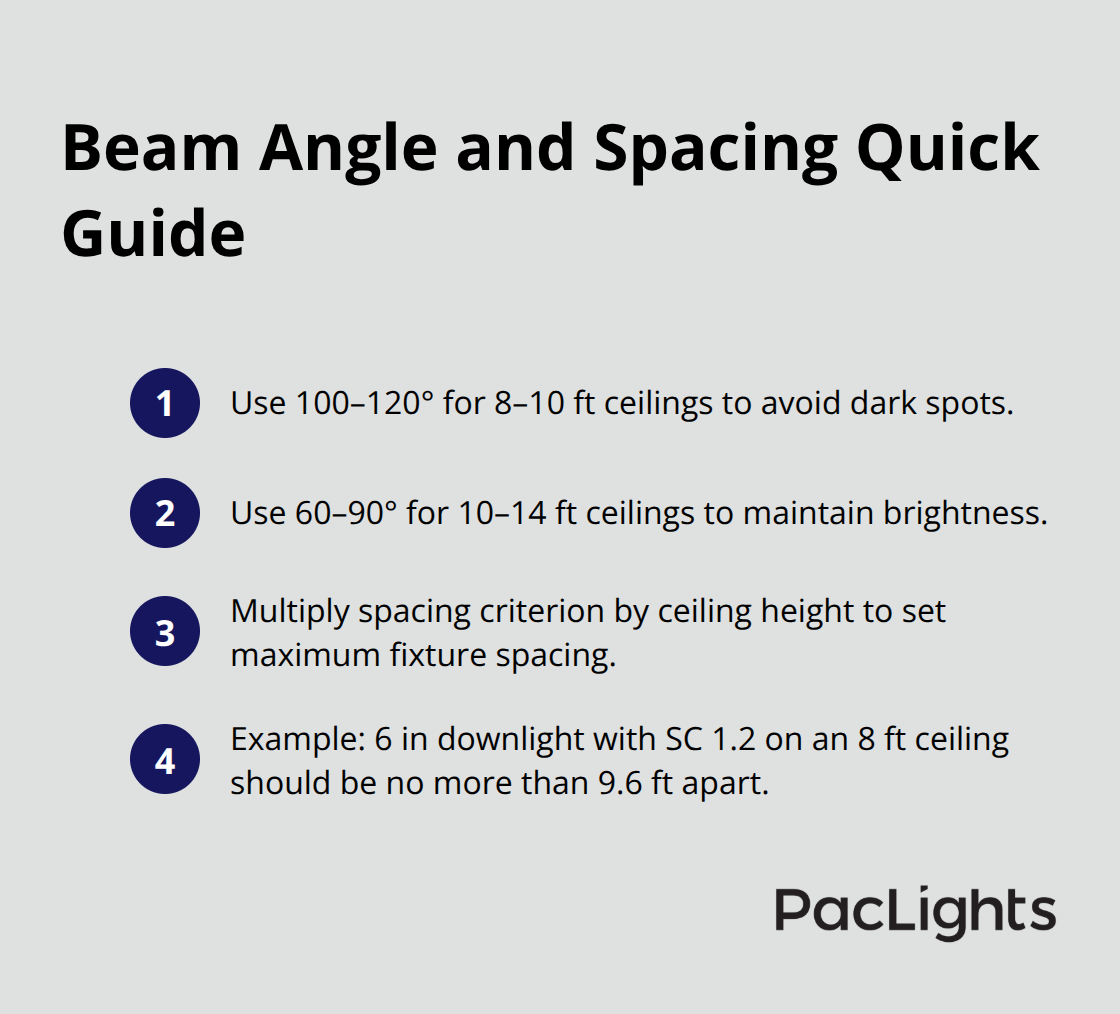
The spacing criterion rule guides proper placement: multiply your fixture’s spacing criterion by ceiling height to find maximum spacing between lights. A 6-inch downlight with a spacing criterion of 1.2 and an 8-foot ceiling means fixtures should sit no farther than 9.6 feet apart. Exceed this distance and you’ll see unlit gaps between lights.
Surface-Mounted and Adjustable Options
Surface-mounted options work when you cannot cut into ceilings or need to retrofit solid concrete surfaces. They mount directly to the ceiling surface and deliver the same light quality as recessed models without requiring above-ceiling space. Adjustable and directional downlights feature gimbal trims that let you aim light precisely at architecture, artwork, or specific work zones. These excel in restaurants where you want to illuminate individual tables, galleries showcasing pieces, or retail environments highlighting product displays.
Trim Styles and Light Output
Baffle trims reduce glare compared to smooth trims, making them better for office environments where screen glare matters. Reflector trims boost brightness output when you need maximum illumination from fewer fixtures. LED downlights typically last 50,000 hours or more, eliminating frequent bulb replacements and reducing maintenance costs significantly over time.
Selecting Your Starting Point
For most commercial applications, recessed 6-inch downlights in standard color temperatures between 3500 and 4000K work well for offices and retail spaces. This combination balances installation simplicity, cost-effectiveness, and proven performance across diverse facility types. However, your specific brightness needs and facility layout will determine whether you need additional fixtures or different beam angles, which we’ll address in the next section.
Key Features to Consider When Selecting Downlights
Brightness Levels and Lumens Per Square Foot
Lumens determine whether your space feels adequately lit or dim and shadowy. Most commercial offices need 30 to 50 lumens per square foot according to IES Recommended Lighting Levels, while retail environments often require 50 lumens per square foot or higher to showcase merchandise effectively. A typical 6-inch commercial downlight delivers between 600 and 1,200 lumens depending on the model, so you can calculate your total square footage and multiply by your target lumens-per-square-foot requirement to determine exactly how many fixtures you need. Underestimate this number and your space feels gloomy; overestimate and you waste energy on unnecessary brightness.
Color Temperature and Its Impact on Operations
Color temperature measured in Kelvin controls whether light feels warm or cool. Try 3500K to 4000K for offices and retail because this range feels natural and keeps employees alert without the harsh quality of cooler light. Hospitality spaces like restaurants benefit from 2700K to 3000K warm white, which creates an inviting atmosphere that encourages longer visits and higher spending. Industrial warehouses and healthcare facilities typically use 5000K or higher cool white for maximum visibility and task accuracy. Selecting the wrong color temperature wastes money because you cannot change it after installation without replacing every fixture in the space.
Energy Efficiency and Long-Term Operating Costs
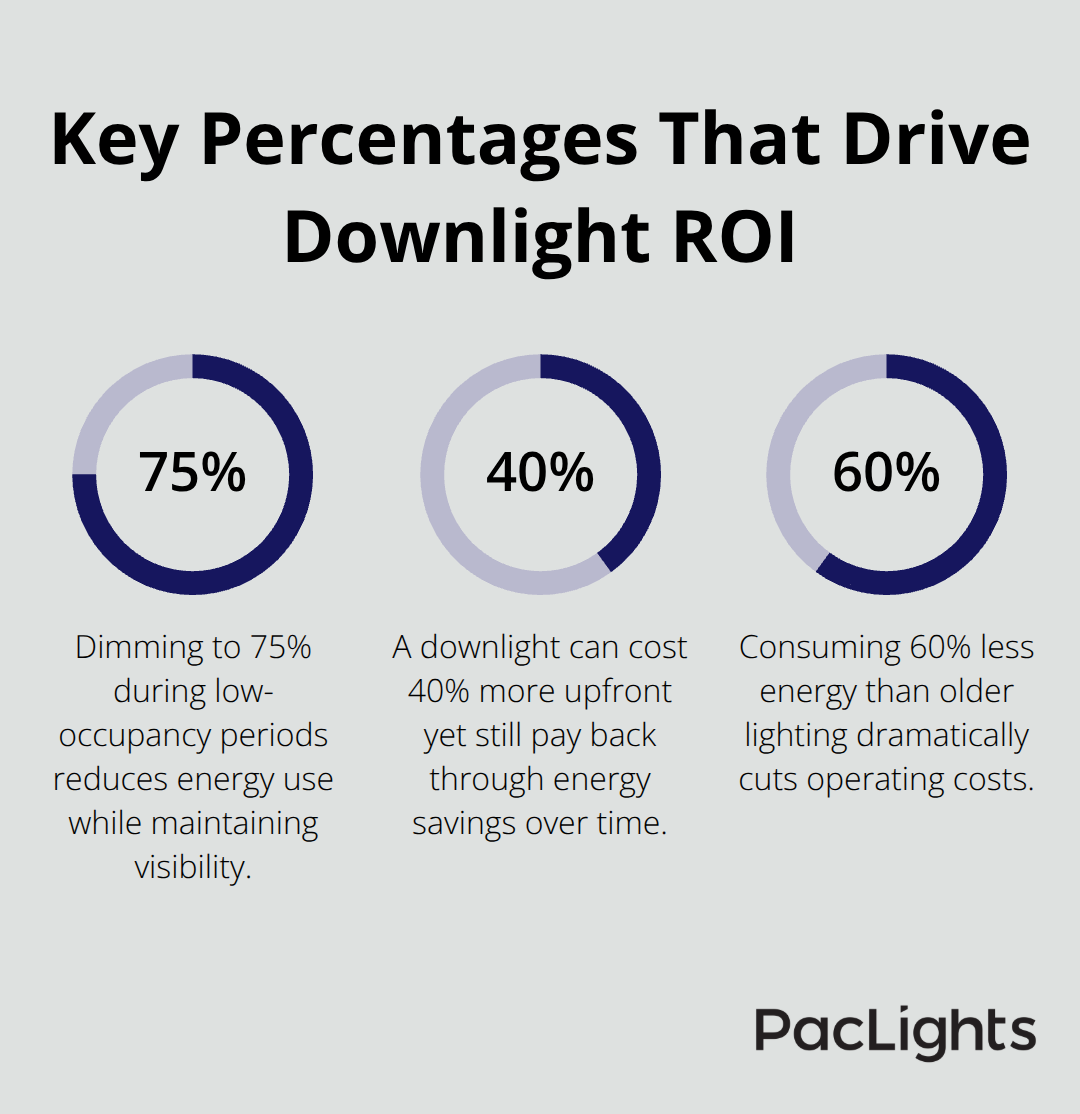
Energy efficiency ratings directly impact your operating costs over the fixture lifespan. LED downlights rated for DLC certification by the DesignLights Consortium typically consume 60 to 70 percent less energy than older fluorescent or incandescent models. With commercial downlights lasting 50,000 hours or more, a facility running lights 12 hours daily could operate the same fixture for over 11 years without replacement. You can calculate your annual energy savings by comparing wattage: a 9-watt LED downlight versus a 35-watt incandescent equivalent saves roughly 26 watts per fixture. Multiply that by the number of fixtures and hours of operation to see real dollar savings.
Dimming and Smart Control Systems
Dimming capabilities add flexibility because reducing brightness to 75 percent during low-occupancy periods cuts energy consumption without eliminating light entirely. Smart downlights with networked controls let you schedule brightness changes automatically, adjust color temperature throughout the day to support circadian rhythms, and create scenes for different activities. These controls cost more upfront but recover their investment within three to five years through reduced energy consumption and improved employee productivity in spaces where lighting adapts to actual needs rather than running at full brightness constantly.
Understanding these features positions you to evaluate which options align with your facility’s specific operational demands and budget constraints.
How to Choose the Right Downlight for Your Space
Assess Your Facility Layout and Lighting Requirements
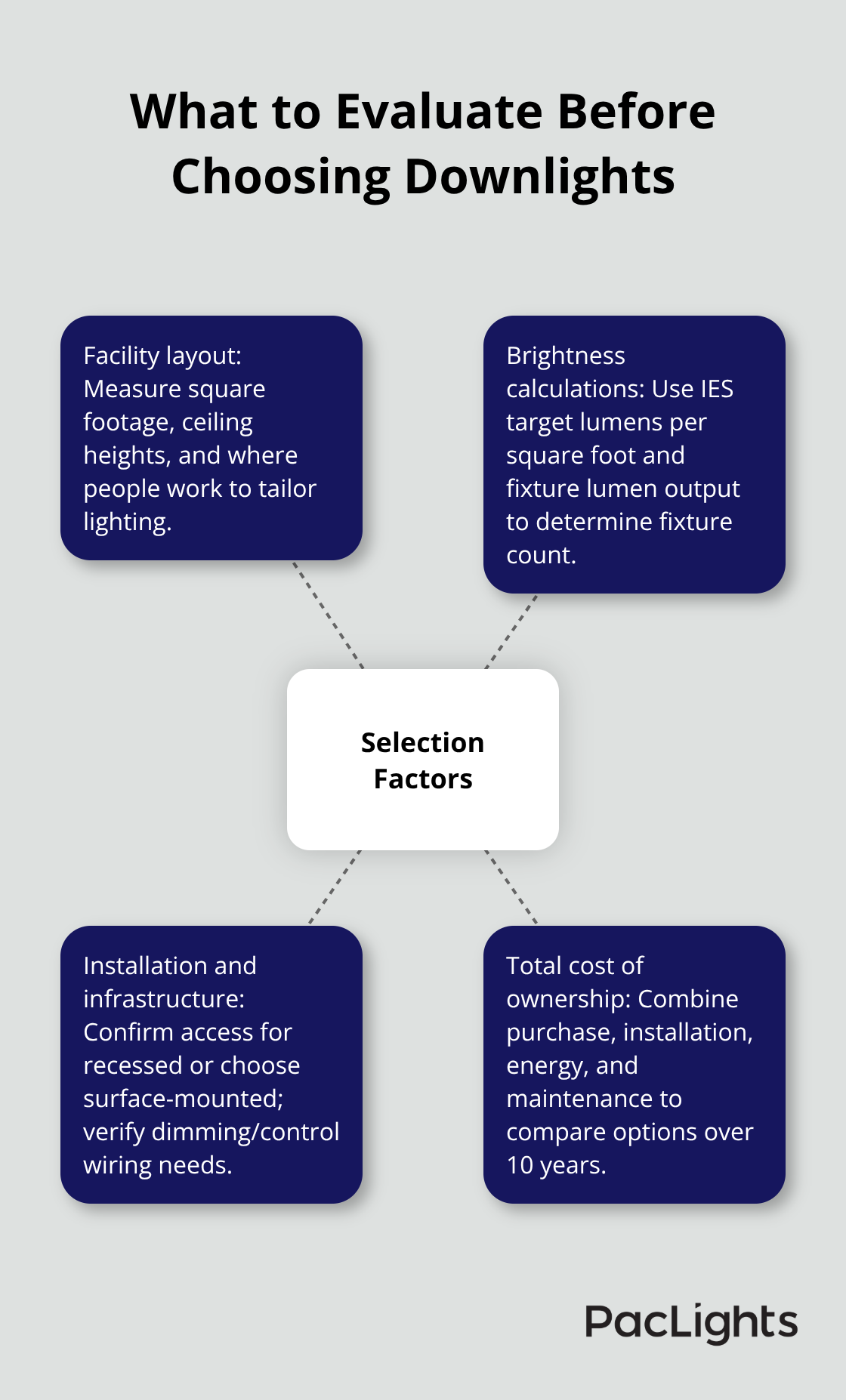
Start with your actual facility layout, not assumptions about what you think you need. Walk through your space and measure square footage, note ceiling height in different zones, and identify where people work or spend time. Offices with computer workstations need different lighting than retail floors showcasing merchandise or warehouse areas handling inventory. A 5,000-square-foot office space with 9-foot ceilings requires a completely different fixture count and beam angle strategy than a 5,000-square-foot warehouse with 16-foot ceilings.
Calculate your lumen requirement using IES Recommended Lighting Levels as your baseline: multiply your square footage by your target lumens per square foot (30 to 50 for offices, 50+ for retail), then divide by the lumens your chosen downlight produces. This gives you an exact fixture count rather than guessing. Most facilities overbuy fixtures because they estimate conservatively, then waste energy running unnecessary brightness.
Evaluate Installation and Infrastructure Costs
Maintenance costs often surprise facility managers because they focus only on purchase price. LED downlights rated for 50,000 hours or longer lifespan mean you replace them far less frequently than older lighting, but you still need to factor in labor costs for installation and any control system maintenance.
Evaluate whether your facility has the electrical infrastructure to support dimming or smart controls-retrofitting existing wiring costs significantly more than installing controls during new construction. Recessed options require above-ceiling access and junction box work, while surface-mounted alternatives mount directly to existing ceilings with minimal labor. If your facility has solid concrete or structural ceilings that cannot accommodate recessed fixtures, surface-mounted downlights eliminate expensive ceiling modification work entirely.
Calculate Total Cost of Ownership
Calculate your total cost of ownership over 10 years by adding purchase price, installation labor, energy consumption, and maintenance labor. A downlight costing 40 percent more upfront but consuming 60 percent less energy typically pays for itself within four to five years in a facility running lights 12 hours daily. Compare installation costs across different mounting types to understand the true financial impact of each option.
The cheapest downlight upfront often becomes the most expensive choice over its operational lifetime. Energy savings compound significantly when you multiply reduced wattage across dozens or hundreds of fixtures operating continuously. A 9-watt LED downlight versus a 35-watt incandescent equivalent saves roughly 26 watts per fixture-multiply that by your fixture count and annual operating hours to see real dollar savings accumulate. We at PacLights provide free ROI assessments and lighting layout designs that calculate exactly what your space needs, eliminating both underlit dead zones and energy-wasting oversupply.
Final Thoughts
Selecting the right commercial downlight options requires you to balance your facility’s actual lighting needs, the total cost of ownership over the fixture lifespan, and the infrastructure required for installation. Recessed downlights work best for suspended ceilings in offices and retail spaces, while surface-mounted alternatives solve problems in facilities with solid concrete or structural ceilings. Adjustable directional fixtures excel when you need to highlight specific areas or architectural features.
Most commercial facilities waste money by either underestimating their lumen requirements and creating dim, unproductive spaces, or overestimating and running unnecessary brightness that inflates energy bills. The spacing criterion rule prevents dark gaps between fixtures, while proper beam angle selection ensures even light distribution at your specific ceiling height. LED downlights lasting 50,000 hours or longer eliminate frequent replacement labor, but the real savings come from reduced energy consumption compared to older lighting technologies.
We at PacLights understand that choosing commercial downlight options involves more than picking fixtures off a shelf. Your facility layout, electrical infrastructure, maintenance capacity, and budget constraints all influence which solution makes financial sense. Contact PacLights today to discuss your facility’s specific requirements and receive a customized lighting plan with transparent cost projections.
Disclaimer: PacLights is not responsible for any actions taken based on the suggestions and information provided in this article, and readers should consult local building and electrical codes for proper guidance.