

Picking the wrong downlight can waste energy and leave dark spots in your facility. At PacLights, we know that surface mount downlight options vary widely in performance, cost, and installation complexity.
This guide walks you through the key factors that separate a good choice from a great one. You’ll learn what actually matters when matching downlights to your specific ceiling and lighting needs.
What Surface Mount Downlights Actually Are
Surface mount downlights attach directly to your ceiling surface without requiring holes or recessed cavities. This fundamental difference from recessed options matters because it changes everything about installation speed, cost, and light output. Facilities choose surface mount fixtures when ceiling conditions don’t allow cutting-whether that’s concrete slabs, exposed beams, or low ceilings where every inch matters. Surface mount fixtures typically deliver more usable light than recessed alternatives because they aren’t confined by a ceiling bore, meaning you get better brightness for the same wattage. Installation takes hours instead of days since there’s no structural modification needed, and labor costs drop significantly. The trade-off is visibility: these fixtures protrude from the ceiling, which some view as a design compromise. However, modern surface mount designs come in sleek profiles that integrate well into contemporary spaces, particularly when you pair them with appropriate shades and finishes.
Components That Control Performance
Surface mount downlights consist of four functional parts: the canopy that mounts to ceiling, the fixture body housing the LED, the fitter that determines shade compatibility, and the shade that controls light diffusion. Fitter sizes come in 2.25 inches, 4 inches, and 6 inches, and this dimension directly controls which shades fit and how light spreads into your space. A 2.25-inch fitter works for tight spaces like bathrooms or closets where a smaller footprint matters, while 4-inch fitters suit standard bedrooms and entryways. Six-inch fitters belong in living rooms and large commercial areas where you need presence and better light distribution.
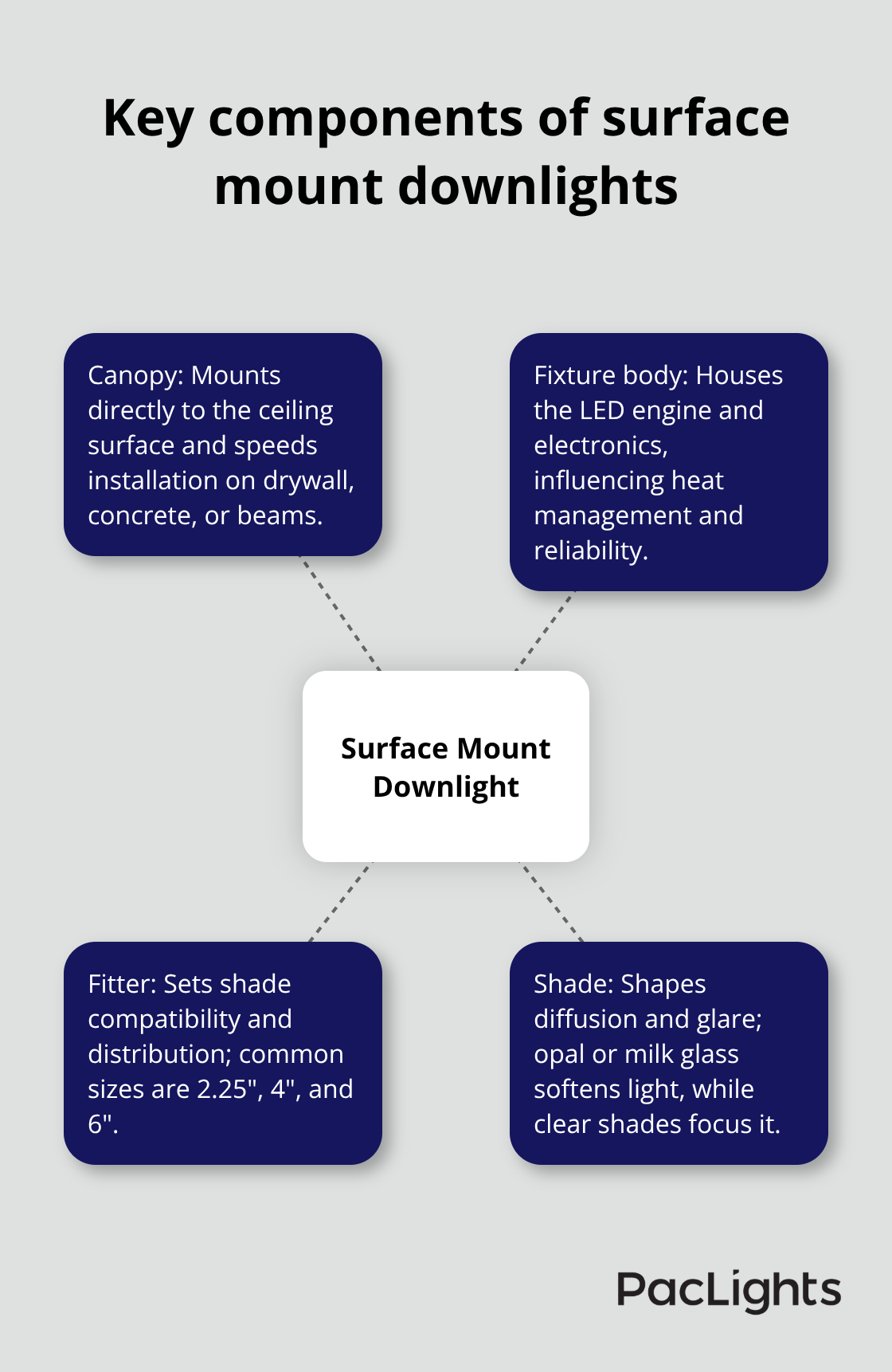
Shade material affects output significantly: opal or milk glass diffuses light softly across a wider area, while clear shades direct light more precisely to task zones. Most facilities order shades separately to customize aesthetics, so verify what comes included before purchasing. LED wattage typically ranges from 10W to 18W depending on fixture size, delivering lumen outputs between 820 and 1500 lumens, with modern fixtures reaching around 120 lumens per watt for efficiency.
Where These Fixtures Actually Get Installed
Commercial facilities use surface mount downlights extensively in hallways, storage areas, laundry rooms, and bathrooms where installation simplicity matters more than a seamless ceiling aesthetic. Industrial settings prefer them on concrete structures and in spaces with exposed infrastructure where recessed installation isn’t practical. Wet-location rated variants with IP44 or IP65 waterproof ratings handle damp environments without degradation, making them suitable for parking garages, canopy areas, and exterior covered spaces. Residential applications concentrate on kitchens and mudrooms where practical lighting outweighs design minimalism. The real advantage emerges during facility upgrades: retrofitting existing spaces with surface mount fixtures avoids expensive ceiling reconstruction, which is why many facilities choose them for renovations over recessed alternatives that demand structural work.
Why Installation Speed Changes Everything
Surface mount fixtures eliminate the need for ceiling cutouts, which means your team avoids the equipment, expertise, and time that recessed installation demands. You mount the canopy directly to drywall, concrete, or exposed beams-whatever your ceiling structure is-and connect wiring in minutes. This speed advantage translates directly to lower labor costs and faster project completion, especially important when you need to minimize facility downtime. Recessed options require specialized tools, careful hole placement, and often structural reinforcement, making them significantly more expensive and time-consuming. For facilities planning upgrades or expansions, surface mount fixtures let you add lighting without extensive construction work.
Matching Fixture Size to Your Space
The fitter size you select determines both the visual impact and the light distribution pattern in your room. A 2.25-inch fitter creates a compact, unobtrusive presence ideal for tight spaces or when you plan to install multiple fixtures close together. The 4-inch fitter strikes a balance-substantial enough to serve as a primary light source in standard rooms yet not so large that it dominates smaller spaces. The 6-inch fitter makes a statement and delivers superior light spread, making it the right choice for large commercial areas, living rooms, or any space where you want the fixture to function as both a lighting element and a design feature. Your ceiling height influences this decision as well: lower ceilings (around 8 feet) benefit from smaller fitters that don’t feel oppressive, while higher ceilings accommodate larger fixtures that maintain proper scale.
Understanding these components and installation realities sets the foundation for selecting fixtures that actually perform in your facility. The next step involves evaluating the specific performance characteristics-light output, color temperature, and energy efficiency-that determine whether a fixture meets your operational and comfort requirements.
Factors to Consider When Selecting Surface Mount Downlights
Ceiling Type and Installation Requirements
Your ceiling structure determines everything about installation feasibility and cost. Concrete slabs, drywall, exposed beams, and steel structures each require different mounting approaches, and surface mount fixtures handle this variety better than recessed alternatives. Before selecting any fixture, inspect your ceiling material and verify that your mounting surface can support the fixture weight-most surface mount downlights weigh between 2 and 5 pounds, but larger 8-inch variants can exceed 6 pounds. If your facility has low clearance, measure the exact distance from your ceiling to any obstructions like HVAC ducts or sprinkler lines; surface mount fixtures typically add 3 to 4 inches of depth, so verify this fits your space.
Wet locations demand IP44 or IP65 rated fixtures, which cost 20 to 40 percent more than standard indoor models but prevent moisture damage in parking garages, covered canopies, and laundry areas. Your installation timeline matters too-surface mount fixtures can go live in a single day across an entire facility, while recessed alternatives typically require 3 to 5 days for comparable coverage.
Light Output and Color Temperature
Light output and color temperature directly impact how your facility actually functions. A 4-inch fixture delivering 1,230 lumens works well for standard 8-foot ceilings in hallways and storage areas, but larger spaces need 1,500-lumen 8-inch variants to eliminate dark spots. Color temperature ranges from 2,700K (warm, residential-feel) to 5,000K (cool, task-focused), and this choice affects both worker performance and energy consumption.
Studies show that 4,000K to 5,000K lighting improves task accuracy in industrial and commercial settings by 5 to 15 percent compared to warmer alternatives, making it the right choice for manufacturing floors, warehouses, and detailed assembly work. For office environments and break areas, 3,500K provides a balance between productivity and comfort without the institutional feel of cooler temperatures.
Energy Efficiency and Control Options
Energy efficiency reaches approximately 120 lumens per watt with current LED technology, meaning a 15W fixture delivers around 1,800 usable lumens-significantly more output per watt than fluorescent or incandescent options. Dimmable models cost 15 to 25 percent more upfront but recover that investment within 2 to 3 years through reduced energy consumption during low-occupancy periods.
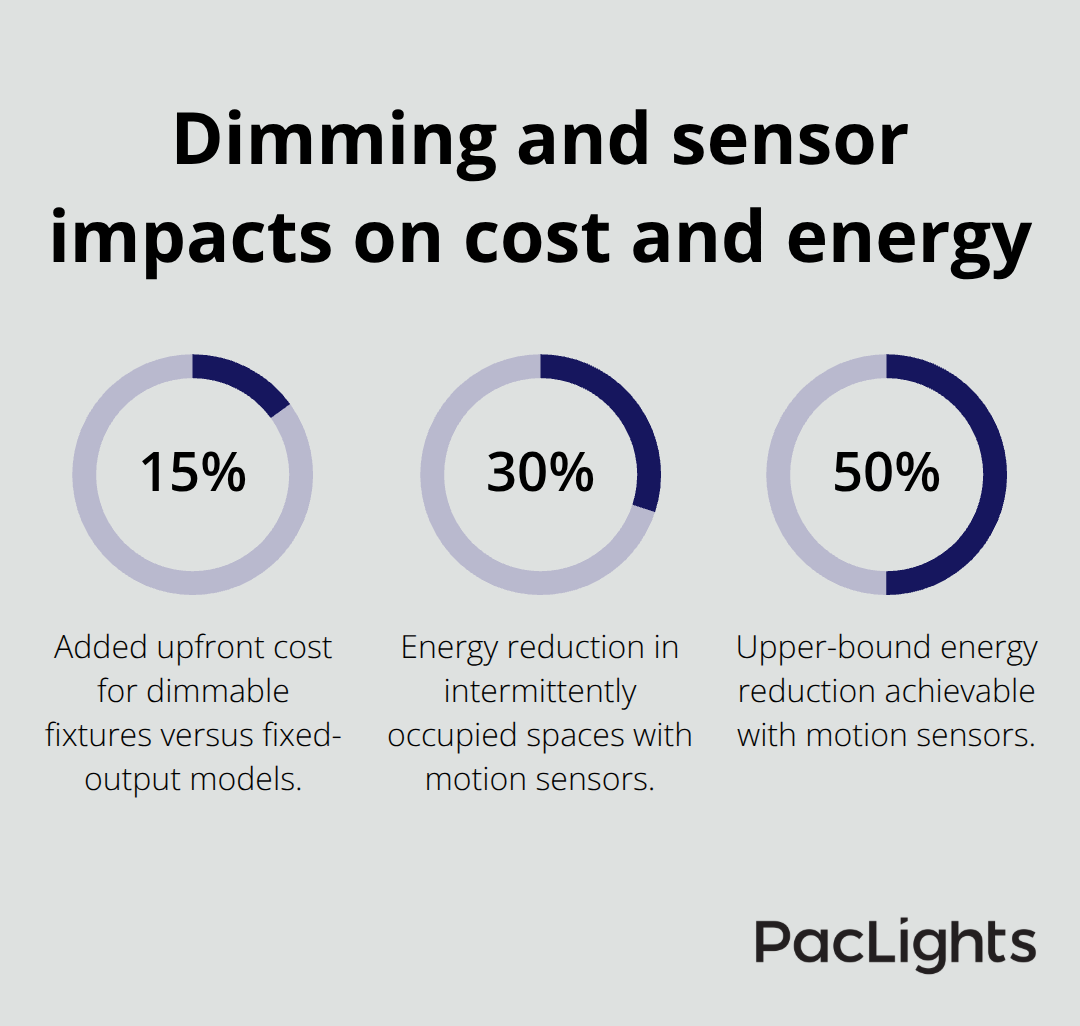
Motion sensors paired with surface mount fixtures reduce lighting energy use by 30 to 50 percent in intermittently occupied spaces like storage rooms and restrooms, making them practical additions for facilities targeting measurable energy reductions. These controls transform your lighting system from a static installation into an active tool that responds to actual occupancy patterns and daylight availability, which means your facility consumes only the energy it actually needs.
LED Fixtures vs. Traditional Lighting: Why the Choice Matters
The Performance Gap Between LED and Older Technologies
LED technology has become the only rational choice for surface mount downlights, and the performance gap is no longer marginal. A 15W LED fixture delivers approximately 1,800 lumens while consuming 75 percent less energy than an equivalent 60W incandescent bulb producing similar output. Traditional fluorescent and incandescent options generate excessive heat, require frequent replacement cycles that disrupt operations, and waste substantial energy as thermal loss rather than usable light.
The lifespan difference alone justifies the switch: LED fixtures last 25,000 to 50,000 hours compared to 1,000 hours for incandescent and 8,000 hours for fluorescent. This means your facility replaces LED fixtures once every 5 to 10 years instead of every few months. You reduce maintenance labor and lower total cost of ownership despite higher upfront pricing.
Modern LED fixtures also offer color temperature flexibility that traditional options cannot match, allowing you to adjust the lighting character of your space without replacing entire fixtures. Facilities that have transitioned to LED surface mount downlights report energy savings between 60 and 75 percent on lighting costs, with most recovering their investment within 18 to 24 months through utility bill reductions alone.
Beam Angles and Coverage Patterns
Beam angle and coverage patterns determine whether your facility ends up with uniform brightness or problematic dark spots that compromise safety and productivity. Surface mount downlights typically offer 30-degree to 120-degree beam angles, and this specification directly controls how light spreads across your ceiling height and floor area.
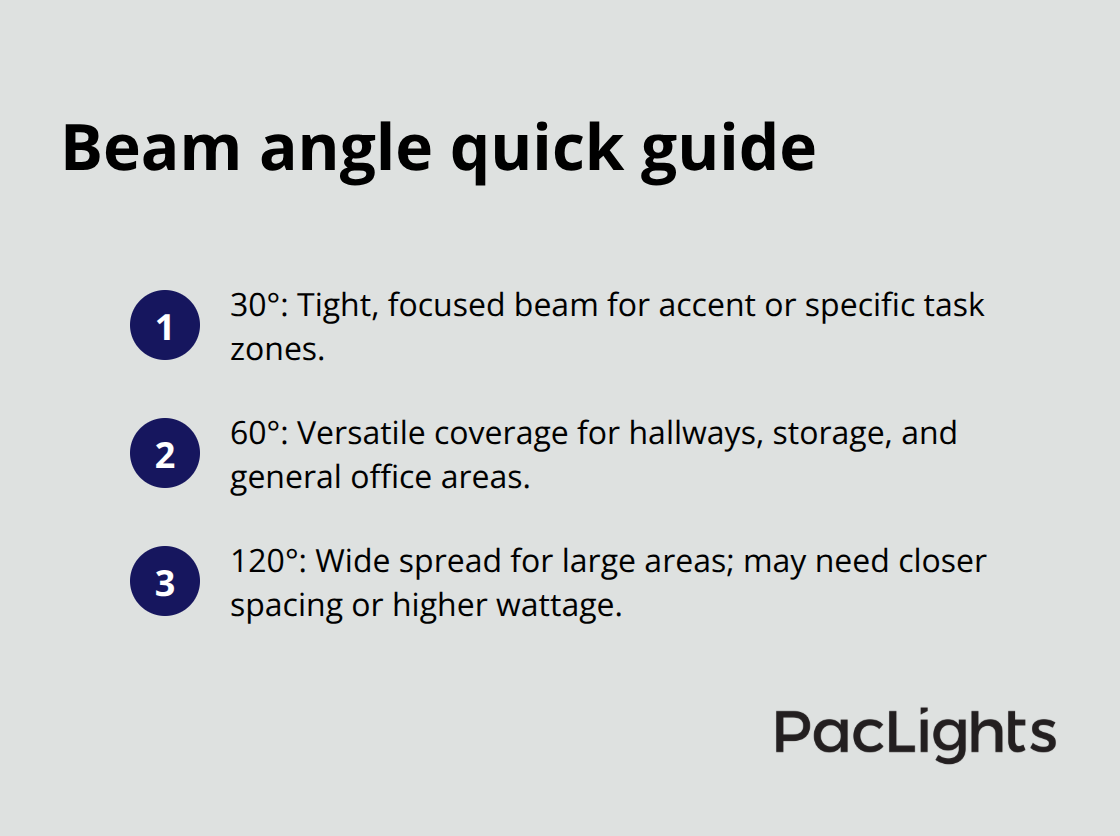
A 30-degree narrow beam concentrates light in a tight task zone, making it appropriate for accent lighting or highlighting specific work areas in manufacturing environments. Standard 60-degree beams suit most commercial applications including hallways, storage areas, and general-purpose office spaces, providing reasonably even coverage when fixtures are spaced 8 to 10 feet apart at 8-foot ceiling heights. Wide 120-degree beams spread light across larger areas but deliver lower intensity at the floor level, requiring closer fixture spacing or higher wattage to maintain adequate brightness.
Calculating proper fixture spacing prevents the expensive mistake of installing too few lights and discovering dark zones after completion. For an 8-foot ceiling in a 20-foot by 30-foot warehouse, you need approximately 12 to 16 fixtures with 60-degree beams spaced evenly to eliminate shadows, whereas a 30-degree narrow beam configuration would require 20 to 24 fixtures in the same space.
Dimming and Smart Control Systems
Dimmable surface mount fixtures with 120V Triac dimming capability cost only 15 to 25 percent more than fixed-output models and provide flexibility for adjusting light levels based on occupancy patterns, time of day, or specific task requirements. Motion sensors integrated into surface mount fixtures reduce energy consumption by 30 to 50 percent in intermittently occupied spaces, automatically extinguishing lights when rooms are empty and restoring full brightness within seconds of occupancy detection.
Smart control systems that network multiple fixtures allow centralized scheduling and dimming across your entire facility, enabling you to reduce lighting during low-occupancy periods like evenings or weekends without manual intervention. These controls transform your lighting system from a static installation into an active tool that responds to actual occupancy patterns and daylight availability.
Final Thoughts
Selecting the right surface mount downlight options requires matching three core factors to your facility’s actual needs: ceiling structure and installation timeline, light output and color temperature alignment with your space’s function, and energy efficiency paired with control capabilities that impact your operating costs. LED fixtures with motion sensors reduce energy consumption by 30 to 50 percent in intermittently occupied spaces, recovering their investment within 18 to 24 months through utility bill reductions alone. Dimmable models with 120V Triac dimming cost only 15 to 25 percent more than fixed-output alternatives and provide flexibility for adjusting light levels based on occupancy patterns.
Your practical next step involves measuring your ceiling height and material, calculating the lumen output needed for your space dimensions, and selecting beam angles that eliminate dark spots at your typical fixture spacing. If your facility has wet locations like parking garages or covered canopies, specify IP44 or IP65 rated fixtures upfront to prevent moisture damage and extend fixture lifespan. A 4,000K to 5,000K fixture improves task accuracy in warehouses and manufacturing areas by 5 to 15 percent, while 3,500K balances productivity with comfort in office environments.
We at PacLights provide free lighting layout designs and ROI assessments to help you evaluate surface mount downlight options specific to your space, ensuring you select fixtures that deliver measurable energy savings and reliable performance. Contact our team to discuss your facility’s lighting needs and discover how the right fixtures transform your space into an efficiently lit environment that supports your operations.
Disclaimer: PacLights is not responsible for any actions taken based on the suggestions and information provided in this article, and readers should consult local building and electrical codes for proper guidance.