

Traditional lighting drains your budget through constant energy bills and frequent replacements. Most facilities spend thousands annually on outdated systems that waste electricity and demand regular maintenance.
At PacLights, we’ve seen how LED wafer retrofit timelines work in real facilities-installations happen fast, often in days rather than weeks. The financial payback is straightforward: lower energy costs start immediately, and your investment recovers within months.
What Traditional Lighting Actually Costs You
Traditional lighting systems bleed money in ways most facility managers never fully quantify. The U.S. Department of Energy reports that incandescent bulbs cost about $7.23 per year to operate, while older metal halide fixtures consume 400 watts or more per unit. For a facility with 50 fixtures running 12 hours daily at $0.125 per kilowatt-hour, that amounts to roughly $2,737 in annual energy costs per fixture type-money that vanishes into your utility bills month after month.
Energy Waste That Never Stops
Beyond energy, maintenance stacks up fast. A 400-watt metal halide fixture lasts only 6,000 to 15,000 hours, forcing replacements every two to three years. Traditional systems also produce excessive heat, forcing your HVAC system to work harder and driving cooling costs higher than necessary. A single 400-watt fixture produces as much heat as a space heater, wasting energy that accomplishes nothing except raising room temperature and inflating cooling bills. Switching just 20 fixtures from halogen to LED can reduce CO2 emissions by roughly 180 metric tons over a decade, but most facilities never calculate this environmental cost into their budgets, treating it as someone else’s problem.
The Hidden Labor Drain
Replacing fixtures in hard-to-reach ceilings costs far more than the bulb itself. Labor typically runs $45 to $100 per fixture replacement, and when you multiply that across dozens of units over several years, maintenance labor becomes a hidden budget drain. A facility with 50 fixtures replacing them every two years spends roughly $2,250 to $5,000 annually just on labor. Downtime matters too-if replacements happen during business hours, productivity losses compound the expense. These constant interruptions disrupt operations and force staff to work around maintenance crews, adding indirect costs that spreadsheets rarely capture.
Why the Status Quo Fails
Your current lighting system demands attention constantly. Burned-out bulbs create dark zones that affect safety and productivity, yet replacing them requires scheduling, purchasing, and labor coordination. This cycle repeats endlessly with traditional fixtures, consuming resources that could fund growth instead. LED wafer downlights eliminate this pattern entirely-they operate for 25,000 hours or more, meaning you install them once and forget about replacements for decades. The shift from constant maintenance to virtually none transforms how your facility operates and where your budget flows.
How LED Wafer Retrofits Slash Operating Costs
Immediate Energy Savings That Hit Your Bottom Line
The financial advantage of LED wafer downlights starts the moment you flip the switch. A 400-watt metal halide fixture consumes roughly 400 watts continuously, while an LED wafer replacement uses only 150 watts-a 62.5% reduction in power draw. At $0.125 per kilowatt-hour and 12 hours of daily operation, that single fixture shift saves $2,737.50 annually. Scale this across 20 fixtures and you’re looking at $54,750 in yearly energy savings.
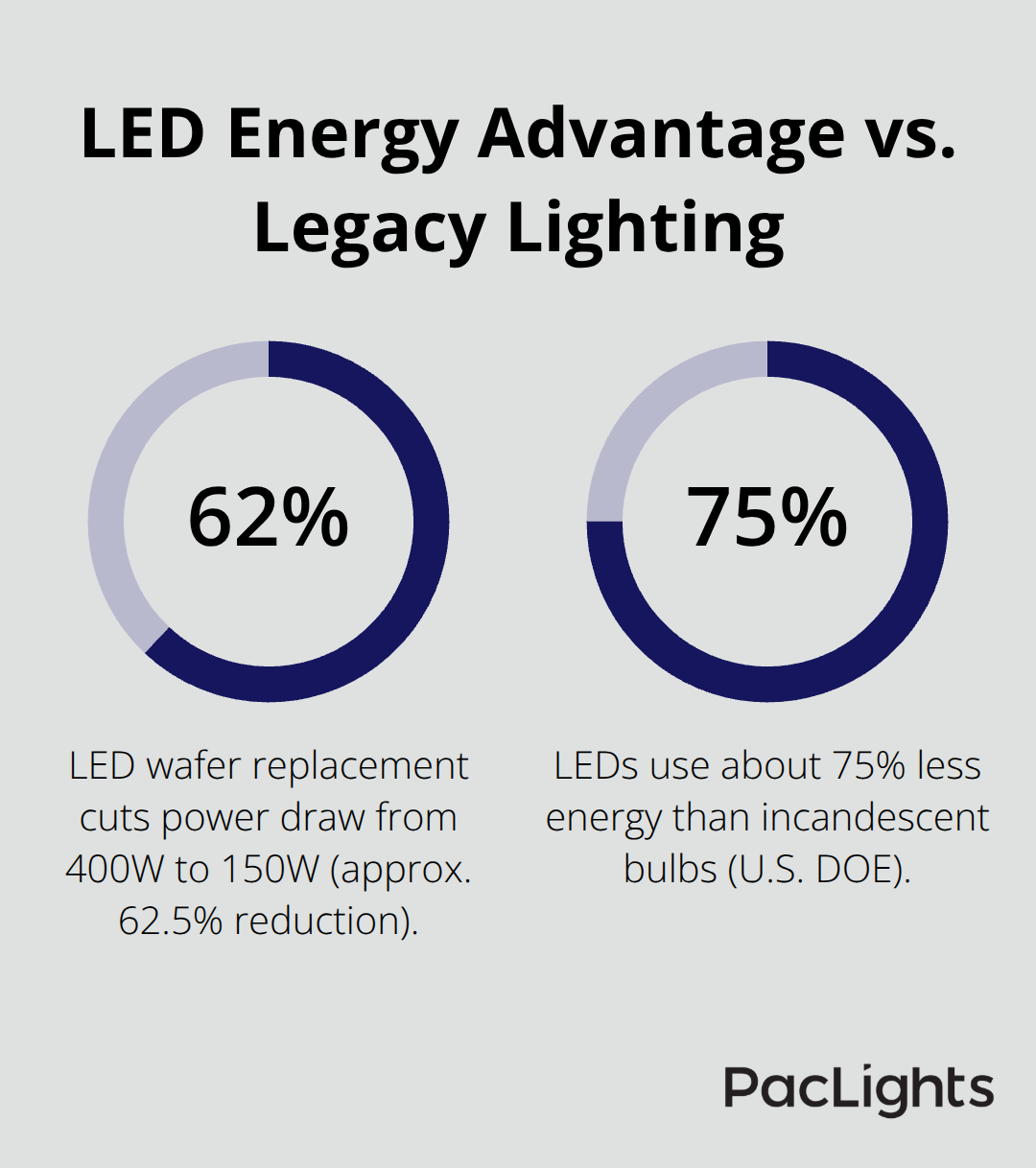
These aren’t theoretical numbers-they’re the direct result of LED efficiency compared to older technologies. The U.S. Department of Energy confirms LEDs use approximately 75% less energy than incandescent bulbs, and wafer designs amplify this advantage because they direct light downward without wasting output through heat and scatter.
Labor Costs Drop Dramatically During Installation
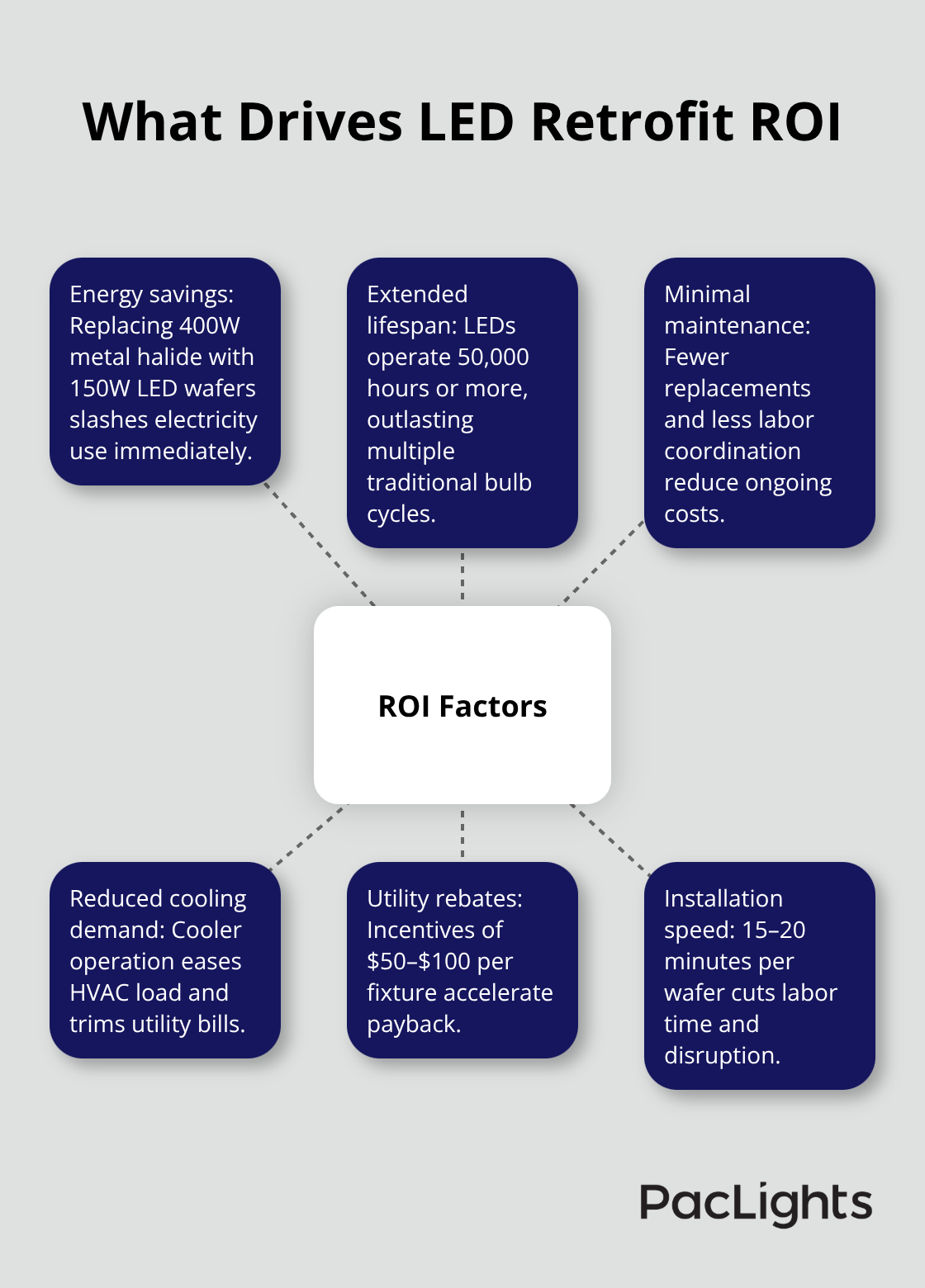
Installation speed compounds the financial benefit. A wafer downlight retrofit takes 15 to 20 minutes per fixture versus 45 to 60 minutes for traditional recessed can replacement, cutting labor costs substantially. For a 20-fixture project, this time difference translates to roughly 8 to 10 hours of saved labor-money that stays in your budget. Utility rebates further accelerate payback. Many electric utilities offer incentives up to $100 per fixture, reducing your net investment significantly. With a typical net investment of about $2,875 for a 20-fixture retrofit after rebates, your payback period lands under nine months, with first-year ROI exceeding 135%.
Lifespan Eliminates the Replacement Treadmill
LED wafers operate for 50,000 hours or more, compared to 6,000 to 15,000 hours for metal halide fixtures. At 3 hours of daily use, a wafer lasts roughly 45 years-a single installation outlasts multiple generations of traditional bulbs. This longevity destroys the maintenance cost model. A facility replacing 20 fixtures every two years spends approximately $13,000 on maintenance labor and materials over the LED’s lifespan. Switching to wafers eliminates virtually all of this expense. Beyond labor and parts, LED wafers run significantly cooler than halogen or metal halide alternatives, reducing your HVAC load. A 400-watt fixture generates heat equivalent to a space heater, forcing your cooling system to work harder and waste energy counteracting that warmth. Wafers eliminate this hidden expense, improving overall building efficiency.
Hidden Cooling Costs Vanish
The heat reduction from LED wafers creates a secondary savings stream that most facility managers overlook. Traditional fixtures force your HVAC system to compensate for unnecessary warmth, inflating cooling bills throughout the year. LED wafers eliminate this burden entirely, allowing your climate control system to operate more efficiently and consume less energy. This compounds your total savings beyond the direct electricity reduction from the fixtures themselves.
Calculating Your Total Financial Picture
When you combine energy savings, extended lifespan, minimal maintenance, and reduced cooling demands, the total cost advantage becomes undeniable. The payback period typically falls between 3 and 6 years for most commercial applications, but high-usage facilities see returns in under 18 months. This isn’t just about lower utility bills-it’s about reclaiming budget currently wasted on constant replacements, labor coordination, and operational disruption.
Understanding your specific usage patterns and electricity rates reveals exactly how quickly your retrofit investment recovers, which makes planning your implementation timeline the logical next step.
Implementation Timeline and ROI for LED Retrofits
Installation speed separates LED wafer retrofits from traditional fixture replacements, and the numbers prove it matters financially. A single wafer downlight installs in 15 to 20 minutes once power is cut and wiring is run, compared to 45 to 60 minutes for traditional recessed can housing replacement. This difference compounds across any retrofit project-a 20-fixture installation saves 8 to 10 hours of labor, translating directly to reduced installation costs and faster return to normal operations. Wafer downlights mount flush to drywall without requiring separate housing between ceiling joists, eliminating structural modifications that extend timelines on traditional retrofits.
The Installation Process Works Fast
The installation process itself is straightforward: drill a 6-3/8-inch hole, run 14/3 Romex wiring through the plenum, wire to color-coded terminals, attach the fixture with a bracket, and test before sealing the ceiling. In suspended drop ceilings, installation becomes even faster since wafers mount directly to the grid without any structural changes whatsoever.
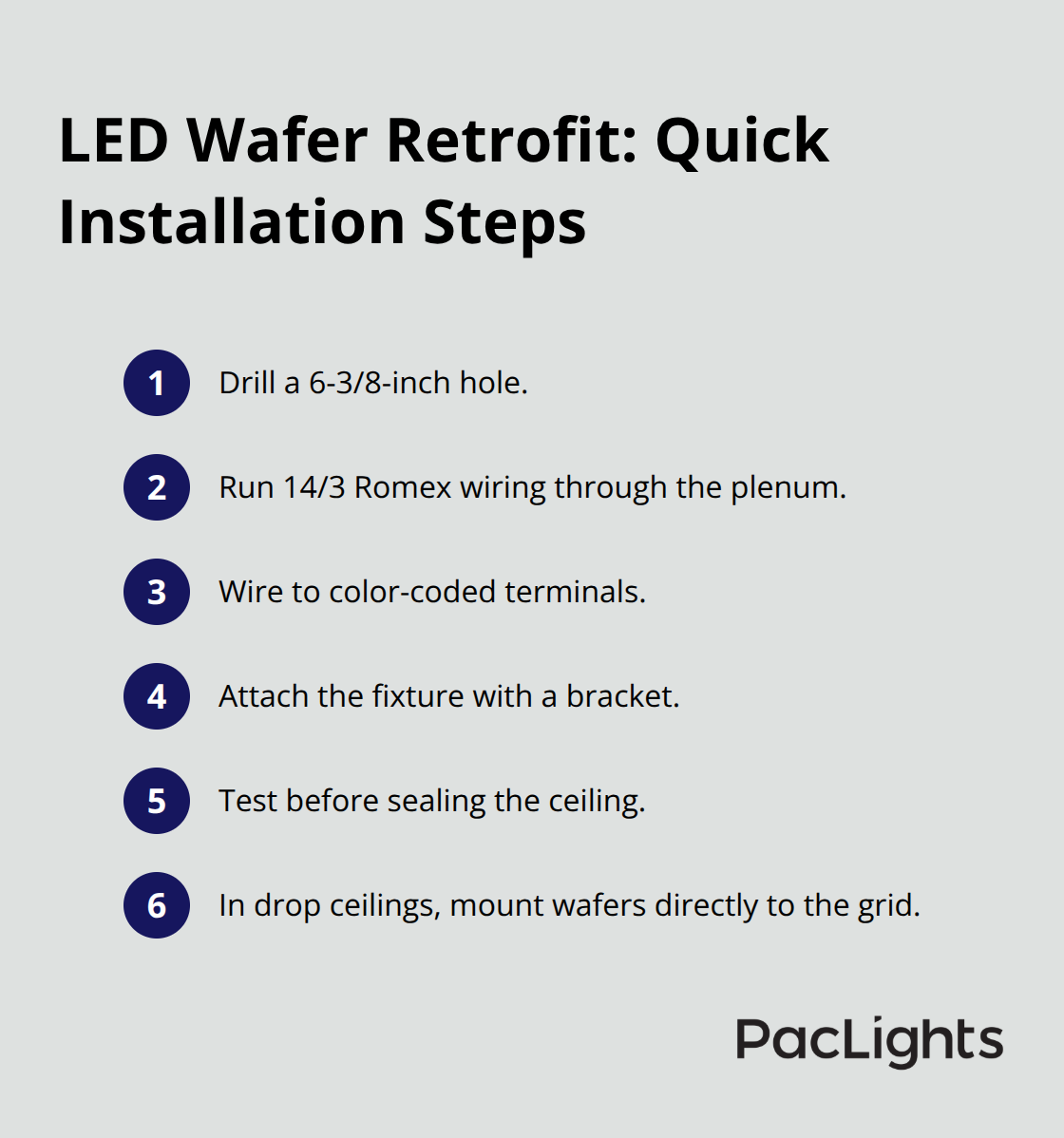
For facilities operating during business hours, this speed advantage means minimal disruption-you can complete entire floors overnight or during off-hours, keeping operations running smoothly while upgrades happen around the clock.
Your Actual Payback Timeline
Most facilities see payback between 9 and 18 months for LED wafer retrofits, though high-usage spaces achieve returns in under nine months. A typical 20-fixture retrofit requires a net investment of approximately $2,875 after utility rebates, which many electric utilities offer at $50 to $100 per fixture (check your local utility rebate finder before purchasing to reduce your upfront cost). With annual energy savings of $54,750 on a 20-fixture deployment (based on 400-watt metal halide replacement at $0.125 per kilowatt-hour and 12-hour daily operation), first-year ROI exceeds 135%. Spaces with higher usage hours see even faster returns-a facility running lights 16 or 24 hours daily recovers investment in under six months.
Long-Term Financial Benefits Extend Decades
Long-term financial benefits extend far beyond the initial payback period. LED wafers last 50,000 hours or more, meaning a single installation outlasts decades of traditional fixture cycles. Over the wafer’s 45-year operational life at 3 hours daily use, you eliminate roughly $13,000 in maintenance labor and materials for every 20 fixtures switched from metal halide. This longevity transforms your maintenance budget from constant replacement cycles into virtually zero fixture replacement costs, freeing capital for other facility improvements.
Ensuring Compatibility Before Installation
Your facility’s existing infrastructure rarely requires modification for wafer retrofits. Wafers install into ceiling openings as small as 4 inches, versus 6 to 8 inches needed for traditional recessed cans, reducing structural changes and labor intensity. Before purchasing, document your current fixtures-note the housing diameter (4, 5, or 6 inches), voltage (120V or 277V), and IC-rating (insulation contact)-then verify wafer compatibility with these specifications. Most modern wafer downlights work with standard drywall ceilings and suspended drop ceiling grids without modification, though you should confirm your specific ceiling type accepts flush-mount installation. Wafers connect directly to existing electrical wiring without requiring new circuits in most cases, though high-wattage facilities should verify panel capacity. If your ceiling has limited plenum height (space above the drywall), wafers excel because they mount flush without housing depth requirements that traditional fixtures demand. PacLights offers free lighting layout designs and ROI assessments that verify compatibility with your specific infrastructure before you commit to retrofit scope, eliminating guesswork and keeping your installation timeline on track.
Final Thoughts
LED wafer downlight retrofits deliver measurable financial returns that traditional lighting cannot match. Your facility stops wasting money through constant energy consumption, frequent replacements, and hidden cooling costs the moment installation completes. A 20-fixture retrofit saves approximately $54,750 annually in energy expenses alone, recovers its investment in under nine months, and eliminates roughly $13,000 in maintenance labor over the fixture’s lifespan. The wafer retrofit timeline accelerates these benefits further-installations finish in days rather than weeks, minimizing operational disruption and letting your facility return to normal function immediately.
The financial case is straightforward, but the operational advantages matter equally. LED wafers last 50,000 hours or more, meaning you install them once and operate without replacement cycles for decades. Your maintenance team stops coordinating constant bulb changes, your HVAC system runs more efficiently without fighting unnecessary heat, and your facility gains the modern, clean aesthetic that wafer downlights provide. Energy consumption drops by 75% compared to incandescent fixtures, maintenance labor vanishes, cooling demands decrease, and utility rebates reduce your upfront investment-this combination of speed, savings, and simplicity makes retrofits the logical upgrade path for any facility still operating traditional lighting.
We at PacLights offer free lighting layout designs and ROI assessments that reveal exactly how much your facility can save and how quickly your investment recovers. Our team provides expert guidance tailored to your infrastructure, ensuring compatibility and maximizing financial returns. Contact PacLights today to schedule your free assessment and transform your lighting system into a cost-saving asset.
Disclaimer: PacLights is not responsible for any actions taken based on the suggestions and information provided in this article, and readers should consult local building and electrical codes for proper guidance.