

Lighting shapes how guests feel the moment they walk into your space. At PacLights, we know that dimmed cylinder pendant lights do more than illuminate-they set the mood and build connection.
The right lighting transforms a room from ordinary to memorable. In hospitality, that difference directly impacts how guests experience your venue and whether they return.
Why Dimmed Cylinder Pendants Transform Hospitality Spaces
The Power of Warm Light and Precise Placement
Warm color temperatures between 2700K and 3000K create the foundation for guest comfort in hospitality settings. Dimmed cylinder pendant lights replicate the comfort of incandescent lighting that guests instinctively associate with relaxation and safety. A 10-inch pendant positioned 30–36 inches above a dining table delivers roughly 350 lumens from a 3.5W LED, enough to illuminate place settings without harsh shadows or glare on faces. This precise placement anchors the table visually while keeping light exactly where guests interact, not scattered across walls or ceilings.
Flexibility Through Dimmable Control
Dimmable fixtures give you control over brightness during different service periods-bright enough for check-in and table service, then softened during dinner to encourage lingering and conversation. You adapt the atmosphere in minutes, not hours, without rewiring or replacing bulbs. This flexibility transforms how your space responds to guest needs throughout the day and evening service.
Energy Savings That Compound Over Time
Dimming protects your bottom line in ways that static lighting cannot match. A mid-size hospitality property with 40 pendant cylinders running 12 hours daily saves approximately $8,208 per year on energy costs compared to older halogen systems. When you dim those fixtures to 60–70% during off-peak hours or slower service periods, you add another $2,000–$4,000 in annual savings through reduced consumption. LED cylinder pendants with Energy Star certification deliver 15–20% additional efficiency gains through superior drivers and thermal management.
Labor and Maintenance Advantages
LED lifespans of 25,000–50,000 hours eliminate the constant bulb replacement that drains labor budgets. A 40-fixture installation saves roughly $3,000–$6,000 annually in maintenance labor alone. The combination of energy savings and reduced maintenance typically recovers your initial investment in 2.5–3 years, with ongoing savings compounding thereafter.
Design That Signals Intentionality
Modern guests expect thoughtful design that feels intentional, not accidental. Dimmed cylinder pendants signal that you’ve invested in their experience. This attention to lighting quality influences how guests perceive your entire venue-from the moment they arrive through their final departure. Understanding how these fixtures perform in specific hospitality environments reveals why they’ve become essential to modern hospitality design.
How to Choose the Right Dimming System and Materials
Select the Correct Dimmer for LED Performance
Dimming technology matters far more than most hospitality operators realize. Not all dimmers work equally, and pairing the wrong dimmer with your LED cylinder pendants creates flickering, color shifts, or dead zones where lights refuse to dim below certain levels. Standard incandescent dimmers often fail with LEDs because they’re designed for resistive loads, not the switching power supplies inside modern LED drivers.
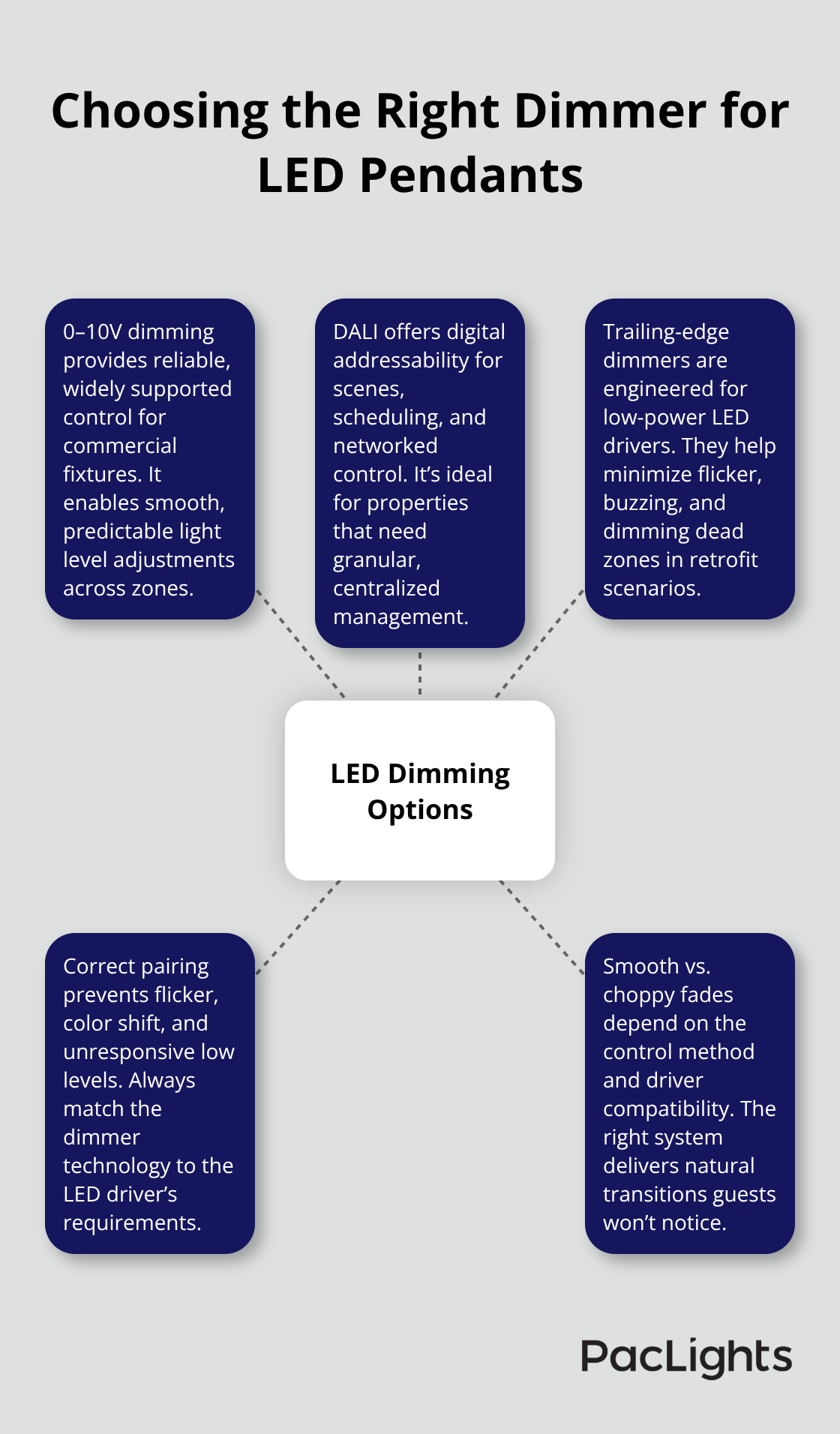
You need dimmers rated specifically for LED loads-0–10V dimming, DALI, or trailing-edge dimmers engineered for low-power fixtures. This choice determines whether your dimming feels smooth and natural or choppy and artificial.
Optimize Light Distribution After Installation
Field-adjustable directional switches let you tune light distribution after installation, shifting from spot to super wide flood patterns to reduce wall scalloping and optimize how light hits dining surfaces. This flexibility means you’re not locked into a single lighting profile the day fixtures go live. You adapt the beam angle to match your actual room geometry and guest placement, rather than accepting factory defaults that may not suit your layout.
Prioritize Durable Materials for High-Traffic Spaces
Material durability directly impacts your maintenance burden and how fixtures age in high-touch hospitality environments. Tempered glass and matte coatings resist fingerprints and cleaner chemicals far better than polished finishes, reducing cleaning frequency in lobbies and dining areas. A 40-fixture installation with matte-finish cylinder pendants requires noticeably less daily wiping than glossy alternatives. Natural finishes like Light Oak, Grey Elm, or Woven Linen age gracefully and hide dust better than bright metals if your property leans into biophilic design. For wet locations like spa corridors or kitchen areas, verify IP65 ratings to confirm suitability.
Protect Your Long-Term Investment Through Thermal Management
LED lifespan of 25,000–50,000 hours means 12–24 years of operation at typical hospitality usage rates, but only if thermal management stays intact. Energy Star-certified fixtures deliver superior driver efficiency and heat dissipation, protecting that lifespan investment. ROI analysis shows that upgrading 40 halogen cylinders to dimmable LED pendants recovers costs in 2.5–3 years through combined energy and maintenance savings, then generates $5,000–$10,000 annually in ongoing benefit.
Validate Financial Impact Before Commitment
Free lighting layout designs and ROI assessments help you determine whether dimmed cylinder pendants make financial sense for your specific property and usage patterns. These evaluations account for your current energy rates, maintenance labor costs, and fixture count to project realistic payback timelines. With this data in hand, you can confidently move forward with implementation or adjust your approach based on actual numbers rather than assumptions. Understanding how these fixtures perform in specific hospitality environments reveals why they’ve become essential to modern hospitality design.
Where Dimmed Cylinder Pendants Perform Best in Hospitality
Hotel Lobbies and Guest Rooms
Hotel lobbies demand lighting that guides guests while creating psychological comfort during arrival and departure. A 12-foot ceiling in a typical lobby benefits from pendant drops of 48–60 inches, creating architectural drama without obstructing sightlines or creating head-clearance hazards. Mount cylinders roughly 4 feet apart in circulation corridors to maintain 1500–2500 lumens per fixture, preventing dark zones that make guests feel unsafe. Dimming to 70% during late evening hours reduces energy consumption while maintaining visibility for staff managing front desk operations.
Guest rooms benefit from surface-mount cylinders above seating areas or work surfaces at 10–15W with dimming capability. Guests adjust ambient and task lighting without calling for maintenance adjustments. Warm 2700K temperature at 60–70% dimming transforms a sterile room into a refuge where guests actually want to spend time beyond sleeping. The payback math is straightforward: 40 guest-room cylinders save $3,000–$6,000 annually in maintenance labor, plus $2,000–$4,000 in energy reduction from dimming schedules, recovering initial investment in roughly 30 months.
Restaurants and Bars
Restaurants and bars rely on dimmed cylinders to define eating zones and control the atmosphere during service transitions. Position 10-inch pendants 30–36 inches above dining tables with 4–6 feet spacing to create intimate pools of light without glare on place settings or guest faces. Opaque finishes cut reflection that bounces off plates and silverware, which guests find visually jarring during meals.
Dimming from 100% during table turnover to 60% during dinner service signals a shift from transactional efficiency to lingering comfort. This adjustment directly influences how long guests stay and their likelihood of ordering additional courses or drinks. Bar areas demand tighter 3–4 feet spacing with slightly higher lumens to maintain task visibility for bartenders while preserving the moodiness guests expect.
Spa and Wellness Facilities
Spa and wellness facilities require consistent 2700K dimming in corridors and treatment areas to support relaxation without compromising staff safety and movement. A 40-fixture spa installation dimmed to 70% throughout operating hours consumes roughly 68,400 kWh annually compared to halogen equivalents, translating to $8,208 in annual energy savings at typical commercial rates of $0.12 per kilowatt-hour.
IP65-rated cylinders in spa corridors withstand humidity and moisture exposure that would degrade standard fixtures. These ratings protect your investment while eliminating premature replacements that disrupt guest experiences during treatments.
Final Thoughts
Dimmed cylinder pendant lights deliver measurable returns that extend far beyond aesthetics. A 40-fixture installation recovers its investment in 2.5–3 years through combined energy and maintenance savings, then generates $5,000–$10,000 annually in ongoing benefit. Energy Star-certified fixtures amplify these gains by 15–20% through superior thermal management, while dimming to 60–70% during off-peak hours adds another $2,000–$4,000 yearly.
Dimmable fixtures shift atmosphere in minutes, from bright service lighting during check-in to intimate ambiance during dinner, without rewiring or replacing bulbs. LED lifespans of 25,000–50,000 hours mean 12–24 years without bulb replacement, eliminating the labor drain that static lighting cannot match. Matte finishes and tempered glass resist fingerprints and cleaner chemicals, reducing maintenance burden in high-traffic lobbies and dining areas.
We at PacLights offer free lighting layout designs and ROI assessments that account for your specific property, energy rates, and usage patterns. This data removes guesswork and lets you move forward with confidence based on actual numbers rather than assumptions. Contact us today to explore how dimmed cylinder pendant lights perform in your hospitality environment.
Disclaimer: PacLights is not responsible for any actions taken based on the suggestions and information provided in this article, and readers should consult local building and electrical codes for proper guidance.