

Wafer downlights have transformed how we think about ceiling lighting. They deliver powerful illumination without the bulk of traditional fixtures, making them perfect for any space where square footage matters.
At PacLights, we’ve seen firsthand how wafer downlight advantages extend far beyond aesthetics. Lower installation costs, longer lifespans, and energy savings make them the practical choice for residential, commercial, and institutional projects.
Space-Saving Design and Installation Benefits
Minimal Thickness Reduces Ceiling Penetration
Wafer downlights sit flush against your ceiling in under two inches of depth, compared to the four to six inches needed for traditional recessed cans. This slim profile matters far beyond aesthetics. When you retrofit an existing building, avoiding structural modifications saves roughly $500 to $1,500 per fixture in labor and materials. A ten-thousand-square-foot office space with a standard seven to nine inch plenum above the structural deck accommodates wafer downlights without any ceiling reconstruction, making retrofit projects faster and cheaper than ripping out old infrastructure. The thin design also frees up valuable space in cramped commercial environments where every inch of clearance counts for HVAC ducts, fire suppression lines, and electrical conduits.
Straightforward Installation Without Heavy Infrastructure
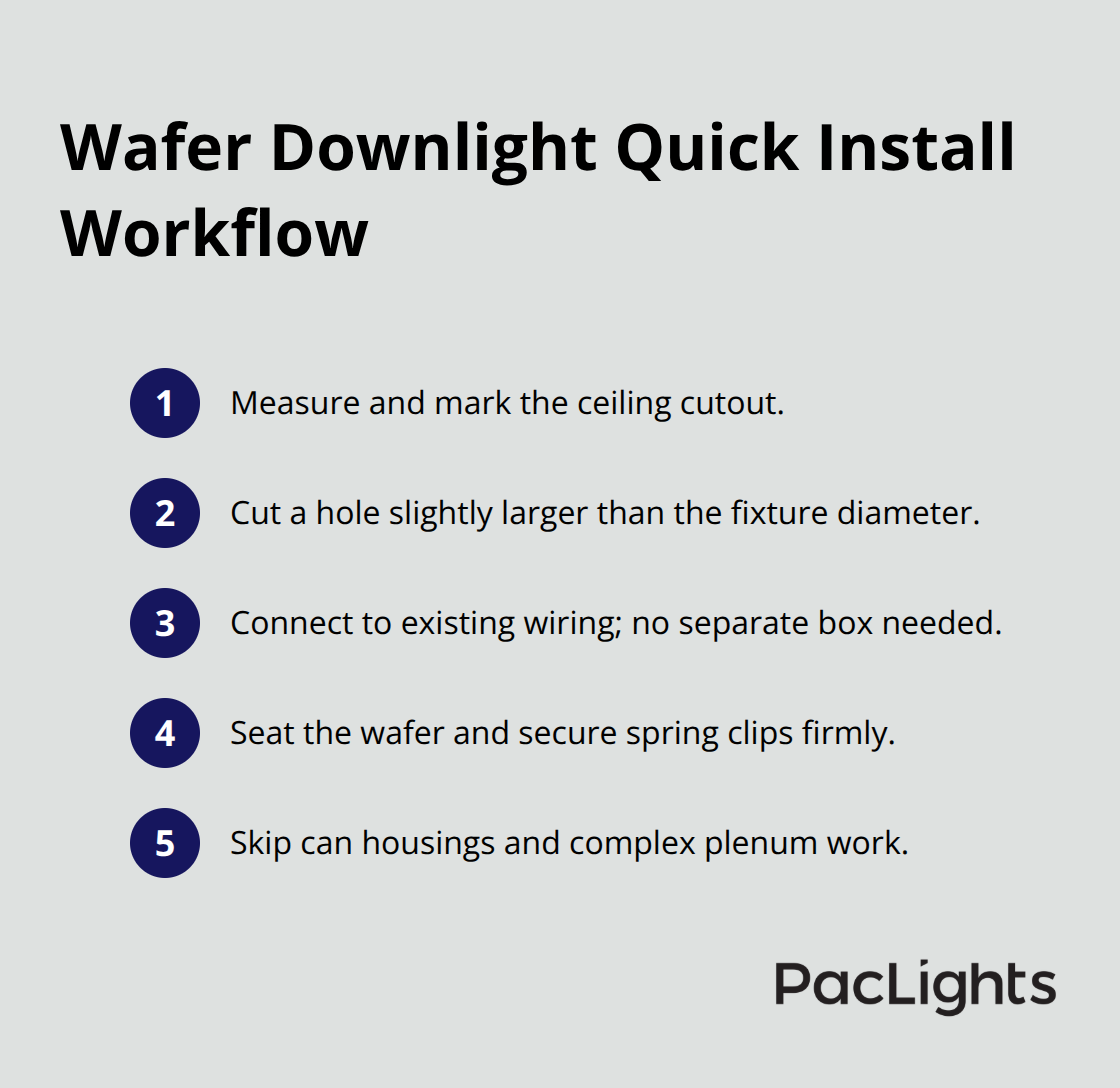
Installation becomes straightforward because wafer downlights connect to existing wiring without requiring separate electrical boxes. You cut a hole slightly larger than the fixture’s diameter, connect the wires, and secure the unit in place. No heavy can housings to wrestle into tight spaces, no complex plenum work, no waiting for structural engineers to sign off on modifications. This simplicity translates directly to lower labor costs and faster project completion.
Financial Returns Compound Quickly
Energy and maintenance savings compound rapidly once fixtures operate. A typical retrofit swapping twenty metal halide fixtures for LED wafer downlights generates roughly $2,737 in annual energy savings at standard commercial electricity rates, according to calculations based on U.S. Department of Energy efficiency data. Maintenance costs drop dramatically because LED wafers last around 50,000 hours-about 45 years at three hours daily operation-versus metal halide lamps at 6,000 to 15,000 hours. That same twenty-fixture swap eliminates approximately $13,000 in maintenance expenses over the LED lifespan.
Retrofit payback typically falls between nine and fourteen months depending on your local electricity rates and fixture count. Phased upgrades work well too; start with high-usage zones to maximize utility rebates, which often reduce net investment by thirty to fifty percent. Bulk orders unlock additional discounts, and checking your utility’s rebate finder confirms incentives before you commit to purchasing.
With space constraints solved and financial benefits clear, the next step involves understanding how wafer downlights perform in specific environments-from retail floors to healthcare facilities.
How Wafer Downlights Deliver Superior Performance Without the Bulk
Exceptional Brightness in Minimal Space
Wafer downlights pack serious brightness into a minimal footprint. A single 1,200-lumen wafer downlight uses only 12 to 15 watts while delivering light quality equivalent to a 75-watt incandescent bulb from the 1990s. Modern LED wafer fixtures achieve over 150 lumens per watt compared to roughly 60 lumens per watt for older fluorescent systems.
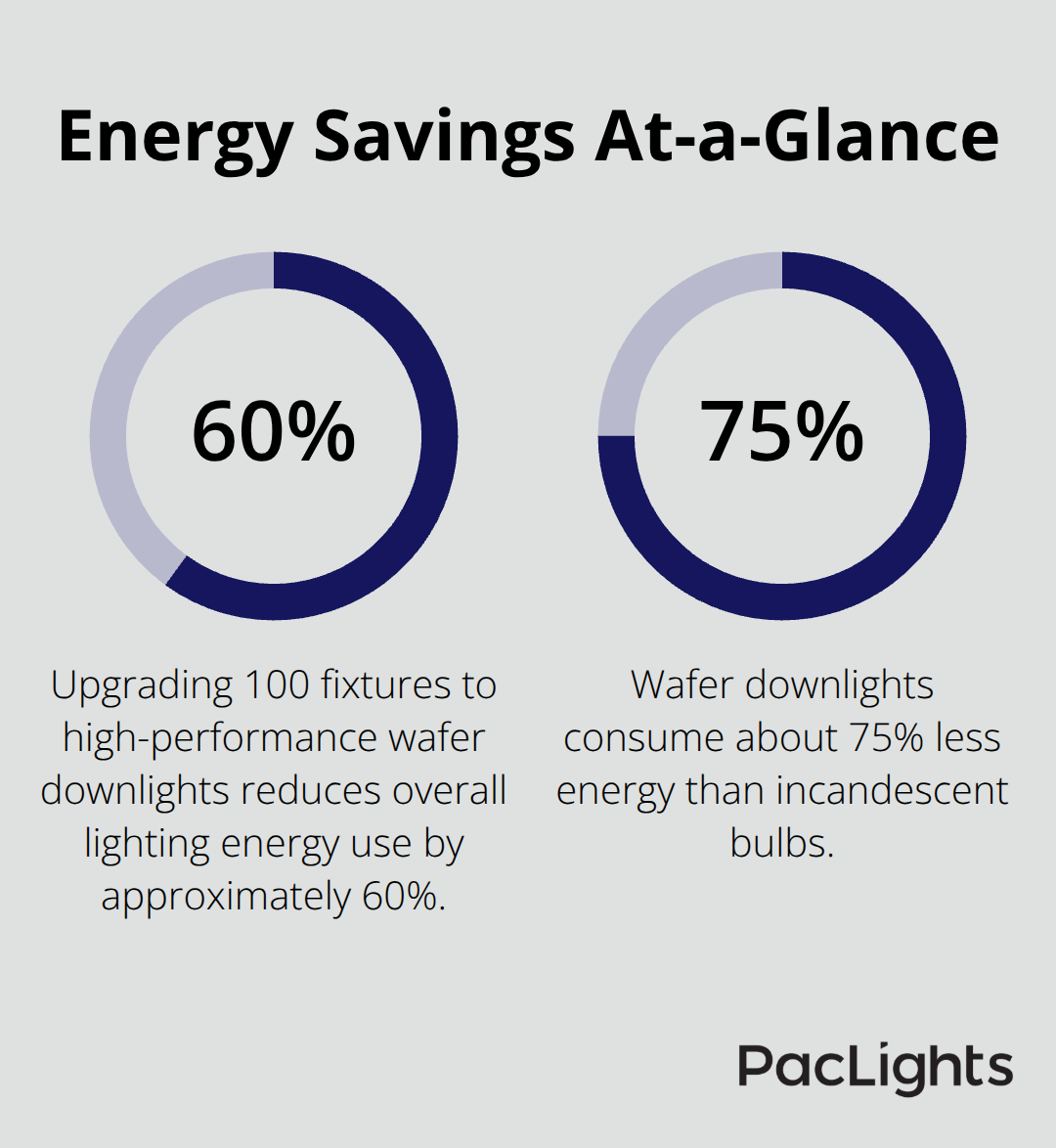
This efficiency gap explains why upgrading 100 fixtures to high-performance wafer downlights reduces overall lighting energy use by approximately 60 percent. The U.S. Department of Energy confirms that wafer downlights consume about 75 percent less energy than incandescent bulbs. A typical retrofit swapping 20 metal halide fixtures for LED wafers saves roughly $2,737 annually at standard commercial electricity rates. Peak performance specs deliver 800 to 2,500 lumens per fixture in footprints smaller than a dinner plate, with color rendering index above 80 and lifespans exceeding 50,000 hours.
Extended Lifespan Transforms Maintenance Economics
Longevity fundamentally changes your maintenance strategy and budget. LED wafers last approximately 50,000 hours, translating to roughly 45 years at three hours daily operation, compared to metal halide lamps at 6,000 to 15,000 hours. That 20-fixture retrofit eliminates approximately $13,000 in maintenance expenses over the LED lifespan. Thermal management keeps the LED junction temperature stable, preserving lumen output and extending that lifespan. Fixtures maintain about 90 percent of initial brightness after 50,000 hours versus roughly 70 percent for older technologies.
Smart Controls Amplify Energy Savings
Smart controls amplify efficiency gains further. Dimming, occupancy sensors, and daylight harvesting reduce total energy use by 35 to 50 percent when properly configured, with sensors consuming only 1 to 2 watts each. In a 10,000-square-foot office, occupancy and daylight controls contribute an additional 25 to 35 percent energy savings plus 15 to 20 percent from daylight harvesting alone. Combining efficient fixtures with networked lighting controls creates a system that adapts to actual usage patterns rather than running at fixed output all day.
These performance advantages position wafer downlights as the ideal solution for specific environments where brightness, efficiency, and reliability matter most. Different spaces-from retail floors to healthcare facilities-demand tailored approaches to lighting design and control strategies.
Where Wafer Downlights Perform Best
Office Spaces: Efficiency Meets Productivity
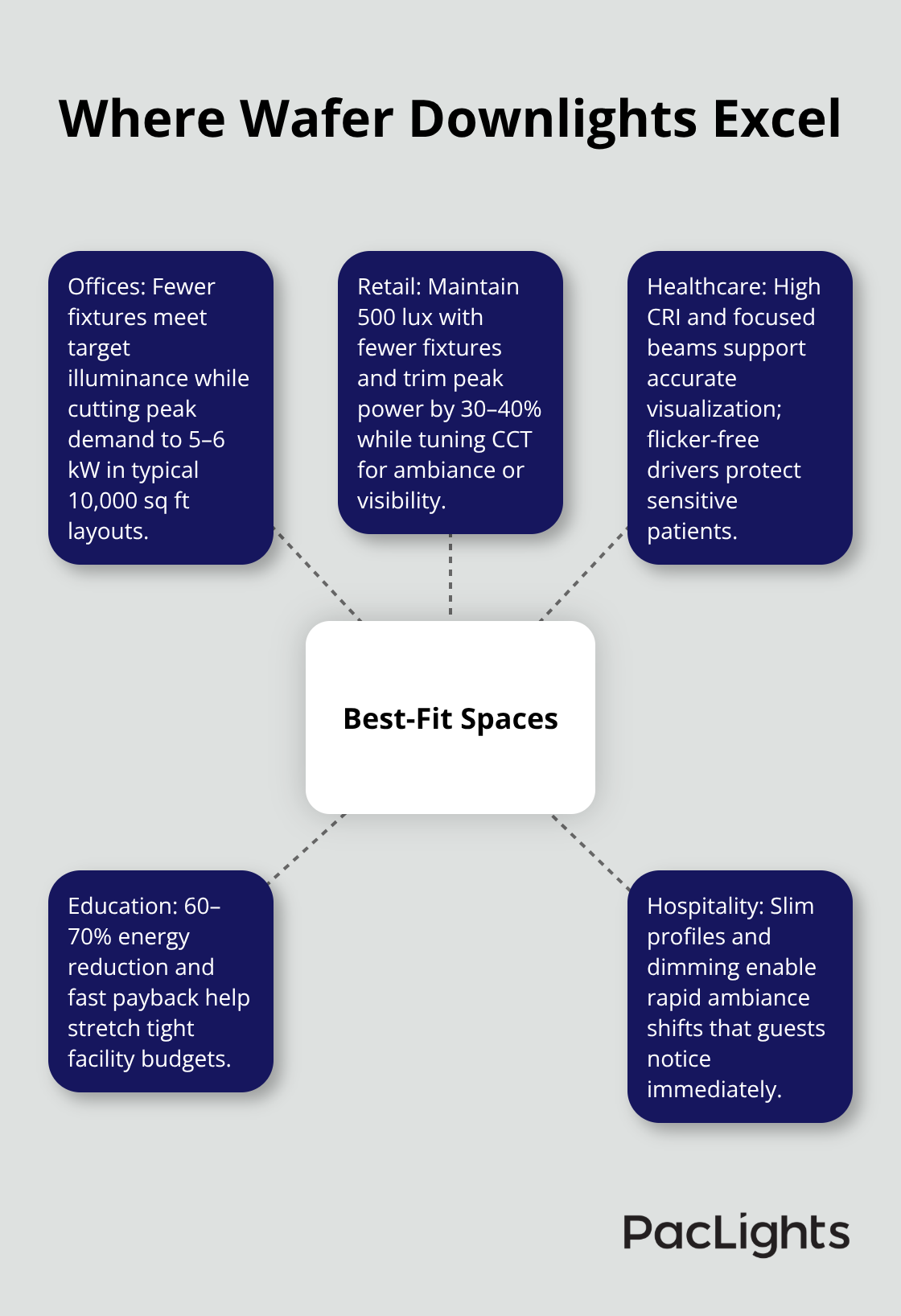
Office spaces benefit enormously from wafer downlights because they solve the dual problem of tight ceilings and constant energy pressure. A 10,000-square-foot office typically needs 80 to 100 traditional recessed fixtures but only 60 to 70 wafer downlights to achieve the same illumination, cutting peak power demand from roughly 8 to 10 kilowatts down to 5 to 6 kilowatts. Occupancy sensors and daylight harvesting unlock an additional 25 to 35 percent energy savings beyond the fixture efficiency alone, plus another 15 to 20 percent from daylight harvesting. Color rendering index above 80 keeps documents readable and reduces eye strain during eight-hour workdays. Tunable white options ranging from 2700K to 4000K support different times of day-warmer tones in morning and afternoon, cooler tones during midday focus periods.
Retail Environments: Strategic Brightness and Ambiance
Retail environments demand a completely different strategy. A 5,000-square-foot retail space can drop from 60 to 80 fixtures down to 40 to 50 wafer downlights while maintaining 500 lux and color rendering index above 80, slashing peak power consumption by 30 to 40 percent. Retail operators must choose between 3000K for warmer ambiance that makes products feel inviting or 4000K for higher visibility that helps customers evaluate merchandise critically.
Dimmable drivers enable adaptive brightness throughout the day-brighter during peak shopping hours, dimmed during slow periods to reduce energy waste.
Healthcare Facilities: Precision and Patient Care
Healthcare facilities require precision lighting that wafer downlights deliver exceptionally well. Surgical suites demand 1,500 to 2,000 lumens with 40-degree beam angles and color rendering index of 90 or higher for accurate tissue visualization. Patient rooms benefit from tunable white fixtures that shift from energizing 4000K during active care to calming 2700K during recovery periods. Flicker-free operation matters in hospitals because sensitive patients notice any visual disturbance, and wafer downlights with constant-current drivers eliminate this problem entirely.
Educational Institutions: Budget-Conscious Upgrades
Educational institutions face the same ceiling space constraints as offices but with higher occupancy density. Classrooms, lecture halls, and libraries all benefit from the 60 to 70 percent energy reduction that wafer downlights deliver compared to older fluorescent systems. Schools operating on tight budgets appreciate that retrofit payback typically falls between nine and fourteen months, meaning energy savings start funding other facility improvements within the first year.
Hospitality Settings: Ambiance and Guest Experience
Hospitality settings leverage the slim profile and dimmable controls to create rapid ambiance transitions-bright and energetic for dining areas, warm and intimate for lounges. Retrofit examples across hotel chains report payback periods in the 18 to 24 month range combined with substantially improved visual appeal that guests notice immediately.
Final Thoughts
Wafer downlight advantages solve two critical problems at once: fitting powerful lighting into tight spaces while slashing energy costs by 60 percent or more. A twenty-fixture retrofit from metal halide to LED wafers generates roughly $2,737 in annual energy savings plus $13,000 in maintenance cost reductions over the fixture lifespan, with payback arriving within nine to fourteen months. Utility rebates often cover 30 to 50 percent of net costs, making the financial case straightforward and immediate.
Beyond the numbers, wafer downlights deliver flexibility that traditional fixtures cannot match. Tunable white options support different activities and times of day, while smart controls with occupancy sensors and daylight harvesting push energy savings to 35 to 50 percent when properly configured. The slim profile frees ceiling space for HVAC, fire suppression, and electrical systems that compete for every inch in modern buildings, transforming how you approach facility upgrades.
We at PacLights offer free lighting layout designs and ROI assessments to help you specify the right wafer downlights for your space and quantify financial returns before installation. Our team evaluates your current setup, calculates exact savings for your facility, and recommends the configuration that balances performance with budget constraints.
Disclaimer: PacLights is not responsible for any actions taken based on the suggestions and information provided in this article, and readers should consult local building and electrical codes for proper guidance.