

A datacenter evacuation in darkness isn’t just uncomfortable-it’s dangerous. When power fails, your team needs clear, reliable pathway lighting to reach safety quickly.
At PacLights, we’ve seen firsthand how proper emergency lighting systems separate datacenters that protect their people from those that don’t. This guide covers the standards, design practices, and technology solutions that make the difference.
What Standards Govern Datacenter Emergency Lighting
Emergency lighting in datacenters isn’t optional-it’s mandated by a strict hierarchy of codes that vary by location but share a common goal: safe evacuation when power fails. NFPA 101, the Life Safety Code, sets the baseline requirement of an average of 1 foot-candle (10.8 lux) along all egress paths, with a minimum of 0.1 foot-candle at any point, maintained for a full 90 minutes on battery backup. This isn’t theoretical-audits regularly find UPS bays with dangerously low illumination because teams relied on UPS systems without dedicated emergency lighting, only to discover during inspections that compliance requires both. UL 924 certification is non-negotiable for all equipment; it means your fixtures have undergone rigorous testing for battery performance and transfer mechanisms that work reliably during actual outages. Beyond NFPA 101, you must also align with NFPA 70 (the National Electrical Code), local building codes like the IBC, and for datacenters specifically, TIA-942-C 2024, which addresses performance metrics and zoning. The transfer from main power to battery must happen automatically in under 10 seconds with zero manual intervention-any delay leaves your facility in darkness during the most critical moments.
Coverage That Matches Your Facility Layout
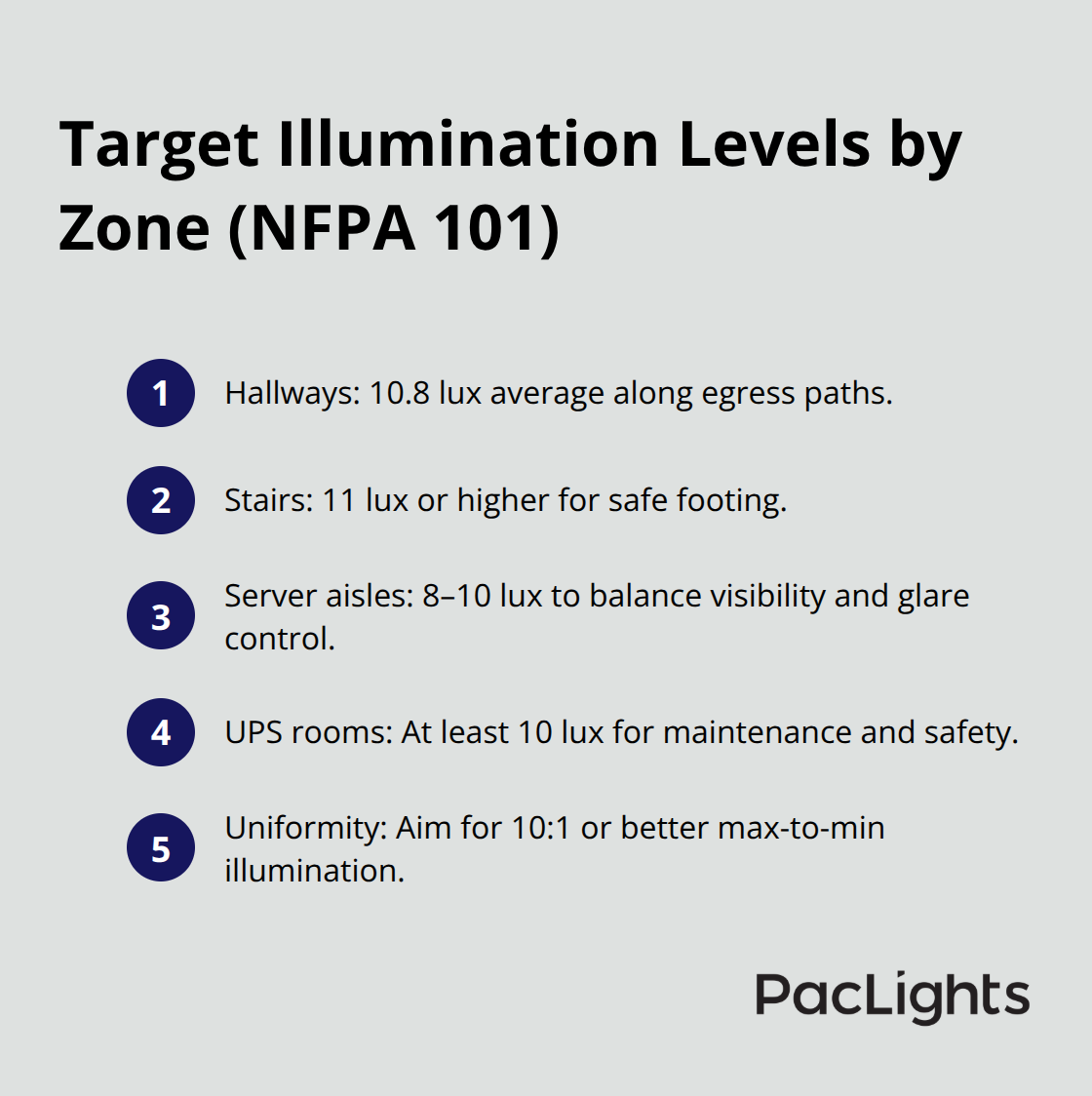
The standards don’t specify a one-size-fits-all layout because datacenters vary wildly in design. Instead, you must map every normally occupied space to the nearest exit, including primary and secondary egress paths, mezzanines, mechanical rooms, and UPS areas. Hallways need roughly 10.8 lux, stairs need 11 lux or higher, server aisles require 8–10 lux, and UPS rooms need at least 10 lux. Ceiling height and surface reflectance directly affect fixture spacing-a 25-foot ceiling requires different placement than a 12-foot space, and dark floors with 10–20% reflectance demand more fixtures or adjusted positioning. Try for a uniformity ratio of 10:1 or better between maximum and minimum illumination along your paths; excessive variation increases evacuation risk and confuses occupants about safe directions.
A practical mistake we’ve seen: teams design adequate coverage in aisles but forget generator areas, which must remain properly illuminated during testing and actual outages. Compliance audits have found expensive retrofit requirements because teams overlooked these zones entirely.
Battery Sizing and Runtime Reality
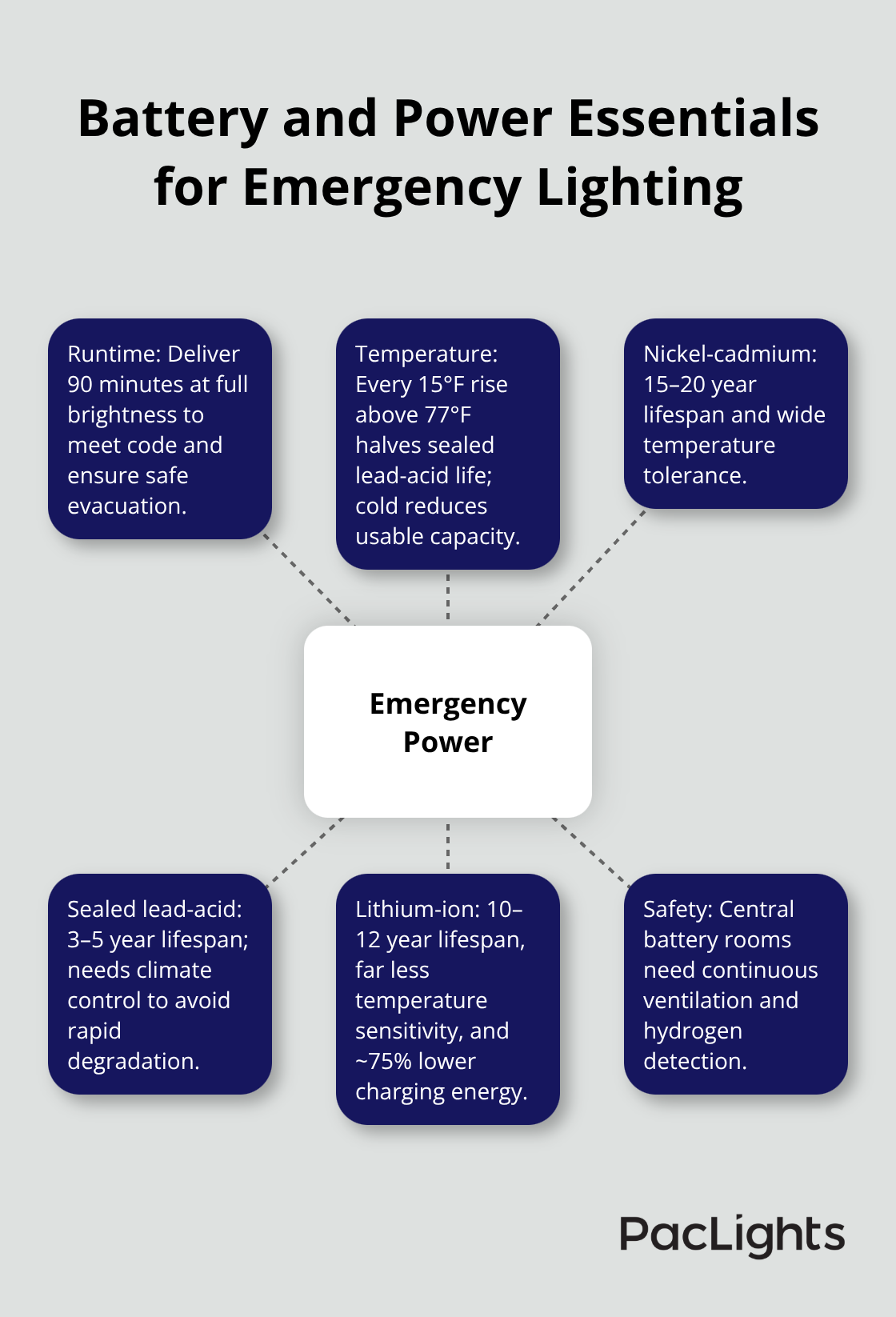
Your emergency lighting system is only as good as its battery capacity. You need 90 minutes of continuous illumination at full brightness, not degraded light that dims over time. Temperature matters critically-every 15°F rise above 77°F halves sealed lead-acid battery life, and cold temperatures reduce usable capacity. If your datacenter runs hot, plan for this derating in your battery calculations. Nickel-cadmium batteries last 15–20 years and tolerate wide temperature swings, while sealed lead-acid lasts only 3–5 years and requires climate control. Lithium-ion costs more upfront (10–12 year lifespan) but eliminates temperature sensitivity and reduces charging energy by roughly 75% compared to older technologies.
A pharmaceutical campus retrofit of 450 emergency units showed that switching to LED self-test fixtures with smart battery systems achieved payback in around 2.8 years through combined energy and maintenance savings. Central battery rooms require continuous ventilation and hydrogen detection because gas generation during charging can create explosive conditions-this isn’t optional safety theater, it’s a real hazard that demands proper exhaust fans running constantly.
Why Testing and Documentation Matter
Monthly 30-second functional tests and annual 90-minute duration tests separate compliant facilities from those that fail audits. You must document every test result, corrective action, and responsible party signature; thorough logs reduce liability and demonstrate your commitment to safety. Self-testing emergency units automate these checks and log results automatically, costing 40–60% more upfront but eliminating manual labor and improving consistency. Many teams discover during inspections that their aging batteries can’t sustain full illumination for 90 minutes, or that transfer mechanisms fail to activate within the required 10-second window. These failures don’t happen overnight-they result from skipped maintenance and missing documentation. Your datacenter’s emergency lighting system must activate during main power loss to illuminate exit routes and support safe operations, which means you can’t treat testing as a box-checking exercise.
Pathway Lighting Placement for Safe Evacuation
Map Your Facility Before You Install Anything
Placement determines whether your emergency lighting system actually guides people to safety or leaves dark zones that create confusion during evacuation. The standard approach of spacing fixtures evenly across a ceiling misses the reality of datacenter layouts-your aisles, corridors, stairs, and mechanical rooms have different geometry and occupancy patterns that demand targeted coverage. Start by mapping your facility to identify every normally occupied space and the shortest path from that space to the nearest exit, then mark secondary routes as backup. This exercise reveals which zones need the most attention and prevents costly oversights during installation.
Match Illumination Levels to Each Zone
Hallways require 10.8 lux average illumination, stairs need 11 lux or higher, server aisles need 8–10 lux, and UPS rooms need at least 10 lux according to NFPA 101 standards. Ceiling height directly affects fixture spacing and brightness requirements; a 25-foot ceiling requires different placement than a 12-foot space, and dark floors with 10–20% reflectance demand more fixtures or adjusted positioning to prevent shadows. Try for a uniformity ratio of 10:1 or better between maximum and minimum illumination along your paths-excessive variation confuses occupants about safe directions and increases evacuation risk. In server aisles specifically, narrow-beam luminaires with beam angles of 90 degrees or less minimize spillover and glare while improving coverage without excessive light bleed, which matters when your team needs to read cable labels and navigate tight spaces during an outage. A critical mistake we see repeatedly: teams light aisles adequately but ignore generator areas, which must remain properly illuminated during testing and actual outages-compliance audits have flagged these oversights as expensive retrofit requirements.
Design Your Backup Power System for Speed
Your backup power system must activate automatically in under 10 seconds with zero manual intervention, which means your pathway lights need dedicated emergency circuits isolated from normal facility switches. Wire emergency circuits ahead of local switches to prevent accidental disconnection during maintenance or renovation work. Nickel-cadmium batteries tolerate wide temperature swings and last 15–20 years, while sealed lead-acid lasts only 3–5 years but costs less upfront-every 15°F temperature rise above 77°F halves sealed lead-acid battery life, so if your datacenter runs hot, account for this derating in your capacity calculations. Lithium-ion batteries eliminate temperature sensitivity, last 10–12 years, and reduce charging energy by roughly 75% compared to older technologies, though upfront costs run higher. Central battery rooms require continuous ventilation and hydrogen detection because gas generation during charging creates explosive conditions-exhaust fans must run constantly, not intermittently.
Test and Document Everything
Monthly 30-second functional tests and annual 90-minute duration tests separate compliant facilities from those that fail audits. Self-testing emergency units automate these checks and log results, costing 40–60% more upfront but eliminating manual labor and preventing the common failure where aging batteries cannot sustain full illumination for 90 minutes or transfer mechanisms fail to activate within the required window. Document every test result, corrective action, and responsible party signature-thorough logs reduce liability and demonstrate your commitment to safety during inspections. A pharmaceutical campus retrofit of 450 emergency units switching to LED self-test fixtures with smart battery systems achieved payback in approximately 2.8 years through combined energy and maintenance savings.
Smart Controls Enhance Your System
Advanced lighting controls integrate your escape route lighting with your broader facility management systems, allowing you to monitor battery health, fixture status, and coverage in real time. These systems detect failures before they become compliance violations and alert your team to maintenance needs before an outage occurs. The next section covers how smart controls and monitoring technology transform emergency lighting from a static safety requirement into a dynamic, responsive system that protects your people and your facility.
Technology Solutions for Datacenter Emergency Lighting
LED Emergency Lighting Delivers Superior Performance
LED emergency lighting has become the only rational choice for datacenters because the performance gap between LEDs and older incandescent or fluorescent systems is enormous. Industrial LED emergency fixtures deliver 50,000+ hour lifespans compared to roughly 2,000 hours for incandescent bulbs, which means you replace fixtures far less often and reduce labor costs dramatically. LEDs generate significantly less heat than traditional systems, which directly reduces the cooling load in your battery room and lowers overall facility operating costs. A Malaysia retrofit project demonstrated this advantage clearly: switching from fluorescent emergency systems to high-efficiency LED fixtures with smart controls cut the lighting energy load by 38 percent. LED fixtures also charge batteries more efficiently-upgrading to LED self-test units reduces charging energy consumption by approximately 75 percent compared to older battery technologies.

Since your emergency lighting system must deliver full brightness for 90 minutes during an outage, efficiency directly translates to smaller battery packs, lower upfront capital costs, and reduced maintenance burden.
When evaluating LED emergency fixtures, prioritize those with efficacy ratings above 130 lumens per watt in line with ASHRAE 90.1 standards for datacenters. Your fixtures must maintain color rendering index above 80 to ensure your team can read cable labels and navigate tight spaces clearly during low-light conditions. Narrow-beam luminaires with beam angles of 90 degrees or less in server aisles minimize spillover and glare while preventing shadows that create evacuation hazards.
Smart Monitoring Catches Failures Before They Become Violations
Smart monitoring transforms emergency lighting from a static compliance requirement into a predictive maintenance tool that catches failures before they become violations. Real-time dashboards integrated with your building management system display battery health, fixture status, and coverage gaps instantly, eliminating the need for manual inspections and logbook reviews that typically consume dozens of labor hours annually. Self-testing emergency units automate your monthly 30-second functional tests and annual 90-minute duration tests, logging results automatically and alerting your team to failures immediately-these units cost 40–60 percent more upfront but eliminate the common scenario where aging batteries fail to sustain full illumination or transfer mechanisms miss the required 10-second activation window. IoT-enabled systems add predictive failure alerts that flag battery degradation or component wear weeks before actual failure, allowing you to schedule replacements during planned maintenance windows rather than discovering problems during audits.
Redundancy and Battery Management Protect Your Facility
For redundancy, implement dual-circuit design aligned with NEC Article 700 so your emergency lighting remains operational even if a single power source fails. Central battery systems work best for larger datacenters because they simplify maintenance and battery management across dozens of fixtures in one location, though distributed systems with individual fixture batteries offer greater resilience if one unit fails. Temperature control in your central battery room is non-negotiable-every 15 degrees Fahrenheit rise above 77 degrees halves sealed lead-acid battery life, so if your datacenter runs hot, either invest in Lithium-ion batteries that tolerate temperature swings or implement dedicated cooling for your battery room. Continuous ventilation and hydrogen detection in battery rooms prevent explosive gas buildup during charging, a real hazard that demands exhaust fans running constantly.
Real-World Results Demonstrate Proper System Design
The Thailand Cloud Facility, a 6,000 square meter Tier III datacenter, verified egress requirements in under 30 minutes using pre-installed emergency modules integrated into fixtures. This result demonstrates that proper system design eliminates inspection delays and retrofit costs that plague facilities with poor planning.
Final Thoughts
Emergency lighting in datacenters isn’t a compliance checkbox-it’s the difference between safe evacuation and chaos when power fails. NFPA 101 requires 10.8 lux average illumination along egress paths for 90 minutes on battery backup, UL 924 certification is mandatory for all equipment, and automatic transfer must happen in under 10 seconds. Your facility layout determines whether pathway lighting actually guides people to safety or leaves dangerous gaps, with hallways needing 10.8 lux, stairs needing 11 lux or higher, server aisles needing 8–10 lux, and UPS rooms needing at least 10 lux.
Monthly 30-second functional tests and annual 90-minute duration tests with documented results separate facilities that protect their people from those that discover problems during inspections. Self-testing emergency units automate this process and cost 40–60 percent more upfront but eliminate the common scenario where aging batteries fail to sustain full illumination or transfer mechanisms miss activation windows. LED emergency lighting with efficacy above 130 lumens per watt reduces charging energy by roughly 75 percent compared to older systems, directly lowering your total cost of ownership.
Map your facility to identify every normally occupied space and egress route, implement LED emergency fixtures with redundant backup power aligned with NEC Article 700, and establish a testing schedule with thorough documentation. We at PacLights offer energy-efficient lighting solutions and free lighting layout designs and ROI assessments to help you design systems that meet standards while controlling costs. Your datacenter’s emergency lighting system protects your team and your facility-treat it as the critical infrastructure it is.
Disclaimer: PacLights is not responsible for any actions taken based on the suggestions and information provided in this article, and readers should consult local building and electrical codes for proper guidance.