

Lighting quality directly impacts facility safety, compliance, and operating costs. At PacLights, we know that NSF certification separates reliable products from those that merely meet minimum standards.
This guide walks you through what NSF certification actually means, why it matters for your commercial downlights and other fixtures, and how to verify certifications when selecting lighting solutions for your facility.
What NSF Certification Actually Requires
NSF International certification for lighting products means your fixtures have passed rigorous third-party testing for safety, performance, and suitability in specific environments like food service areas, healthcare facilities, and other regulated spaces. The NSF doesn’t manufacture lights or maintain financial stakes in any lighting company, which makes their certification genuinely independent. When a light carries NSF certification, the manufacturer submitted detailed specifications, materials documentation, and actual product samples for testing. NSF evaluators examine everything from electrical safety to photometric performance to material compatibility with cleaning agents and moisture exposure. This isn’t a simple pass-fail checkbox.
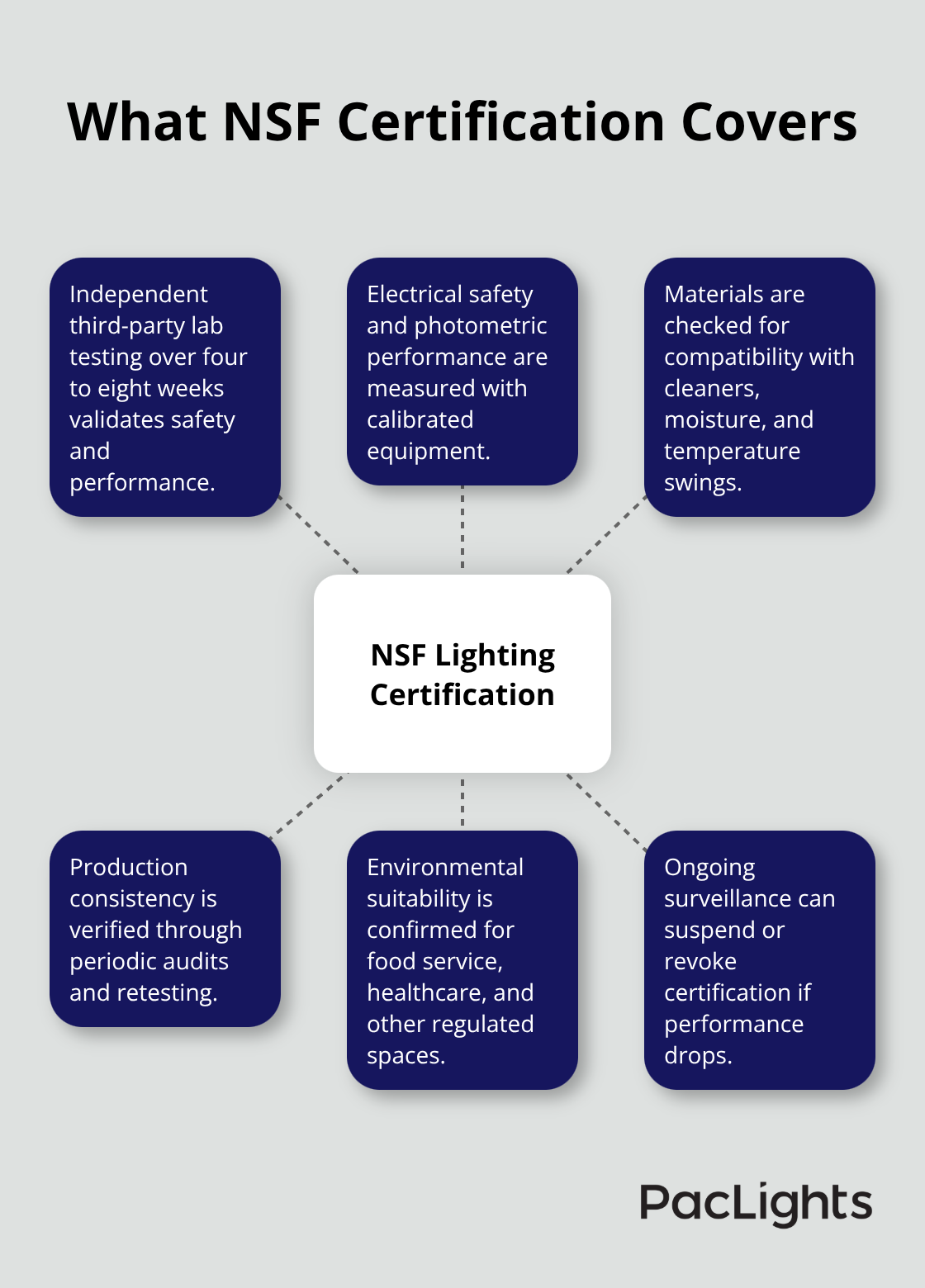
NSF certification requires manufacturers to maintain consistent quality across production runs, with periodic audits and retesting to verify ongoing compliance. A facility manager selecting NSF-certified fixtures gains assurance that performance won’t degrade after six months or a year of operation in challenging environments.
Performance Requirements That Matter
NSF-certified lighting products must meet specific technical standards depending on their intended use environment. For food service lighting, fixtures must withstand exposure to acidic cleaners, high-moisture conditions, and temperature fluctuations without corrosion or material degradation. NSF tests color rendering index, lumen output stability, and heat dissipation under continuous operation. For healthcare environments, NSF certification includes verification that fixtures don’t harbor bacteria or allow liquid infiltration into electrical components. The testing also confirms that UV emissions stay within acceptable ranges and that fixtures perform reliably under the specific voltage and frequency of facility electrical systems. Most commercial facilities operate on 120-277V systems, and NSF certification confirms lights function safely across this range without flickering or premature failure. Materials used in NSF-certified fixtures must pass flammability testing and chemical compatibility assessments to prevent degradation when exposed to hospital disinfectants or industrial cleaning compounds.
How Testing and Verification Actually Works
NSF conducts testing in accredited laboratories where technicians measure photometric performance using calibrated equipment over extended periods. A typical NSF certification process takes four to eight weeks from initial submission to final approval, depending on product complexity and whether revisions become necessary. NSF tests at least three production samples from the manufacturer’s facility to confirm consistency. Thermal cycling tests expose fixtures to repeated temperature changes that simulate seasonal variations and continuous operation stress. Moisture resistance testing submerges components or exposes them to salt spray environments to predict corrosion rates. For electrical safety, NSF verifies insulation integrity, grounding effectiveness, and performance under fault conditions. Once certified, manufacturers receive ongoing surveillance audits where NSF inspectors visit production facilities and randomly select fixtures from inventory for retesting. If performance drops below standards during surveillance audits, NSF can suspend or revoke certification immediately. This ongoing oversight means NSF certification remains valid only as long as manufacturers maintain their quality standards consistently.
What This Means for Your Facility Selection
When you evaluate lighting solutions for your commercial or industrial space, NSF certification signals that a manufacturer stands behind their product through independent verification. The certification process (which includes both initial testing and continuous surveillance) protects your facility from fixtures that fail prematurely or don’t perform as specified. Facilities in regulated industries-food service, healthcare, pharmaceutical manufacturing-face serious compliance consequences if lighting fails to meet environmental standards. NSF certification removes guesswork from your purchasing decision and provides documentation that satisfies regulatory audits. Your next step involves identifying which specific NSF-certified fixtures match your facility’s actual lighting needs and performance requirements.
Why NSF Certification Protects Your Bottom Line
Regulatory Compliance Demands NSF Standards
Commercial and industrial facilities operating in regulated environments face serious financial and legal exposure when lighting fails to meet standards. NSF certification addresses this directly by verifying that fixtures perform reliably in demanding conditions where non-compliance carries real consequences. Food service facilities must comply with FDA regulations that specify lighting durability in environments with frequent chemical cleaning and high humidity. Healthcare facilities face Joint Commission standards requiring fixtures that resist bacterial contamination and maintain consistent performance in sterile areas. Pharmaceutical manufacturing plants operate under FDA Current Good Manufacturing Practice regulations that demand fixtures meeting specific photometric and durability requirements. When your facility uses non-certified lighting in these environments, a single regulatory inspection can result in fines, operational shutdowns, or loss of licensing. NSF certification provides documented proof during audits that your fixtures meet the standards regulators actually enforce.
Maintenance Costs Drop Significantly With Certified Fixtures
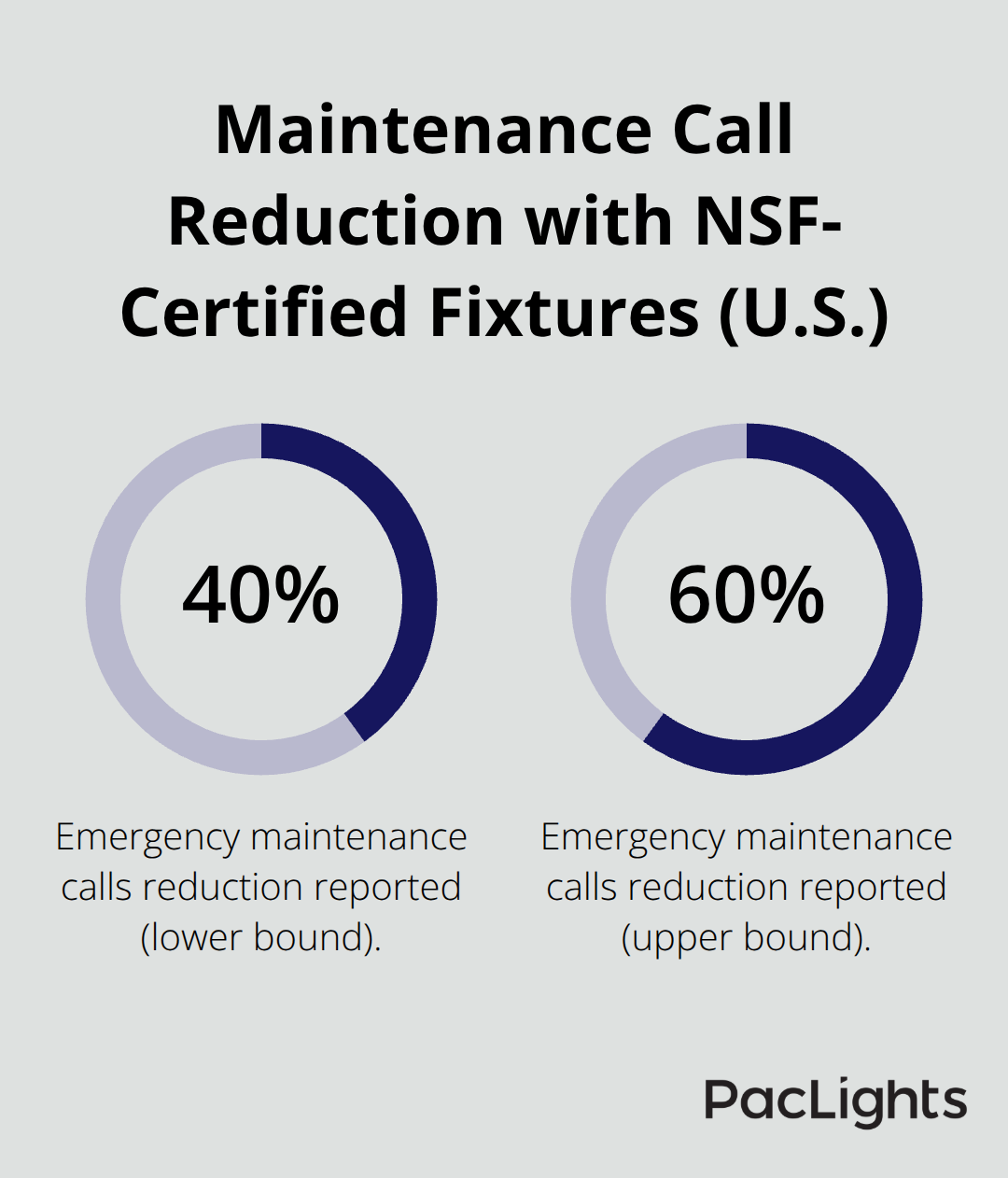
Beyond regulatory compliance, facility managers report that NSF-certified fixtures reduce emergency maintenance calls by 40-60 percent compared to standard commercial lighting, according to data from the International Association of Certified Home Inspectors. This reliability translates directly to reduced labor costs, fewer production interruptions, and lower replacement expenses over a five to ten year period.
The upfront cost of NSF-certified fixtures typically runs 15-25 percent higher than uncertified alternatives, but facilities that calculate total cost of ownership over seven years consistently find that certified products cost less overall when accounting for reduced maintenance, fewer replacements, and avoided compliance penalties.
Operational Safety and Liability Protection
The liability protection extends beyond regulatory compliance to actual operational safety. When a fixture fails in a commercial kitchen, the risk of contamination spreads rapidly and can force temporary closure. When healthcare lighting fails, patient care procedures may be delayed or compromised. When industrial facility lighting malfunctions, worker safety depends on immediate response and replacement. NSF certification means manufacturers stand behind their products through ongoing surveillance testing and quality audits, so you have recourse if performance degrades unexpectedly.
Selecting Fixtures That Match Your Environment
Your facility’s specific environment determines which NSF-certified fixtures will perform best and protect your investment most effectively. Food service areas require different durability standards than healthcare settings, and both differ from pharmaceutical manufacturing requirements. The next section walks you through identifying your facility’s actual lighting needs and evaluating which NSF-certified options available in the market align with those requirements.
How to Match NSF-Certified Fixtures to Your Facility’s Real Requirements
Document Your Facility’s Actual Operating Conditions
Start by mapping your facility’s actual operating conditions rather than making assumptions based on general lighting categories. Food service facilities differ dramatically in their specific challenges: a quick-service restaurant with high-volume throughput faces different moisture and chemical exposure than a commercial bakery or a central commissary kitchen. Walk through your space during peak operating hours and document where fixtures sit relative to steam sources, cleaning procedures, and humidity levels. The NSF certification categories align with these real-world conditions, so a fixture certified for food service environments won’t necessarily perform in a pharmaceutical cleanroom, and vice versa.
Measure your current lighting levels using a basic light meter (available for under fifty dollars from hardware retailers) to establish baseline lux or foot-candle readings. This data becomes critical when evaluating NSF-certified replacements because you need fixtures that deliver equivalent or better light output while meeting your environment’s durability demands. Healthcare facilities should identify which areas require the most stringent bacterial resistance standards-operating rooms demand different fixture specifications than administrative offices within the same building. Industrial facilities must account for dust, vibration, temperature swings, and chemical exposure specific to their manufacturing processes. This detailed environmental assessment prevents purchasing over-specified fixtures for low-stress areas or under-specified products for demanding zones, both mistakes that waste budget and create compliance gaps.
Verify Certifications Through Independent Sources
Evaluating available NSF-certified options requires checking the actual NSF certification documents rather than relying on manufacturer marketing claims. Request the NSF certificate from your lighting supplier and verify the specific certification scope-which environments, which performance standards, which testing protocols the product actually passed. NSF maintains a searchable database where you can confirm a product’s certification status independently without relying on vendor information.
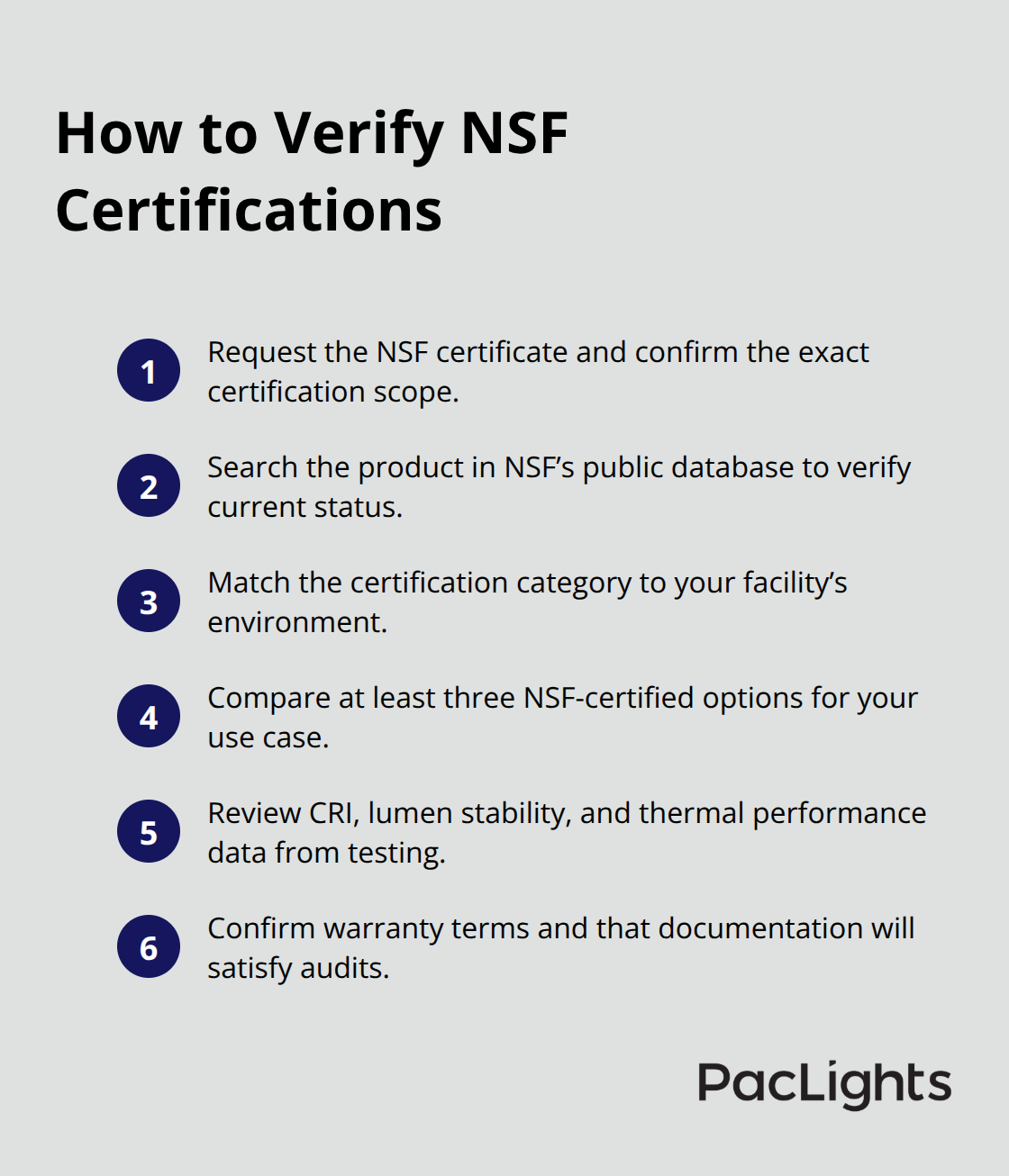
Compare at least three NSF-certified fixture options that match your environmental requirements and note the specific performance metrics each one achieved during testing: color rendering index scores, lumen output stability ratings, and thermal performance data. A fixture certified for food service with a CRI of 95 performs noticeably better than one with a CRI of 80 in applications where color accuracy matters for food presentation or quality inspection.
Calculate Total Cost of Ownership Across Seven Years
Calculate the total cost of ownership across a seven-year period by factoring in fixture cost, installation labor, expected maintenance frequency, and energy consumption-NSF-certified LED fixtures typically consume thirty to forty percent less energy than older fluorescent alternatives according to the U.S. Department of Energy. Work with your lighting provider to confirm they can verify certifications in writing before purchase and that they’ll provide documentation satisfying regulatory audits. Reputable suppliers should offer warranties matching or exceeding five years and provide maintenance support throughout the fixture lifecycle.
Evaluate Supplier Reliability and Support
If a supplier hesitates to provide NSF documentation or cannot explain specific performance requirements their fixtures meet, that hesitation signals you should evaluate alternative vendors. Request sample installations in comparable facilities if possible, then follow up with those facility managers about actual maintenance costs and performance over twelve to eighteen months of operation. Suppliers who stand behind their NSF-certified products provide transparent documentation and realistic performance expectations based on actual field experience.
Final Thoughts
NSF certification separates lighting products that perform reliably in demanding environments from those that fail prematurely and create compliance headaches. The testing and verification process NSF conducts protects your facility by confirming that fixtures meet rigorous standards for safety, durability, and performance before you install them. When you select NSF-certified lighting, you gain documented proof that your fixtures will withstand the specific conditions your facility operates under, whether that means food service chemical exposure, healthcare bacterial resistance requirements, or industrial temperature fluctuations.
Your investment in NSF-certified fixtures pays dividends through reduced maintenance costs, fewer emergency replacements, and protection against regulatory penalties. Facilities that calculate total cost of ownership over seven years consistently find that certified products cost less overall despite higher upfront prices. The compliance documentation NSF certification provides satisfies regulatory audits and removes guesswork from your purchasing decisions.
Making informed decisions about certified lighting requires matching fixtures to your facility’s actual operating conditions rather than assuming generic categories apply. Request NSF certificates from suppliers, verify certifications independently through NSF’s database, and compare performance metrics across at least three options before purchasing. We at PacLights offer commercial downlights and other fixtures tailored to diverse industrial needs, with optional advanced lighting controls to optimize energy use and help you select the right certified solutions for your facility’s specific requirements.
Disclaimer: PacLights is not responsible for any actions taken based on the suggestions and information provided in this article, and readers should consult local building and electrical codes for proper guidance.