

Industrial linear LED lighting transforms how businesses illuminate their facilities. These systems deliver superior performance while cutting energy costs by up to 75% compared to traditional fluorescent fixtures.
At PacLights, we’ve seen manufacturers, warehouses, and production facilities dramatically improve their operations through strategic lighting upgrades. The right linear LED solution enhances worker productivity and reduces maintenance headaches.
What Makes Industrial Linear LED Lighting Different
Industrial linear LED lights consist of long-shaped luminaires that deliver targeted illumination across expansive commercial and manufacturing spaces. These fixtures achieve 120-140 lumens per watt efficiency compared to fluorescent tubes at just 80 lumens per watt, according to federal energy management data. Modern linear systems maintain over 90% of their initial light output after 50,000 hours while fluorescent alternatives drop to 70% after only 20,000 hours. The technology eliminates ballast failures and mercury disposal concerns that plague traditional systems.
Performance Specifications That Matter
Quality linear LED fixtures deliver 800-1,200 lumens per foot while they consume only 8-15 watts per foot. High-bay linear models produce 15,000-30,000 lumens for warehouse applications at heights of 20-40 feet. IP65-rated fixtures handle dust and moisture in manufacturing environments.
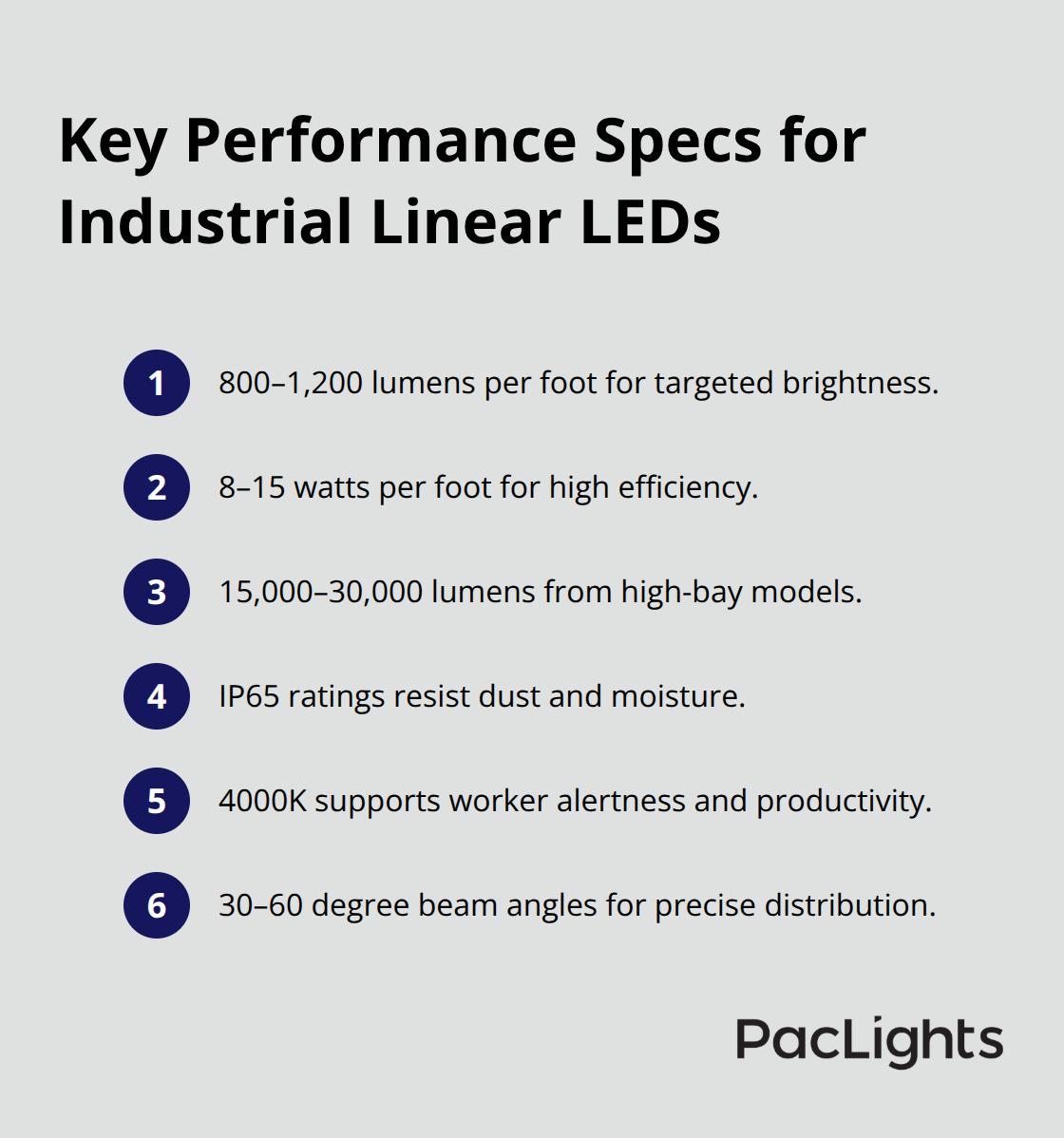
Color temperatures of 4000K support worker circadian rhythms and boost productivity (studies show 15-20% improvements in office settings). Beam angles of 30-60 degrees provide precise light distribution for retail merchandise displays.
Real-World Industrial Applications
Manufacturing facilities use linear LEDs for assembly line illumination where consistent light quality prevents defects. Food processing plants require NSF-certified linear fixtures that meet sanitary standards. Warehouses install high-bay linear systems that reduce worker eye strain during operations. Cold storage facilities benefit from fixtures rated for sub-zero temperatures. Hazardous locations demand Class I Division 1 certified linear lights for petrochemical and pharmaceutical environments where explosive atmospheres exist.
Installation Options and Flexibility
Surface-mounted linear lights cost 30-40% less to install than recessed alternatives and offer budget-friendly options for most facilities. Recessed installations enhance aesthetics and eliminate dust accumulation points but require structural modifications. Suspended fixtures work well in open ceiling applications (particularly in warehouses with exposed structures). Strip lights excel in accent applications while troffer lights provide uniform distribution across 64-100 square feet per fixture in office environments.
These performance advantages and application flexibility make linear LED technology the foundation for modern industrial facilities, but the real value emerges when you examine the comprehensive benefits these systems deliver to your operations.
Why Linear LEDs Transform Industrial Operations
Linear LED systems deliver measurable operational improvements that traditional lighting cannot match. Manufacturing facilities report energy savings of 60-70% when they replace 100-150 watt fluorescent systems with 40-60 watt LED linear fixtures. The Federal Energy Management Program confirms that a 2-foot by 4-foot LED luminaire saves over $161 in lifetime energy costs at federal electricity rates of $0.099 per kWh. Smart controls add another 20-30% in savings through occupancy sensors, while dimmable systems provide 35-50% additional reductions in spaces with variable natural light. Networked control systems slash energy consumption by 40-60% compared to basic switches.
Superior Light Performance Drives Productivity
Linear LEDs produce consistent 4000K color temperature that supports worker circadian rhythms and generates 15-20% productivity gains in office environments. High-bay linear fixtures eliminate the 30% light loss that occurs with dirty fluorescent reflectors in dusty warehouses. The uniform light distribution reduces eye strain during detailed assembly work, while beam angles of 30-60 degrees provide precise task illumination. Manufacturing quality improves because linear LEDs maintain consistent color rendering throughout their 50,000-hour lifespan (unlike fluorescents that shift color temperature as they age).
Maintenance Costs Drop With LED Durability
Quality linear LED fixtures operate for over 50,000 hours while they maintain 90% of initial light output, compared to fluorescent tubes that drop to 70% after just 20,000 hours. This longevity reduces replacement costs by 60% and eliminates the labor expense of changing bulbs in high-ceiling applications. IP65-rated linear fixtures withstand industrial environments without ballast failures or mercury disposal requirements.

The absence of fragile glass tubes eliminates breakage concerns in high-vibration manufacturing settings, while solid-state construction handles temperature fluctuations that destroy traditional systems.
Heat Reduction Lowers HVAC Costs
LED linear fixtures generate significantly less heat than fluorescent alternatives, which reduces HVAC loads in manufacturing facilities. This heat reduction creates additional energy savings beyond the direct lighting consumption improvements (particularly in climate-controlled environments like food processing plants). The lower heat output also extends the life of temperature-sensitive equipment and improves worker comfort in production areas.
These operational advantages position linear LEDs as the foundation for modern industrial facilities, but selecting the right system requires careful evaluation of your specific facility requirements and available installation options.
Which Linear LED System Fits Your Facility
Facility assessment starts with measurement of current light levels and identification of problem areas where workers struggle with visibility or eye strain. Calculate your existing power density in watts per square foot and compare it against modern LED benchmarks of 0.5-0.8 watts per square foot for office areas and 0.8-1.2 watts per square foot for manufacturing spaces. Document ceiling heights, mounting points, and environmental conditions like temperature ranges, humidity levels, and exposure to chemicals or dust. The Federal Energy Management Program requires minimum efficiency of 131 lumens per watt for commercial linear fixtures and 175 lumens per watt for industrial high bay applications, which eliminates underperforming options immediately.
Strip Lights Excel in Focused Applications
Linear strip lights work best for accent lighting, under-cabinet illumination, and narrow spaces where precise light placement matters. These fixtures deliver 800-1,200 lumens per foot while they consume just 8-15 watts per foot, which makes them ideal for workbenches, conveyor systems, and equipment maintenance areas. Strip lights cost significantly less upfront but lack the light output needed for general area illumination in large spaces. High bay linear fixtures produce 15,000-30,000 lumens and handle mounting heights of 20-40 feet, which makes them the only viable choice for warehouses, manufacturing floors, and distribution centers where workers need consistent illumination across vast areas.
Smart Controls Multiply Energy Savings
Occupancy sensors add 20-30% energy savings beyond base LED efficiency, while networked control systems reduce consumption by 40-60% compared to basic switches (according to Department of Energy studies). Daylight harvesting systems automatically dim fixtures when natural light increases and provide 35-50% additional savings in facilities with skylights or large windows. Motion sensors work particularly well in storage areas and corridors where intermittent use occurs, while continuous dimming suits production areas where task requirements vary throughout shifts.

Environmental Factors Drive Fixture Selection
Manufacturing environments require IP65-rated fixtures that protect against dust and moisture exposure. Cold storage facilities need fixtures rated for sub-zero temperatures that maintain performance in extreme conditions. Hazardous locations demand Class I Division 1 certified linear lights for petrochemical and pharmaceutical environments where explosive atmospheres exist. Food processing plants require NSF-certified fixtures that meet sanitary standards and resist chemical washdown procedures (which standard fixtures cannot handle).
Final Thoughts
Industrial linear LED lighting transforms facility operations through measurable performance improvements. Energy savings of 60-70% reduce costs while 50,000-hour lifespans eliminate maintenance disruptions. The 120-140 lumens per watt efficiency surpasses fluorescent systems by 50%, and smart controls deliver another 40-60% in energy reductions.
Professional assessment identifies current inefficiencies and calculates potential savings for your specific facility. Document ceiling heights, environmental conditions, and requirements for hazardous or sanitary areas. Federal rebate programs often reduce project costs by 15-30% (making the financial case stronger for most facilities).
ROI occurs within two years when you factor energy savings, reduced maintenance costs, and productivity improvements. Manufacturing facilities report 15-20% productivity gains from consistent 4000K color temperature that supports worker performance. We at PacLights provide comprehensive solutions and free assessments to help you make informed decisions about your facility upgrade.
Disclaimer: PacLights is not responsible for any actions taken based on the suggestions and information provided in this article, and readers should consult local building and electrical codes for proper guidance.