

Selecting the right linear strip light transforms your workspace lighting from mediocre to exceptional. Poor lighting choices cost businesses thousands in energy bills and reduced productivity.
We at PacLights see companies struggle with this decision daily. The wrong specifications lead to dim workspaces, high maintenance costs, and frustrated employees.
This guide breaks down the technical requirements and practical considerations that matter most for your specific application.
Where Do Linear Strip Lights Work Best
Commercial spaces require different approaches than residential applications. Office environments need 30-50 foot-candles for general tasks, while manufacturing facilities require 50-100 foot-candles according to Illuminating Engineering Society standards. Strip lights excel in commercial environments because they deliver uniform illumination across long distances without shadows or dark spots that plague traditional point-source options.
Task-Focused Applications
Manufacturing and assembly operations benefit most from focused task illumination that delivers 100-200 foot-candles directly where workers perform detailed activities. Linear strip lights mounted 8-10 feet above workbenches provide this concentrated illumination while they minimize glare. Food processing facilities use IP65-rated strips that withstand washdown procedures, while automotive assembly lines rely on high-CRI strips above 90 to accurately identify paint defects and component variations.
Warehouse and Distribution Centers
Large storage facilities present unique challenges that strip lights solve effectively. Aisles between 20-foot tall systems require continuous illumination to maintain safety and productivity. Installation of 4-foot or 8-foot strips in parallel rows creates consistent illumination levels of 20-30 foot-candles for general warehouse activities. Cold storage facilities that operate at -10°F to 32°F need specialized low-temperature strips that maintain full light output.
Motion-Activated Solutions
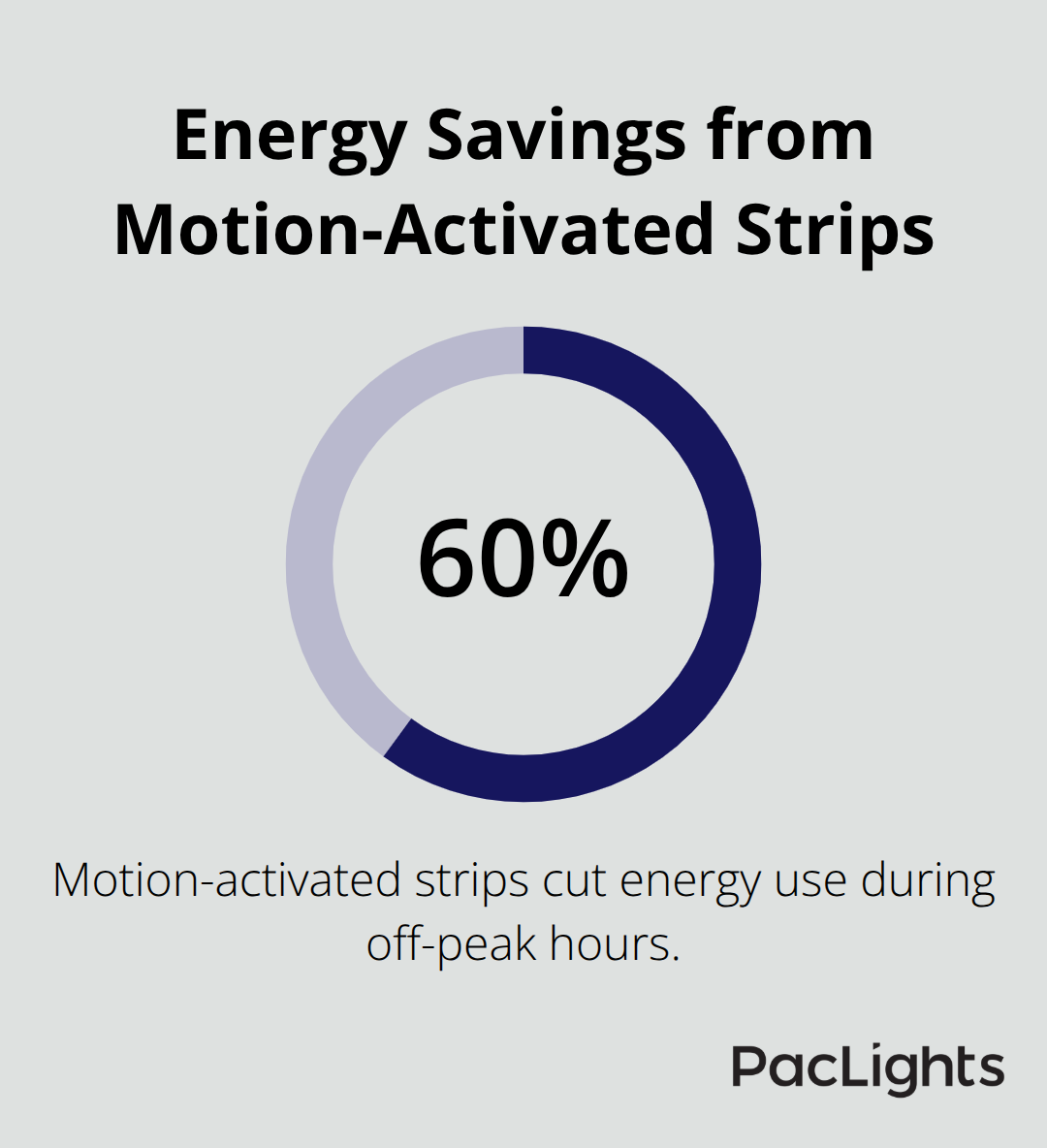
Distribution centers benefit from motion-activated strips that reduce energy consumption during off-peak hours by up to 60 percent. These smart systems detect movement and adjust brightness levels automatically (saving significant operational costs). Warehouses with irregular traffic patterns see the greatest returns from this technology, particularly in storage areas accessed only during specific shifts.
High-Bay Applications
Facilities with ceiling heights above 20 feet require specialized strip configurations to achieve proper illumination. High bay fixtures work best for industrial spaces, delivering concentrated beams that penetrate long distances while maintaining uniform coverage patterns. Manufacturing plants often combine multiple strips in geometric arrangements to eliminate shadows around large equipment and machinery.
The right strip light selection depends heavily on your specific technical requirements and performance expectations.
What Technical Specs Matter Most
Lumens output determines whether your strip lights provide adequate illumination for specific tasks. Manufacturing facilities need 15,000-20,000 lumens per 100 square feet to achieve the 100-200 foot-candles required for detailed assembly work. Warehouse applications typically require 8,000-12,000 lumens per 100 square feet to maintain the 20-30 foot-candle standard for safe navigation and inventory management.
Light distribution patterns prove equally important – asymmetric distribution works best for aisle applications while symmetric patterns suit open work areas. The Department of Energy confirms that proper lumen calculations prevent over-illumination, which wastes 25-40 percent of energy costs in commercial facilities.
Color Temperature and Visual Performance
Color temperature selection directly impacts worker productivity and safety outcomes. Cool white temperatures between 4000K-5000K increase alertness and reduce errors in precision tasks by 12 percent according to Illuminating Engineering Society research. Manufacturing environments benefit from 4000K strips that enhance contrast for quality control inspections.
Warm white 3000K strips work better in break rooms and administrative areas where comfort matters more than task performance. Color Rendering Index above 90 becomes mandatory for applications that require accurate color identification (automotive paint booths, textile manufacturing, and food processing operations cannot function properly with CRI ratings below this threshold).
Installation Methods That Reduce Costs
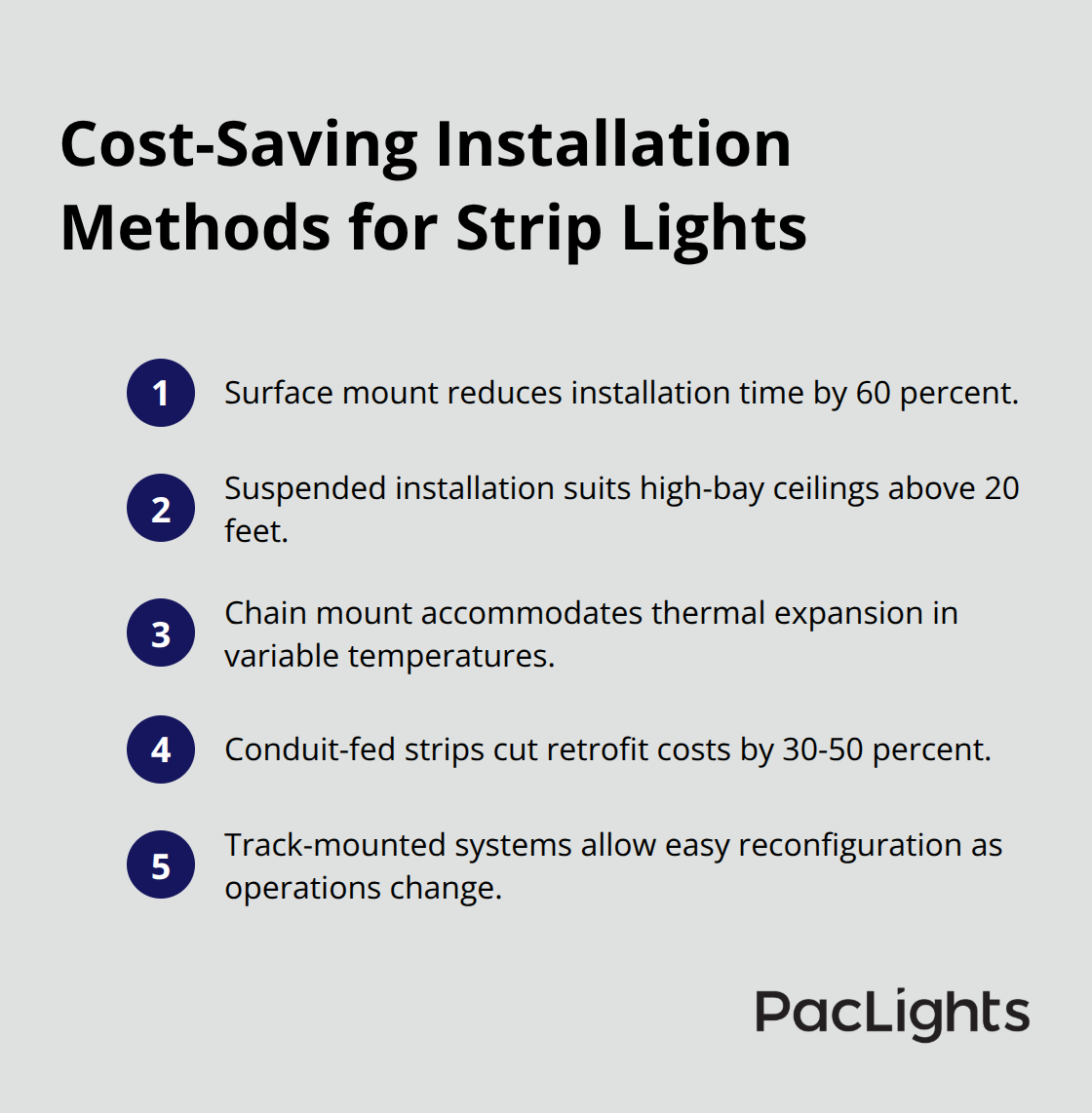
Surface mount options reduce installation time by 60 percent compared to recessed alternatives while they provide identical light output. Suspended installation works best for high-bay applications above 20 feet, which allows optimal light distribution angles. Chain mount systems accommodate thermal expansion in temperature-variable environments like cold storage facilities.
Conduit-fed strips eliminate the need for separate electrical runs when you replace fluorescent fixtures (this cuts retrofit costs by 30-50 percent). Track-mounted systems provide flexibility for reconfiguration as facility operations change, which makes them ideal for manufacturing plants with evolving production requirements.
Power Requirements and Voltage Options
Strip lights operate on 120V, 277V, or 347-480V systems depending on your facility’s electrical infrastructure. Higher voltage options reduce current draw and allow longer runs without voltage drop issues. Most commercial installations benefit from 277V strips that integrate directly with standard three-phase electrical systems without additional transformers.
Power consumption varies from 20W to 80W per fixture based on lumen output requirements. Calculate total wattage needs before you select power supplies to avoid undersized drivers that cause premature failure.
These technical specifications work together with cost considerations to determine your optimal strip light solution.
Why LED Strips Beat Fluorescent Every Time
LED strip lights consume 50-75 percent less energy than fluorescent equivalents while they deliver superior light quality and performance. A 40-watt fluorescent fixture produces approximately 2,800 lumens compared to a 20-watt LED strip that generates 3,200 lumens according to Department of Energy test data. This efficiency gap translates to immediate operational savings for commercial facilities that operate lights 12-16 hours daily.
Energy Consumption Analysis
Manufacturing facilities that switch from fluorescent to LED strips save $0.08-$0.12 per square foot annually on electricity costs based on national average commercial rates of $0.10 per kWh. A 50,000 square foot warehouse reduces energy consumption from 150,000 kWh to 60,000 kWh per year with LED retrofits (this generates $9,000 in annual savings). Payback periods range from 18-36 months based on local utility rates and hours of operation, with facilities that run three shifts see the fastest returns on investment.
Maintenance Cost Reduction
LED strips last 50,000-100,000 hours compared to 20,000-30,000 hours for fluorescent tubes, which cuts replacement frequency by 65-80 percent. Labor costs for fixture maintenance average $75-$125 per replacement in commercial settings when you factor in equipment rental, safety protocols, and worker downtime. Facilities with 200 fixtures save $8,000-$15,000 annually on maintenance labor alone after LED conversion.
Ballast Failure Elimination
Ballast failures that plague fluorescent systems disappear entirely with LED technology. These emergency repairs cost $200-$400 per incident and disrupt operations at the worst possible times. LED strips operate without ballasts, which eliminates this failure point completely. Facilities report zero ballast-related service calls after LED conversion (compared to 15-25 annual incidents with fluorescent systems in typical warehouse environments).

Performance Advantages
LED strips provide instant full brightness without the warm-up period that fluorescent tubes require. Temperature variations that reduce fluorescent output by 20-30 percent have minimal impact on LED performance. Cold storage facilities maintain consistent illumination at -10°F with LED strips while fluorescent systems struggle to start and operate at reduced capacity.
Final Thoughts
Your linear strip light selection demands precise technical alignment with operational needs. Match lumens output to your foot-candle requirements, select color temperatures between 4000K-5000K for maximum productivity, and specify CRI above 90 for tasks that require color accuracy. Installation methods and voltage compatibility with your electrical infrastructure determine long-term performance and reliability.
Professional lighting assessments prevent expensive installation mistakes that cost facilities thousands in corrections. Experts calculate exact lumen requirements, identify optimal mounting positions, and eliminate voltage drop problems that shorten fixture life. These assessments cost $500-$1,500 but prevent $5,000-$15,000 in retrofit expenses from wrong specifications.
Implementation begins with accurate facility measurements and electrical system evaluation. We at PacLights provide lighting layout designs and ROI assessments that simplify this process. Schedule your lighting assessment within 30 days to capture current energy costs for accurate ROI calculations (facilities that delay lose $200-$400 monthly in unnecessary energy expenses).
Disclaimer: PacLights is not responsible for any actions taken based on the suggestions and information provided in this article, and readers should consult local building and electrical codes for proper guidance.