

Switching to commercial LED lighting is one of the smartest investments a facility manager can make. The upfront costs have dropped significantly, and the long-term savings are substantial.
At PacLights, we’ve helped countless businesses navigate this decision. This guide walks you through the key factors that matter most when selecting the right fixtures for your space.
Energy Efficiency and Cost Savings
Calculate Your Current Energy Consumption and Costs
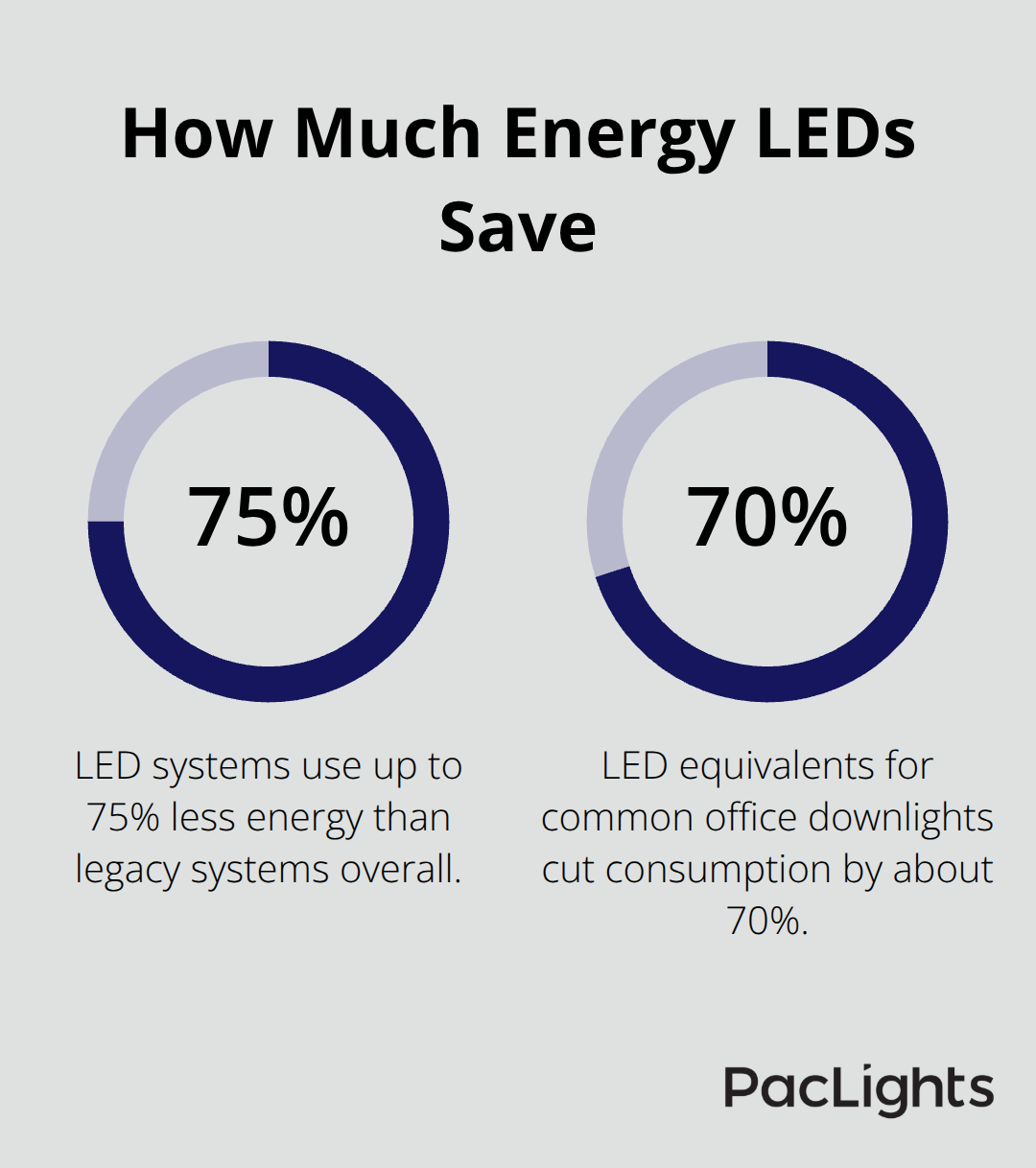
Start by measuring what you currently spend on lighting. Most facility managers underestimate this number because they focus only on electricity bills without isolating the lighting component. Pull your last 12 months of utility statements and calculate your total kWh consumption, then multiply by your rate per kWh. Next, identify which fixtures consume the most power. Older fluorescent systems in warehouses and manufacturing spaces typically draw 400–600 watts per fixture, while outdated high-pressure sodium outdoor lights can exceed 250–400 watts each. A typical office with 50 recessed incandescent downlights running eight hours daily uses roughly 2,400 kWh annually just for those fixtures. LED equivalents performing the same task use 600–800 kWh annually, cutting consumption by 70 percent or more.
According to ENERGY STAR and the Department of Energy’s Solid-State Lighting Program, LED systems use up to 75 percent less energy than legacy systems overall. This isn’t theoretical-it’s the difference between a $2,000 annual lighting bill and a $500 one in a medium-sized facility.
Understand Payback Periods and ROI Potential
The payback period depends on three variables: your current energy costs, how many hours fixtures run daily, and the price difference between old and new fixtures. ENERGY STAR data shows typical payback ranges from 18 to 24 months for most commercial retrofits, especially when you factor in utility rebates. A 10,000-square-foot warehouse replacing 40 high-bay fixtures at $150 per LED unit costs $6,000 upfront. If those fixtures run 12 hours daily and your electricity rate is $0.12 per kWh, the annual energy savings reach $4,800 compared to older metal halide alternatives. That payback happens in just 15 months.
Rebates from local utilities or programs like the Design Lights Consortium can knock $1,500–$3,000 off the total project cost, accelerating payback to under 12 months. Federal Section 179D deductions also apply to commercial lighting projects, allowing you to deduct the full cost in the year installed, which improves your financial position immediately. The math gets even stronger if your space runs lighting 16 or 24 hours daily-data centers, manufacturing floors, and 24-hour retail facilities see payback in 12 months or less.
LED Lifespan Transforms Long-Term Economics
LEDs last 50,000 to 100,000 hours or more according to ENERGY STAR standards, compared to 10,000 hours for fluorescent tubes and 5,000 hours for metal halide bulbs. In a space running lights 12 hours daily, a traditional fixture needs replacement every 2–3 years, while an LED lasts 11–23 years. This means fewer maintenance visits, lower labor costs, and reduced downtime. A warehouse spending $2,000 annually on ladder work and replacement labor sees that cost drop to $200 or less over the same period with LEDs.
Over a 10-year facility lifecycle, the total cost of ownership-energy plus maintenance plus replacement-favors LEDs by a factor of three or more. These economics shift the conversation from fixture cost to total value delivered. Once you understand your energy baseline and payback timeline, the next step involves selecting fixtures that match your specific space requirements and performance needs.
What Specs Actually Matter in LED Fixtures
The right LED fixture specs determine whether your installation delivers the energy savings you calculated or falls short. Color temperature, brightness, and control capabilities aren’t afterthoughts-they directly affect how your space functions and how much you’ll save.
Color Temperature Sets the Tone for Your Space
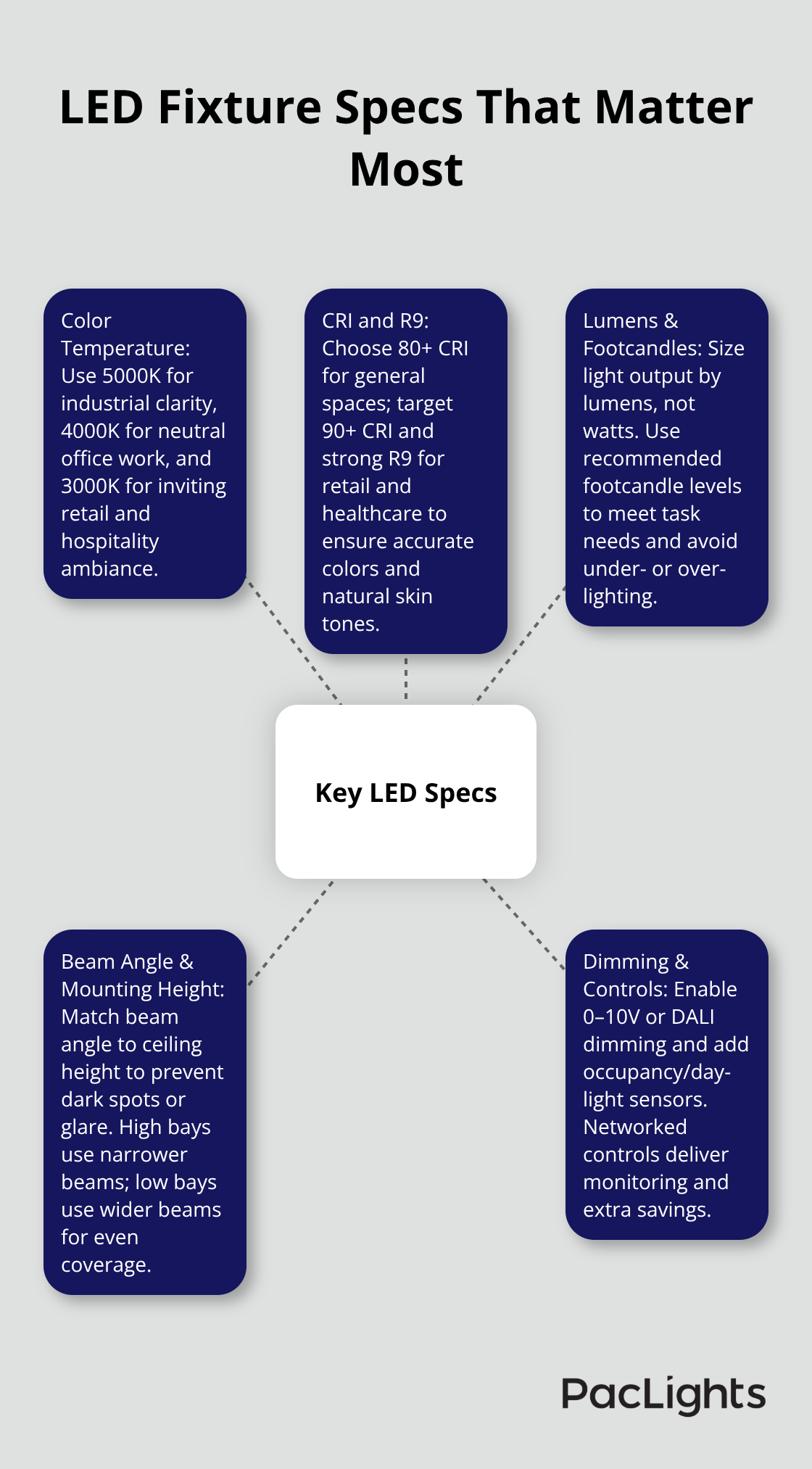
Color temperature, measured in Kelvin, shapes worker productivity and customer experience. Warehouses and industrial spaces perform best at 5000K, which delivers crisp visibility for task work and safety inspections. Offices and schools work well at 4000K, a neutral white that doesn’t cause eye strain during eight-hour workdays. Retail environments and hospitality spaces benefit from 3000K, a warmer tone that makes products and spaces feel inviting.
The Illuminating Engineering Society provides these recommendations based on decades of research, and they matter because workers in mismatched color temperatures report higher fatigue and reduced productivity.
Color Rendering Index and Red Accuracy Matter More Than You Think
The Color Rendering Index (CRI) measures how accurately a light source shows true colors. A CRI of 80 or higher works for general commercial use, but retail spaces displaying merchandise should target 90 or higher to show true product colors and improve customer perception. Healthcare facilities also need 90+ CRI because accurate color rendering affects diagnosis and patient confidence. High R9 values matter too-R9 measures red accuracy specifically, and poor R9 makes skin tones and reds appear washed out, which hurts retail sales and professional appearances.
Lumens, Not Watts, Tell You How Bright Your Space Will Be
Brightness comes down to lumens, not watts. A standard 100-watt incandescent produces roughly 1,500–1,700 lumens, so when comparing LED fixtures, ignore wattage and focus on lumen output. The Lumen Method provides the practical calculation: multiply your space’s square footage by the footcandles recommended for that space type. Offices require 50–75 footcandles for reading and writing tasks, hallways need 10–20 footcandles, and libraries need 50–100 footcandles. A 100-square-foot office at 50 footcandles requires about 5,000 lumens total.
Beam Angle and Mounting Height Prevent Dark Spots and Hotspots
For ceiling heights above 20 feet, use high-bay fixtures with 60-degree beam angles; for 12–20 foot ceilings, low-bay fixtures with 120-degree beams prevent hotspots and dark patches. Beam angle mismatches cause visible dark spots or washed-out areas, so match your mounting height to the beam angle before ordering. This alignment ensures even coverage across your entire space without wasted light or shadowed zones.
Dimming and Controls Amplify Your ROI Significantly
Dimming and controls amplify your ROI in ways that fixture selection alone cannot. Occupancy sensors automatically cut lighting by 30–50 percent in spaces used intermittently-conference rooms, storage areas, and bathrooms see the biggest returns. Daylight harvesting reduces artificial lighting when natural light is available, which is particularly effective in perimeter offices and retail spaces with windows. Circadian-tuning LEDs adjust color temperature throughout the day to support worker alertness and sleep cycles, proven effective in 24-hour facilities like data centers and manufacturing floors. Ensure your fixtures support 0–10V dimming or DALI control, as these standards integrate with most building management systems. Advanced controls from networked lighting systems allow remote monitoring and analytics, letting you track energy consumption in real time and adjust settings across multiple locations from a single dashboard. Without dimming capability, you leave 20–30 percent of potential savings on the table.
The specs you select now determine your long-term performance and savings. Once you’ve identified the right color temperature, brightness level, and control features for your needs, the next step involves matching these requirements to your specific facility type and assessing which fixtures will deliver the durability and warranty protection your operation demands.
Selecting the Right Lighting Solution for Your Facility
Match Fixtures to Your Facility Type
Different facility types demand different fixture approaches, and selecting the wrong category wastes money on features you don’t need while missing critical performance requirements. Warehouses and manufacturing floors with 15–45 foot ceilings require high-bay fixtures that throw light downward efficiently; these typically deliver 10,000+ lumens per fixture with 143–175 lumens per watt according to ENERGY STAR efficiency standards. Office buildings and schools with 8–12 foot ceilings work best with LED troffers or flat panels in 2×2, 2×4, or 1×4 formats, which provide uniform ambient lighting without glare. Retail spaces need a hybrid approach: lower ambient lighting from panels (around 300–500 lux general illumination) combined with higher-intensity accent lighting on displays (750–1,500 lux) to showcase products effectively. Outdoor applications like parking lots and building perimeters require wall packs, area lights, or flood fixtures rated IP65 or higher to withstand moisture and dust exposure. PacLights offers indoor fixtures such as high bays, troffer lights, flat panel lights, and outdoor fixtures such as area lighting, flood lights, and wall lights, each engineered for the specific demands of its environment.
Verify Certifications and Compliance Standards
Durability and warranty terms separate fixtures that fail prematurely from systems that deliver their promised 50,000–100,000 hour lifespan. Look for UL Listed or ETL Listed certification, which confirms the fixture meets safety and performance standards required for commercial installations. DLC (Design Lights Consortium) qualification matters because most utility rebate programs require DLC-certified fixtures to approve incentives-skipping this step leaves $1,500–$3,000 in rebate money unclaimed.
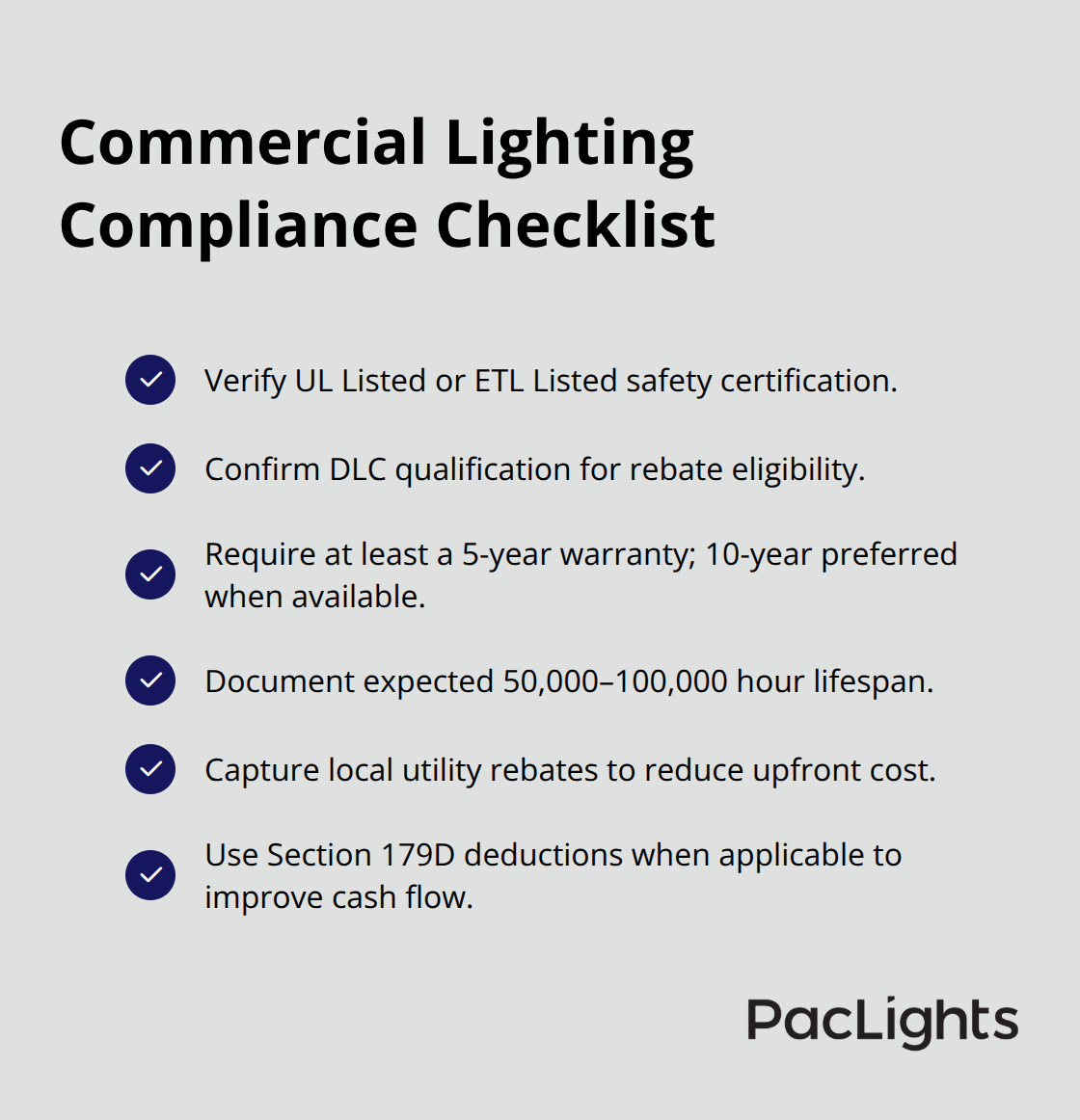
Warranties should cover at least five years; many LED manufacturers now offer 10-year warranties, signaling confidence in their product reliability and reducing your replacement risk substantially.
Assess Environmental Ratings and Installation Compatibility
IP ratings indicate environmental protection: IP20 suits dry indoor spaces, IP44 handles splash exposure in kitchens or car washes, IP65 works for outdoor areas and humid manufacturing environments, and IP66/IP67 handles coastal or heavily corrosive settings. Installation compatibility requires checking whether your existing building management system supports the dimming protocol your new fixtures use-0–10V dimming integrates with most legacy systems, while DALI and Bluetooth Mesh offer more advanced control but may require gateway devices. Verify mounting heights, electrical connections, and emergency backup requirements before purchasing. A facility running emergency lighting must ensure fixtures include battery backup or generator connection capability and meet the 90-minute runtime minimum mandated by NFPA 101 standards.
Final Thoughts
Your commercial LED lighting decision rests on three core actions: calculate your energy baseline and payback timeline, match fixture specs to your space type, and verify durability standards before installation. LEDs consume 75 percent less energy than legacy systems, cutting your annual lighting costs by thousands of dollars while delivering a 50,000 to 100,000 hour lifespan that eliminates the constant replacement cycle of older fixtures. Over a 10-year facility lifecycle, total cost of ownership favors LEDs by a factor of three or more when you account for energy, maintenance, and replacement expenses combined.
Start your assessment by calculating your current lighting costs, identifying which fixtures consume the most power, and determining your facility’s specific lighting requirements by space type. Select fixtures that match your ceiling height, task requirements, and environmental conditions, then verify that your choices carry proper certifications and warranty protection. Confirm compatibility with your building management system before ordering to avoid installation delays or control integration problems.
We at PacLights understand that lighting decisions affect both your bottom line and your facility’s performance. Our team provides free lighting layout designs and ROI assessments to help you make informed decisions tailored to your specific needs, and PacLights offers energy-efficient fixtures and retrofit solutions engineered for your environment with optional motion controls and advanced lighting controls to maximize your savings.
Disclaimer: PacLights is not responsible for any actions taken based on the suggestions and information provided in this article, and readers should consult local building and electrical codes for proper guidance.