

Datacenter technicians spend hours in front of equipment racks, performing critical work that demands precision and focus. Poor lighting in these environments leads to eye strain, mistakes, and exhaustion-problems that directly impact both safety and operational efficiency.
At PacLights, we’ve seen firsthand how the right task lighting transforms technician workstations. This guide shows you how to implement lighting solutions that boost productivity while cutting energy costs.
Why Task Lighting Matters for Datacenter Technicians
The Visual Demands of Datacenter Work
Datacenter technicians work in environments with dense equipment, multiple monitor displays, and tasks that demand precision-all while maintaining eye comfort during shifts that often stretch 8 to 12 hours. OSHA research shows that for LCD display work, technicians need illumination around 73 foot-candles to see clearly without straining, yet many datacenters rely on ambient lighting alone, leaving technicians in a state of visual compromise. This mismatch between task requirements and available light creates immediate problems.
How Poor Lighting Degrades Performance
When lighting falls short, eye strain becomes inevitable. Poor illumination forces your eyes to work harder to distinguish cable connections, identify component labels, and read server status indicators. This constant effort depletes your visual system and leads to headaches, fatigue, and reduced focus-exactly the opposite of what precision work demands. Research on workplace lighting shows that technicians working under proper illumination complete tasks 10 to 15 percent faster and with fewer mistakes than those in suboptimal conditions. The cumulative effect of inadequate illumination across weeks and months degrades both performance and wellbeing.
Why Task Lighting Outperforms Ambient Solutions
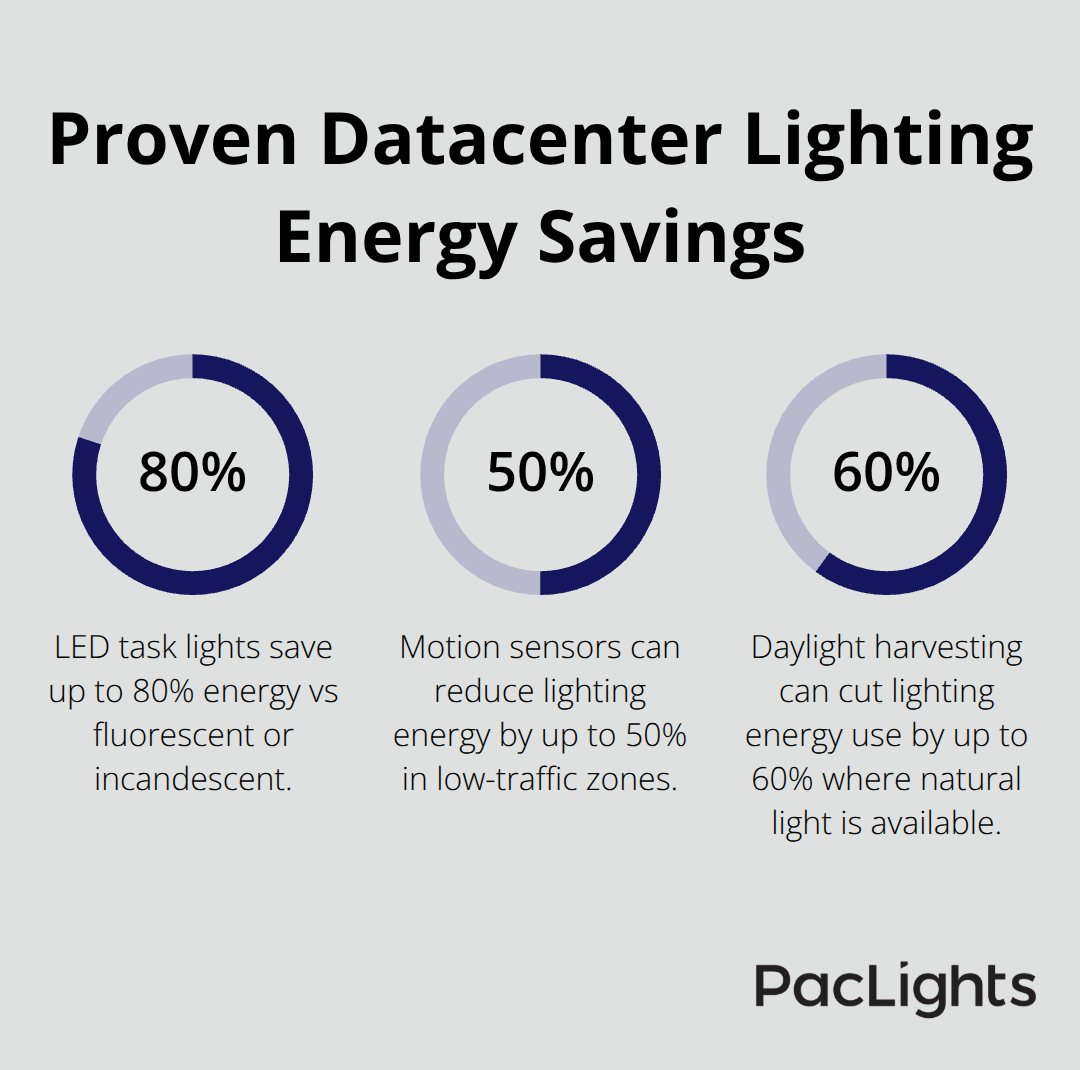
The solution isn’t just brighter light-it’s the right light in the right place. Task lighting positioned directly on your workstation, cabinet, or rack eliminates shadows where problems hide and reduces the contrast glare that comes from bright overhead fixtures reflecting off monitor screens. LED task lights deliver up to 80 percent energy savings compared to traditional fluorescent or incandescent alternatives. This matters in datacenters where lighting runs 24/7, making efficiency gains compound across the year.
The Comfort and Efficiency Connection
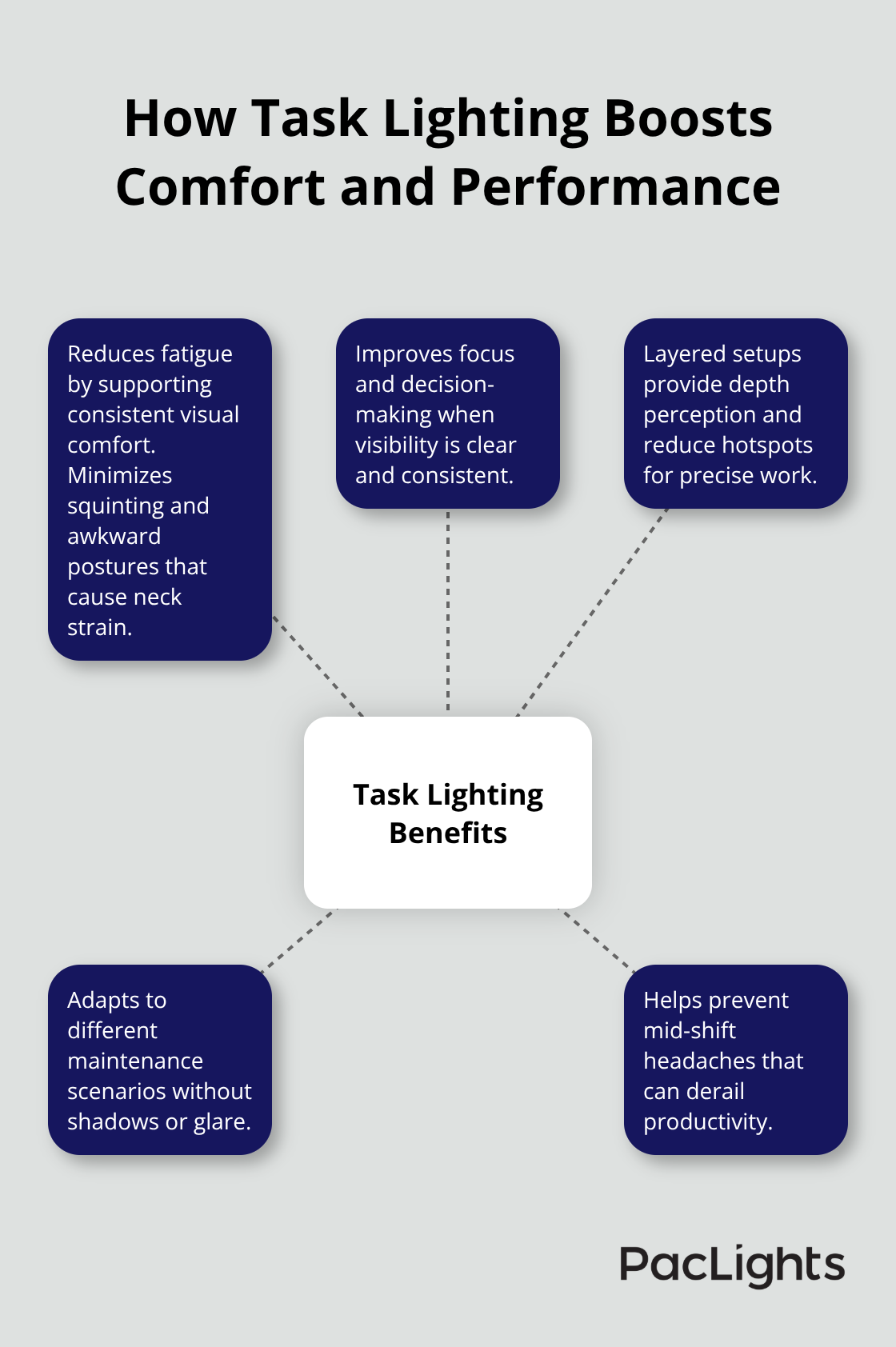
Proper task lighting reduces fatigue by supporting consistent visual comfort-no squinting, no neck strain from leaning closer to see details, no mid-shift headaches that cloud judgment. When you can see clearly and comfortably, your focus sharpens, your decisions improve, and your efficiency climbs. Layered lighting approaches that combine ambient illumination with focused task lights provide depth perception, reduce hotspots, and adapt to different maintenance scenarios without forcing you to work in shadows or glare.
The right lighting setup transforms how technicians interact with their environment and directly influences the quality of their work.
Understanding these fundamentals sets the stage for selecting and implementing the specific lighting solutions that address datacenter workstation challenges.
Lighting Fixtures That Match Datacenter Workstation Needs
Why LED Panels and Linear Strips Lead Datacenter Solutions
LED panel lights and linear strip fixtures form the foundation of effective datacenter task lighting because they solve the core problem: inadequate illumination without the heat and inefficiency of older systems. Adjustable LED panels mounted above or beside workstations deliver precise brightness control, letting technicians dial in exactly the foot-candles they need for their specific task. For LCD display work, OSHA guidance sets the target around 73 foot-candles, and modern LED panels reach this with minimal power draw. Linear strip lights installed along cabinet fronts or under overhead structures eliminate shadows that hide cable connections and component labels-the exact locations where mistakes happen. These fixtures run cool, which matters in datacenters where every watt of lighting becomes additional cooling load.
Motion Sensors Cut Energy Without Sacrificing Safety
Motion-activated controls on fixtures in low-traffic maintenance zones cut energy use substantially without sacrificing safety. A datacenter corridor that sees technician activity only a few hours daily can reduce lighting energy by 30 to 50 percent when motion sensors dim or switch off fixtures in unoccupied sections. The practical advantage is straightforward: you pay only for the light you actually use. Staging areas and backup equipment sections benefit most from this approach, as these spaces sit empty for extended periods yet still require immediate illumination when technicians arrive.
Strategic Placement Eliminates Glare and Shadows
The real implementation question is placement and control strategy. Mount adjustable LED panels at 45 to 60 degrees from your primary work surface to minimize glare on monitor screens while maintaining clear visibility of equipment below.

Linear strip lights work best when positioned parallel to cable runs and server rack fronts, creating uniform illumination without hotspots. This directional approach prevents the contrast glare that comes from bright overhead fixtures reflecting off monitor screens.
Layered Controls Adapt to Shift Patterns and Workload
PacLights flat panel lights and linear strip lights come with optional daylight and motion controls, allowing you to layer automated energy savings on top of manual brightness adjustment. Technicians working night shifts can dial down brightness to match circadian preferences around 4000K color temperature, while day-shift teams benefit from slightly higher brightness. Motion sensors in these fixtures activate only when movement is detected, cutting wasted energy in low-activity zones. The combination of adjustable brightness, directional placement, and automated controls transforms lighting from a fixed overhead expense into a responsive system that adapts to actual work patterns and technician needs.
With the right fixtures and controls in place, the next step is calculating the financial impact of these investments and understanding how energy efficiency translates into measurable cost reductions across your datacenter operation.
How to Cut Datacenter Lighting Costs Without Sacrificing Visibility
Daylight Harvesting and Motion Controls Drive Immediate Savings
Daylight harvesting and motion controls form the practical foundation for reducing datacenter lighting energy consumption. In spaces where datacenter corridors or adjacent technician areas receive window exposure, daylight harvesting sensors adjust artificial lighting based on natural light availability, cutting lighting energy use by 20 to 60 percent. This matters most in facilities with east or west-facing walls where morning and afternoon light can meaningfully offset artificial lighting demand.
Install these sensors in maintenance zones and support areas first, where natural light integration is feasible and technician presence is intermittent.
Motion sensors in low-traffic backup equipment sections and staging areas drive additional savings by eliminating wasted light in unoccupied spaces, reducing energy use by 30 to 50 percent in these zones alone. The combination of daylight harvesting and occupancy-based controls creates a responsive lighting system that operates only when and where technicians actually work.
Zoned Illumination Responds to Real Activity Patterns
Advanced lighting controls enable zoned illumination strategies that divide your datacenter into activity-based regions, each with independent brightness and activation settings. High-traffic rack maintenance areas stay fully lit during shift hours, while secondary equipment sections and corridor spaces operate on motion-activated dimming that activates only when movement is detected. Networked lighting controls allow you to program these zones remotely and adjust settings without visiting each fixture. This approach eliminates the inefficiency of uniform lighting across spaces with vastly different usage patterns.
LED Efficiency Compounds Across Multiple Control Layers
LED lighting itself delivers up to 80 percent energy savings compared to fluorescent alternatives. When combined with daylight and motion controls, total energy reduction across a datacenter workstation can exceed 60 percent annually. For a datacenter with 50 technician workstations running LED task lighting 24/7, this translates to roughly 10,000 to 15,000 kilowatt-hours saved per year, worth approximately 1,200 to 1,800 dollars at standard commercial electricity rates (based on typical commercial rates of $0.12 per kilowatt-hour).
Calculate Your Specific ROI Before Committing Capital
Multiply your current lighting wattage by hours of operation, divide by 1,000 to get kilowatt-hours, then multiply by your local electricity rate. This calculation reveals the financial impact of your existing system and provides a baseline for comparing upgrade scenarios. PacLights offers free lighting layout designs and ROI assessments that model your exact facility configuration, showing the financial impact of upgrading to efficient task lighting with automated controls before you commit capital.
Final Thoughts
Task lighting in datacenter workstations directly shapes how efficiently your technicians work and how safely they operate. Proper illumination reduces eye strain, cuts errors, and accelerates task completion-when technicians can see clearly without glare or shadows, they make better decisions, work faster, and experience less fatigue across their shifts. LED fixtures deliver up to 80 percent energy savings compared to fluorescent systems, and layering in daylight harvesting and motion controls pushes total energy reduction beyond 60 percent annually, which translates to thousands of dollars in annual electricity savings for facilities with multiple workstations running 24/7.
The real challenge lies in matching the right lighting solution to your specific datacenter layout and technician workflow, since generic overhead lighting rarely accounts for equipment density, monitor placement, or shift patterns. Your facility needs a customized approach that considers cable runs, rack configurations, natural light availability, and actual technician movement patterns. We at PacLights specialize in exactly this kind of tailored solution-our flat panel lights and linear strip lights feature optional daylight and motion controls, plus networked lighting controls to optimize energy use across your entire operation.
Contact PacLights to schedule your facility assessment and discover how task lighting transforms both technician performance and your bottom line. We offer free lighting layout designs and ROI assessments that model your exact configuration, showing the financial impact before you commit capital. Our team works with commercial and industrial facilities to implement solutions that deliver measurable results.
Disclaimer: PacLights is not responsible for any actions taken based on the suggestions and information provided in this article, and readers should consult local building and electrical codes for proper guidance.