

Datacenters face serious safety risks when hazard lighting falls short of compliance standards. Equipment failures, power outages, and inadequate visibility can turn routine maintenance into dangerous situations.
At PacLights, we’ve seen firsthand how proper hazard lighting prevents accidents and protects your team. This guide covers the standards you need to meet and the practical steps to get there.
OSHA and Building Code Standards for Datacenters
Federal Requirements That Override Local Rules
OSHA standards 1910.37 and 1910.38 supersede local building codes entirely. Your facility must comply with federal requirements regardless of what your municipality permits. OSHA mandates a minimum of 1.0 foot-candle along all egress paths during normal operation, dropping to an average of 0.6 foot-candles during power loss, with a maximum-to-minimum uniformity ratio capped at 40:1 to prevent dangerous shadows. Emergency lighting must activate within 10 seconds of power failure and sustain operation for at least 90 minutes. Non-compliance triggers fines averaging around $15,000 per violation.

The International Building Code and NFPA 101 Life Safety Code layer additional requirements on top of OSHA rules. NFPA 101 classifies datacenters as special-purpose industrial occupancies, which means your egress paths must remain continuous and unobstructed. Any electromagnetic locks or security doors must automatically unlock during power loss or fire alarm activation. Many facilities incorrectly assume that meeting one standard satisfies all three-this assumption costs them during inspections.
Exit Signage and Photometric Demands
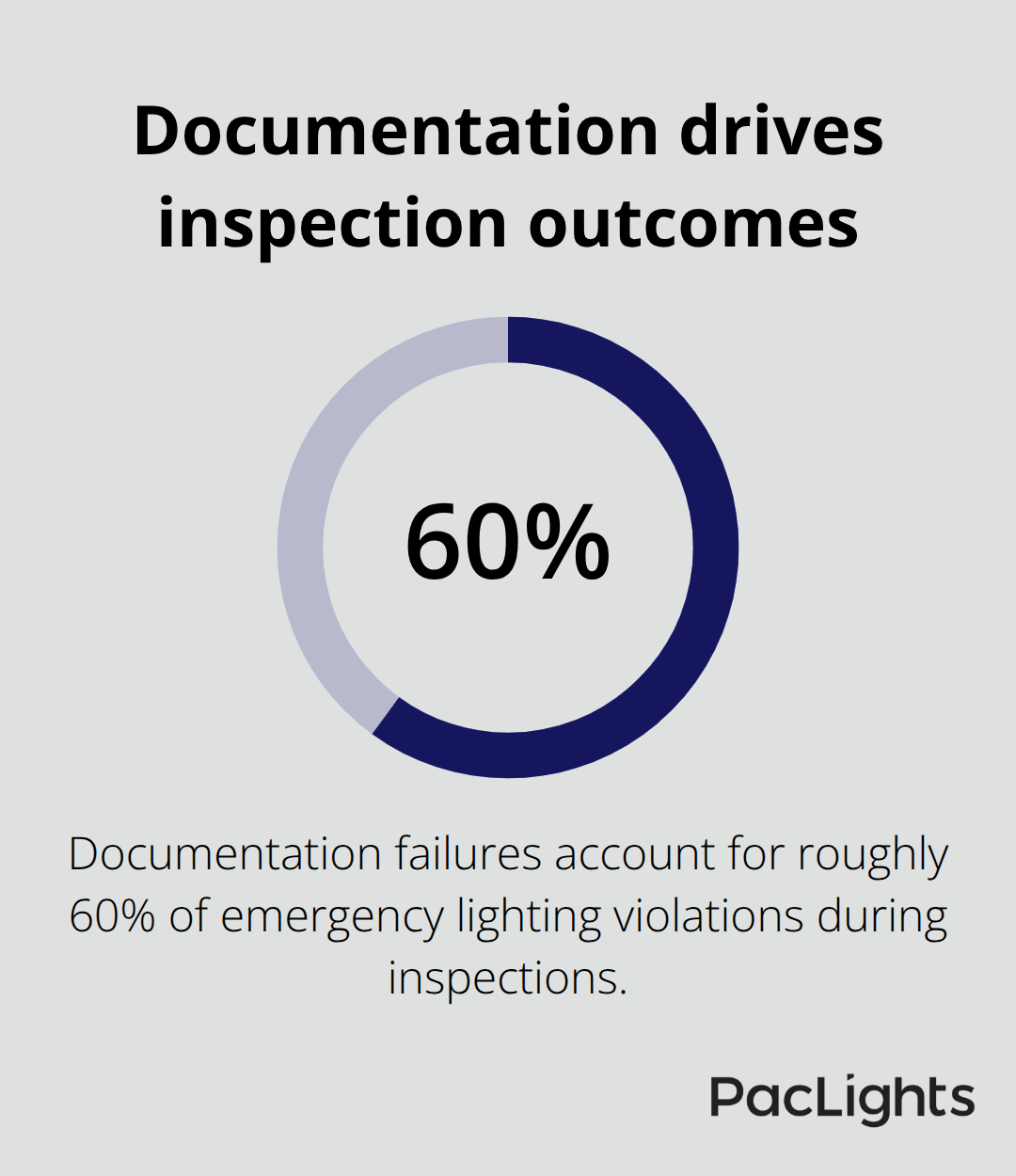
Exit signs must deliver approximately 54 lux on their sign faces. LED panels maintain visibility through smoke and dust far better than older photoluminescent materials. UL 924 compliance requires monthly 30-second functional tests and annual 90-minute duration tests, with written logs retained for at least three years. Documentation failures account for roughly 60% of emergency lighting violations during inspections, which means your maintenance records are as critical as the fixtures themselves.
Quarterly lux verification using calibrated meters is non-negotiable for exit signs and main pathways. High-density server aisles demand additional attention because containment systems and tall racks create shadowed zones where standard ceiling-mounted fixtures fall short.
Fixture Placement in Server Halls
Install wall-mounted emergency units at roughly 80 to 84 inches high to avoid rack obstructions, and space ceiling fixtures approximately 10 feet apart in server halls to maintain uniform coverage. Equipment rooms require a minimum illumination of about 108 lux to support maintenance, diagnostics, and IT operations. Datacenters with properly documented quarterly lux audits and monthly visual inspections reduce compliance violations by detecting faults early. Facilities that skip testing consistently fail inspections and face operational shutdowns during audits.
The standards are rigid, but the path forward is clear: test regularly, document everything, and verify your lux levels quarterly. Once you understand what the codes demand, the next step is selecting the right lighting solutions that actually deliver compliance in your specific environment.
Selecting Fixtures That Meet Hazard Requirements
Self-Diagnostic LED Systems Over Centralized Designs
LED emergency fixtures with self-diagnostic capabilities outperform centralized inverter systems by reducing testing complexity by roughly 40 percent. Self-contained units embed battery backup in each fixture, which eliminates single points of failure that plague older centralized designs. When you install self-diagnostic LEDs, automatic fault detection and battery status alerts notify maintenance staff exactly which fixtures need attention without manual testing of dozens of units. Nickel-metal hydride batteries in quality LED fixtures last 7 to 10 years compared to lead-acid alternatives that fail after 3 to 5 years, and NiMH batteries tolerate temperature swings far better than lead-acid in server rooms where cooling systems create thermal stress.
Battery replacement notifications should trigger roughly 60 days before end-of-life capacity is reached so you never face a compliance gap. A Malaysian facility that switched from fluorescent to LED lighting reduced maintenance calls by approximately 50 percent, and that savings compounds when you factor in the cost of emergency service calls during outages.
Fixture Ratings and Material Selection
IP65 and IP66-rated fixtures resist condensation and dust ingress that destroys older fluorescent ballasts in data center environments. Vapor-proof fixtures specifically designed for IT equipment rooms handle moisture, vibration, and thermal cycling without degradation. Avoid generic commercial emergency lights; select fixtures tested to IEC 60598-1 for safety and thermal endurance under continuous operation. These standards ensure your fixtures survive the harsh conditions inside server halls where temperature fluctuations and humidity spikes occur constantly.
Control Systems and Smart Integration
Motion sensors and photocells cut energy waste in spaces with variable occupancy, though their application in data halls is limited because server rooms operate 24/7. DALI and Casambi-enabled fixtures allow remote access via your building management system, which enables quarterly lux verification without physically visiting each fixture with a meter. Narrow-beam luminaires improve coverage in high-rack aisles and minimize light bleed that creates hot spots violating the 40:1 uniformity ratio.
Placement Strategy and Photometric Planning
Mount ceiling fixtures about 10 feet apart and wall units at 80 to 84 inches high to avoid obstruction by racks and cable trays. A Malaysian colocation facility discovered that 20 percent of dark spots occurred from incorrect placement above cable trays, demonstrating that photometric planning with tools like DIALux prevents installation failures before they happen. Document IES files and product sheets for every luminaire model so site teams can validate beam spreads and mounting heights against your design.
Commissioning and Integration
Pre-wired emergency modules reduce commissioning time and simplify achieving compliance because they arrive tested and ready to integrate with your backup power system. This approach accelerates your path to full compliance while minimizing installation errors that create dark zones or uneven illumination patterns. Once your fixtures are in place and commissioned, the real work begins-establishing the maintenance and testing protocols that keep your system compliant year after year.
Backup Power Architecture and Fixture Placement Determine Compliance Success
Separating Emergency Lighting from UPS Systems
The most common compliance failure occurs when facilities treat backup power as optional or attempt to route emergency lighting through their UPS. Your UPS cannot serve emergency lighting because UPS systems prioritize IT equipment loads, not life-safety circuits. NFPA 110 Level 1 emergency power requires restoration within 10 seconds of primary power loss and at least 1.5 hours of run time, but OSHA mandates 90 minutes of continuous illumination at 0.6 foot-candles minimum during an outage. Your data center needs a dedicated emergency lighting circuit with battery backup that operates independently from your IT infrastructure. Many facilities discover during actual power events that emergency lights never activate because the UPS prioritized server shutdown over egress illumination.
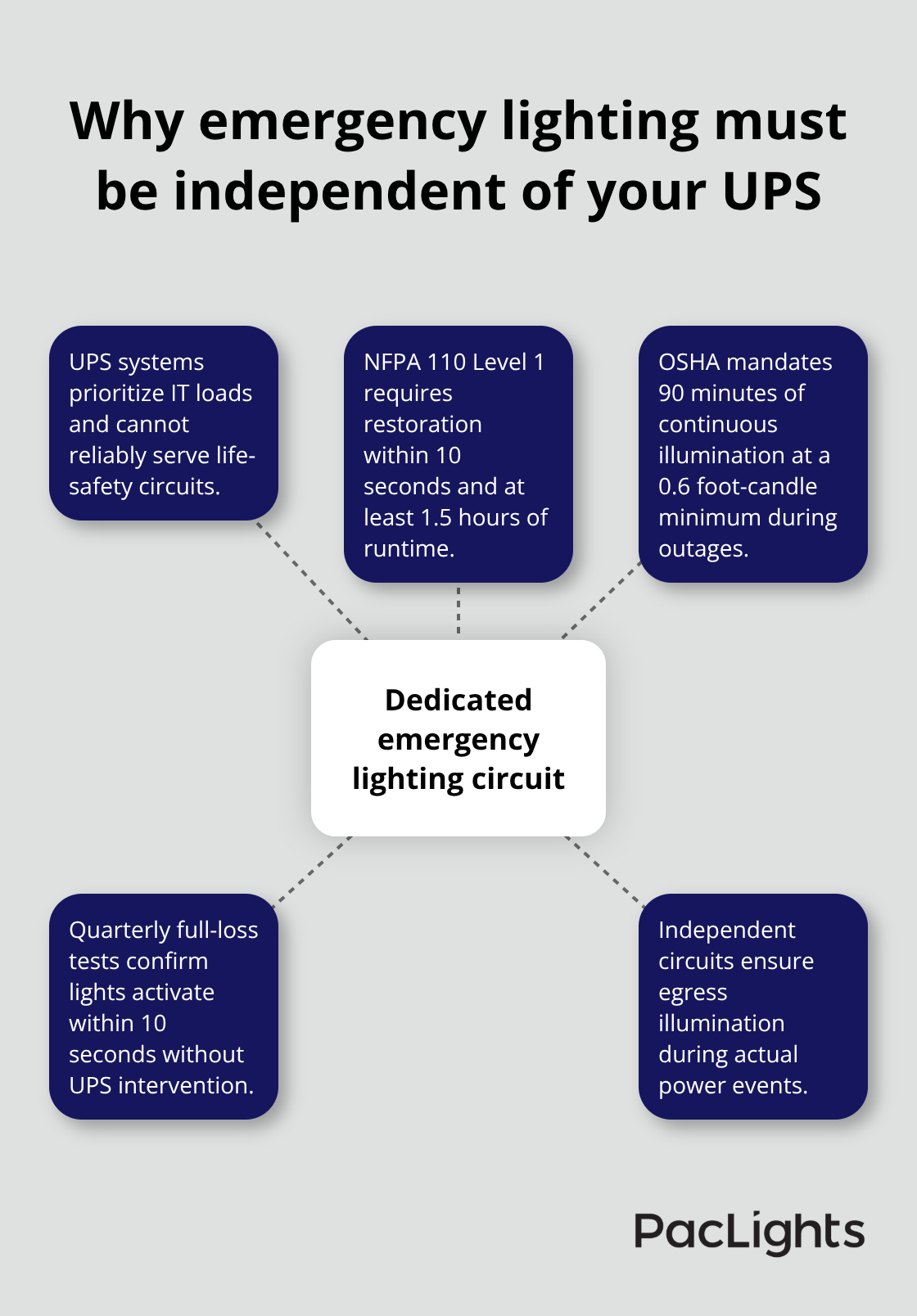
Install a centralized inverter system with UL 924 listing or deploy self-diagnostic LED fixtures with embedded NiMH batteries that bypass the UPS entirely. Test this separation quarterly by simulating a complete power loss and verifying that emergency lights activate within 10 seconds without any UPS intervention. This independent circuit saves lives when primary power fails.
Validating Coverage Before Installation
Fixture placement errors cause roughly 20 percent of compliance violations because installers position lights without consulting photometric data or validating beam spread against actual rack heights and aisle widths. A Malaysian facility discovered that mounting fixtures directly above cable trays created dark zones where technicians could not see equipment during maintenance, violating the 40:1 uniformity ratio and creating genuine safety hazards.
Use DIALux or similar planning tools with IES files from your fixture manufacturer before installation begins. Measure your actual cold aisle width, hot aisle depth, and rack heights, then run a photometric simulation to confirm that your planned fixture spacing delivers minimum 500 lux in work zones and 0.6 foot-candles minimum in egress paths. Mount ceiling fixtures approximately 10 feet apart and wall units at 80 to 84 inches high, but verify these distances against your specific layout because high-density containment systems and vertical cable management can block light paths.
Quarterly Verification and Documentation
Quarterly lux verification with a calibrated meter confirms whether your installation actually delivers the coverage your design promised. Facilities that skip this step consistently fail inspections because dark spots emerge after equipment installation or layouts change. Document every measurement with dates and locations so you have proof of compliance for audits and can quickly identify which zones need fixture additions or repositioning. This documentation protects your facility during regulatory reviews and demonstrates your commitment to ongoing safety compliance.
Final Thoughts
Hazard lighting compliance in datacenters is not optional-it directly determines whether your facility passes inspection and whether your team stays safe during power failures. OSHA mandates 1.0 foot-candle minimum along egress paths during normal operation, dropping to 0.6 foot-candles during outages, with emergency activation within 10 seconds and 90 minutes of sustained operation. Non-compliance costs roughly $15,000 per violation, but the real cost emerges when a power event occurs and your team cannot safely evacuate because emergency lights never activated or dark zones block visibility.
The path to compliance requires three concrete actions: install self-diagnostic LED fixtures with independent battery backup that operates separately from your UPS, validate your fixture placement using photometric planning tools before installation begins, and establish quarterly lux verification with calibrated meters so you detect faults before inspections arrive. Facilities that switched from fluorescent to LED emergency systems reduced maintenance calls by approximately 50 percent, and self-diagnostic fixtures cut testing complexity by 40 percent compared to centralized inverter designs. Nickel-metal hydride batteries last 7 to 10 years versus 3 to 5 years for lead-acid alternatives, lowering replacement costs and reducing service interruptions.
We at PacLights understand that datacenter hazard lighting demands precision and reliability. Our vapor-proof fixtures are tested to IEC 60598-1 standards and rated IP65 or IP66 to handle the moisture, vibration, and thermal stress of server environments. Contact PacLights to discuss your hazard lighting upgrade and ensure your facility meets every federal requirement while protecting your team.
Disclaimer: PacLights is not responsible for any actions taken based on the suggestions and information provided in this article, and readers should consult local building and electrical codes for proper guidance.